To help us provide you with free impartial advice, we may earn a commission if you buy through links on our site. Learn more
- Expert Reviews has tested over 40 projectors since the start of 2023, ranging from budget FHD options to premium native 4K beamers.
- Each projector we review undergoes objective and subjective tests to assess its performance across key areas, including picture quality, audio quality and smart functionality.
- Our favourite projector overall is the Hisense C2 Pro, which delivers strong 4K HDR performance and powerful audio in an easy-to-use package.
- For a cheaper, more compact option, consider the Aurzen Eazze D1R, a pint-sized projector that produces vibrant 1080p images.
- Plenty of other great options cater for a wide range of needs. Read on to find the best projector for you, no matter your budget.

Our number one projector has fallen to an all-time low price
XGIMI's Best Buy-winning Horizon 20 Max blew us away in testing earlier this year and was named "the new compact living room projector king". A taste of living room royalty can now be yours for the princely sum of £1,799. That's almost £150 cheaper than we've ever seen the 20 Max.
£1799 vs average 180-day price of £2,486
Pick up a pint-sized portable projector for under £300
The Nebula Capsule 3 has been around a while and always gets discounted during deal events, but this is only the fifth time in three years that it's available under £300. If you want a compact, convenient and capable beamer, this is the option for you.
£299 vs average 180-day price of £372
Save the best part of £1,000 on XGIMI's Titan Noir Pro 4K projector
We haven't reviewed this model, but the base Titan won a Best Buy award at £3,499. The Noir Pro has superior brightness and contrast, a more comprehensive suite of gaming features, and now costs less than the Titan. A Black Friday no-brainer if you want to beam 4K images as large as 300in.
£2999 vs average 180-day price of £3,863
Projectors come in all shapes and sizes and can cost anywhere from a couple of hundred quid to many thousands of pounds. We’ve tested options across that range and, as much as it pains us to say, the more you pay, the better the picture.
However, you don’t have to spend a fortune to enjoy an immersive big-screen TV show, movie, or sports experience at home; plenty of great-value projectors are out there. Below, you’ll find the models we recommend for various needs and budgets.
If you need more information before choosing a projector, our buying guide at the bottom of the page will help you decide which projector is right for you as an alternative to a large-screen TV.
READ NEXT: Projector vs TVs
Best projector: At a glance
- Best overall: XGIMI Horizon 20 Max | Check price
- Best cheap option: Aurzen Eazze D1R | Check price
- Best compact option: Nebula Capsule 3 | Check price
How we test projectors
We test all projectors by setting them up from scratch in a darkened room with an 80in to 100in screen. We set up and configure the projector, addressing any focus or geometry issues. Where a projector has built-in streaming features, we will install a range of streaming apps, including Netflix, Amazon Prime Video, YouTube and Disney+. Where projectors lack such features, we have a Roku 4K Streaming Stick with the apps pre-installed.
We then use the projector to watch a range of test material, including blockbuster movies, popular streaming series and drama or documentary shows. We also use any built-in Chromecast or screen-mirroring features to cast 1080p or 4K video directly from an Android tablet or smartphone. On premium 1080p and 4K projectors, we also run additional tests using a 4K Blu-ray player and a PlayStation 5 console. This will reveal how the projector handles high-quality sources, high-refresh modes, and 4K gaming.
We also test any built-in speakers at low, medium, and high volumes, and run portable projectors on battery power, where available, to see how long the battery lasts. Finally, we use a colorimeter, mounted on a tripod 30cm from the screen, to check brightness and contrast levels, colour accuracy and colour depth.
The best projectors you can buy in 2026
1. XGIMI Horizon 20 Max: Best overall
Price when reviewed: £2,599
- Easy to set up and use
- Super bright and sharp images
- Great gaming and streaming features
- Some illogical setting options
Tested and reviewed by Stuart Andrews
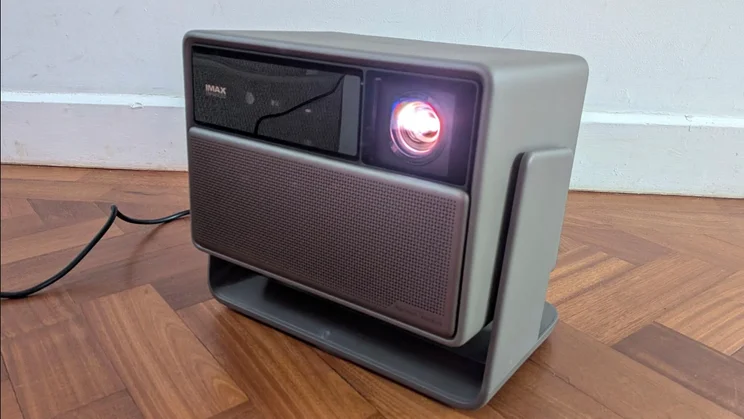
The Horizon 20 Max is the most complete one-box projector we’ve tested that’s practical for most living rooms. Its RGB triple-laser system delivers the best picture quality of any Horizon series projector we’ve reviewed, thanks to brilliant brightness, excellent contrast and HDR10+, Dolby Vision and IMAX Enhanced.
Meanwhile, the auto-keystone correction and auto-focus work superbly, and you can project images between 75in and 300in, depending on your space. Colour coverage is top-notch (we measured 97.7% of the sRGB gamut with a 149% gamut volume, and 93.4% of DCI-P3 with a 106% gamut volume), and Google TV is the ideal platform for accessing apps and streaming services, except BBC iPlayer.
That omission and some unintuitive menu options are the Horizon 20 Max’s only real weaknesses. It’s not cheap, sure, but it’s sensationally good for casual use, gaming and serious home cinema.
Read our XGIMI Horizon 20 Max review from February 2026
Key specs – Resolution: 4K; Brightness: 5,700 ISO lumens; Contrast ratio: 20,000:1; Throw ratio: 1.20-1.50:1; Zoom: Yes; Light source: RGB Laser; Lifespan: Up to 20,000 hours
2. Aurzen Eazze D1R: Best cheap projector
Price when reviewed: £130
- Impressive picture quality
- Quiet in operation
- Easy autofocus and keystoning
- Remote lacks backlight and voice search
Tested and reviewed by Jonathan Bray
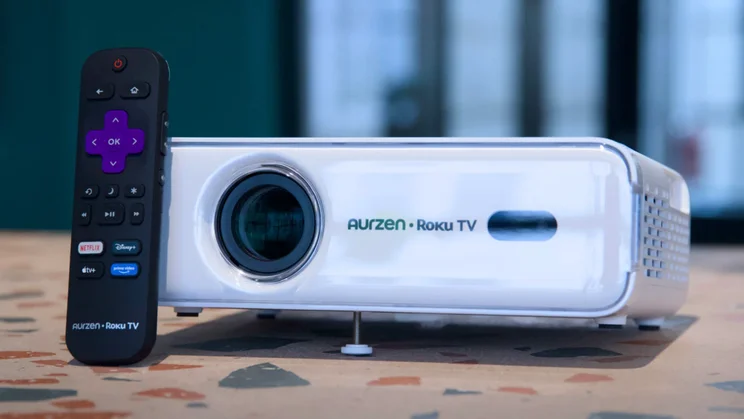
In years gone by, a projector this cheap would have been a waste of time. However, Aurzen, in partnership with Roku, has delivered an affordable option actually worth buying. Setup takes seconds thanks to effective autofocus and keystone correction, and Roku’s operating system supports a pleasing variety of content platforms, including BBC iPlayer, Netflix and Prime Video.
In a dim room, image quality can’t be faulted for the money. Pictures look crisp, sharp and well-balanced and go as big as 150in across the diagonal, though 80in is the sweet spot. Sound quality exceeded our reviewer’s expectations, and he was surprised by how quiet the D1R was in operation.
As long as you’re in a darkened viewing space, the Aurzen Eazze D1R is incredible value for money and the best cheap projector around.
Read our Aurzen Eazze D1R review from June 2026
Key specs – Resolution: 1080p; Brightness: 280 ANSI lumens; Contrast ratio: 1,000:1; Throw ratio: 1.28:1; Zoom: Yes; Light source: LED; Lifespan: Up to 30,000 hours
3. Nebula Capsule 3: Best compact projector
Price when reviewed: £369

- Vibrant 1080p images
- Very compact
- Google TV streaming
- Short battery life
- Angle can’t be adjusted
Tested and reviewed by Stuart Andrews
The Nebula Capsule 3 may be the most compact option on this list, but don’t underestimate it because of its size. We measured sRGB and DCI-P3 colour gamut coverage figures of 91.4% and 74.8% – superior scores to many larger projectors – and the Capsule 3 reproduces colours in a dark room very effectively as a result.
Onboard Google TV smarts make accessing content via the Capsule 3 a doddle, and it supports every major UK catch-up app, which is very welcome. Also welcome is the volume this can-shaped beamer can output; we really enjoyed its ability to communicate low-end warmth, detail and plenty of welly on big-screen blockbusters.
Read our Nebula Capsule 3 review from January 2024
Key specs – Resolution: 1080p; Brightness: 200 ANSI lumens; Contrast ratio: 400:1; Throw ratio: 1.2:1; Zoom: Yes; Light source: LED; Lifespan: Up to 30,000 hours
4. Sony VPL-XW5000ES: Best native 4K projector
Price when reviewed: £3,999

- Supremely detailed 4K images
- Effective tone mapping
- Compact and stylish build
- Lens controls are manual
- Doesn’t support HDMI 2.1
Tested and reviewed by Stephen Withers
The Sony VPL-XW5000ES combines cutting-edge SDR and HDR performance with a great design, making it the best native 4K projector we’ve tested. Unlike the other options on this list, it doesn’t use pixel shifting; Sony’s SXRD display technology beams images in full 3,840 x 2,160 resolution. Those images look gorgeous and are very accurate, too. In Reference mode, we measured Delta E errors for greyscale and colour at 2.6 and 1.7, respectively. If you choose to calibrate the projector, you can get these below 1.
Motion handling is brilliant; Sony’s Reality Creation sharpens pictures in an incredibly sophisticated way, and frame-by-frame HDR tone mapping helps deliver punch and detail. The laser light source is bright enough for most viewing situations and won’t dim significantly over its lifespan, making this not only the best native 4K choice, but one that will stand you in good stead for years to come.
Read our Sony VPL-XW5000ES review from August 2022
Key specs – Resolution: 4K; Brightness: 2,000 ANSI lumens; Contrast ratio: 10,000:1; Throw ratio: 1.38-2.2:1; Zoom: 1.6x; Light source: Laser; Lifespan: Up to 20,000 hours
5. XGIMI MoGo 4 Laser: Best portable projector
Price when reviewed: £649

- Supremely convenient
- Ingenious design
- Impressive picture performance
- Battery life could be better
Tested and reviewed by Stuart Andrews
The MoGo 4 Laser’s clever design is a major factor in our selection of it as the best portable projector. It’s easy to transport, and it rotates 360 degrees to project onto any surface, including your ceiling. Its built-in battery lasts about two hours, enough for a reasonable-length film.
That flexibility is backed up by great picture performance thanks to the triple laser light source. This lets the MoGo 4 Laser reach brightness levels visibly above similarly priced competitors, prompting us to question whether XGIMI was underselling the projector by listing a luminance of 550 ISO lumens. Finally, if you’re not using the MoGo 4 Laser to watch something, it can transform into a Bluetooth speaker or project ambient visuals. Vibes.
Read our XGIMI MoGo 4 Laser review from July 2025
Key specs – Resolution: 1080p; Brightness: 550 ISO lumens; Contrast ratio: 1,000:1; Throw ratio: 1.2:1; Zoom: Yes; Light source: Laser; Lifespan: Up to 20,000 hours
6. Nebula X1: Best projector for sound quality
Price when reviewed: £1,899

- Immersive sound
- Fantastic image clarity
- Simple to set up
- No BBC iPlayer
Tested and reviewed by Stuart Andrews
The Nebula X1’s pair of 15W woofers and two 5W tweeters deliver a better audio experience than any other projector we’ve tested. Still, we highly recommend buying the £499 accessories bundle, which includes two satellite speakers, two karaoke mics and a carrying case.
Doing so takes the X1’s sonic performance to epic levels. The combination of forward-, upward-, and side-firing drivers helps create a much wider, deeper soundstage and delivers a home audio experience that can give some soundbars a run for their money. The picture quality is impressive, too; we measured DCI-P3 HDR gamut coverage at a whopping 89%, and the image scale and detail were breathtaking.
Read our Nebula X1 review from May 2025
Key specs – Resolution: 4K (1,080p native); Brightness: 3,500 ANSI lumens; Contrast ratio: 5,000:1; Throw ratio: 0.9-1.5:1; Zoom: Yes; Light source: Laser; Lifespan: Up to 30,000 hours
7. Samsung Premiere 9: Best ultra-short throw projector
Price when reviewed: £3,999

- Super-accurate Filmmaker mode
- Amazing colour coverage
- Great sound
- Expensive
Tested and reviewed by Stephen Withers
Ultra-short-throw projectors produce big images from very short distances, and the Samsung Premiere 9 does this better than any other option we’ve tested. It can fill a 130in screen from just 24cm away, and its images are uniformly well-defined. The Premiere 9 is also quiet: we measured noise levels of just 26dB when sitting at a sensible distance from the Premiere 9.
It also blew us away with peerless gamut coverage of 100% for DCI-P3 and 92% for BT.2020. Filmmaker mode accuracy was superb: using our measurement tools, we recorded greyscale and colour Delta E errors below the visible threshold of three, and sound quality is top-notch, too. Samsung’s Tizen operating system has loads of useful features and is the icing on this amazing ultra-short-throw cake.
Read our Samsung Premiere 9 review from September 2024
Key specs – Resolution: 4K (1,080p native); Brightness: 3,450 ISO lumens; Contrast ratio: 1,700:1; Throw ratio: 0.189:1; Zoom: Yes; Light source: RGB Laser; Lifespan: Up to 20,000 hours
8. BenQ X500i: Best projector for gaming
Price when reviewed: £1,499

- Three specific game modes
- Low input lag
- Effective HDR
- Lacks brightness
Tested and reviewed by Stuart Andrews
The X500i truly shines when paired with a current-gen console or other modern gaming device. 4.2ms input lag across its three Game modes makes it super snappy and responsive, and the projector switches to these modes immediately after detecting a gaming source, which is a nice touch.
The three Game modes all positively impacted our testing experience. In RPG mode, visuals were more cinematic and audio was bassier; SPG brightened colours and enhanced commentary on sports games, while FPS improved clarity in darker areas and positioned audio cues more accurately. If there’s a reasonably priced 4K projector with a gaming feature set as impressive as the X500I, we haven’t tested it.
Read our BenQ X500i review from March 2024
Key specs – Resolution: 4K (1080p native); Brightness: 2,200 lumens; Contrast ratio: 1,350:1; Throw ratio: 0.69-0.83:1; Zoom: 1.2x; Light source: LED; Lifespan: Up to 30,000 hours
How to choose the best projector for you
What resolution projector do I need?
If you’re looking for a projector to watch movies, make sure the model you buy is at least Full HD (1,920 x 1,080). You’ll find plenty of cheaper office or portable projectors, but they’ll have limited resolutions like 800 x 600, 800 x 480, 1,280 x 720, or 1,024 x 768.
They might be fine for PowerPoint slides or streaming Netflix, but for sports, games, and home cinema, you really need to watch 1080p content at its native resolution.
If you want a 4K projector, then expect to pay more. True 4K projectors with a native 4K resolution cost many thousands of pounds. However, more and more projectors simulate 4K using pixel-shifting techniques on a 1080p panel. Purists will tell you these aren’t really 4K, but the technology has reached a point where it’s almost impossible to tell the difference unless you have native and 4K models side by side. Even then, it’s a challenge.
How bright does a projector need to be?
This is such an important consideration that we’ve dedicated an entire article to answering the question: how many lumens does a projector need?
Manufacturers quote different lumen values (ISO and ANSI), and what brightness you need depends on when and where you plan to use the projector. If you’re only going to use it at night, for instance, you don’t require as much brightness as you do for mixed daytime and evening viewing.
Generally, the higher the lumen value, the better; however, high-brightness projectors typically cost significantly more than their dimmer counterparts.
What are DLP and LCD projector technologies?
Most home-theatre projectors use one of two technologies: DLP (Digital Light Processing) and LCD (Liquid Crystal Display). DLP projectors are more common and typically offer better value, while LCD projectors tend to be larger and more expensive.
DLP projectors do have a downside, though. As most display colours sequentially use a spinning, segmented colour wheel (there’s the odd exception to this rule), they suffer from what’s called the “rainbow effect”, where small areas of the image appear to splinter into small rainbows when you shift your gaze from one side of the screen to the other. Some people are less prone to it than others, though, so if you haven’t experienced a DLP projector, make sure you get a demo before spending your money.
Lamp vs LED vs Laser: What’s the difference?
All projectors require a light source to function, and both technologies mentioned above can use lamps or LEDs (light-emitting diodes). But there’s also a third source option: laser. Each has its pros and cons, which we’ve covered below:
- Lamp light source: Lower cost, high heat and noise generation, short lifespan.
- LED light source: Long life, compact, low noise and heat generation, low brightness.
- Laser light source: Ultra-long life, strong colours, high contrast, quiet, expensive.
What is throw ratio, and why does it matter?
Throw ratio reflects the relationship between the distance from the projector to the screen or wall and the projected image’s width. A projector with a higher throw ratio than another needs to be placed farther from the screen to achieve the same picture size.
- Long-throw projectors have a throw ratio greater than or equal to 1:1
- Short-throw projectors have a throw ratio less than 1:1 but greater than 0.4 :1
- Ultra-short-throw projectors have a throw ratio of less than 0.4:1
If space is tight, consider a short-throw or ultra-short-throw projector, which can create big images on your screen or wall from incredibly short distances – as little as 10cm for a 50in image in some cases. The downside is that the projected image tends to suffer more from geometric distortion.
What does keystone correction do?
When a projector isn’t perpendicular to the surface it projects onto, the resulting image is trapezoidal. Keystone correction adjusts the vertical and horizontal aspects of images to create a rectangular shape that’s much easier to watch.
Many projectors offer automatic keystone correction, so you don’t have to fiddle with the picture, while others provide manual tools to adjust the picture yourself.
Do I need optical zoom and lens shift?
Once you’ve determined the throw ratio that works best in your space, consider optical zoom and lens shift capabilities, which will affect projector placement.
Optical zoom lets you enlarge or reduce the screen without moving the projector, while lens shift lets you move it up, down, left and right without losing quality or moving the projector. The cheaper the projector, the more limited these options will be.
What connections do I need?
This depends on what you plan to connect to the projector, but HDMI, USB-C, and USB-A ports are the main ones to look for.
USB ports let you plug in streaming sticks, which can be invaluable if the projector’s operating system lacks support for certain streaming services, while HDMI is the best way to connect laptops and game consoles.