
To help us provide you with free impartial advice, we may earn a commission if you buy through links on our site. Learn more
- Very quiet and smooth
- Plenty of adjustability
- Very wieldy in use
- Line is brittle and prone to breakage
- Overly complex trigger operation
- Deflector bar feels flimsy
Picture the scene: you’re relaxing in your garden on a warm summer day, and your neighbour fires up the petrol strimmer. We’ve all been there; the peace is shattered. Step forward, then, the Stihl FSA 50, which could put an end to neighbourly disputes before they begin.
That’s because, with the FSA 50, Stihl has put real emphasis on quiet running. Indeed, it’s one of the least dB-bothering grass trimmers we’ve tested. That’s good, because at £239 (with battery and charger), price isn’t on its side – particularly compared to the Flymo UltraTrim 300. That said, it counters this with the ability to convert into a brush cutter with an optional blade set.
But does the Stihl FSA 50 have more than the sound of silence on its side, and should it be on your list of the best cordless grass trimmers? I’m going to find out.
Stihl FSA 50 grass trimmer: what do you get for the money?
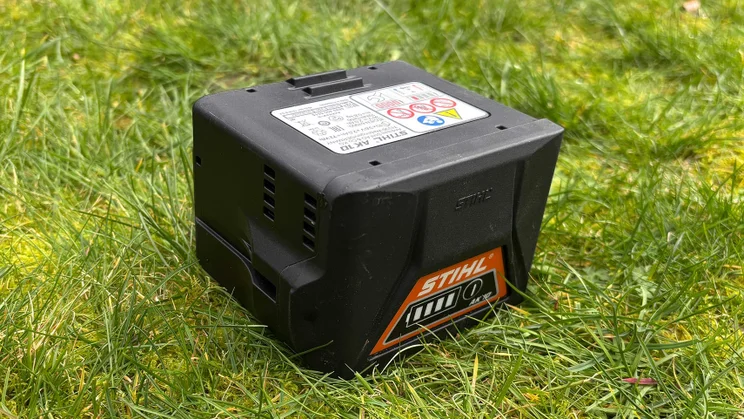
The Stihl is available as a £159 bare unit, or as a £239 kit that includes a 36V, 2.0Ah lithium-ion AK10 battery, and a charger. It comes with a 1.6mm cutting line, which extends using a bump-feed, so you simply tap the mower on the ground to extend the line.
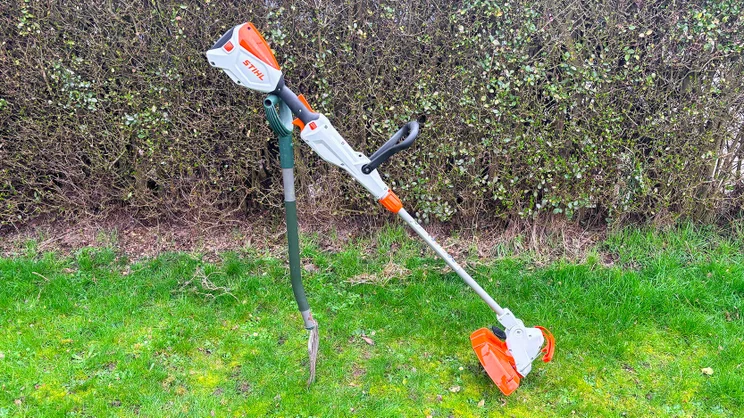
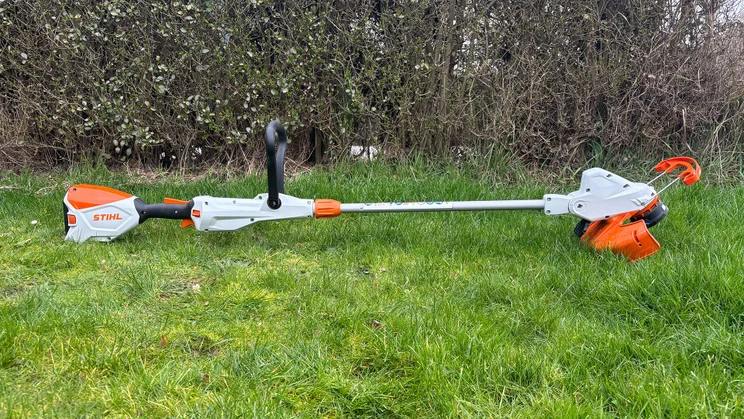
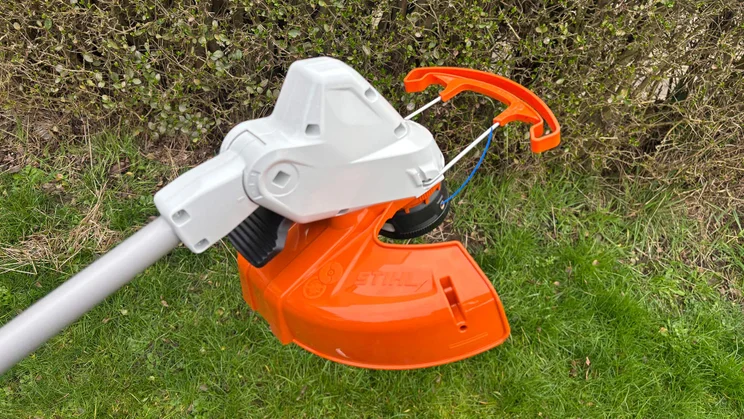
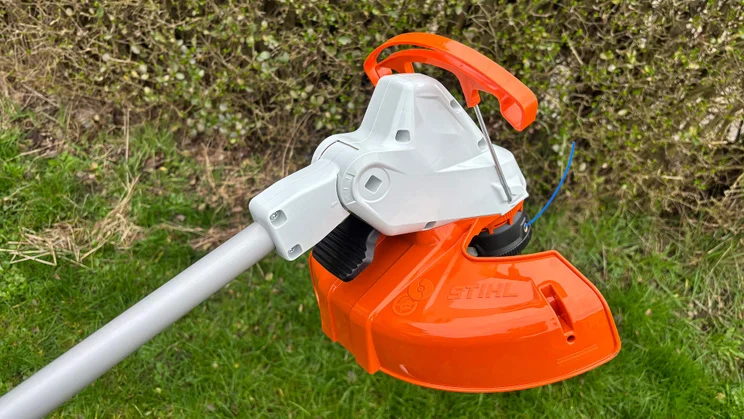
It has a telescopic boom which extends by 15cm, and it twists 90 degrees to switch between cutting and edging functions, while the head itself adjusts through multiple positions. I also like that it has a plant deflector bar which flips down to prevent you damaging plants. Unusually, it has a flexible bumper on the front which allows you to push a little closer should you wish, but I’m not convinced it will take a lot of heavy use, especially after a few years stored in a hot (or cold) shed.
Impressively, the FSA 50 has a variable speed control, which much like a car’s accelerator pedal, makes the cutting line spin faster the more the trigger is pressed. That makes it possible to precisely balance trimming performance and runtime – particularly useful if you have a larger garden, or one with varying thicknesses of unwanted growth. Although it’s unlikely you’ll be using the grass trimmer in the cold, the battery can operate at temperatures as low as -20°C, and uses technology to optimise temperature for the best power delivery.
There’s no shoulder strap, but the loop handle is easy to hold – and at 3.7kg with the battery installed, it’s not heavy.
How easy is it to use?
The Stihl FSA 50 ships in a huge, long box, so there’s not a great deal of assembly required. The handle attaches by screwing in an adjustable knob, there are a couple of screws that hold the line shield in place, and the deflector simply clips into place.
This process takes a few minutes and once you’ve fully charged the battery, which takes 95 minutes, you’re ready to go. That is, unless you want to wall-mount the charger, which is possible.
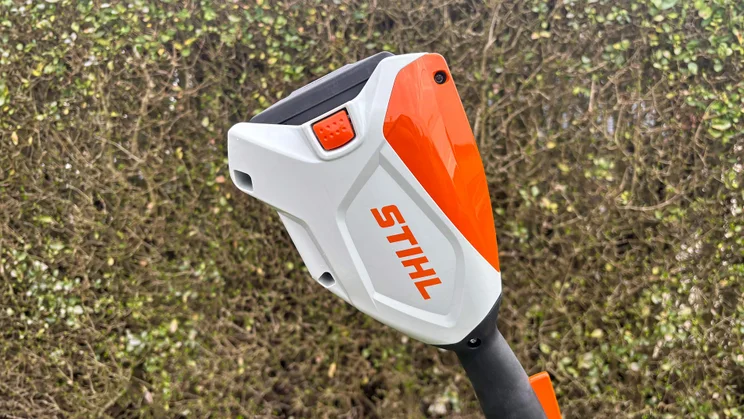
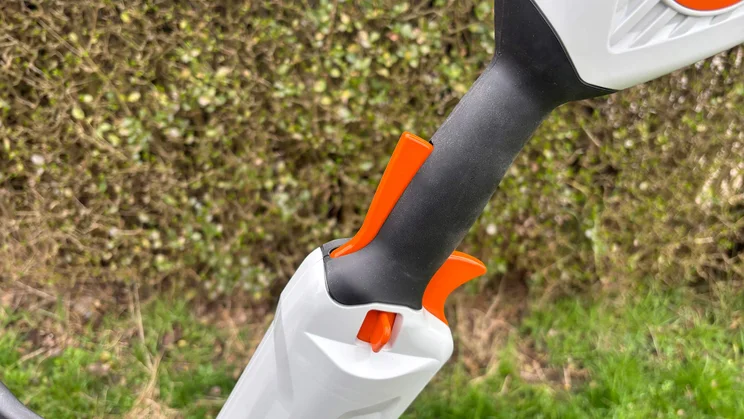
It requires a bit of mental gymnastics to get going, because there are two triggers – plus a lever that stretches through the unit and twists up or down, making it equally useful for left or right-handed users. That lever acts as the lock, so it must be activated before the bottom trigger is pressed to start the strimmer.
Once you release the trigger, the lock button must be activated again…unless you hold the upper trigger, in which case, you can start and stop the trimmer as you please. It seems unnecessarily complex, although it does become more intuitive the more you use it.
To extend the boom, or to twist the cutting head to switch between cutting and edging, you loosen an orange collar below the handle and adjust as required. The cutting head pivots through three positions by pressing a foot-operated pedal: two positions for trimming and one which angles the head vertically for edging.
The unit is exceptionally well balanced. Even when using a single finger to lift it by the handle, the Stihl hangs in a virtually perfect position for strimming. Other nice touches include a hanging eyelet and a protrusion on which to store spare plastic brush-cutting blades, should you be using the optional £26 PolyCut 3-2 brush cutter head.
As per its billing, the Stihl FSA 50 is very quiet in operation; I recorded 78dBA at ear level, which is pretty much in line with Stihl’s own figures. I was delighted with the lack of vibration, and recorded a barely-there 2.9mm/s which according to the Government’s own figures could be used all day without breaching daily limits.
Unless you have a stash of batteries, that will never be an issue, because in my no-load continuous runtime test, the FSA 50’s power pack expired after 42 minutes, and was giving full power right up until it expired. Stihl quotes 25 minutes of working time, suggesting your real-world results might be closer to that.
The battery needs a good shove to install: on several occasions, it clicked into its first locking position, but needed an extra firm press to fully secure it in its operating position. It’s not immediately obvious which way round it goes, either.
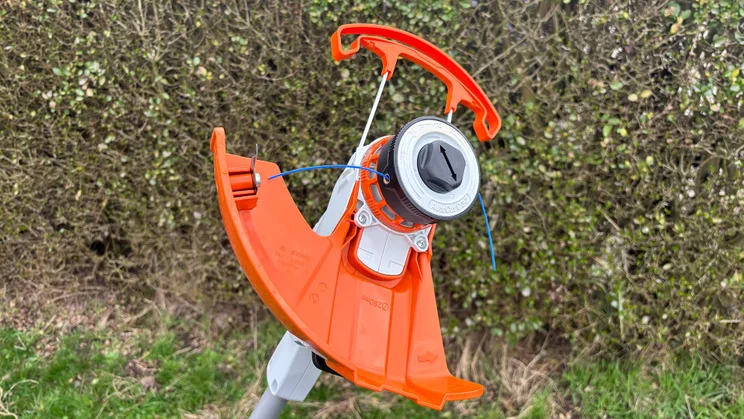
On the other hand, swapping the reel is easy: simply press two buttons on the side of the head to remove the cap, and the reel pulls straight out.
How well does it trim?
Two things strike you when you fire up the FSA 50. The first is just how quiet it is, even when hacking through weeds. The second is how ergonomic it is. It’s beautifully weighted and, with adjustment for boom length and head angle, it’s really easy to get comfy for the job ahead.
It cuts really well, too. I found it makes short work of tall, wet and thick grass quickly, quietly and efficiently, and the ergonomics mean it was easy to get a good swing. It performed well on thicker vegetation, and satisfyingly sliced through nettles and thin-to-moderate brush. I think it may have performed well in thicker brush and brambles, but the line seemed fragile out of the box. The instructions say to soak the line for between 12 and 24 hours before use which improves matters, but this is inconvenient.
It does a very good job of edging, although like other grass trimmers, it would eat line fairly quickly: a result of occasional contact with concrete. I found that this would usually require removing the spool cover and rethreading, and on a couple of occasions this resulted in a jam.
The only ergonomic frustration is the position of the pedal to adjust the angle – when in edging mode, it was difficult to access with my foot, so I’d use my hand instead. It’s a particular annoyance, because you can’t use the bump feed function until it’s returned to a regular position.
Should you buy the Stihl FSA 50 grass strimmer
For many, gardening should be a peaceful, relaxing endeavour – and the Stihl FSA 50 slots perfectly into this world. It’s so quiet, it could probably be used at the end of a typically large garden without bothering anyone in the house.
Fiddly controls aside, what I like most of all is that it’s brilliantly thought out, putting the user first. It’s highly adjustable, so whether you’re tall or short, you should have little problem, and the deformable deflector helps give you that extra control when cutting close to plants and other objects.
The brittle line may be a concern, though. While soaking it for a day or two does improve its elasticity and makes it less prone to breakage, it’s just not practical for those snap gardening decisions on an unexpectedly warm day.


