To help us provide you with free impartial advice, we may earn a commission if you buy through links on our site. Learn more
- Vision Dock remote screen is brilliant
- Lots of mounting options
- Excellent image and stabilisation quality
- Still overheats a little too quickly
In the action camera business, one company dominates so completely that rivals have to think differently. DJI has certainly been doing that over recent years, supplementing its stock GoPro-style Action series with various modular, handheld and 360 cameras. The DJI Osmo Nano is its latest take on the modular action camera genre, and this time it’s nailed the format.
I say that because its first effort was underwhelming. The DJI Action 2 might have been super dinky and beautifully designed, but its battery life disappointed, and we found it overheated too readily when used indoors and in warmer conditions. The Osmo Nano isn’t perfect on this count, but it does improve on it, so is it worth grabbing hold of over its main rival, the Insta360 Go 3S?
What do you get for the money?
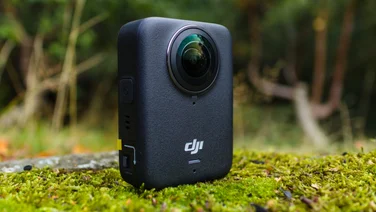
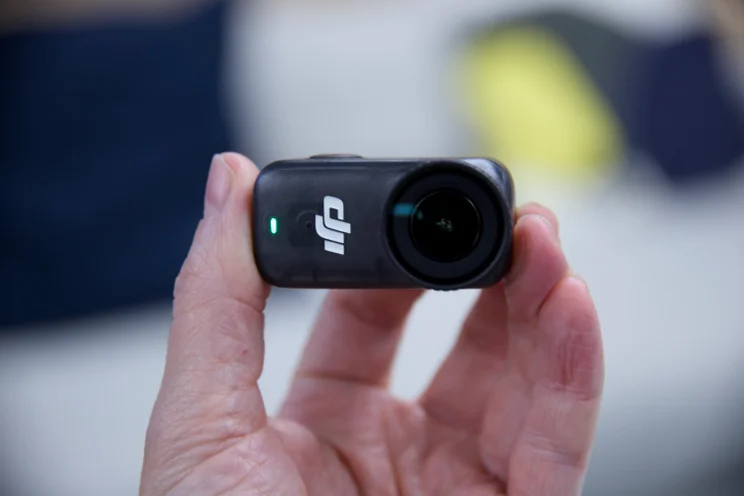
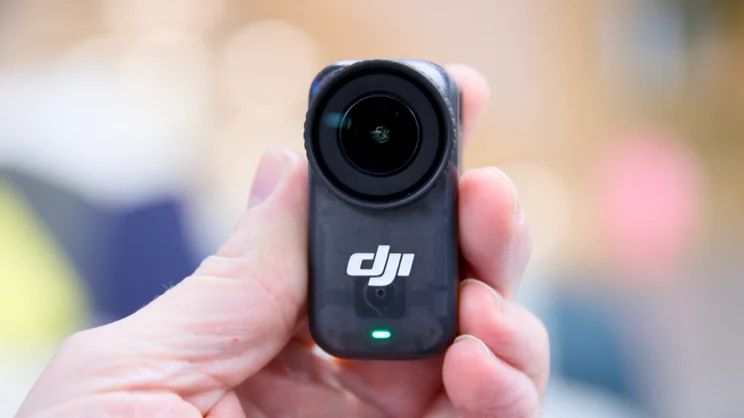
Sensibly, DJI has not gone down the smaller-is-better route with the Nano. Despite the name, the main camera unit is actually a fair bit chunkier than the DJI Action 2 of old, and it’s also larger than the Insta360 Go 3S’ camera unit.

Size and video specs
It’s still pretty small, though. It measures 57 x 28 x 28mm (WDH), weighs a mere 52g and trounces both its rivals for image quality and resolution; it can shoot up to 4K 60fps of 10-bit video (120fps in slow motion) and 35MP stills from a 1/1.3in sensor. And it comes with either 64GB or 128GB of storage built in, with a microSD card slot to expand this with up to 1TB extra.
For activities where weight or bulk is a concern – running, for example – this is the ideal camera. I took the Insta360 Go 2S with me when I ran the London Marathon in 2024, and I barely noticed it in my pocket. The DJI Osmo Nano could easily do the same job and yet delivers far superior video quality.
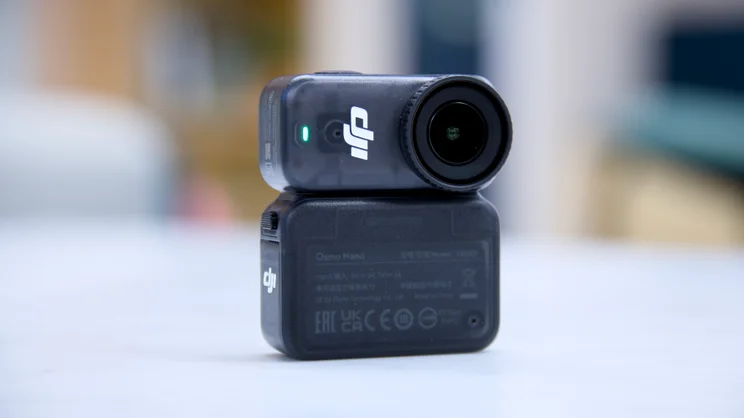
The size means the camera can be mounted pretty much anywhere you fancy, too, without having to worry about camera wobble, while magnets on the base and rear allow it to be quickly secured to any metal surface (though not aluminium, as it’s non-ferrous).
Detachable screen
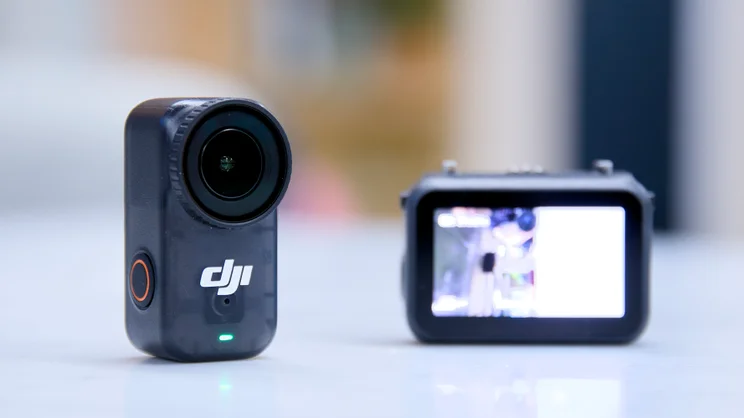
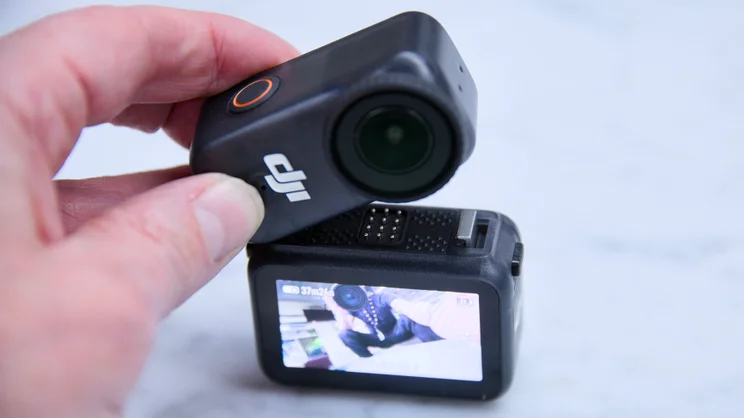
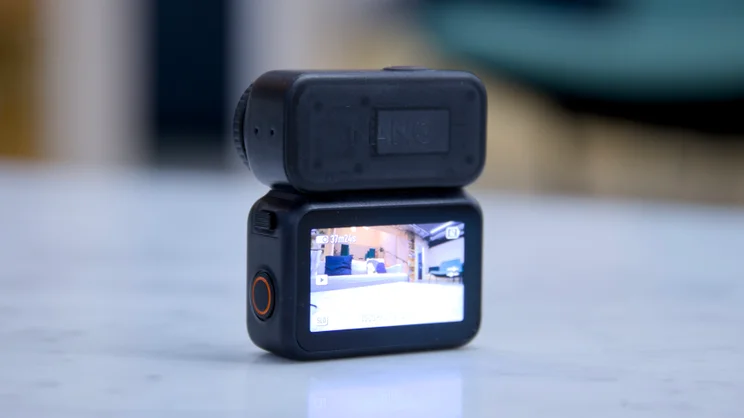
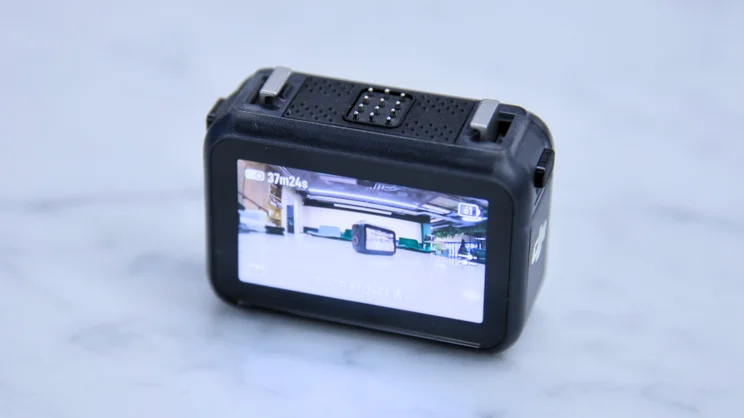
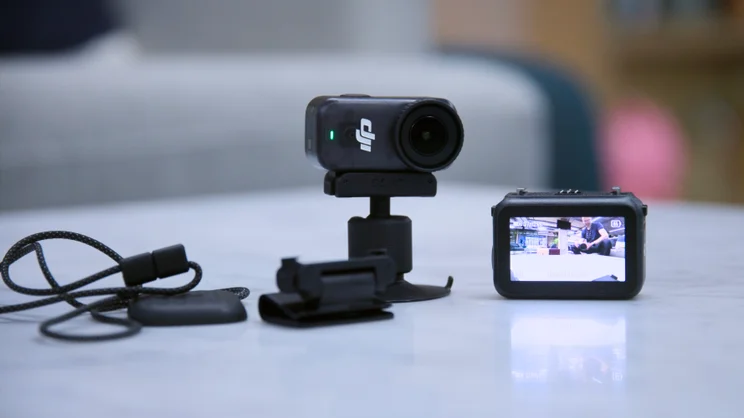
There’s no screen on the Nano itself (it’s too small for that), but what makes modular action cameras like this special is that you can add one when you need it, simply by clipping the provided “Multifunctional Vision Dock” onto the base.
This adds a 1.96in 314 x 556 resolution OLED display to the camera and an extra 1,300mAh battery. It can be clipped on facing the front or the rear and even removed for remote viewing and operation.
Accessories and package combos
As with most action cameras these days, the DJI Osmo Nano is available in a variety of different packages, each aimed at different types of sports and activities. The Standard Combo Action package is a good place to start.
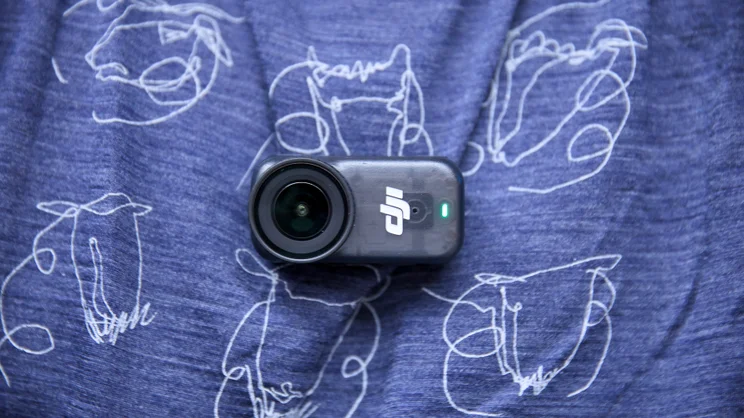
It costs £239, and that price includes the Nano itself plus the Vision Dock, a hat clip so you can attach the camera to the peak of a baseball cap, and a magnetic lanyard. The latter is standard issue for small action cameras like this: you hang it around your neck behind your t-shirt or top, and its magnetic plate allows you to attach the camera to the front of your shirt.
There’s also a running package that adds a headband mount (£265), one for vlogging that comes with a selfie stick and a transmitter for the DJI Mic Mini (£295), plus road cycling (£336), mountain biking (£323), hiking (£318) and car mount (£308) combos that include different selections of mounts.
The most useful accessory of all, however, is the dual-direction, quick-release foldable adapter mount. This clips onto the base of the Nano (or the Vision Dock) and adds a 3/4in threaded tripod mount to the base of the Nano and fold-out legs, allowing you to use the camera with pretty much any GoPro-compatible mount. It’s a bit pricey at £34, but if you have ever owned an action camera before, you likely have a few old mounts in a drawer somewhere, and this will save you some cash.
What did we like about it?
Battery life
Because we’d had issues with the first modular DJI camera, the first thing I set about testing was how long the thing would last on a single charge and how soon it would overheat.
The good news is that it’s far better on this count than the DJI Action 2. Fully charged, I plonked it down on my desk and started recording 4K/60fps footage with the high bitrate setting enabled. The Nano lasted 42 minutes before the battery ran flat. That’s some way short of the claimed 90 minutes, but this claim is for less demanding 1080p/24 capture. The Osmo Action 2 lasted 18mins 40secs in this test.
Adding the screen unit to the camera extends battery life, but it also causes the camera to overheat after around 21 minutes (more details below). Out in the colder air of a mild London winter’s day, it kept going until both batteries were flat, delivering a more impressive total of 96mins 28secs.
Image quality and audio
With a large 1/1.3in sensor, still image shooting at up to 35MP and video capture of 4K/60fps (or 4K/120fps in slow motion), the Nano beats both the Insta360 Go 3S and its predecessor, the Action 2, on pure specs.
It also produced some seriously impressive results in my tests. I carried out most of my testing during what was one of the dullest October and November periods I can ever remember, and the Nano captured bright, balanced exposures throughout. Videos were packed with detail; the camera retained details in the sky while keeping darker areas well-lit on the brighter days, and it performed comparatively well even in darker environments.
I was particularly impressed with the level of detail it captured of the road surfaces during a recording of one commute into central London. The Nano managed to capture the subtleties of detail like the grains of aggregate and cracks in the tarmac as I rode past on my bike at speed, while balancing those with bright, bold colours of pedestrians and cars. Those are the sorts of details I’ve seen other cameras turn into mush in the past. The DJI, thanks to its big sensor, is a detail monster in good light.
Plus, there are plenty of ways you can tweak the footage to your own liking. I found the 8-bit colour recordings perfectly acceptable, but the camera also supports 10-bit colour and DJI’s own flat D-Log M profile for those who want to colour-grade their footage professionally in post.
I was also impressed with the audio and how good the Nano is in general at cutting out wind noise. It did pick up during my bike ride, but it’s not overly distracting, and it picked up my voice over the wind surprisingly clearly and cleanly, although not with an awful lot of body. If you need high-quality audio for YouTube videos, you’re best off grabbing yourself one of DJI’s wireless microphones and pairing that with the Nano instead, but the built-in microphones work well enough.
Stabilisation
Stabilisation in dim and dark environments is where this and other action cameras typically fall short, and that is the only image quality issue I encountered with the DJI Osmo Nano. Out on a run in the morning, beneath some tree cover, you can see the trees shimmering and shuddering very slightly as I pad my way along the footpath. It’s by no means the worst I’ve seen, and the footage is still usable, but worth bearing in mind.
As soon as you get out into halfway decent light, however, these problems go away, and the camera exhibits rock-solid image stabilisation. I tested it on both runs and rides, and the results in both situations were incredibly smooth.
Moreover, you have plenty of creative options to play around with. There are two core settings: Daily – for vlogging, walking and activity where there’s not too much motion to deal with; and Action, for sports such as running, cycling, etc, where the camera applies a more aggressive stabilising effect, but at the cost of some visual detail. Both work very well.
The camera also offers horizon-balancing, where the camera keeps the horizon dead level, no matter how far the camera tilts to the left or right. This works impressively, but doesn’t allow you to rotate the camera 360 degrees while keeping the view level – it will flip around into portrait and back again if you do that.
Flexibility and mounting options
I absolutely love the flexibility thumb-sized cameras offer, and the Nano is the best I’ve seen. This is mainly due to the way the screen can be used remotely from the camera unit to preview live what the camera can see through its sensor. This means you can mount the camera, say, on your helmet while riding a bike, or the peak of your hat when running, while still being able to check the framing of what you’re recording or change the settings of your video on the fly – all without having to remove the camera from wherever you’ve put it.
You can, of course, simply attach the screen unit to the camera and use it just like you would a regular action camera. You can also split it into two and just take the camera out with you – and the light weight of the Nano means it can be mounted in places you wouldn’t want to put a regular GoPro, like your shirt or a running cap.
It also has strong magnets on both the rear and the base, so you can stick it securely to a metal surface, and its low profile and light weight mean it wobbles less than a traditional action camera, so you’re more likely to be able to get steady footage in extreme circumstances.
But it’s the ability to combine these capabilities with that remote screen unit that sets the Nano apart from the competition. It’s just a fantastic little camera.
What could it do better?
Overheating
Although I didn’t have overheating problems with the camera on its own, when I attached the Multifunction Vision Dock physically, I found overheating did kick in from around 16 minutes while recording in 4K at 60fps indoors. At this point, it paused for a few seconds, then resumed recording until it stopped fully at 21mins 28secs.
I carried out this test indoors, though. Outdoors with the temperature at around 15 degrees Celsius, it recorded until it ran out of storage or battery life, whichever came first. In fact, with the Vision Dock attached, I managed to eke out 96mins 28secs while recording 4K60fps footage – an impressive achievement for such a small camera.
However, it is probably worth being quite careful with the camera if it does overheat (and it will at some point) and giving it some time to cool down before recording again, because I managed to kill the first sample I was sent through overheating it too frequently during my battery life testing.
Should you buy the DJI Osmo Nano action camera?
Other than this, there is nothing I would improve about the DJI Osmo Nano. It is, quite simply, my favourite action camera. No, it can’t beat the very best when it comes to outright quality or resolution or professional-level features. It doesn’t have a square sensor for recording vertical and horizontal footage simultaneously, and it can’t record 5K or 8K footage, either.
However, the image quality as is, is exceptional, the stabilisation is superb, and the mounting system and remote Vision Dock make it more flexible than any action camera I’ve ever reviewed. Best of all, though, is that it’s remarkably reasonably priced. At £239 for the basic camera package, it’s phenomenally good value, and I have no hesitation in recommending it as a result.