To help us provide you with free impartial advice, we may earn a commission if you buy through links on our site. Learn more
- Tiny when folded
- Excellent cut quality
- Really easy to use
- Disappointing battery life
- Handles are fiddly to fold
- Damp leaves can cause chute to clog
It’s an irrefutable fact that no matter how much time you spend mowing and preening your lawn, your mower will spend most of its days locked up in the shed. But as the compact Ryobi RY18LMX33A proves, they don’t have to be in harm’s way.
That’s particularly important in homes with smaller gardens, because the chances are your 6×4 shed is already full to the gunwales. Of course, the quality of cut and ease-of-use is important whatever mower you’re choosing. And if you’re choosing a battery operated mower, then the brand you plump for will play a part, too: choose wisely and you can share those batteries across multiple products.
So then, the Ryobi RY18LMX33A has size on its side, and is powered by a popular battery ecosystem. Let’s find out if it’s one of the best cordless lawn mowers on sale.
Ryobi RY18LMX33A review: What do you get for the money?
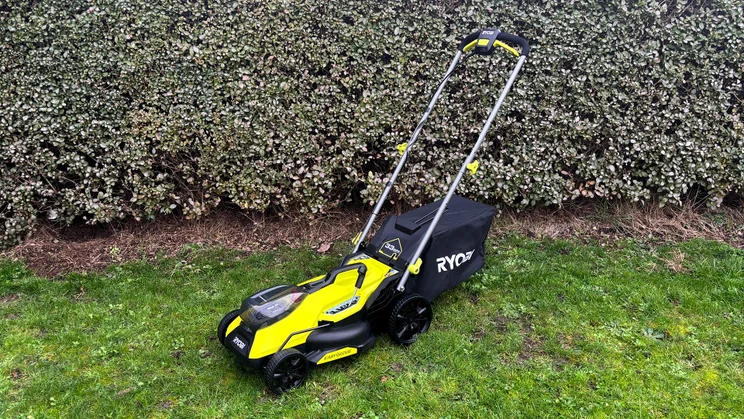
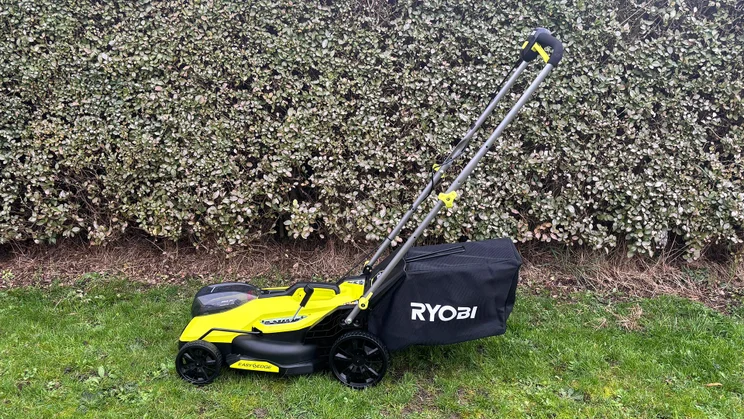
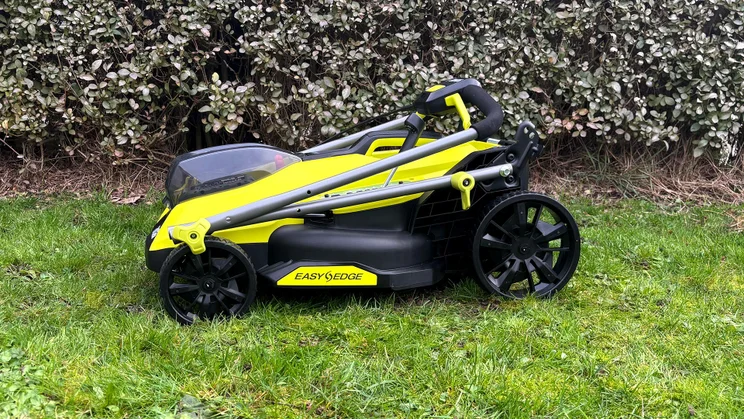
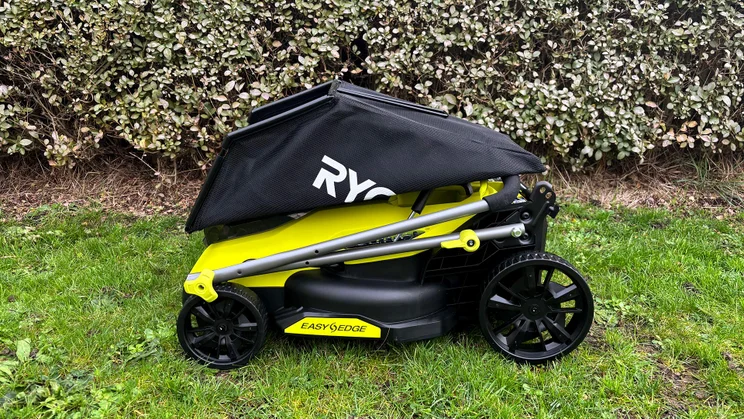
The Ryobi RY18LMX33A is superbly proportioned. With the handles folded, it’s just 24cm tall, 36cm wide and, without the 30-litre grass collector attached, 66cm long. The grass collector itself collapses, snugly fitting on top, and the whole thing is small enough to slide under a workbench.
The RY18LMX33A costs £230 as a bare unit, or £260 with a charger, 4.0Ah battery and a (rather effective) strimmer. The latter package makes this an exceptionally cheap way to keep your lawn tidy – the battery and charger alone would cost you £110 – and cheaper than the similarly-specced Stihl RMA235 with battery.
The 4.0Ah battery is good for 220m² of mowing, according to Ryobi, and 275m² with the 5.0Ah battery. The bundled charger will take the 4.0Ah from flat to full in 120 minutes.
What’s particularly nice about the RY18LMX33A is that all it requires fresh out of the box is the handles to be unfolded, the grass collector attached and a charged battery plugged in. Indeed, that no parts need to be removed for transit shows just how space-efficient it is.
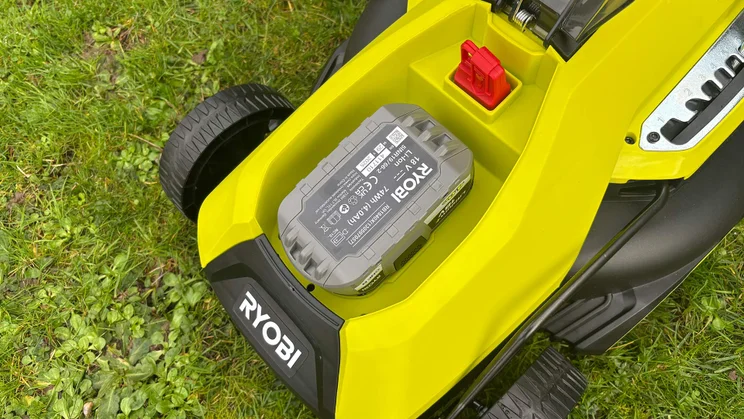
The sleek Ryobi looks and feels good quality. The plastics are nicely finished and feel like they’re more than up to the job, though it’s a bit of a shame that the battery cover is a little flimsy and doesn’t stay open: it’s spring-loaded, so you’ll have to hold it while you insert the battery. I like that there’s a removable safety key preventing it being started accidentally, and a hole on the end allows it to be placed on a keyring or hung on a hook to avoid getting lost.
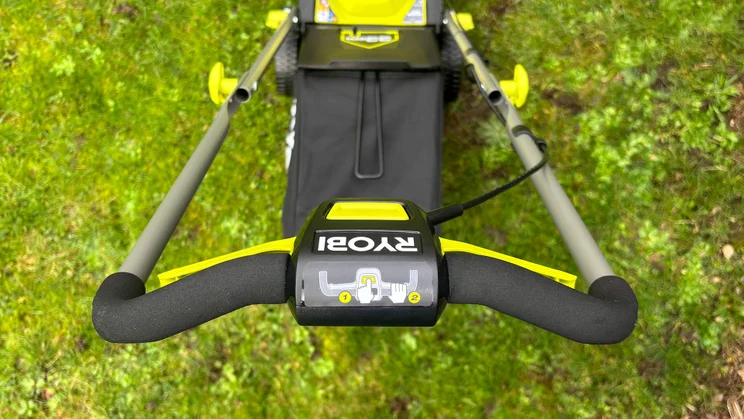
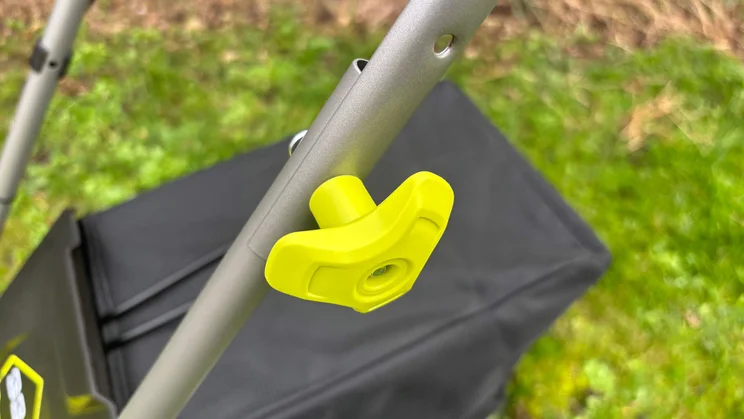
There’s no telescopic adjustment in the handle, although it pivots between two height settings. The handle folds in half, and is secured in place by a pair of threaded knobs. More on these later.
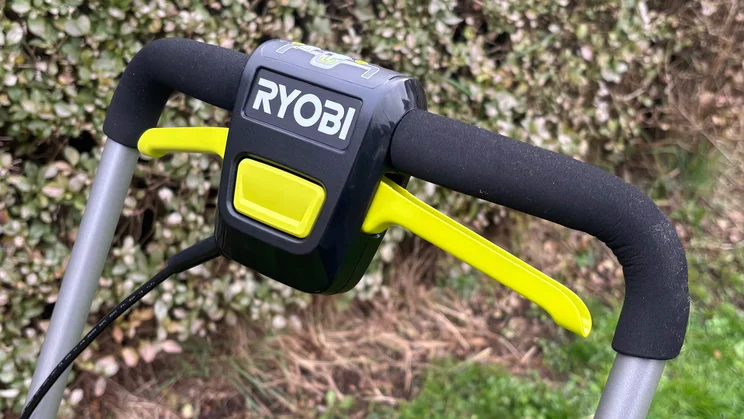
The mower starts and stops by pressing the lock button and by squeezing one or both of the triggers. There’s no blade speed adjustment and no battery level indicator – but given its focus on mowing small lawns, that doesn’t feel like a big problem.
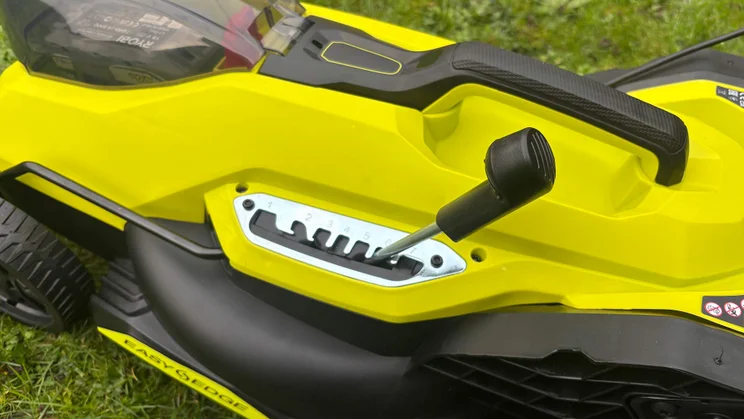
The high-adjustment handle moves through a metal gate, which is a surprisingly upmarket feature, and slightly reminiscent of a Ferrari’s gear-shift gate. It adjusts through seven settings between 25mm and 90mm – that’s a wider range than most of its rivals; indeed few can cut longer than 70mm.
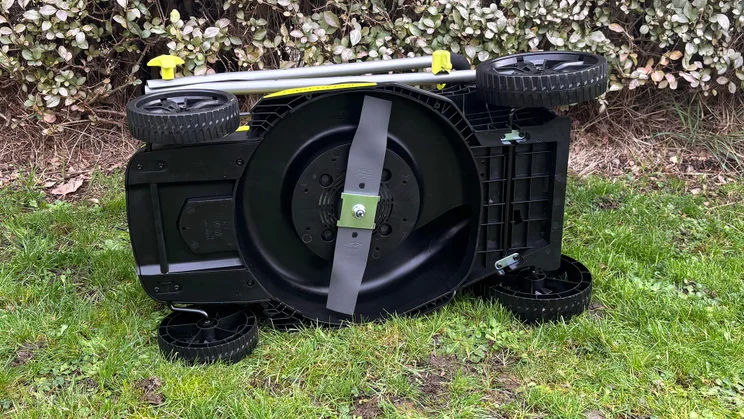
It has a 33cm cutting deck, which is almost as wide as the mower itself, and is able to draw stray grass into the deck, meaning it’s good at edging.
A compact fabric and plastic grass collector feels high quality and has a metal frame which attaches to the mower with some hooks. It’s a little fiddly to connect at first, but becomes intuitive after a few goes.
Ryobi RY18LMX33A review: How well does it mow?
My first run out with the Ryobi RY18LMX33A was on a long, damp lawn festooned with magnolia leaves. That’s a baptism of fire for any mower, let alone a budget battery-powered model. Yet it cut extremely well.
My first pass was a 60mm trim, but to test its mettle, I swung it down to 40mm for the next cut. Even thick tufts and leaves that had blown into the undulations in the lawn were finely shredded and fired into the collector.
This more extreme test did reveal a tendency for particularly damp clippings to get clogged in the chute. This was likely exacerbated by the thick magnolia leaves. You can work around that, though.
The biggest issue, however, is battery life. I made two passes over my 40m² lawn – admittedly hacking damp grass and a lot of leaves – and the 4.0Ah battery expired shortly after. A runtime test, where the mower is left running on some hard standing, revealed it would last just 29 minutes regardless of whether it was powered by a 4.0Ah or 5.0Ah battery. By comparison, the Bosch CityMower 18, with its 4.0Ah 18v battery, lasted 62 minutes, and the Stihl RMA235 clocked in at a massive 77 minutes.
It’s likely the battery life will be better in the summer, when you’re more likely to be cutting shorter and drier grass. Batteries generally perform better in warmer temperatures, too. We will update this test when the weather allows us to do so.
The 33cm cutting deck is ideal for a small garden, and I was impressed by its ability to funnel stray blades into the mower, so it was surprisingly effective at cutting close to fences and walls.
It’s light enough to be manoeuvreable, although the small front wheel/large rear wheel arrangement of the larger (and more expensive) Flymo UltraMow Duo 460 is better still.
The controls are very basic. Apart from the height adjuster, which requires a bit of manhandling because the mower is so light, there’s a conveniently located lock button and pair of triggers to start at stop the mower. As long as the lock button and one of the triggers are pressed simultaneously, the Ryobi will start, unlike the Stihl which requires the lock button to be pressed first.
Finely-cut mulch is fired into the 30-litre grass collector effectively. It’s a shame there’s no indicator to show when it’s full, but there’s a comfortable metal handle to remove it, and the square shape and wide neck makes it really easy to empty.
I recorded the Ryobi operating at 85dBA around head level, which is louder than the Stihl RMA235, but by no means uncomfortable. Similarly, vibration levels of 2.5m/s² were well below government limits, and a foam handle mutes what little there is.
So far, so very good, then. But the RY18LMX33A isn’t perfect. While it’s small enough to neatly slide under a workbench on its wheels, it tilts backwards when trying to store it upright so will either take up a little more space or fall over, depending on how it’s orientated.
The other frustration are the threaded knobs which need to be loosened or tightened when folding or unfolding the handles. They require far more turning than you’d expect and you need to take care not to pinch the cable that runs from the mower to the controls. A well-placed cable tie could solve this but, ultimately, levers would be a better option.
Ryobi RY18LMX33A review: Should I buy it?
There’s no shortage of budget battery mowers on the market, but the Ryobi RY18LMX33A is among the easiest to use and most useful when it comes to storing. Ryobi frequently runs promotions with bundled batteries and chargers (and, as is the case here, a strimmer) so keep an eye out for those. Sniff out one of these deals, and the RY18LMX33A is great value.
I was extremely impressed with the quality of the cut and the ease with which the grass collector can be emptied. The general build quality is very good, too.
The elephant in the room is the battery life, though. Regardless of whether it was powered by a 4.0Ah or 5.0Ah battery, it expired after 29 minutes. That will clearly be a frustration for those with medium-sized gardens, but could be less of an issue for those with smaller lawns, or a ready supply of compatible Ryobi batteries.