To help us provide you with free impartial advice, we may earn a commission if you buy through links on our site. Learn more
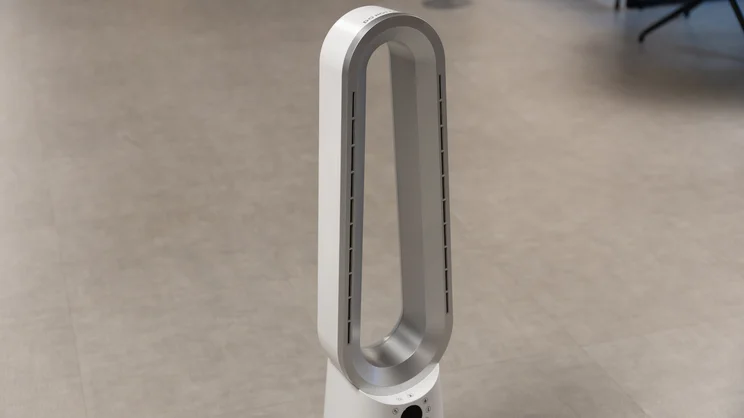



- Stylish Dyson-esque design
- Easy to use
- Energy-efficient in fan mode
- Lower airflow than equivalent tower fans
- Quite noisy
It’s nigh on impossible to talk about the Beldray 2-in-1 Bladeless Fan & Heater without referencing the Dyson AM09 Hot+Cool, so I’m not even going to try. We’ll be polite and describe the former as an homage to the latter, covering the same basic functions in a similar design, but at less than half the price.
Like the Dyson, it’s a dual-purpose fan and heater, working to cool you when the temperatures soar and warm you up once they drop in the autumn. Also like the Dyson, it’s designed to be energy-efficient and quiet. But is Beldray’s tribute act worth buying, or a pale imitation of the real deal? I’ve been testing it over the last week across both functions to find out.

Beldray 2-in-1 Bladeless Fan: What do you get for the money
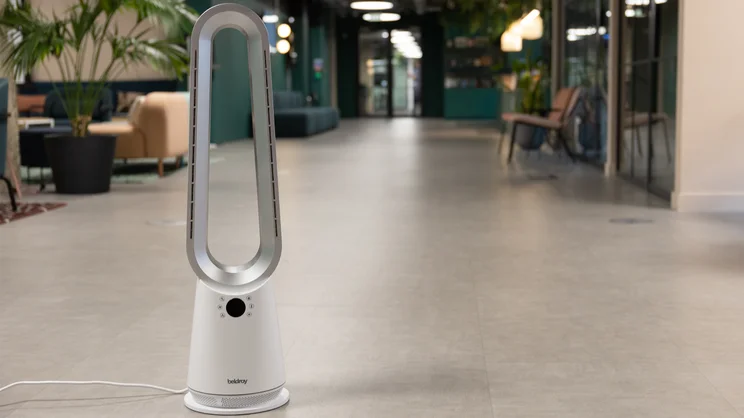
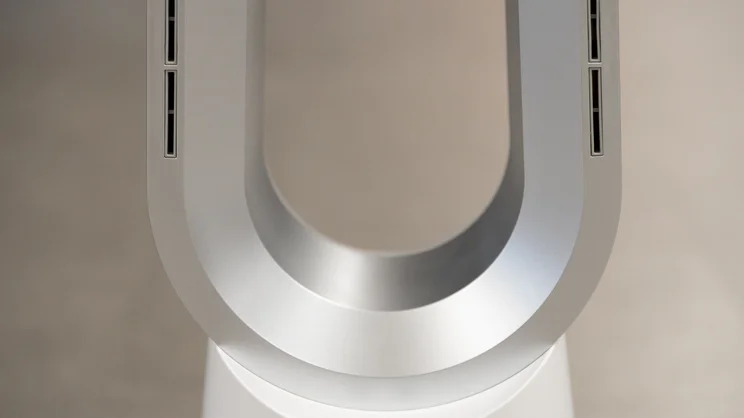
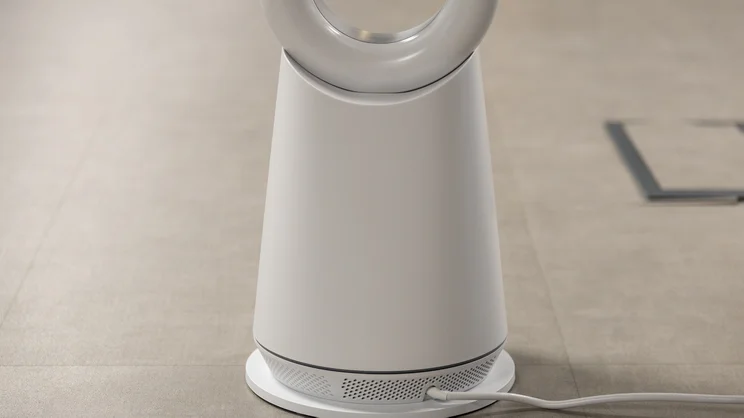
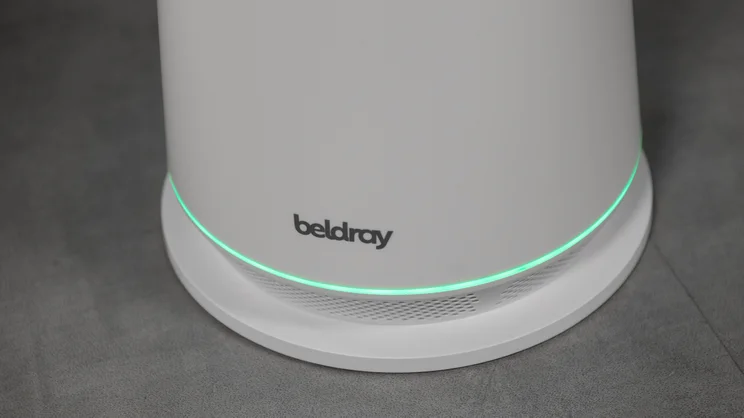
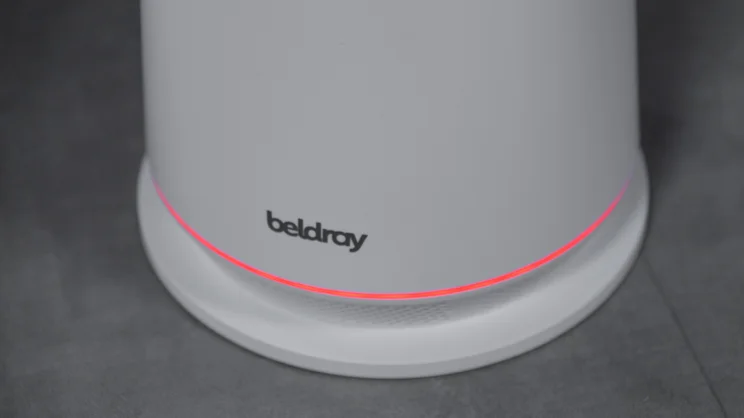
This is a fan and heater combining oscillating, bladeless cooling and a 2KW fan heater in the same device. As with Dyson’s classic design, a fan in the column sucks in air through vents on the base and channels it up into the stretched oval ring at the top, where it’s pushed out at speed through a series of slim outlets. It also incorporates a glowing ring at the bottom, customisable with a choice of intensities and six colours.
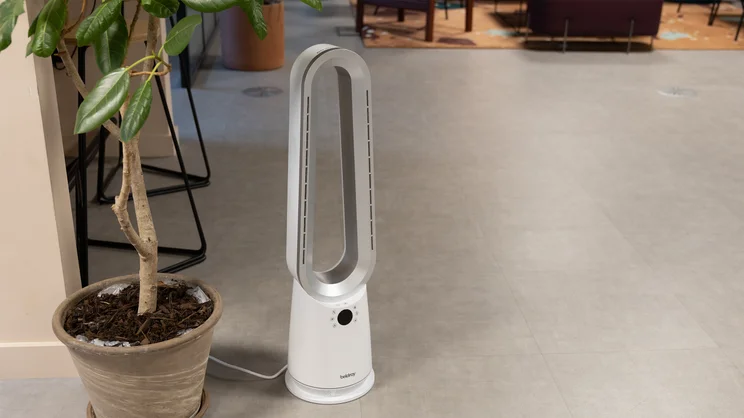
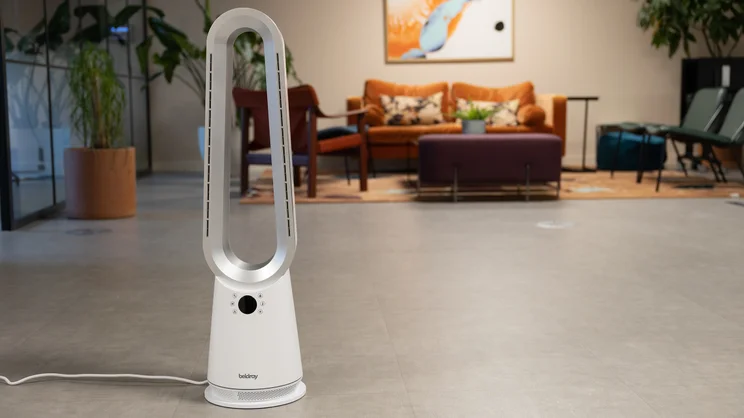
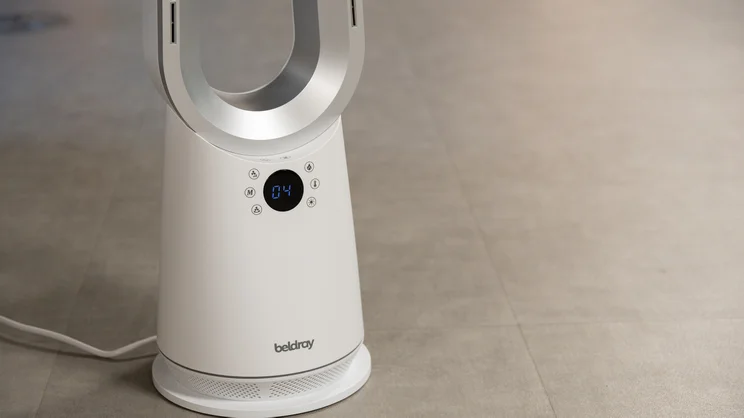
It’s a reasonably stylish unit, and while everything – including the silver ring – is plastic, it feels like a thick and solid plastic rather than anything cheap and nasty. It stands 84cm tall but has a compact 225 x 225mm footprint, so it’s easy to fit in most rooms and just as easy to stow away when not in use.
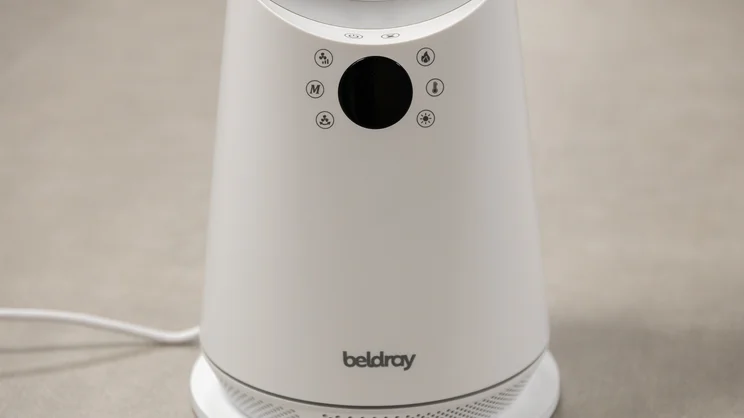
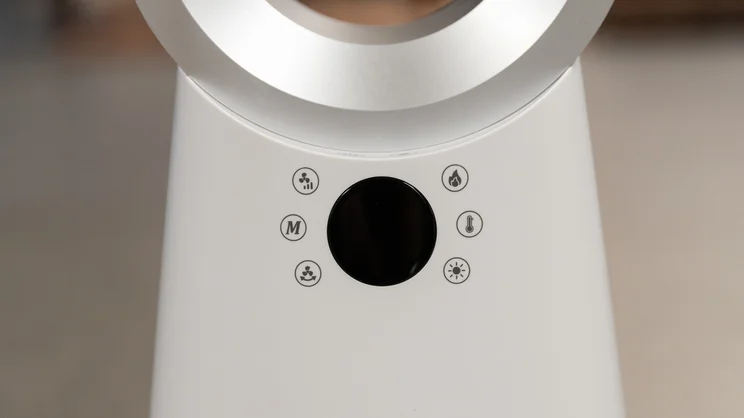
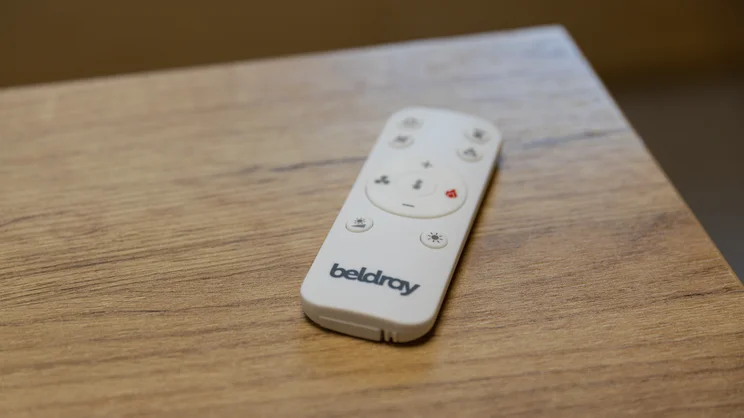
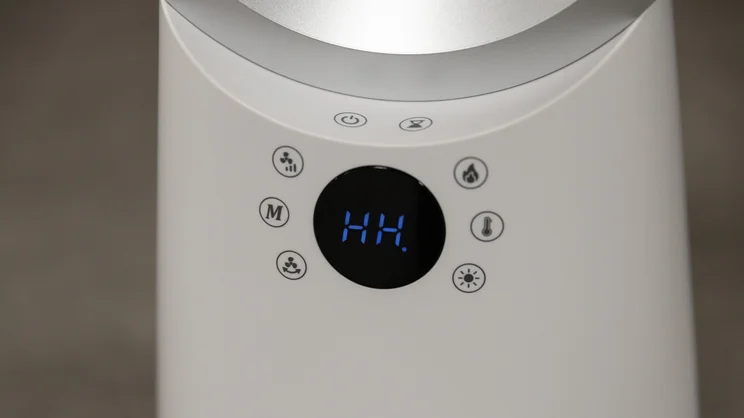
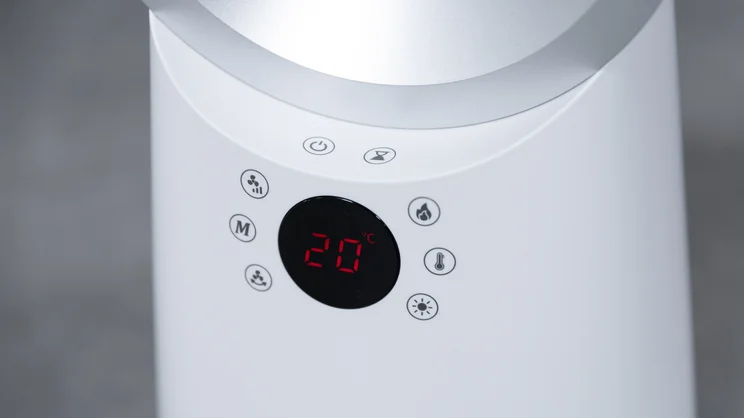
A circular digital display in the centre of the base gives you the current fan speed or temperature, while the eight touch-sensitive buttons arranged around it allow you to change the mode or speed – as well as adjust the target temperature, set the timer, or alter the brightness and colour of the LED ring. The buttons work first time without repeated prodding, and the same functions are mirrored on the compact remote control. It’s well laid out and responsive when you’re trying to use it, which (sadly) isn’t something you should take for granted.
What features and settings does it have?
Beyond the basic fan and heater functions you have a choice of nine speeds and two fan modes. In the standard mode it runs at the current selected speed until turned off, but you can also set it to an Eco mode, where it alters the current speed according to the room temperature. The heating has four speed settings and you can change the target temperature from 5°C to 35°C. There’s also an oscillation function, rotating the fan by 40° in either direction, and a timer to switch the fan off after a period between one and eight hours, adjustable in one hour increments.
How well does it perform?
It’s not the fan to go for if you want a lot of airflow. Even at its maximum speed the airflow only reached speeds of 1.5 metres per second, which is less than the Dyson Pure Hot + Cool we tested back in 2019 (2.1m/sec) and the similar Hotsnap Vortex I reviewed in 2023 (1.9m/sec). At lower speeds it’s even softer. My anemometer recorded speeds of 1.2m/sec on the fan’s medium setting (five) and just 0.8m/sec on setting one. At that point I had to move the anemometer closer to the fan just to get it spinning.
That said, it’s still quite capable of dishing out a comforting breeze. You can still just about feel it even on the minimum setting, and by the time you hit the fourth or fifth speed there’s enough airflow to help you cool down.The 80° oscillation means it can cover a good area, too, though there’s no vertical oscillation, or even a tilt function, if you want to spread the air upwards at all.
Turn on the heater, and it’s quite effective. You can feel the warming breeze coming through for a couple of metres away, and in half an hour it raised the temperature in my living room from a slightly chilly 18°C to 20°C. Your only worry is power consumption. While active, the heater guzzles 2kW and can peak even higher for short periods when first heating up. On the fan setting it’s much more frugal, using 20W at its highest speed but 8.7W on medium. On its lowest setting it uses just 3W.
Is there anything we didn’t like?
Fans of this type are supposed to be near-silent, but the Beldray can get fairly loud. At minimum speed it puts out a fairly quiet 30.1dBA whir, but turn it up to five and you’re looking at 40dBA, or 48.9dBA at full whack.
That’s more than the Hotsnap Vortex and more than a range of the best tower fans we’ve looked at, including the EcoAir Halo and the Levoit 36in Tower Fan.
Should you buy the Beldray 2-in-1 Bladeless Fan?
Maybe. My biggest issue with the Beldray 2-in-1 is that, while it looks the part, it’s not as effective as more conventional tower fans. It puts out less airflow than the Levoit or the EcoAir Halo, while also making more noise. There’s enough breeze coming through to cool you down on a hot day, and there are positives to having a fan that won’t blast papers from a nearby desk or table, but I’d still recommend a normal tower fan if you wanted airflow across a wide area from a space-saving design. What’s more, the Levoit can be found at a lower price.
In fact, the biggest plus with the Beldray is that it can also function as a heater, and while it’s too power-hungry to provide cost-efficient background heat, it’s still pretty useful for quickly warming up a chilly room. As a fan, it would be so-so, but it’s a solid 2-in-1 device.