To help us provide you with free impartial advice, we may earn a commission if you buy through links on our site. Learn more
- Unbelievably easy to set up and use
- Superb value for money
- Extremely low power consumption
- Printed instructions aren’t the best
- 900 Series model naming isn’t clear
- Some may bemoan a lack of features
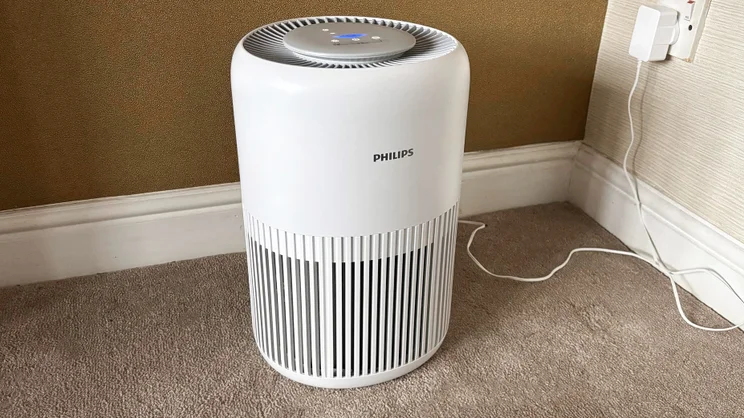
In a world of complex smart tech and connectivity, sometimes simplicity is best. And it’s this refreshingly honest approach that Philips has taken with the AC0920/10 air purifier: the entry point to the three-strong Philips 900 Series range of air purifiers.
That’s because there’s no Wi-Fi connectivity, no app to configure, and no Bluetooth to establish – just a compact air purifier with simple controls and a clear screen. Yes, that means it lacks the more advanced features, such as long-term air quality monitoring. But it also means it’s something that almost anyone can use straight away.
It’s compact in size and competitively priced but, on paper at least, it compares favourably with the pricier Levoit Sprout. But should it be on your shopping list if you’re looking for the best air purifiers?
Philips PureProtect Mini 900 Series (AC0920/10) Air Purifier: What do you get for the money?
The Philips PureProtect Mini 900 Series costs £130 at full price, though at the time of writing you can currently get it for a penny under the £100 mark. So, while it’s not the cheapest air purifier on the market, it’s well priced, particularly considering it’s a decent product from a big-name brand.
And for the money, there’s little to complain about when it comes to its clean air delivery rate (CADR) of 250m3/h, or its ability to clean a 65m2 room, figures which are both greater than the similarly priced Blueair Blue Pure 511 and significantly more expensive Levoit Sprout.
Like the Blueair and Acer Acerpure Cool 2, it’ll only treat PM2.5 particles. In the case of the Philips, it’ll remove up to 99.97% of the stuff. For reference, the Levoit will also filter larger PM10 (for almost three times the price).
There’s no volatile organic compound (VOC) filtration, but that’s something that – Levoit aside – is usually the preserve of far more expensive air purifiers.
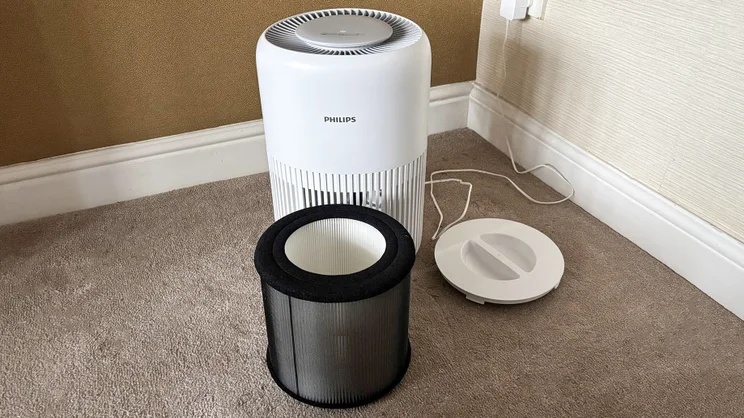
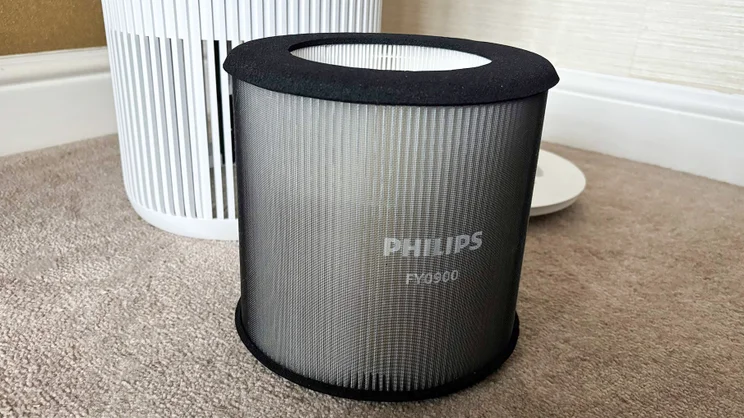
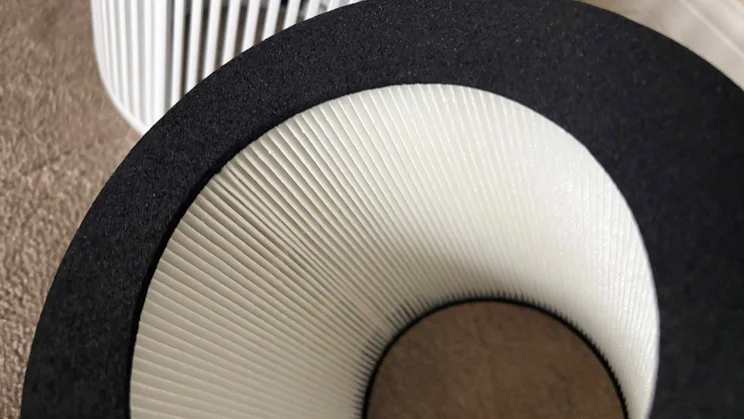
The AC0920/10 ships with a HEPA filter wrapped in a pre-filter and should last for around 12 months. Philips recommends regularly removing it and giving it a clean using a vacuum cleaner – a light will display when it’s time to do so, with a separate light illuminating to let you know when it’s time to replace it. Replacement filters cost £27.
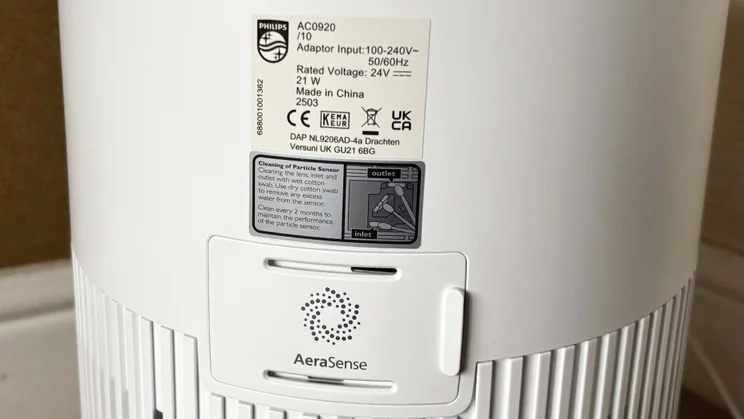
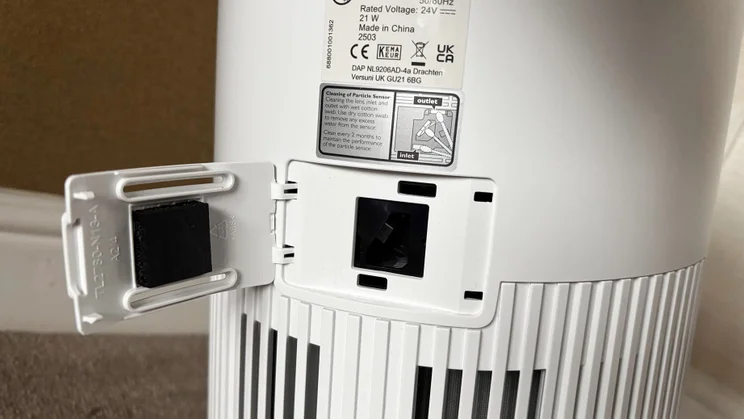
From an ongoing care point of view, aside from the occasional pre-filter clean, Philips recommends cleaning the rear-mounted particle sensor every couple of months with a cotton bud, especially if the air purifier is used in a dusty or humid environment – condensation from the latter can deliver overenthusiastic readings.
If you want more filtration, then step up to the white AC0950/10 or dark grey AC0951/13 – both of which cost £150 at full price (but which you might also be able to pick up at a discount). With these models, you’ll get activated carbon filtration, plus they both work with the Philips Air+ smartphone app.
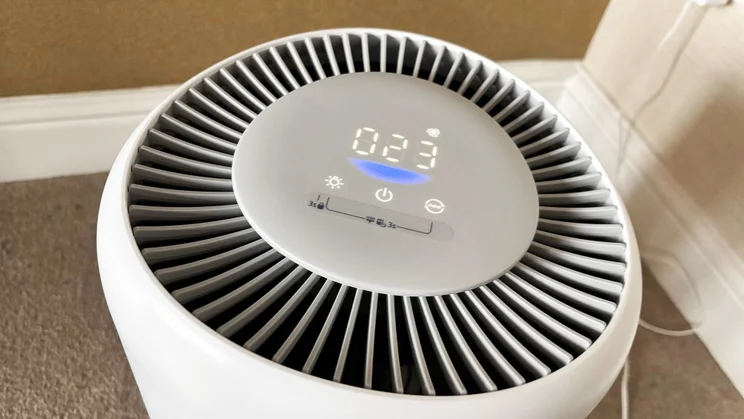
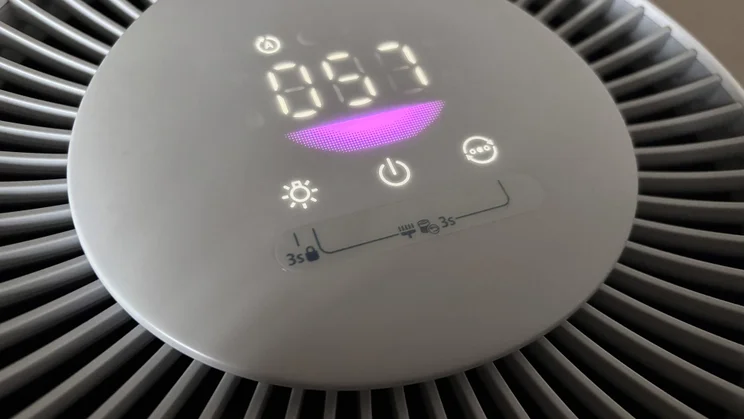
The Philips AC0920/10 has a simple display on the top: when it’s off, only the power symbol is visible. Turn it on and after settling down, it’ll display the PM2.5 levels and a coloured band, which progresses from blue to purple, pink and red as pollutant levels increase. This colour coding is precisely in-line with its easy-to-use ethos: users needn’t have a grasp of numerical levels to see how polluted their air is.
There’s a button to vary the brightness of the display – bright, dark or off – although none are particularly effective in bright sunlight. There’s also a fan speed button which cycles through auto, night (which also turns the display off after a few seconds), medium and ‘turbo’ modes. There’s also a child lock, and a sticker to illustrate that the light and fan speed buttons should be pressed together once the filter has been cleaned or replaced.
Technophobes will rejoice in there being no companion app to control more advanced features, nor any internet or Bluetooth connectivity, and certainly no integration with Amazon Alexa or Google Home. This could make it a winner for the elderly, or anyone who prefers a Nokia brick over an iPhone 16 – and there’s no shame in that.
How well does it work?
The Philips AC0920/10 really is a breath of fresh air – in more ways than one. To get it set up, simply turn the base of the unit, remove the filter and the bag it ships in, then refit it and reattach the base. Then it’s a case of plugging it in, waiting a few moments for it to start displaying the PM2.5 levels and…that’s it.
That’s just as well, though, because the printed instructions are graphical and lack any kind of written context, which doesn’t make things very clear. There’s a QR code on the front of the printed literature to register the product, but it’s not very clear that that’s where you’ll also find the full instructions. I missed it and ended up resorting to Google.
There’s no indication of where the AC0920/10 should be placed, other than away from curtains that could interfere with the sensor that’s positioned on the back of the unit.
To test its effectiveness as an air purifier, I sprayed a can of deodorant in a bathroom for five seconds, and used an air quality monitor to record the resultant quantities of PM2.5, measured in micrograms per cubic metre, or µg/m³.
Usually, the air quality monitor picks up the presence of pollutants before the air purifier itself. However, the reverse was true here, which perhaps suggests that the Philips AC0920/10 has a particularly effective sensor. Across repeated tests, it stepped straight into its turbo mode to clean the air, filtering the lengthy spray of deodorant to a safe 25µg/m³ in 195 seconds (or 3m15s if you prefer). That’s not the quickest we’ve seen – the Acer Acerpure Cool 2 managed it in 135.2 seconds – but it’s still more rapid than some more expensive models.
While it’s unlikely that you’d use the Philips AC0920/10 as a fan (mainly because it pushes air out vertically instead of angling it towards you), it still shifts a healthy amount. In its fastest ‘turbo’ setting, I recorded a wind speed of 2.9m/s, which is even more than the £900 Dyson Big+Quiet Formaldehyde.
The packaging suggests the AC0920/10 is quiet and light on power consumption. Those claims hold water because, in its night mode, I recorded a barely-more-than-background 32dBA. On the other hand, I measured 44dBA when it was working at its medium speed, and 56dBA at full speed – which is a little louder than its rivals. Power consumption of 2.0W and 21.1W is as low as we’ve seen for a new launch recently.
What could be improved?
A hard one to answer, this. That’s because any additional features would inevitably push up the price – and this is its trump card.
Nevertheless, shipping the Philips AC0920/10 with better instructions would certainly be a good place to start. And if we’re being super critical, the explanatory sticker on the control panel detracts a little from the air purifier’s otherwise sleek aesthetic.
Perhaps the biggest thing to address is how Philips brands the three 900 Series air purifiers, and illustrates the differences. All three models are labelled “PureProtect Mini 900 Series Air Purifier” on Philips’ website, with the model names (largely similar strings of letters and numbers) in small print above. For those not used to manufacturer model names, this might be unclear and confusing.
Should I buy the Philips PureProtect Mini 900 Series (AC0920/10) Air Purifier?
If you’re in the market for an effective air purifier but have a tight budget, then the Philips AC0920/10 is an extremely compelling proposition: cheap to buy, cheap to run and the reassurance of hailing from a big brand.
Similarly, if you just want something that works out of the box, without any tedious setup, it’s definitely worth shortlisting. That particularly applies if you’re buying for elderly relatives, locations without internet connectivity or if you’re moving it between multiple locations.
Of course, if you’re looking for something far more fully featured, then hunt elsewhere – and stretch to deeper pockets. But for something that fulfils the key purpose of an air purifier, the Philips AC0920/10 is well worth a look.