To help us provide you with free impartial advice, we may earn a commission if you buy through links on our site. Learn more
- Vast grip and traction
- Massive coverage potential
- Easy to set up
- Very expensive
- Shelter is a costly option
- Bewildering number of app functions
Segway is best known for its personal mobility devices, but more recently has branched into e-bikes and its growing Navimow brand of robot lawn mowers.
The Navimow X430 is one of three models in the Navimow X4 series, sitting as you might expect, between the X420 and X450, and all are heavyweight and extremely capable mowers. As tested here, the X430 can autonomously mow up to 3,000m2, which is about as good as residential mowers get, and can do so without the need for perimeter wires thanks to some clever thinking.
It’s undoubtedly talented, both in terms of the technology it uses and the quality of its cut, but you’ll need a lot of grass to trim to make use of its coverage capabilities, or a large lawn with plenty of undulations. It excels in both environments, but is it worth its £2,500 asking price, and should it be on your list of the best robotic mowers on sale?
Navimow X4 Series review: What do you get for the money?
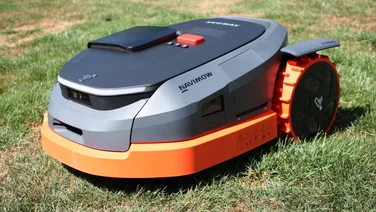
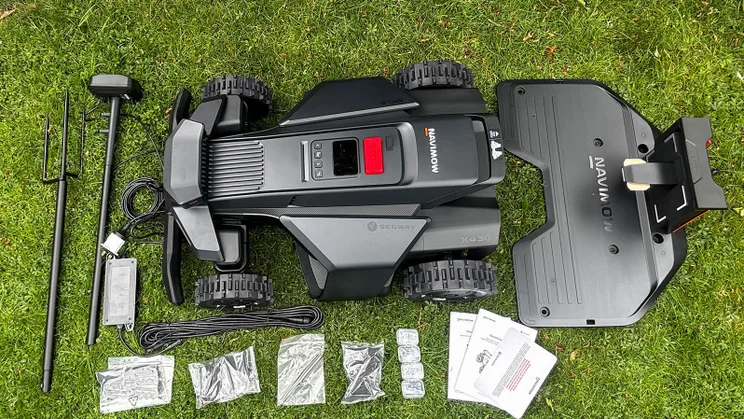
The Navimow X430 arrives in a huge box. But that’s not just because the mower itself is massive (think of a child’s go-kart for scale), but because it packs a large number of accessories.
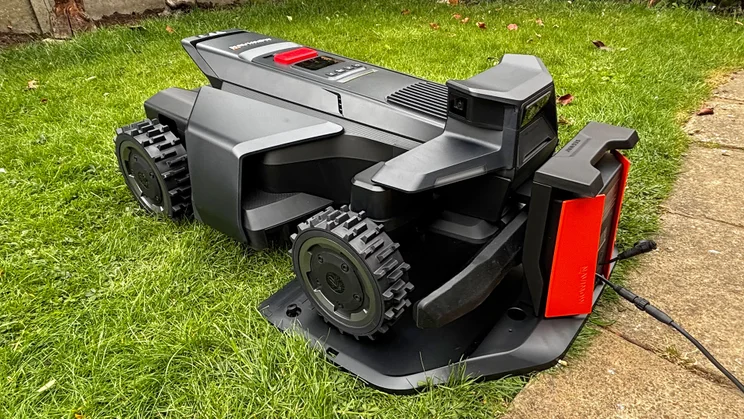
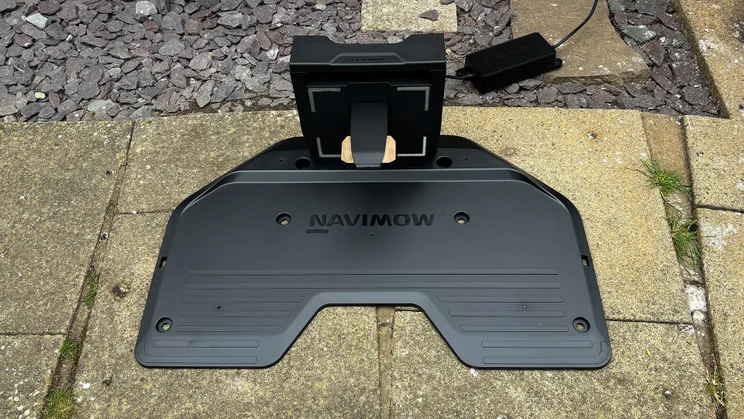
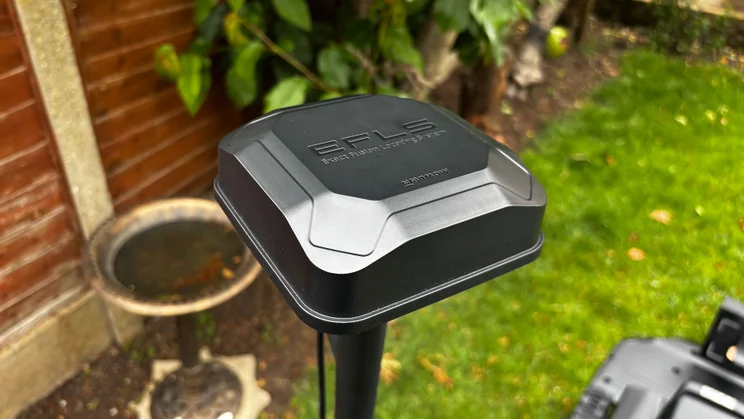
There’s no separate battery, but there is a large docking station, with ground anchors to help it stay put, plus a positioning antenna, which you might or might not need to use, depending on connectivity.
Now, this is a lot of gear, but the price is equally substantial. At £2,499 it’s about £200 cheaper than the EcoFlow Blade, but at that money, you’re into ride-on mower territory. Very different propositions, for sure, but some useful context.
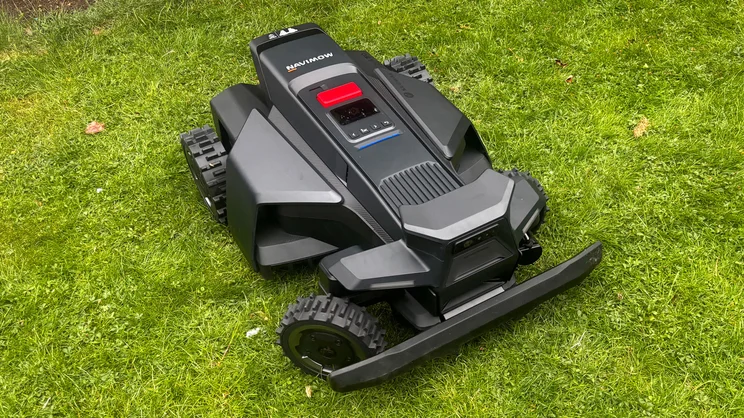
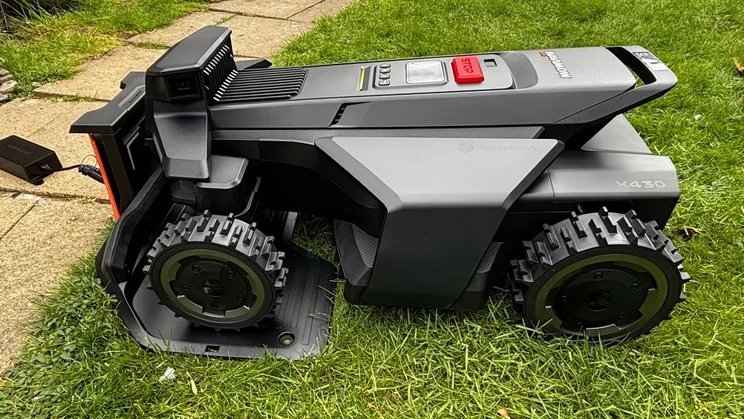
At just over 28kg, the Navimow X430 is also extremely heavy and very hard to carry. Fortunately, it’s possible to guide it around via a smartphone app, much like a radio-controlled car, and with four-wheel drive, chunky tyre tread and impressive wheel articulation, it’s able to cross uneven, wet or difficult terrain easily.
It has AI-powered obstacle avoidance, and can recognise more than 200 types of items, including pets, pots and ponds. Usefully, it can create lawn maps automatically, or you can create them using the app. That’s particularly handy, as it can support up to 120 mowing zones, which makes it a great choice if you have fragmented areas to mow.
According to Navimow, the X430 can cover 3,000m2 (about two thirds of an acre) matching the EcoFlow Blade, but more than the similarly priced Landroid Vision L1600 WR216E and Husqvarna Automower 415X. If you need more, then the £2,799 X450 can cut a gargantuan 5,000m2, which isn’t far off a regulation football pitch. According to Navimow’s figures, it’ll take 11 hours to cover the full 3,000m2, and will run for around 150 minutes before requiring a 90-minute charge.
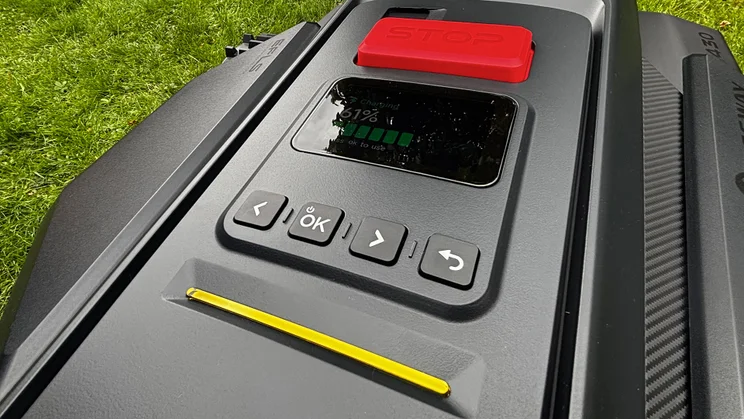
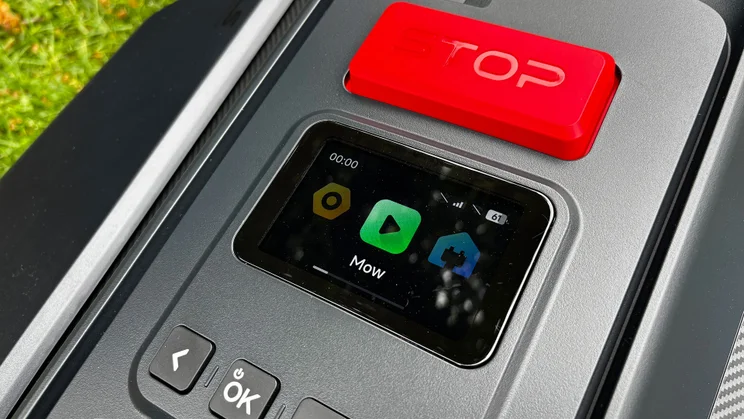
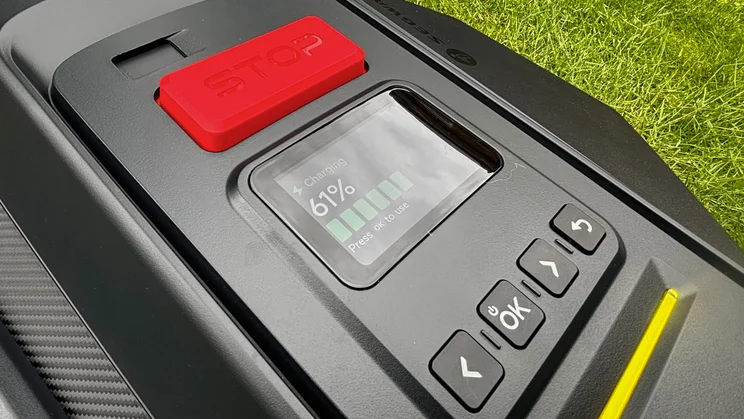
The Navimow X430 measures a very substantial 850 x 610 x 351mm, which is about twice as long as the EcoFlow Blade, and about twice as heavy. There’s a row of four buttons on the top accompanied by a clear and crisp colour display and a large red stop button.
It uses Navimow’s own Exact Fusion Locating System (EFLS), which is a hybrid of Network RTK (providing precision) and VSLAM (Visual Simultaneous Localisation and Mapping). It’ll use the former primarily, but will switch to the latter if it loses connectivity. The VSLAM cameras allow it to continue recognising its surroundings until a network connection is restored.
Cleverly, it can read local forecasts and you can vary the sensitivity to ensure it returns in drizzle, light rain or moderate rain; even so, its IP66 rating means it will shrug off heavy rain. It can also mow at night, although it won’t run as close to boundaries and will run at a slower speed.
The X430 has four-wheel drive, deep tread on the tyres and distributes its hefty weight perfectly. It has independent front suspension and an articulated solid rear axle. That might be a slightly archaic setup for a car, but here it endows the Navimow with enough traction to tackle 40-degree slopes, gravel paths, potholes and kerbs up to 7cm in height.
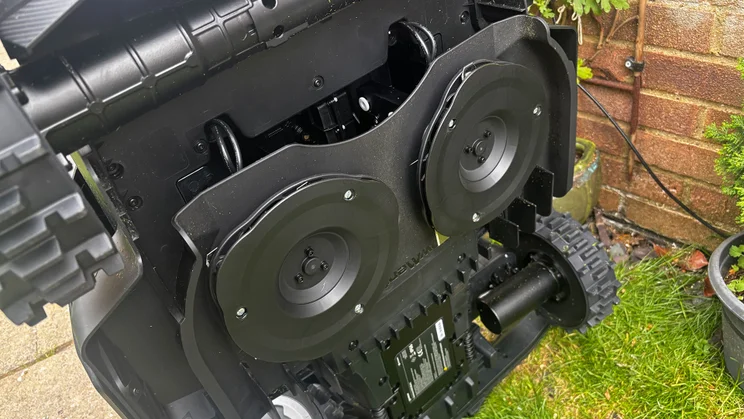
Underneath, you’ll find a pair of cutting discs with 12 small blades that cover a total of 43cm. That’s a great deal more than the EcoFlow Blade can cover on a single pass, but given you’re not pushing the mower up and down yourself, that’s less relevant than its precision with which it places itself on the lawn. The mower’s cutting height is adjustable from 20mm to 60mm in 10mm increments.
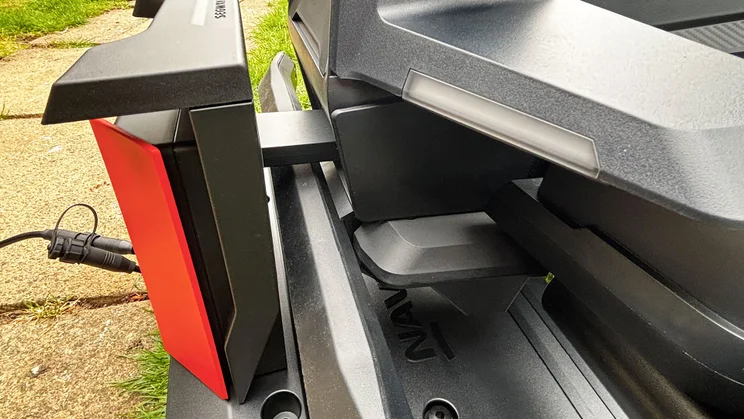
The Navimow will start and end its journeys on a large charging plate. It measures around 66x46cm and its power supply can be attached to walls, making it ideal if you park it in a robotic mower shed.
As attractive as a £2,500 mower is to the green-fingered, it’s also appealing to light-fingered types. To that end, it can be tracked using the Navimow app or via Apple’s Find My app, thanks to its on-board GNSS receiver.
Navimow X4 Series review: Is it difficult to set up?
Despite the amount of kit in the box, the Navimow X430 is surprisingly easy to set up. In fact, the hardest part is lifting the heavy and awkward mower out of the box.
The vertical charging unit needs to be attached to the base plate, and Navimow recommends securing it using the supplied ground anchors and pinning the cable out of the way using the supplied ground pegs. The charger plugs securely into the cable using a waterproof screw fitting. The unit can be left outside, but given the near £2,500 asking price, we’d recommend the optional shelter – although at that price, the £250 shelter ought to be included; it is with the much cheaper Eufy C15 robot mower.
The charger needs to be installed on flat ground with 2m of clear space in front of it, and 50cm each side. Ideally, this will be on hardstanding adjacent to (and level with) the lawn.
The next step involves setting up the X430’s Network RTK system, which if the Navimow’s built-in 4G modem has a strong enough signal, is very easy indeed. It requires this so it can talk to regional reference stations and gain a secondary, stationary GNSS signal for centimetre-level accuracy. It’s only slightly trickier if the mower doesn’t have sufficient connectivity, because it requires the antenna to be assembled and connected. This plugs into the base station and needs an unobstructed view of the sky.
This requires a clear view of the sky with no walls blocking its view of the mower in any direction. Navimow can supply a £50 extension kit to allow the antenna to be mounted high on a wall or outbuilding, and if you’re mowing a particularly large lawn, or both front and back gardens, a second antenna can be used.
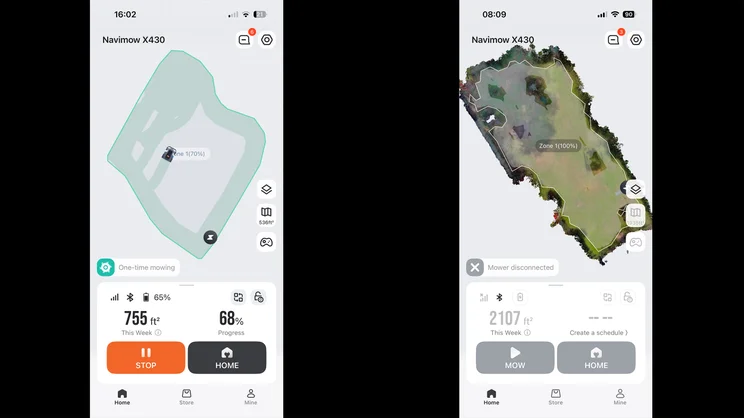
You’ll also need to install the Navimow app, which is slick and easy to use. Step one is to create a map. In the larger gardens the X430 is designed for, I found it easier to use its automatic mode which requires very little tweaking. You simply guide it to the first lawn using the app’s manual controls.
You can either let it scout around the perimeter of the garden, before returning to base, or pilot it to other lawns, hit the map button and it will map them all in one go. An Isolated Zone setting means it’s possible to set maps for lawns that aren’t accessible by paths, but of course that means carrying the heavy mower between them.
It works well for mapping large gardens, but for smaller areas, I found it easier to take control and use the manual mode; it seemed to get a little confused using auto mode in tighter spaces. It’s worth noting you’ll need to stay within six metres of the mower while manually controlling it, and it won’t deal particularly well with angles of less than 90 degrees.
Once mapping is finished, you can set boundaries, permanent and temporary no-go zones, and set areas where the cameras will deactivate. The manual suggests this is useful for mowing grass growing through stone paths; I found it useful for the mower not being fazed by blankets hanging on a washing line.
Its doodle mode is fun; you can draw a shape, such as a heart or a name, and the Navimow will leave that uncut.
And I particularly like that you can set zones within each map to vary the direction of mowing, and set individual schedules. That’s handy if you have patches of lawn that struggle more than others.
At 68dBA, it’s fairly loud for a robotic mower, but less so than its primary alternative: a ride-on mower.
How well does it mow the lawn?
For the price, you’d expect an impeccable cut on its first pass. On that basis, I’d regard it as very good, but not perfect. However, before you reject it out of hand, it’s worth mentioning that on a second pass, it hunted out the odd remaining long blade of grass leaving a very good cut.
And if you consider how robot mowers are actually used, I think that’s perfectly acceptable. That’s especially the case if you’re maxing out its 3,000m2 capabilities, where you simply won’t spot that errant blade from a distance.
Given the X430’s £2,500 price tag, I had expected perfection on that first pass, but I don’t actually think the odd missed blade here and there is a deal-breaker. Robot mowers are designed to cut little and often, and after a second pass the finish was excellent.
In my tests, the Navimow started by lapping the edge of the garden a couple of times, in a pattern of concentric circles. With bushes and barely-defined flowerbeds around the edge, this was a tough test, but it typically got within 5cm to 10cm of them, which I was happy with.
I set the cutting height using the buttons on the mower, although it can also be done via the app. Navimow suggests the X430 will attempt to mow in long straight lines, and I found that to be the case in more open areas of the lawn, although I did find it would miss bits and return to them later. That’s not a problem because the X430 won’t stripe the lawn, but it does feel like it lacks that last few percent of efficiency.
One corner of the lawn seemed to be treated as a standalone zone, presumably as it was bordered by beds on one side and contained a child’s wooden climbing frame and, about 8m away, a fully laden washing line.
Nevertheless, the quality of the mow was very, very good throughout, and the four-wheel drive system and impressive wheel articulation wasn’t fazed by tree roots and some bumpy areas. The grass was mostly dry, and I didn’t need to activate the traction control system, but I’m in little doubt it would perform well in most conditions.
Special mention must go to its wheels, which can vary their power independently, and the front wheels, which turn to 90 degrees, making the Navimow exceptionally manoeuvrable. Despite the very aggressive tread patterns, they didn’t cause any damage, even on the tightest of turns.
I do have some gripes, however. I found it unwilling to mow under a fully laden rotary washing line, until I selected the function to turn off the cameras; I assume it was treating the blankets as an obstacle. This underlined the importance of getting very familiar with the app first.
And while I was impressed with the way it would get close to the boundaries, I did find I was able to get a little closer by taking over control manually. Here, you use your left thumb to switch on or off the blades, and your right thumb controls direction. Two points on this, though: I think I could have got even closer by spending more time manually mapping the garden, and the fear of actually damaging plants with active mowing sharpens the mind.
Should you buy it the Navimow X4 Series?
Your options for a robotic mower that can cut such large expanses of grass are relatively limited, and none are cheap. Even so, at nearly £2,500 (£2,800 if you buy the shelter and secondary antenna), it’s mightily expensive.
But then again, it’s a mighty performer. If you have substantial grounds to cover, such as a meadow or a paddock, then the X430 could well be the setup-and-forget mower you’ve been looking for. Similarly, the traction and ability for it to deal with huge undulations make it ideal if you need to traverse woodland between mowing duties.
Certainly on the large lawns I mowed, it performed brilliantly, and with a maximum speed of 0.8m/sec, it’s no slouch, either.
The EcoFlow Blade is slightly cheaper, and has an optional grass collector, but for sheer rugged, go-anywhere ability, the Navimow X430 could be the big capacity robotic mower you’re looking for.