
To help us provide you with free impartial advice, we may earn a commission if you buy through links on our site. Learn more
- Good value for money
- Good for shaping hedges
- Effective hedge sweeper blade
- Too small for larger hedges
- Lacks outright oomph
- No trigger lock-out
The genius of Ryobi is that it offers a range of good value power tools which lower the barrier to entry into its battery ecosystem. Once you’re there, there are more than 300 tools to choose from. One such entry-level tool is the Ryobi RY18HT40B, a sub-£100 hedge trimmer that, on paper at least, should be ideal for trimming box hedges or keeping on top of fast-growing Leylandii.
Like the even cheaper Vonhaus 20V Max hedge trimmer, the £99 Ryobi comes with a battery and charger and no gimmicks. A differentiator could be Ryobi’s HedgeSweep, a removable guard that sits perpendicular to the blade, allowing you to push clippings along, into a neat pile.
The bargain Ryobi doesn’t have the outright punch of more expensive rivals, but does that matter to many buyers? And should it be on your shortlist of the best hedge trimmers on sale? Let’s find out.
What do you get for the money?
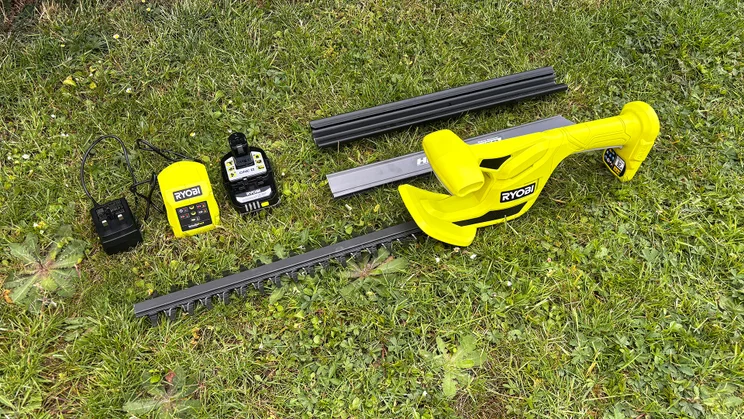
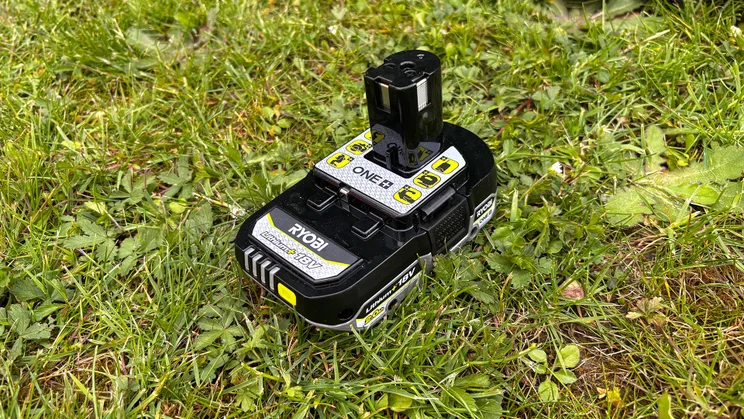
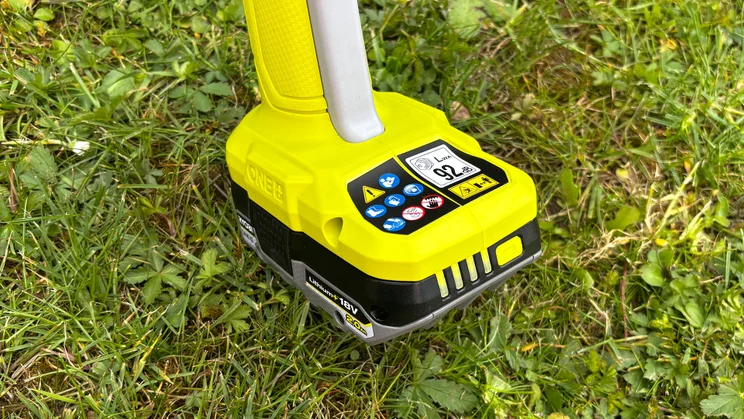
For just £99, the Ryobi RY18HT40B ONE+ Cordless 40cm Hedge Trimmer kit gives you all you need to get trimming: a RY18HT40B trimmer, 2.0Ah battery and a charger, plus that HedgeSweep and a blade guard. It’s available as a bare tool for £85, but for an extra £15, why wouldn’t you buy the starter kit?
There are manuals for the charger and for the trimmer itself. You probably won’t look at the former, and the latter is packed full of safety warnings, and some rather Ikea-like visual instructions which, truth be told, aren’t especially insightful.
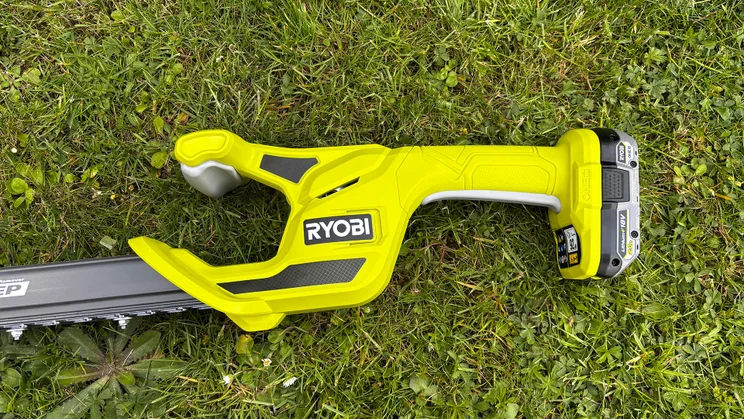
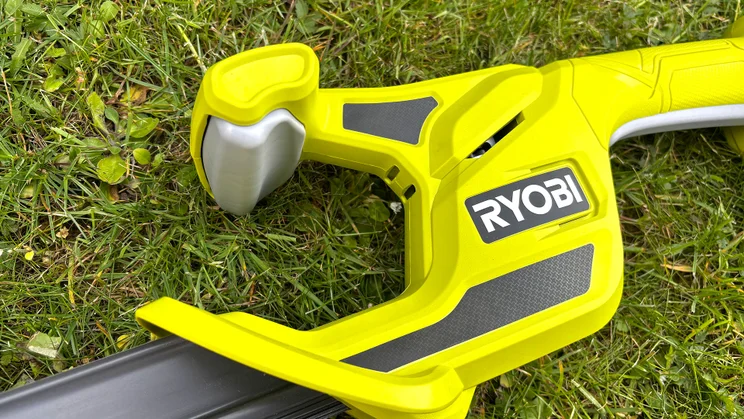
The Ryobi feels of decent quality, and the blade cover and HedgeSweep attachment feel well made. The pommel grip arrangement is easy to get hold of, and gives the unit a more streamlined look – indeed the blade guard is so discreet you’ll probably not even notice it – which should make it easier to store in your shed.
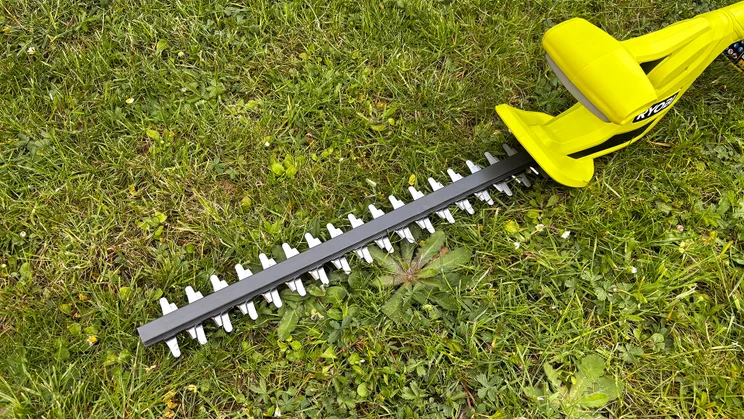
The 40cm blade isn’t the longest, so it’s best suited to lighter duties – something that its modest 1,300spm (strokes per minute) attests. Still, for a typical topiary, it should be sufficient. An 18mm cutting capacity is more than the Vonhaus 20V Max also on test this year, but you’ll need to spend a fair chunk more for something that’ll cut through thicker growth.
It’s worth noting that there’s no guard on the blade tip, so you’ll have to take care not to damage walls or fences as you trim.
What’s it like to use?
There’s zero assembly required, although you’ll need to slide the HedgeSweep attachment on, if you plan to use it. I was pleasantly surprised that even with it in place, I was able to slide on the blade cover, meaning they’re both less likely to be lost in an overflowing shed.
As is typical, there are two buttons to press, although it doesn’t matter in which order you do it in. One button is located under the pommel grip, the other on the rear handle. Both are neatly positioned, and are easy to hold regardless of the cutting angle. There’s no lock, though, and no battery safety position to avoid unintentional starting.
The rearmost handle means your knuckles could be close to the freshly-cut hedge, which isn’t ideal, but the 2.1kg trimmer is nicely balanced and not too nose-heavy. That makes it wieldy and less tiring to use.
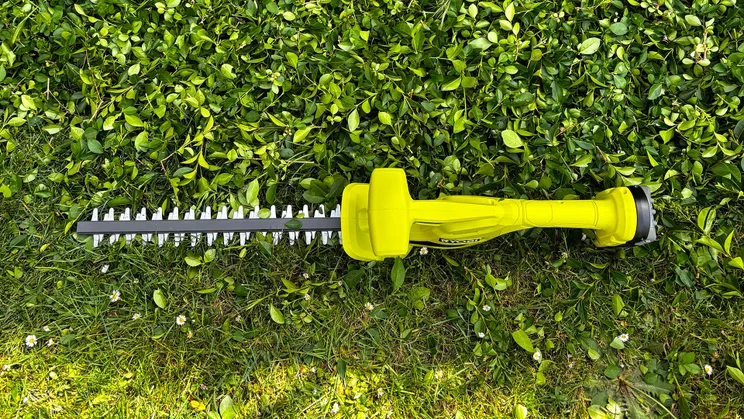
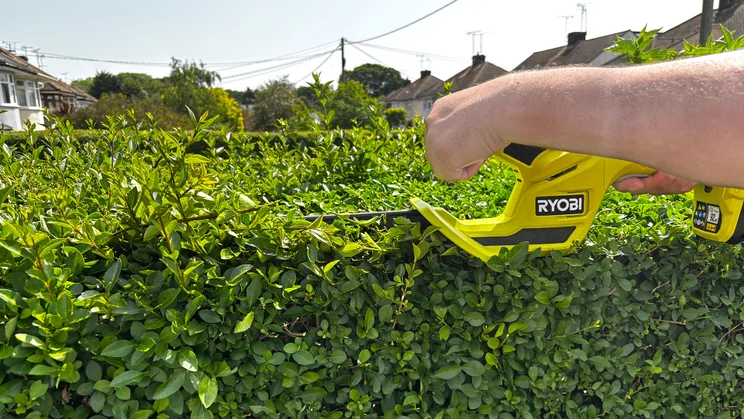
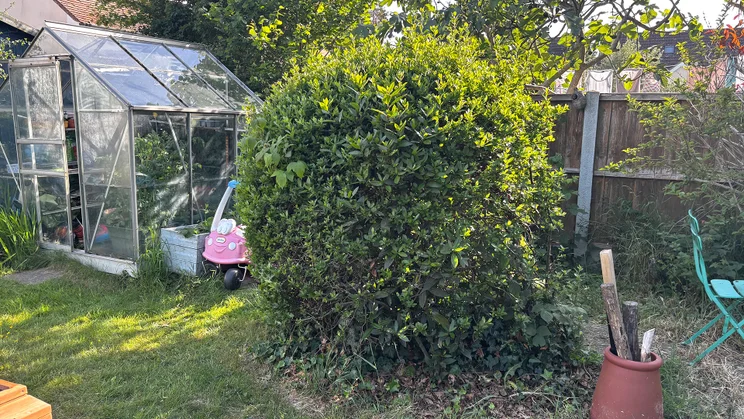
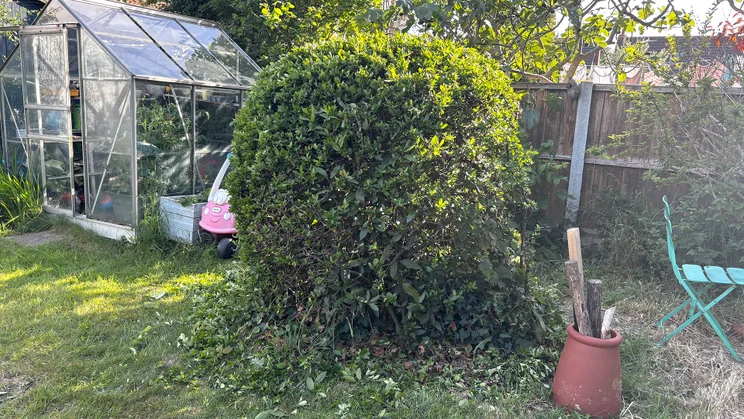
Unsurprisingly for a cordless hedge trimmer with an 18mm cutting capacity, it struggled to effectively trim a well-established laurel, but it’s far more at home on thinner box hedges. I found it particularly good at shaping, where its light weight and relatively short blade made it easy to delicately and precisely position the trimmer when working one common box into a ball. Here, the cut was clean, with minimal hacking, even clearing pesky trailing brambles.
In all honesty, I thought the HedgeSweep blade may have been a bit of a gimmick, but when trimming the flat top of another box hedge, it became mightily effective at brushing off the trimmings as I cut. It’s not perfect, because you have to remove it when trimming vertically, but for the purpose intended, it’s the kind of feature that leaves you wondering why more trimmers don’t use it.
How powerful is it?
The Ryobi’s size and specifications don’t promise huge power, but despite that modest 1,300spm figure, I was impressed with how cleanly it trimmed box hedges. For lightweight work like that, it’s ideal – but you’ll want to step up to something more gutsy for thicker jobs.
Before
After
It recorded 82dBA in our no-load noise test, and Ryobi provides an official 83.5dBA figure. I recorded vibration levels of 7m/s² which meant I was able to work for long enough without any tingling. Indeed at those levels, daily government exposure levels won’t be exceeded until more than four hours of use.
Is the battery life good?
Under Ryobi’s figures, the RY18HT40B will run for up to 30 minutes using the supplied 2.0Ah battery, although in our no-load runtime test, it lasted a reasonable 44 minutes. You can buy a replacement for £52, although higher capacity batteries of 2.5, 4.0, 5.0, 6.0, 8.0 and 12.0Ah are also available, costing between £66 and £190.
It takes an hour to charge from flat to full using the supplied charger, although if you need to cut the time taken, or have multiple Ryobi tools, faster chargers or those with up to six docks are also available.
Should you buy the Ryobi RY18HT40B hedge trimmer?
As I’ve found with other low-cost Ryobi kit, such as the Ryobi RY18LT23A strimmer, the RY18HT40B punches well above its weight. Yes, if you have thicker hedges – laurel, holly, chunky privet – you’ll want something a little bigger. But its size and weight make it good for shaping and trimming box or conifer hedges.
The supplied HedgeSweep attachment, and the fact that the kit tested here costs a bargain £99 makes it hard to overlook for light use.
How I test hedge trimmers
Every hedge trimmer I test battles the same varied set of shrubs in mine and my neighbours’ gardens over the course of around a month: laurel, box, privet, holly and hawthorne. I also run the same battery tests on every trimmer: my battery tests are no-load (that is, the trimmers are not actively cutting hedges), which guarantees the fairest possible proving ground and the best possible basis for comparison.
While I use the trimmers, I’ll be assessing ergonomics, ease of use and performance, and to paint a fuller picture I also measure vibration and noise levels when operational.


