
To help us provide you with free impartial advice, we may earn a commission if you buy through links on our site. Learn more
- Comfortable to use
- Very well priced
- Delivers a very clean cut
- Flimsy-feeling blade cover
- Long charge time
- Lock-out trigger could be unintentionally pressed
If there’s one brand that doesn’t have an image problem, it’s Stihl. With a great history in heavyweight professional tools, using one of its orange and grey tools will certainly provoke a conversation from a knowledgeable neighbour.
But does distilling that reputation in an affordable tool work? Step forward the Stihl HSA 50, which sits towards the top of its cordless hedge trimmer range aimed at the home gardener.
It’s not cheap, but its specs are perfectly suited to the keen gardener who needs something to keep on top of trimming, rather than someone who needs a tool to hack back.
So, does it fulfil these expectations, and should it be on your list if you’re looking for one of the best hedge trimmers? Yes, it does – and yes, it absolutely should.
What do you get for the money?
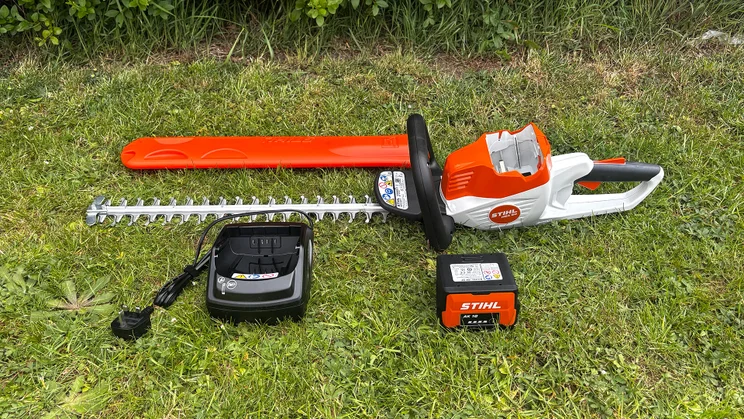
The Stihl HSA 50 costs £159 as a bare tool, or £259 with an AK 10 battery and charger as tested here. That’s a lot more than the likes of the Ryobi RY18HT40B but a lot less than the EGO HT5110E. It’s unsurprising, therefore, that its specs sit somewhere between the two.
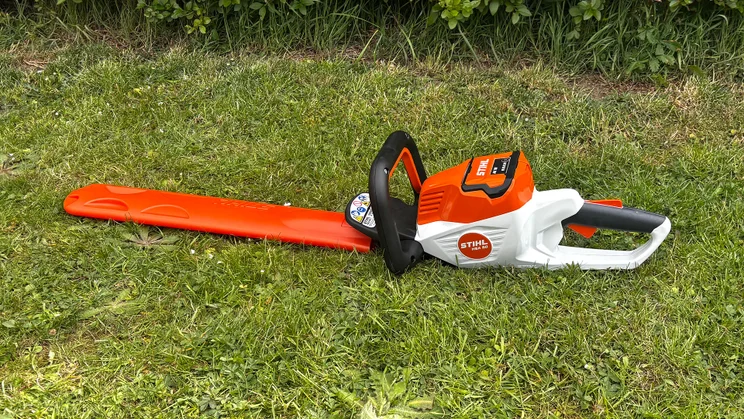
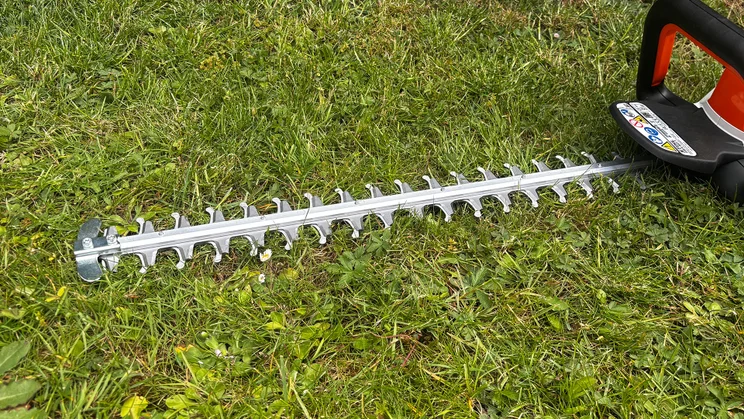
Measuring 101cm from tip to tail, it’s a large trimmer, although with a 50cm blade, quite a lot of that length is in the handle – a boon, as we shall see. It has a cutting capacity of 16mm, which is fairly typical, but its 2,800spm no-load speed is punchy, and pays real dividends.
The blade is designed to produce a clean cut and has a tip protector, which allows you to trim near walls or fences without causing any damage. When not in use, it’s protected by a scabbard which is bright orange, so you’re unlikely to lose it in a dark shed, although it doesn’t feel particularly high quality.
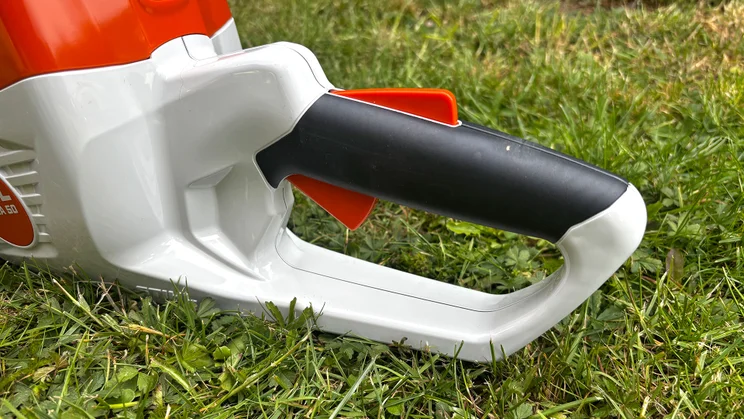
A hole in the back of the handle allows the entire trimmer to be hung on a shed wall, but apart from that, the entire base is smooth, meaning it shouldn’t get caught as you’re using it. It makes cleaning that bit easier, too.
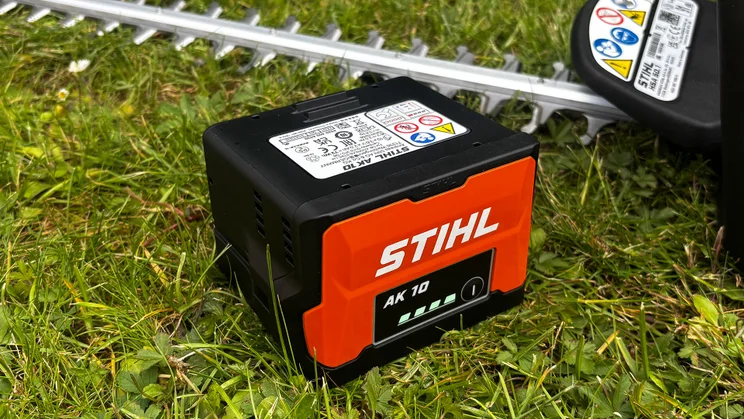
The kit, as tested here, includes a chunky AK 10 battery boasting 2.5Ah and 36v capability, although Stihl will also sell you batteries in 4.0 and 5.0Ah flavours if you need extra runtime. The standard charger doesn’t feel the last word in quality and will take 75 minutes to charge the 2.5Ah battery – about 15 minutes longer than many of its rivals.
What’s it like to use?
There’s a pleasing toughness to the Stihl, which is immediately apparent as you remove it from the box. The scabbard is the exception, because it feels like a child’s toy to the touch.
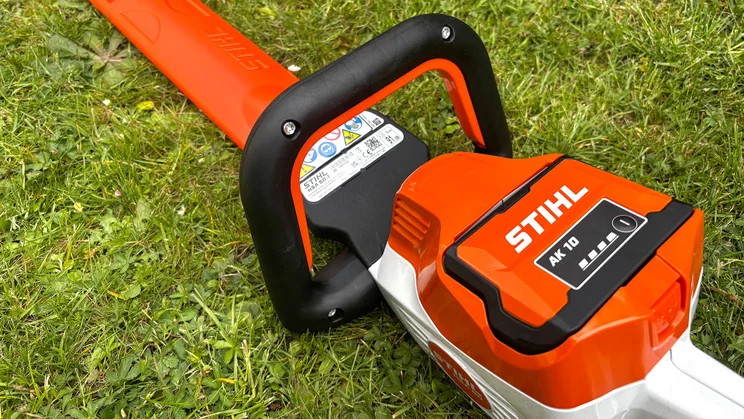
Nevertheless, the chunky AK 10 battery slots in with a reassuring click, and can be removed easily by pressing a button next to it. I like that there are four bright charge-state LEDs which illuminate by pressing a button.
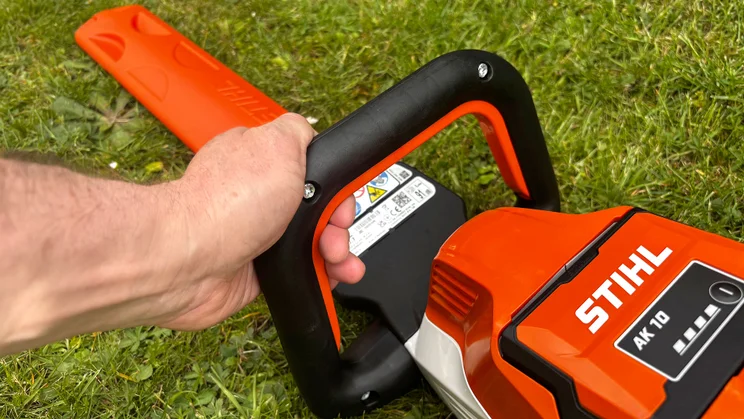
To operate, you press the unlock button with your hand and squeeze the trigger under the rubberised handle with your fingers. A forward trigger, which stretches around the front handle also needs to be pressed to start proceedings. My only slight concern is that the rear trigger and locking lever are almost too easy to press, meaning you could start it unintentionally, although the battery can be seated in a safety position.
The blade guard doesn’t sit as proudly as it does on some other hedge trimmers, but I didn’t find it an issue.
I like that the battery is more forward-mounted than some rivals. That improves the balance and I found that ultimately, it reduced fatigue when in use.
When it comes to the business of actually trimming, the Stihl is a joy to use. I found the positioning of the handles to be pretty much perfect, which makes it very easy to place and achieve precise cuts, whether that’s a flat surface or delicate curves.
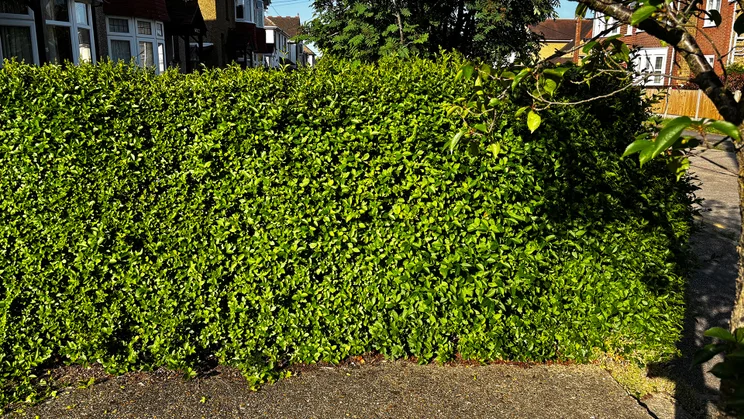
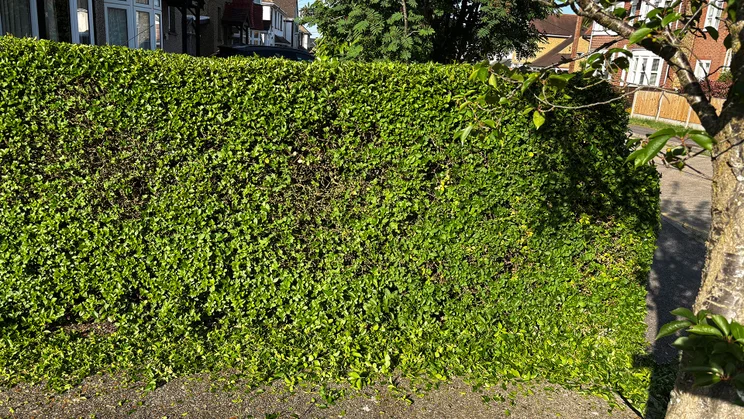
Box hedges presented zero issues whatsoever, and the cuts were exceptionally clean, although a longer blade would make it easier to reach across larger hedges without resorting to using a step or asking your neighbour to open their side gate.
How powerful is it?
Despite its relatively modest 16mm cutting capacity, I found it dealt with branches quite a bit thicker, slicing through laurel, tough holly and privet very well. Its 2,800spm no-load speed is plenty and diamond ground cutting blades make for a perfectly clean cut.
Before
After
I recorded an 82dBA no-load noise level, against Stihl’s official 81dBA figure, which is in line with other comparable hedge trimmers. Vibration levels of 15m/s² is slightly more than the Bosch AdvancedHedgeCut 36V-65-28, and would see government daily exposure levels exceeded in 52 minutes. However, through my hands, it felt like these levels were much lower. After 30 minutes of pretty much continuous use, I wasn’t feeling any ill effects.
Is the battery life good?
With the supplied charger, the 2.5Ah, 36v battery takes 75 minutes to fully charge. That’s a fair bit longer than most others, which typically take around an hour to do the same. Stihl quotes a 50 minute runtime, although in our no-load tests it took 56 minutes to expire meaning the Bosch AdvancedHedgeCut 36V-65-28 ran for longer. The 4.0Ah battery should run for 100 minutes, and the 5.0Ah for 130 minutes.
Should you buy the Stihl HSA 50 hedge trimmer?
Short answer: yes. While there are lighter, cheaper and more powerful hedge trimmers around, I’ve not used one that combines such a package of talents. When it comes to usability, ergonomics and cutting quality, the Stihl HSA 50 is extremely hard to beat.
How I test hedge trimmers
Every hedge trimmer I test battles the same varied set of shrubs in mine and my neighbours’ gardens over the course of around a month: laurel, box, privet, holly and hawthorne. I also run the same battery tests on every trimmer: my battery tests are no-load (that is, the trimmers are not actively cutting hedges), which guarantees the fairest possible proving ground and the best possible basis for comparison.
While I use the trimmers, I’ll be assessing ergonomics, ease of use and performance, and to paint a fuller picture I also measure vibration and noise levels when operational.


