To help us provide you with free impartial advice, we may earn a commission if you buy through links on our site. Learn more

- Sleeps cool throughout the night
- Firm and supportive
- Responsive memory foam layers
- Heat dissipation might be too good for colder sleepers
- Lightweight side sleepers may find it too firm
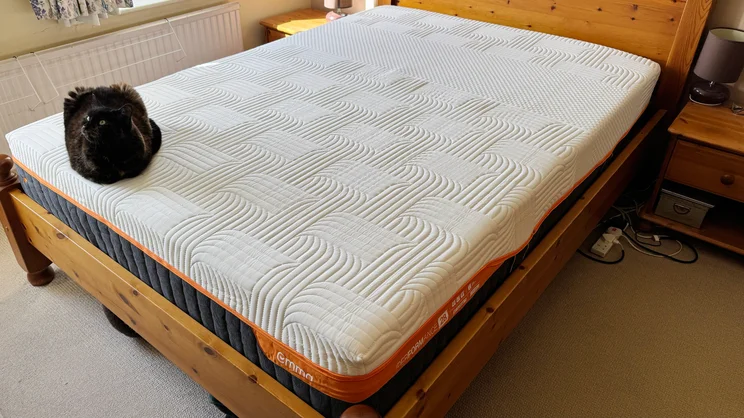
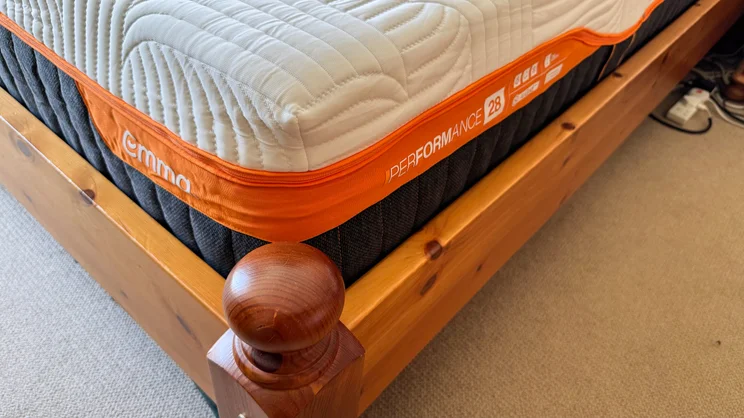
Emma’s latest “Performance” range consists of three hybrid mattresses of varying depths: 26cm, 28cm and 30cm. Reviewed here is the Performance 28 in the middle of the range, a mattress that Emma claims is designed to offer “enhanced cushioning and contouring”.
According to the bed-in-a-box brand, the Performance mattresses will also provide you with a cooler sleep with optimal airflow.
Having tested The Emma Performance 28 alongside my husband, someone who is prone to overheating at night, I can confidently say that it’s very effective when it comes to temperature regulation – perhaps even too effective for cooler sleepers.
What you need to know
Design
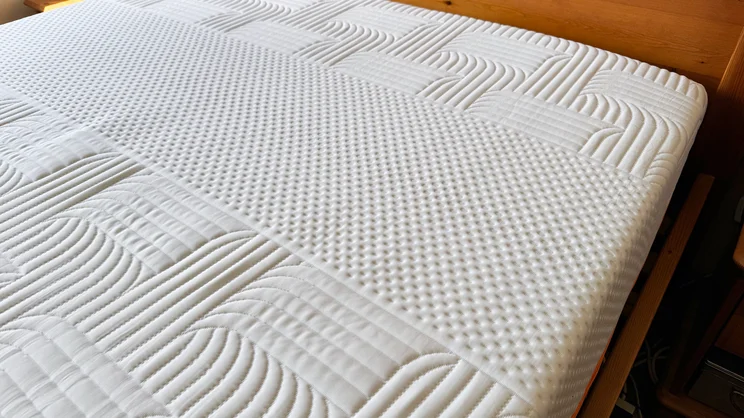
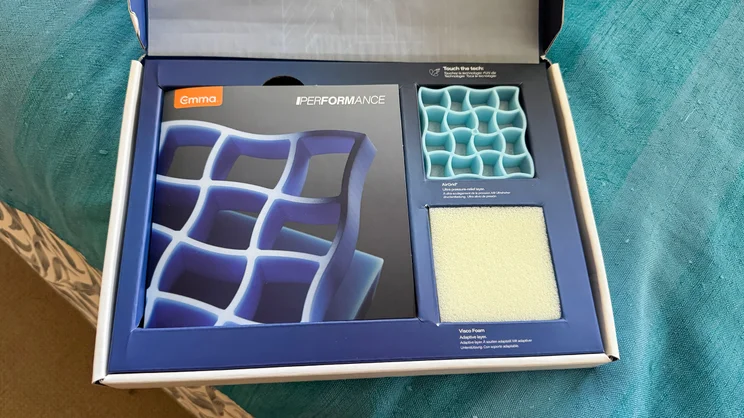
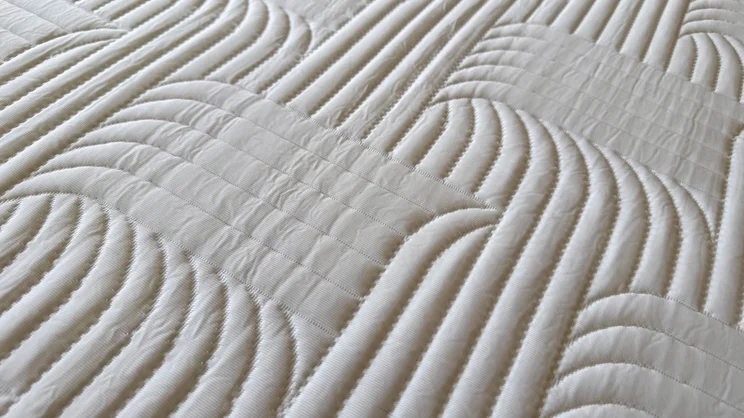
The Emma Performance 28 is, like many hybrid bed-in-a-box mattresses, made from a combination of springs and foam. At the top you’ll find a soft knitted cover, followed by a flexible ”AirGrid” layer that’s designed to move with the sleeper and spring back into shape, while also allowing air to move through its open spaces.
Underneath this are two foam layers: a “MemoryAdapt” layer for cushioning and contouring, followed by a base layer to ease strain on pressure points. This base also serves as a buffer against the zoned pocket springs beneath it, which – according to Emma – are designed to give responsive support and reduce motion transfer. The main difference between the three different Performance mattresses is the thickness of their foam layers; as their names suggest, these are thicker in the Performance 30 and thinner in the Performance 26.
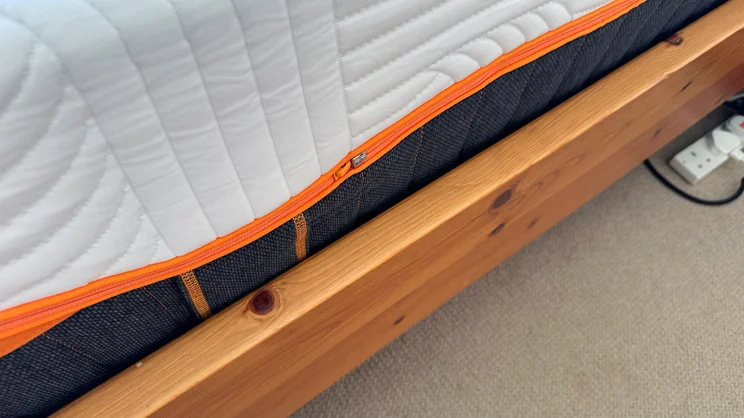
The bottom section of the mattress cover is designed to keep the mattress in place on your bed, while the top part can be removed and washed at up to 40°C. There are handles on the sides, which are designed for rotating the mattress but are not suitable for carrying it.
Price and competition
At full price, a double Performance 28 will set you back £859 for a single, £1,209 for a small double, £1,349 for a double, £1,499 for a king and £1,709 for a super king. You can also get an EU double for £1,429 or an EU queen for £1,569. By contract, the Performance 26 retails at £1,209 for a double, while the Performance 30 costs £1,709.
This is comparable to other premium mattresses, such as The Odd Company Blenheim 1500 at £1,545 (double), the Simba Hybrid Pro (£1,299) and the Origin LumbarCloud (£1,230).
That said, Emma is known to offer frequent discounts on its mattresses and bedding, particularly around peak deals periods such as Black Friday. At the time of writing, for instance, a double is £400 cheaper than its RRP at £949.
The Performance mattress comes with a 200-night trial period, with a money-back guarantee and free returns, as well as a 10-year guarantee.
Delivery
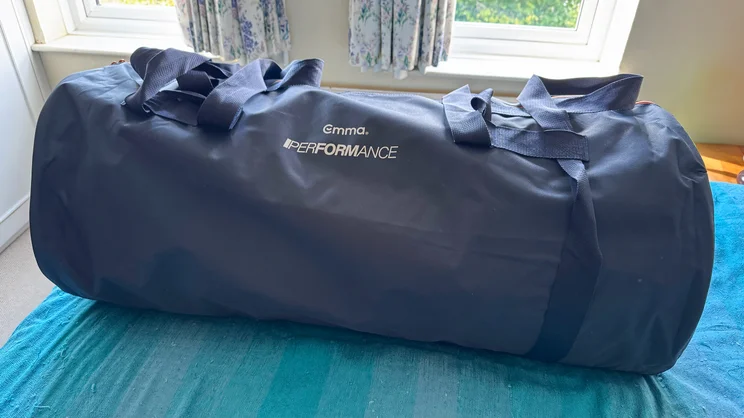
As with all of Emma’s bed-in-a-box mattresses, delivery of the Performance 28 is free. It’s rolled up and vacuum packed, delivered by UPS, Evri or DX in a rather stylish blue bag (unfortunately, you can’t specify a particular courier).
For an extra £59, you can upgrade to ‘room of your choice’ delivery, which also includes the collection of your old mattress. As the Performance 28 is quite heavy (a double weighs 40.3kg), this might be something to consider.
How I tested the Emma Performance mattress
The best way to get a feel for a mattress is obviously by sleeping on it, so that’s what I do – alongside my husband. We both evaluate the mattress for factors such as comfort and support, edge support, temperature regulation and motion isolation. I also determine value for money, by comparing the mattress’ price to those of its closest competitors.
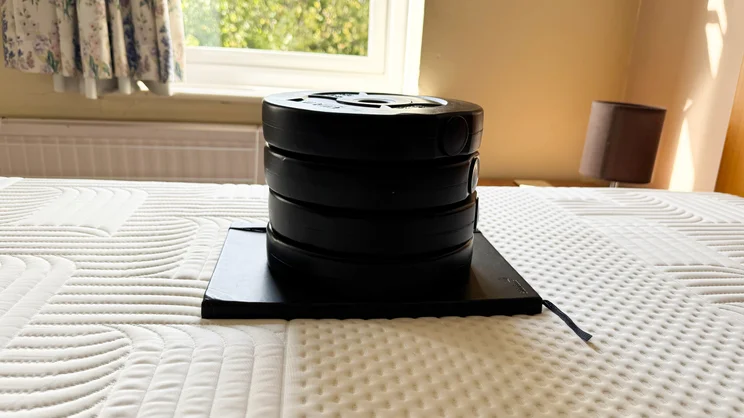
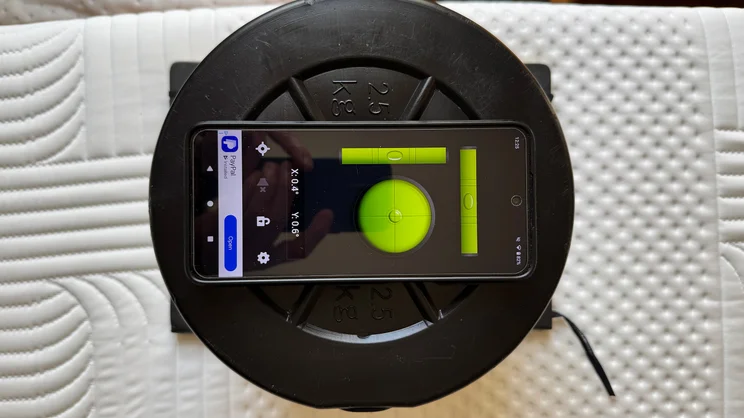
As anecdotal testing isn’t sufficient on its own, I also run standardised tests to obtain objective data that can be compared across all mattresses tested at Expert Reviews. I gradually place four 2.5kg weights on the bed, measuring the sinkage as I add more weight. I do this at shoulder height and at 3 inches from the edge of the bed to assess edge support. I also measure how much the total 10kg of weights causes the edge of the bed to tilt.
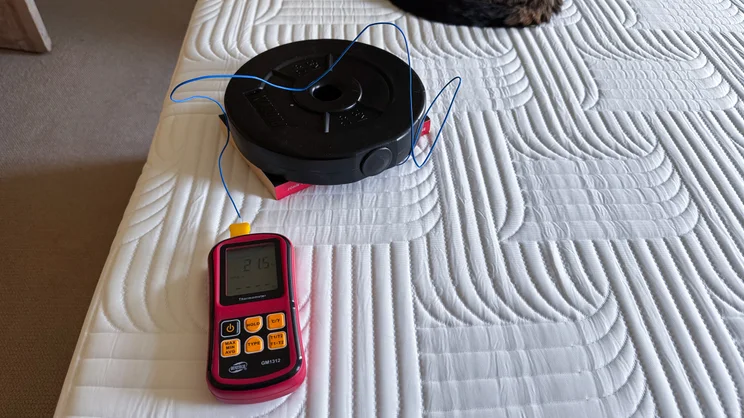
I carry out two tests with a digital thermometer – one for body heat and another using a heat pad – to see how much the mattress retains heat. For the former, I sit on the mattress with the thermocouple probe placed underneath me, until the thermometer reaches 30°C. After getting up, I then record the temperature decrease at one minute intervals for ten minutes. The heat pad test follows a similar process. After heating up the pad in boiling water, I place it on the surface of the mattress to heat it up. Once the temperature has stabilised and fallen to 50°C, I remove the heat pad and, again, record the temperature at one minute intervals for ten minutes.
Comfort and performance
Our standardised tests
I started by measuring how far the surface of the Emma Performance 28 mattress sank under weight. With 10kg of weights placed toward the centre of the mattress, at shoulder height, I measured a dip of 10mm. The same amount of weight at three inches from the edge of the mattress produced the exact same result, which suggests great edge support. It’s a little firmer than its stablemate, the Emma Original, which sank by 16mm (shoulder height) and 14mm (edge) and more in line with the REM-Fit 5000 Lux Elite Hybrid, which sank by 12mm at shoulder height.
The results of my temperature tests, conducted in an ambient temperature of 20°C, were also impressive. My body temperature test saw the surface temperature of the Performance 28 drop from 30°C to 21.4°C after three minutes, where it lingered for the remaining 10 minutes. In my heat pad test, I recorded a drop to 29.2°C (from 50°C) after three minutes, and to 22.1°C after 10 minutes. These results were on a par with the Dreams TheraPur ActiGel Glacier 3000 Combination and slightly better than the Emma Original Pro, two of our best cooling mattresses.
Is it comfortable?
You don’t get much of a sinking feeling with the Performance 28 mattress. While I noted a slight floating sensation from its upper foam layers, these are very responsive and quick to bounce back when you shift your body weight – great news for those who prefer a firmer, more supportive mattress.
Initially, I found the Performance 28 too firm for side sleeping. But over a few days, as the foams warmed and adjusted to my body, it gradually became much more comfortable. On the other hand, my husband, who weighs more than I do, found it immediately comfortable when sleeping on his side.
Despite its firmness, we both found it a little too soft around the lower lumbar region when sleeping on our backs. Not to the extent that it gave us back pain, but we both felt we would have liked a little more support here. As I’m quite particular about lumbar support, I asked a few friends to try lying on the Performance 28, and found that it was much more of a hit with them. Provided you aren’t after very firm support around the lumbar region, you should get on well with this mattress.
Temperature regulation
The Performance 28 was a big hit with my husband in this area. As someone who sleeps hot, he really appreciated the cover that stayed cool to the touch and felt that the mattress did a fantastic job of keeping him comfortable overnight.
I, on the other hand, am not a hot sleeper. I must admit that I found the mattress too cold, and I began to feel a bit of a chill after just 15 minutes. This problem was easily solved with a thicker duvet and a throw blanket. But if, like me, you’re someone who gets very cold, the Emma Performance 28 might not be the best choice for you.
Motion isolation and edge support
While it wasn’t very pronounced, I did notice a small amount of motion transfer, which I would only consider an issue for the most restless of sleepers.
Edge support, on the other hand, is excellent. I could easily spread out and use the full width of the bed, and it was comfortable to sit on as well. The only slight issue was that the mattress cover feels quite slippery, even with a mattress protector and fitted sheet on top. This is a very minor problem, but it’s noticeable when sitting on the edge of the bed.
Verdict
The Performance 28 is another excellent mattress from Emma, justifying the brand’s popularity. And if you’re a hot sleeper, you’re going to absolutely love spending time on it. Temperature regulation is excellent and all but the most lightweight of side sleepers should find it comfortable and supportive. The nice bounce makes it a great pick for combination sleepers as well.
If you’re of a more reptilian nature, you may find this mattress too cold – so impressive is its temperature regulation. But if you’re in the market for a mattress that will truly keep you cool at night, the Performance 28 is hard to beat.