To help us provide you with free impartial advice, we may earn a commission if you buy through links on our site. Learn more
- High 12,000mAh capacity
- 100W charging via USB-C
- Easy-to-see digital display
- Larger and heavier than similar capacity power banks
- Not so good for charging multiple devices
The best way to describe the UGreen Nexode PB724 is that it promises roughly what you’d expect from a compact mid-range power bank, plus a little more. Where others at this price point might give you a 10,000mAh capacity, UGreen ups it to 12,000mAh.
Instead of LED indicators, you get a digital display you can read without squinting. Even the charging speeds are better than average, with 100W available for devices that support it. It’s one of the few compact power banks that can recharge an iPad Pro or high-end Windows laptop at close to full speed.
What do you get for the money?
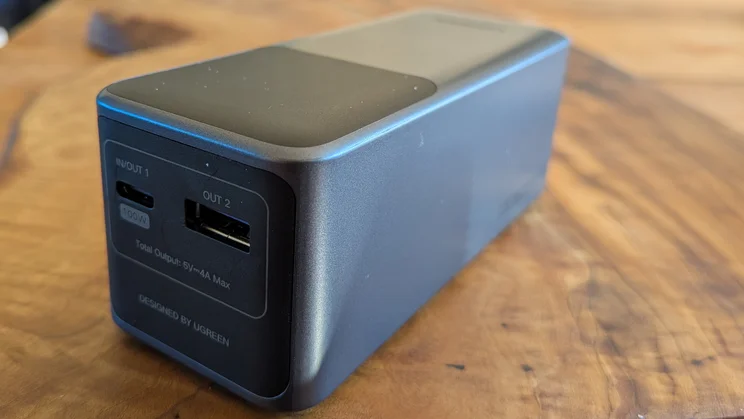
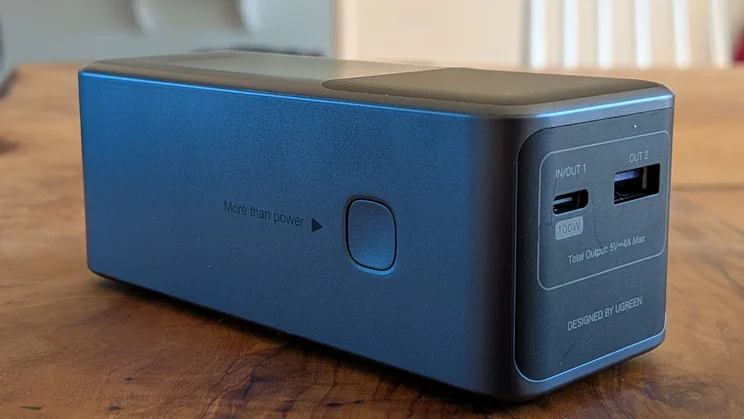
The UGreen Nexode PB724 is a smaller cousin of the larger, brick-shaped power banks we’re seeing aimed at laptop and handheld gaming PC users. As mentioned above, it has a generous 12,000mAh capacity and can output up to 100W through its single USB-C port. That same port lets you charge the power bank itself at speeds of up to 65W, while the lone USB-A port can output up to 22.5W.
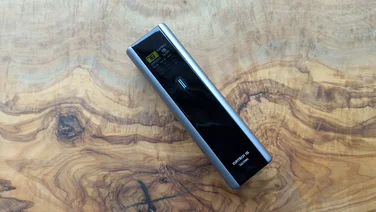
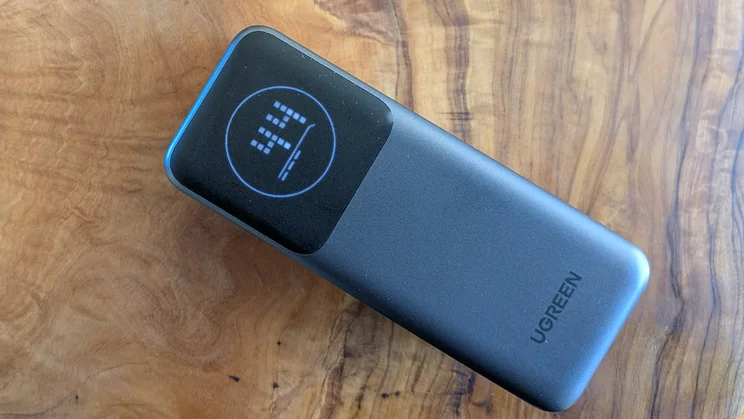
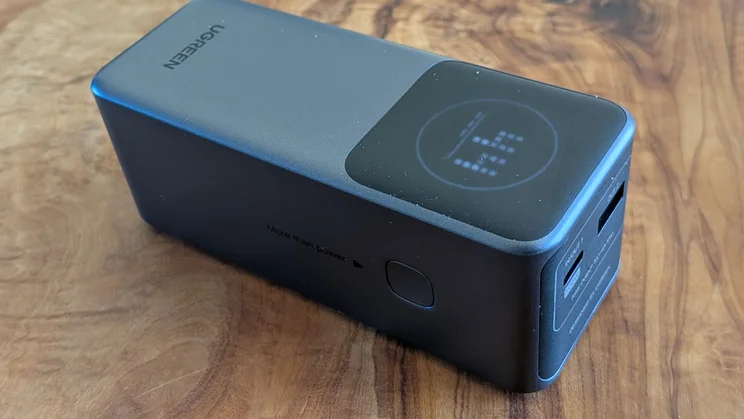
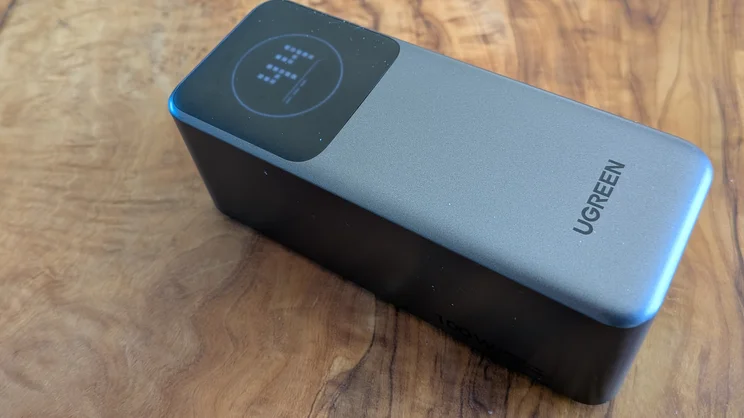
The design keeps things simple, with a seamless grey metallic plastic shell covering five sides, and a darker plastic base with two slim rubber feet. It feels sturdy enough and stays fairly cool to the touch while charging and recharging.
The black square section on the top covers an understated chunky pixel LCD digital display, which shows the current charge level and nothing more. Still, even that’s an improvement on the LED indicators used on most compact power banks, and the subdued glow won’t disturb you much in a darkened room, especially as it goes into standby after 60 seconds until you press the button on the side to wake it up.
What do we like about it?
This charger’s biggest selling point is its versatility. In tests, the USB-A port put out a fairly average 20.9W, but the USB-C port comfortably dished out 48.3W to my Android smartphone and 58.6W to my laptop, while hooking it up to a Cuktech 15 Ultra power bank saw it output 93.4W consistently for fifteen minutes.
Charging performance is also roughly on a par with many larger, more expensive chargers. It took my test smartphone from empty to 42% in 15 minutes, which actually puts it ahead of UGreen’s own Nexode PB771 power bank, though just behind the Iniu SnapGo Air and the Cuktech 10 Mini.
It’s reasonably quick to recharge, too. Hooked up to a 65 charger, it reached 20% in 15 minutes and 43% in half an hour.
What didn’t we like?
The downside of the Nexode PB724’s design is that it’s bulkier and heavier than your average 10,000mAh to 15,000mAh power bank. It’s 46mm wide, 115mm long and 45.5mm high, while it weighs 309g. The Cuktech 10 Mini is smaller and lighter, at 216g, while the Anker Zolo A1680 – itself no slimline model – comes in at 200g.
It’s also not the best power bank for charging power-hungry devices simultaneously. Trying to charge a smartphone via USB-A and a laptop via USB-C, I couldn’t get above 7.3W on the phone, while the USB-C output dropped from nearly 60W to around 15W, and even then not a stable 15W.
Should you buy the UGreen Nexode PB724?
Possibly. It’s great to have a power bank that can charge your smartphone at 50W to 100W speeds, depending on your device, and even better to have one that could top-up your laptop quickly if you’re in a fix.
That said, I think most people want something with a higher capacity for laptops, handheld gaming devices and other power-hungry devices, with another lighter power bank for travel or the daily commute. This one, unfortunately, falls between those two.