To help us provide you with free impartial advice, we may earn a commission if you buy through links on our site. Learn more
- Built-in QI2 wireless and MagSafe
- Good simultaneous charging speeds
- Practical design
- No rapid recharge
- Bulkier and heavier than a standard power bank
Think of UGreen’s Nexode PB771 as a portable mini-tower of power. This chunky power bank comes complete with 20,000mAh of charging capacity, a pair of USB-C ports and one USB-A for charging ; there’s even a QI2 wireless charging pad on the top.
What’s more, with a maximum 145W combined output, it can charge your laptop or handheld gaming console and your phone or tablet at the same time. Is this the ultimate power bank for long trips and weekends away from civilisation? I’ve been testing the new Nexode to find out.

What do you get for the money?
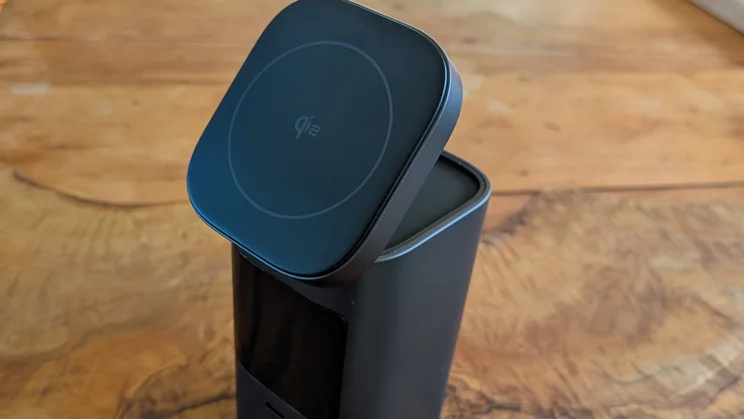
The Nexode PB771 is a chunky 555g power bank that’s stuffed with features and as well as charging all your various digital accessories, it can also double as a phone stand. Its wireless charging pad is MagSafe compatible and folds out to hold your iPhone near vertical.
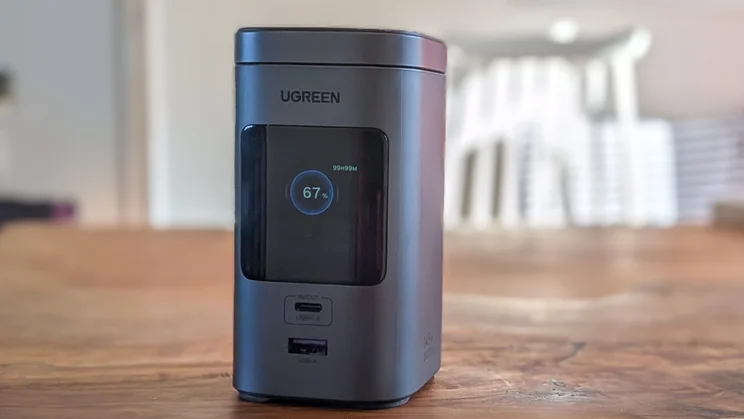
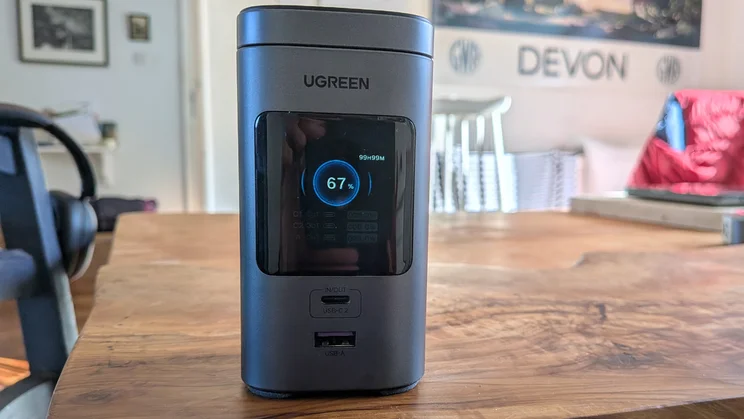
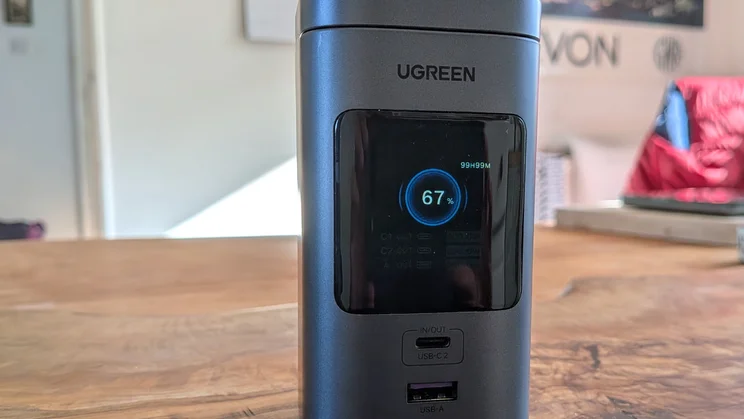
It’s a smart-looking thing and mostly constructed from a dark, metallic grey plastic, bar a glass panel in the middle that covers a 33mm-wide colour display.
This cycles through its different modes when you press the button on the rear. One mode gives you the current charge level, the predicted charging time remaining, plus the input/output status of the ports. The other provides more detailed information on the current charging activity.
The QI2 pad has the usual maximum 15W charging rate, while the USB-C output on the front gives you a maximum 45W, with a potential 22.5W from the USB-A port below it. The biggie, however, is the USB-C port at the back, which can supply 100W to compatible USB-PD devices.
In terms of inputs, the front USB-C port can take 45W while the rear can handle 65W. There’s no way to combine them for a faster recharge.
What did we like?
UGreen’s stated charging speeds aren’t too wide of the mark. While I don’t have a 100W MacBook Pro to test with, it charged my 65W laptop at 60.4W and a Cuktech 15 Ultra power bank at 98.5W, although this dropped to 88.5W as the 15 Ultra reached 80% charged.
Better still, it can handle two power-hungry devices simultaneously, delivering 98W to the power bank with 42W to a laptop or a phone. What’s more, I had it running at 69W and 42W over USB-C while simultaneously charging a smartphone through the wireless pad. It recharged my iPhone 13 Mini by 23% in 15 minutes, making it a little slower than the Iniu SnapGo Air, but not by much.
As a final note, the Nexode gets extra points for the cheerful robot face it displays on the screen while your devices are charging, alongside the current charge level.
What didn’t we like?
Not much. There’s no rapid recharge for the power bank itself, and the 65W charging input isn’t super speedy. In my tests, it got to 19% in 15 minutes and 36% in half an hour.
Otherwise, the main thing it has against it is its size and weight. At 68 x 60 x 112mm, it’s bulkier than conventional 20,000mAh power banks. At over half a kilogram, it’s noticeably heavier, too. For comparison, the 24,000mAh Juice Eco Max+ is more than 150g lighter.
Should you buy the Ugreen Nexode PB771?
If you can handle the extra weight in your backpack, cabin bag or briefcase, then the Nexode PB771 is a great power bank to buy. It’s not too expensive at its current and seemingly permanent discount price, and it’s more versatile than many more conventional power banks, giving you MagSafe-compatible wireless charging on top of fast USB-C and USB-A wired charging.
It has enough capacity to handle laptops, but enough convenience to charge your smartphone, too. Sure, it’s chunky and the price is hardly chimp change, but when it does so much so well it’s hard to grumble.