To help us provide you with free impartial advice, we may earn a commission if you buy through links on our site. Learn more
- Great battery life
- 48MP cameras all round
- Great pocketable size
- Ugly redesign
- Shorter telephoto zoom than 16 Pro
As a smartphone reviewer, particularly when it comes to iPhones, it’s good to have something different to talk about, and 2025 has been very good to me in this regard. Like all of Apple’s new models, the iPhone 17 Pro has received a dramatic overhaul, and this one is perhaps my favourite of the bunch.
Yes, the iPhone Air is a bit more exotic. It’s very thin, it looks different from your usual Apple fare. But Apple hasn’t had to make compromises with the 17 Pro. It has the full complement of ultrawide, wide and telephoto lens, it has stereo speakers – and battery life is up there with the very best phones on the market.
Last year and the year before, I’d have picked the Pro Max or the 16 Plus due to their superior battery life, but this time around, I reckon the 17 Pro is good enough – plus it’s a lot more pocketable than either.

What you need to know
As in previous generations, the Apple iPhone 17 Pro is Apple’s option for those wanting a premium phone in a more compact package, which is something not many other companies offer. As such, it sits just below the iPhone 17 Pro Max in the range, but above the iPhone Air and the iPhone 17. Apple hasn’t launched an iPhone 17 Plus this year or an iPhone 17e yet.
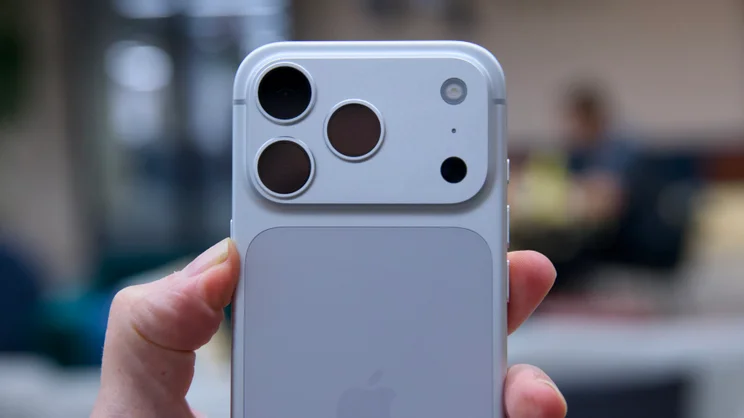
Essentially, it’s the same phone as the iPhone 17 Pro Max, just with a smaller 6.3in screen and battery. It has three cameras on the rear, setting it apart from the iPhone 17, which has two, and the iPhone Air, which has only one.
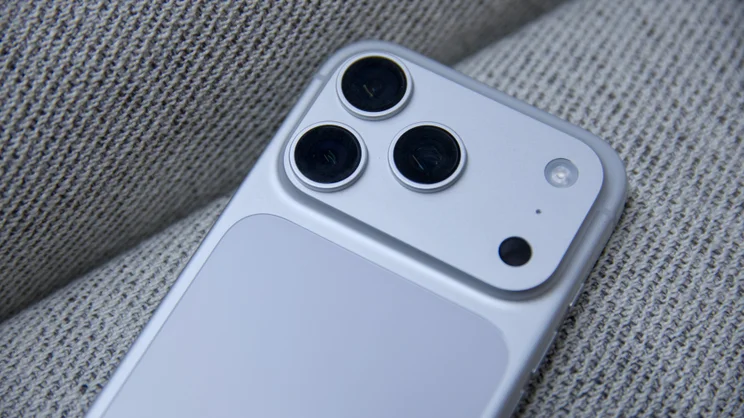
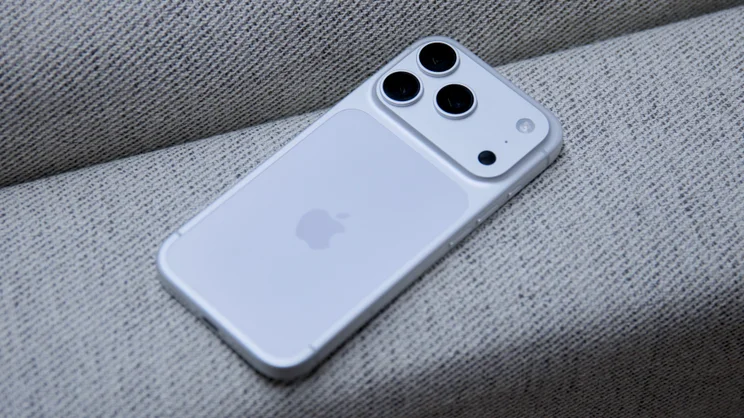
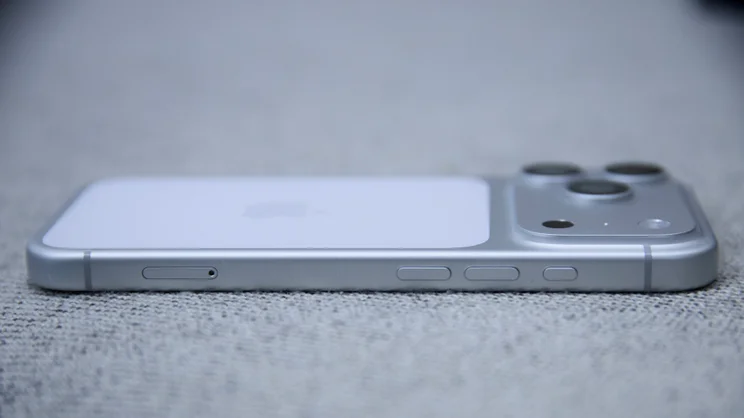
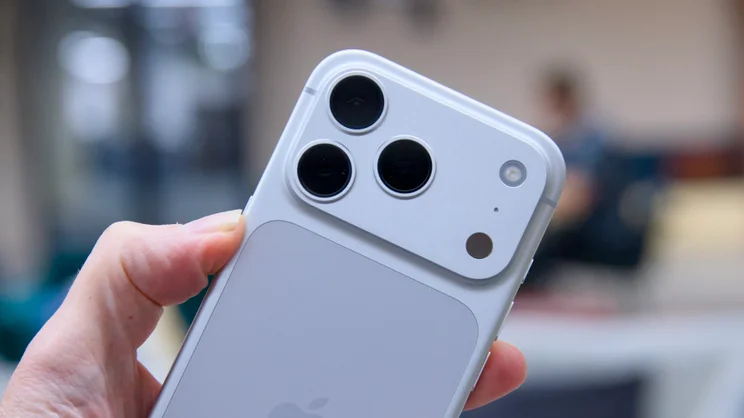
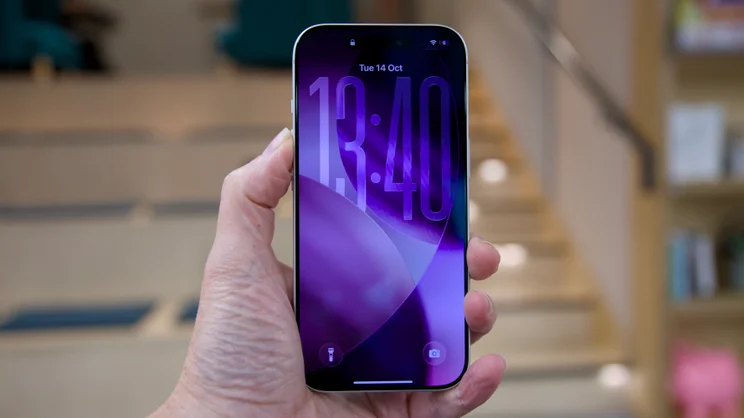
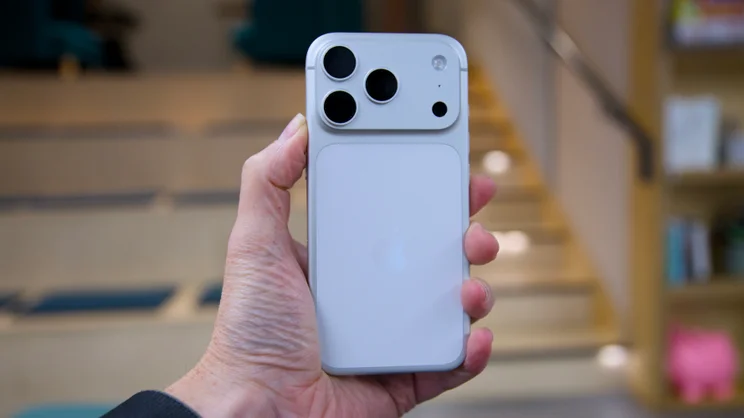
These are the features we have come to expect from an iPhone Pro in recent times, so what new temptations does Apple have for us this time around? The most obvious update is a much larger, full-width camera “plateau” and an aluminium body. It’s available in silver, Cosmic Orange and Deep Blue.
There’s a new, more scratch- and scuff-resistant Ceramic Shield 2 glass on the front of the phone, the screen itself has a higher peak brightness of up to 3,000cd/m2 and inside, there’s the new Apple A19 Pro, an increased 12GB of RAM and – for the first time in an iPhone – a vapor chamber cooling system.
As for the cameras, you still get one ultrawide, one main camera and one telephoto, but these are all now 48MP units; on the 16 Pro, only the main and the ultrawide cameras were 48MP. Apple has reduced the optical magnification of the telephoto lens from 5x to 4x, although that’s not a huge issue as I’ll discuss in more detail below. There’s also a new 18MP ”Centre Stage” selfie camera with a square sensor allowing for landscape shots without having to hold the phone horizontally.
Price and competition
The SIM-free price of the iPhone 17 Pro is £1,099, which gets you 256GB of storage. That price rises to £1,299 if you want 512GB and £1,499 for 1TB.
As for rivals, at least in the realm of flagship handsets, you’re looking mainly at the Samsung Galaxy S25, which comes with a slightly smaller 6.2in display, and a similar selection of cameras. Its telephoto camera has a shorter 3x reach and a lower 10MP resolution, but it’s much cheaper; it starts from £799 on Samsung.com and can often be found for even less on Amazon.
The Samsung Galaxy S25 Ultra is more comparable when it comes to features, with a 5x telephoto lens and super-long battery life, but it’s a much larger phone.
The Google Pixel 10 Pro is your next alternative. It has significantly worse battery life and is a lot less powerful, but its telephoto camera has an optical magnification of 5x and matches the iPhone 17 Pro for resolution. It’s £100 cheaper at Google.com.
For a decent budget option, meanwhile, we have the Xiaomi 15, which is nearly half the price of the iPhone 17 Pro at £599, comes with three rear 50MP cameras and a flagship processor, although the telephoto camera only has a 2.6x optical reach.
Design and new features
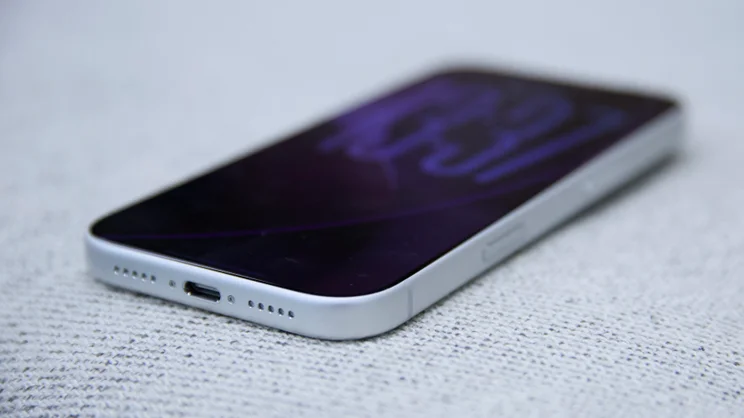
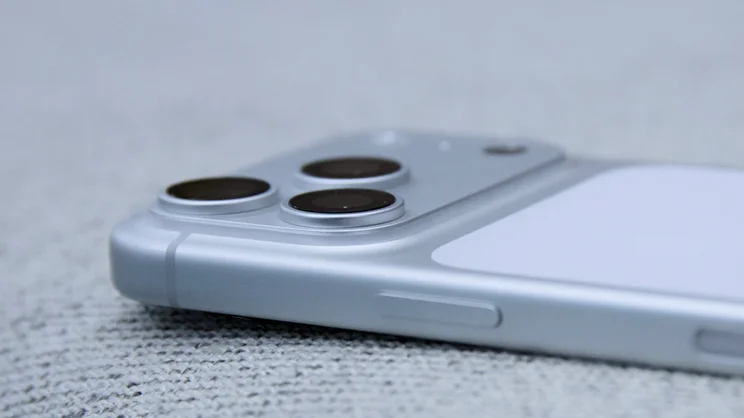
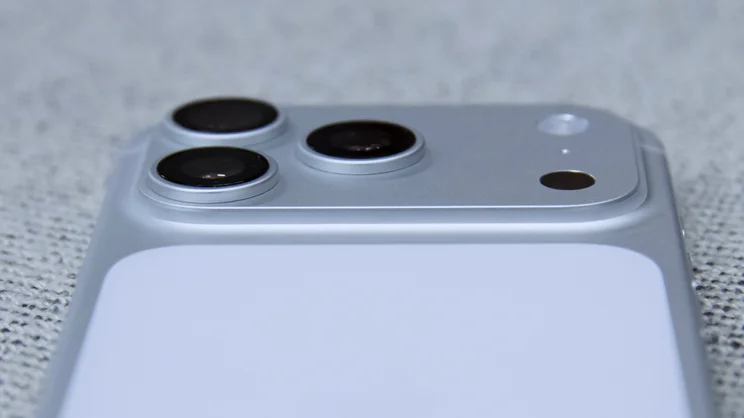
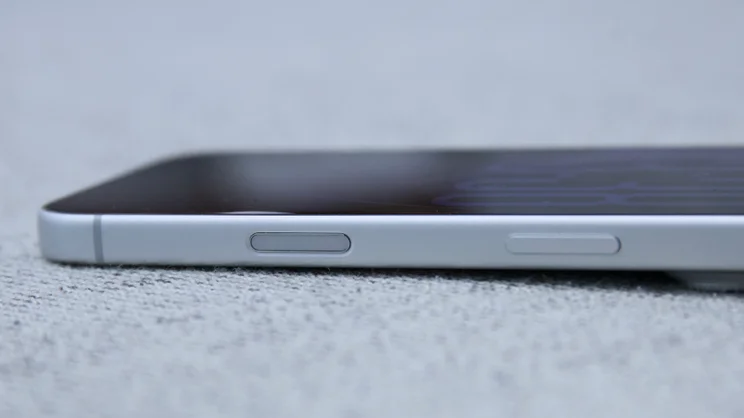
Two things dominate the redesign this year: the massive, full-width camera bump (or “plateau” as Apple calls it) at the rear, and the shift from titanium alloy to anodised aluminium this year. In the process, it has added the rather eye-catching Cosmic Orange and Deep Blue (perhaps as a distraction?) to the Pro’s formerly rather drab collection of colourways.
The camera bump is pretty ugly in my view, but for better or worse this is the direction the smartphone industry seems to be going these days. Google has its full-width camera bar and other manufacturers seem to be equally keen on these awkward protuberances. I’m willing to accept that some might be more forgiving of this, though, and some credit is certainly due Apple’s engineers for taking advantage of the extra space the bulge provides to house most of the phone’s interior components.
I also have some concerns about the move from titanium alloy to anodised aluminium, a material that can be scratch-prone. In this case, Apple is using a technique to produce a highly durable coloured coating that sits at level 9 on the Mohs scale of mineral hardness – that’s one level below diamonds and just as tough as the sapphire crystal glass used in the phone’s camera lenses.
However, while the main body of the phone seems tough enough, some users have been reporting the sharp corners surrounding the camera plateau aren’t so resistant to marks and are already showing the aluminium underneath the coloured finish. That Cosmic Orange paint job might look nice when you get it out of the box, then, but if you want your phone to retain its good looks in the long term you’re probably better off choosing the boring silver model.
Even if you don’t manage to scratch it and you actually like big camera bumps (who am I to judge?), I really don’t think you’ll find anyone who actually likes the look of the inset glass panel on the rear. The reason it’s there in the first place is so the phone can be charged wirelessly – the technology doesn’t work through aluminium – but it just looks out of place to me.
In fact, the only thing I like about the new design is the softer, rounder edges on the rear of the phone, which produces a more organic, less clinical feel than previous iPhones. Otherwise, it’s mostly a step back for me.
Perhaps the more significant change, though, at least in terms of using the phone day to day, comes courtesy of the move to iOS 26, although this is not exclusive to the iPhone 17 range. I have to say that I’ve so far been underwhelmed by the Liquid Glass redesign but I do appreciate some of the new features and tweaks.
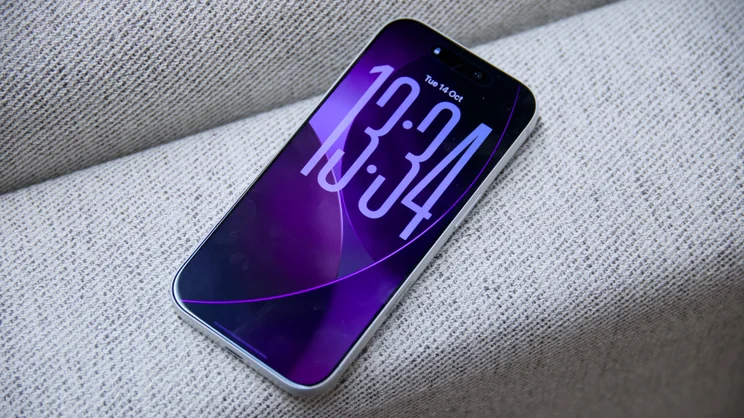
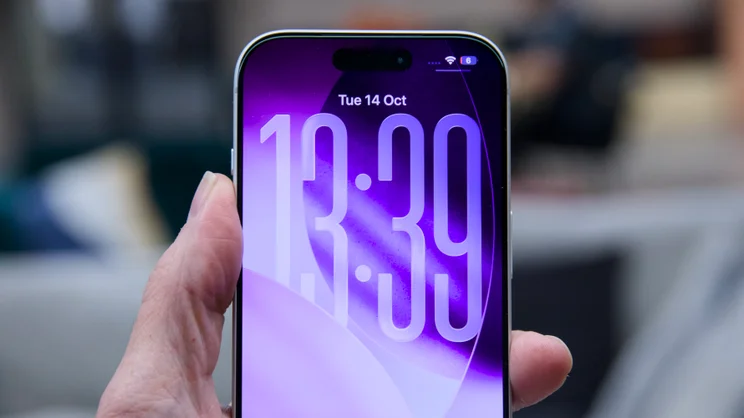
One change that’s been long overdue is moving the search box to the bottom of the screen across the UI, which saves a lot of unnecessary thumb movement. The addition of call screening and hold assist are two other features that I can see coming in hugely useful. And I also like the new lock screen options and spatial photos.
Display
While the physical design is a step backwards, the display is an improvement, albeit only for peak brightness. This now reaches an impressive quoted 3,000 nits while playing Dolby Vision HDR material and 2,000 nits in high brightness mode (HBM). For context, last year’s iPhone 16 Pro’s equivalent specifications were 2,000 nits and 1,600 nits, respectively.
Otherwise, it’s pretty much as you were. The OLED panel has a resolution 1,206 x 2,622 with a pixel density of around 460ppi. There’s again a variable refresh rate of 120Hz and Apple’s full-screen always-on display technology, which lets you see the time, notifications and even your favourite photos when the phone is in standby.
And it’s all protected by Corning’s new Ceramic Shield 2 glass for scratch protection. This is rated at a Mohs level 5 for hardness, so it’s not as tough as the sapphire crystal glass that protects the cameras, which tends to be around nine on this scale.
In testing, I measured the display at 2,944cd/m2 while playing back HDR material, at 1,070cd/m2 with a full white screen with auto brightness enabled and a bright torch shining on the light sensor, and colour accuracy versus sRGB was excellent, as always, with an average Delta E error of 1.87. It is, in other words, a highly capable display. I didn’t notice any issues with it in general use, either, but then last year’s iPhone 16 Pro was absolutely fine, too.
Cameras
Big changes abound for the iPhone 17 Pro on the camera front as well, but don’t believe anyone when they say this is the first time all the rear cameras have shared the same resolution. The three cameras on the rear of the iPhone 11 Pro, 12 Pro and 13 Pro shared the same resolution as well.
To be specific, this IS the first time an iPhone has had three 48MP cameras at the rear – those earlier phones had three 12MP cameras – and it does represent a welcome upgrade over the iPhone 16 Pro, which had 48MP main and ultrawide cameras, but only 12MP on the telephoto.
The main gotcha this year is that Apple has downgraded the optical zoom from 5x to 4x, but that’s not too much of a problem, as the extra resolution compensates for this. Compare the pairs of 8x images below and you’ll see that the iPhone 17 Pro images are more detail-packed and refined than the iPhone 16 Pro’s, despite the latter’s superior optical magnification.


Elsewhere, the differences are smaller and, to be perfectly honest, if you’re looking for the ultimate camera setup, you probably want to look elsewhere. Samsung’s Galaxy S25 Ultra has a higher 200MP pixel count and longer 5x optical zoom, plus an impressive 100x digital zoom, where the iPhone 17 Pro only goes up to 40x. The Google Pixel 10 Pro has a similar complement of 48MP cameras with 5x optical zoom and 100x digital zoom.
Still, the iPhone 17 Pro does deliver a highly capable camera system and the colours remain consistent from one lens to the next. I was particularly impressed with how well it coped with scenes with extremes of light and dark, such as the shot below from Piestewa Peak across the urban sprawl of Phoenix, Arizona. Despite the bright, hazy conditions, the shot is balanced, sharp and the exposure well-judged.


Close examination shows that the results from the main camera have a very slightly different look the iPhone 16 Pro’s, but I couldn’t say better to any significant degree. If anything, the colours are a tad richer in low light but these are tiny differences.
A couple of things to be aware of, though. First up, although you may want to use the telephoto lens for a close-up shot, be aware that the camera app will switch you to the main camera (without telling you) if you are closer than a metre or so from your subject. Annoying but not a disaster.
Meanwhile, video is still afflicted by reflections inside the lens barrels, so you need to be careful shooting scenes with point light sources such as city scenes, or they’ll be overrun with floaters. Again, it’s an irritation you can work around if you’re aware but Apple really should have fixed this by now.
Otherwise, the video capabilities of the iPhone 17 Pro are seriously impressive. You can record in 4K at up to 60fps, in Dolby Vision HDR fully stabilised, and you can do so in Apple ProRes format and/or LOG colour for colour grading at a later date. With the iPhone being used more and more commonly in professional grade workflows, this is a great option to have.

Meanwhile, at the front, let’s not forget the new Centre Stage camera. This has an 18MP square sensor, and it allows you to capture selfies in either portrait or landscape aspect without having to hold your phone in a precariously horizontal position.
It will also rather cleverly detect when there is more than one person in the shot, zooming and cropping automatically to squeeze everyone in. These are useful features, they work pretty well, and the quality of the images produced is pretty good, too – although obviously, they’re a lot less sharp than the images the main camera can capture, especially once you’ve cropped in.
Performance and battery life
As usual, the iPhone 17 Pro gets Apple’s top-level smartphone silicon, in this case, the Apple A19 Pro. You don’t have to buy the Pro to get Apple’s flagship processor in 2025 – the iPhone Air and 17 also benefit from the very latest silicon – but the two Pro phones do have a slightly beefier GPU, with six cores to the cheaper phones’ five.
That’s not the only difference when it comes to performance, however, because inside the iPhone 17 Pro and Pro Max is a feature never seen before on an iPhone: a vapour chamber cooling system, intended to help the phone perform at its maximum level for longer, without throttling or overheating.
Now, the benchmarks we use don’t really push the processor to its limits for enough time to show this up, so to see if made much of a difference versus the iPhone 16 Pro, which doesn’t have a vapour chamber, I ran the 3DMark Steel Nomad Light stress test, and compared results.
This isn’t strictly an apples-to-apples comparison (sorry), as the iPhone 16 Pro has a less powerful processor overall, but it’s interesting to see the differences between the two phones’ behaviour. Ultimately, after the 20-minute stress test, the difference between the iPhone 17 Pro’s highest and lowest performance levels was larger than on the 16 Pro. However, performance fell more gently, gradually falling over time, whereas the iPhone 16 Pro’s performance fell sharply after only one minute or so and stayed low for the rest of the test. That’s a win for the iPhone 17 Pro, just about.
The iPhone 17 Pro’s results in the battery life tests, however, are what impressed me the most. Where last year’s 16 Pro lasted 28hrs 56mins in our video playback test, with the display set to 170cd/m2, auto brightness disabled and flight mode engaged, the iPhone 17 Pro extended that out to 31hrs 31mins – or about the same as the iPhone 16 Pro Max. And if you’re lucky enough to live in an area where you’re able to purchase the eSIM only model, you get a slightly bigger battery and (presumably) even better performance.
Verdict
The question is, should you buy this phone – the iPhone 17 Pro – or opt for the 17 Pro Max, the 17 or the Air? For me, the iPhone 17 Pro is the phone to buy of this current crop of iPhones, despite the ugly redesign.
It’s nice and compact, it’s quick and the new 4x telephoto camera is an impressive performer. The battery life is as good as it was on the iPhone 16 Pro Max and you get one more camera than the iPhone 17. Ignore the Cosmic Orange and Deep Blue models (if you can), grab the silver one for long-term good looks and you’re onto a winner.
The question as to whether this beats the Android world’s best phones is a more tricky thing to answer. But if you’re after a flagship phone in a more compact package, there isn’t much to compare to the iPhone 17 Pro.