To help us provide you with free impartial advice, we may earn a commission if you buy through links on our site. Learn more
- Compact design
- Useful, seamless app
- Nearly silent operation
- Slow filtration
- Filter is fiddly to change
- Light emits an annoying ringing sound
Falling asleep and staying asleep has never been my strong point. Nor have I ever enjoyed waking up in the morning. The harsh buzz of my phone alarm makes for a nightmarish awakening, and the arrival of allergy season every spring means I’m often battling a runny nose through the night.
Enter the Blueair Mini Restful, an air purifier that can clear pollen and other pollutants with a built-in dimmable light that doubles as a sunrise alarm clock. This unconventional combination sounded like the answer to my prayers.
But it’s double the cost of Blueair’s Blue Pure 511 compact purifier, and there’s stiff competition in the sunrise alarm clock market. I was intrigued to see if the two-in-one device could give me the peaceful night’s sleep of my dreams, or if I’d be better off buying two separate appliances.
Blueair Mini Restful: What do you get for the money?
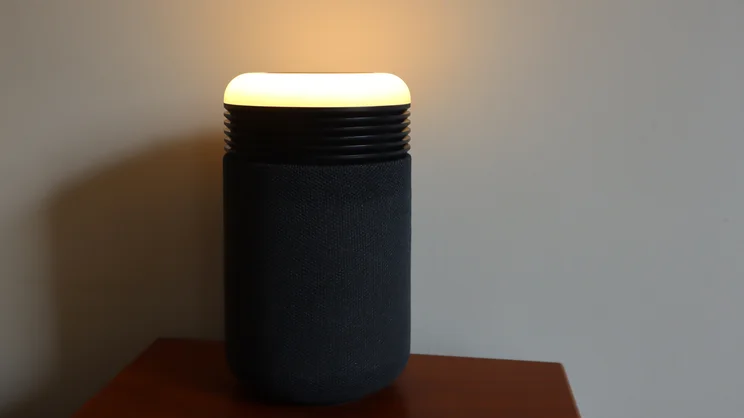
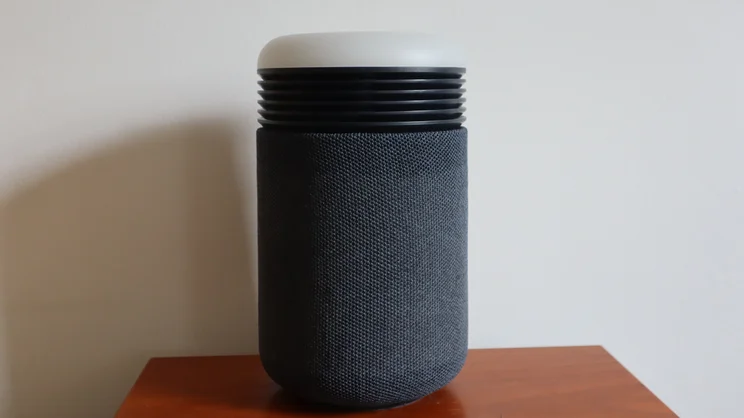
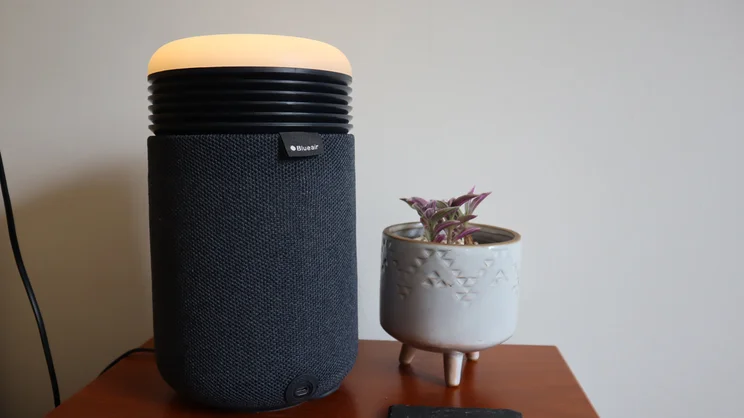
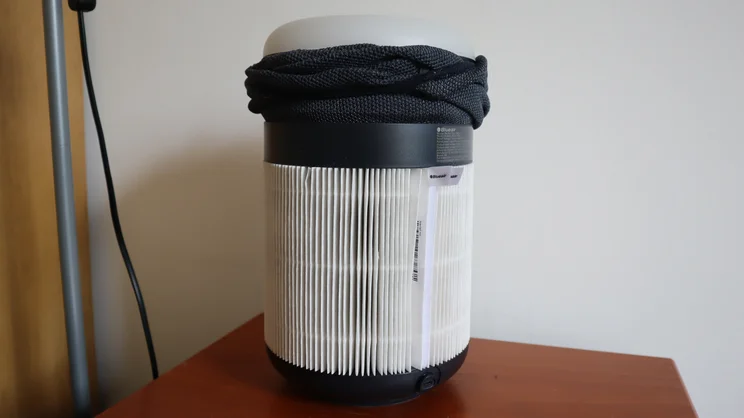
The Blueair Mini Restful costs £160 and is the smallest of the brand’s air purifiers. It weighs just over a kilo, is 30cm tall and measures 17cm in diameter, meaning it can fit comfortably on most bedside tables. Unlike some of its competition, its design isn’t ugly. Its Scandinavian look is unobtrusive and feels homely, and there are two colour options available: midnight blue (which I tested) and a coastal beige.
The Mini Restful has a CADR (clean air delivery rate) of up to 158 m³/h and can clean spaces up to 31m2 in 30 minutes. It filters air using a fabric layer and a HEPA filter, which Blueair claims removes 99.97% of pollutants, including pollen, dust, smoke and pet dander. There are four speed options, including a night mode, which is Quiet Mark Certified, to give undisturbed sleep. The faster options are, of course, louder.
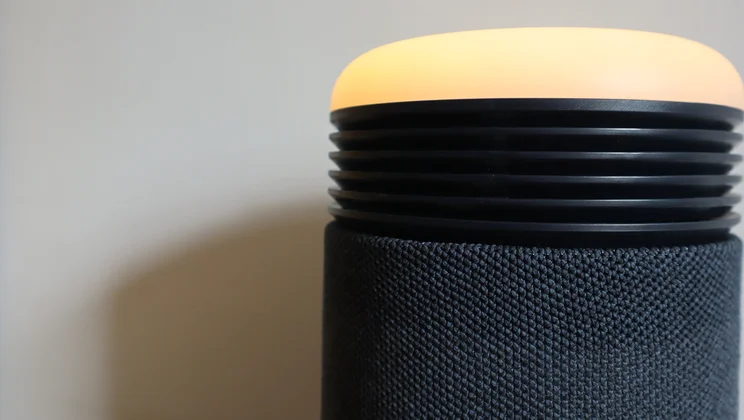
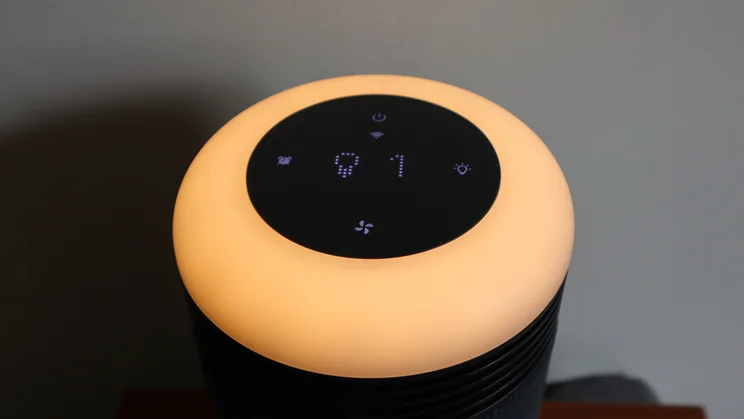
As a sunrise alarm clock, it features a built-in light. This primarily mimics a sunrise, but can also be used as a bedside lamp, which means you could swap it with your existing lamp to avoid losing out on bedside table space. It also has a USB-C port to charge your devices.
You can set the ‘sunrise’ to last anywhere between 15 and 30 minutes, during which the light’s brightness increases gradually. There are also eleven alarm sounds to choose from in the app, from gentle birdsong to smooth jazz.
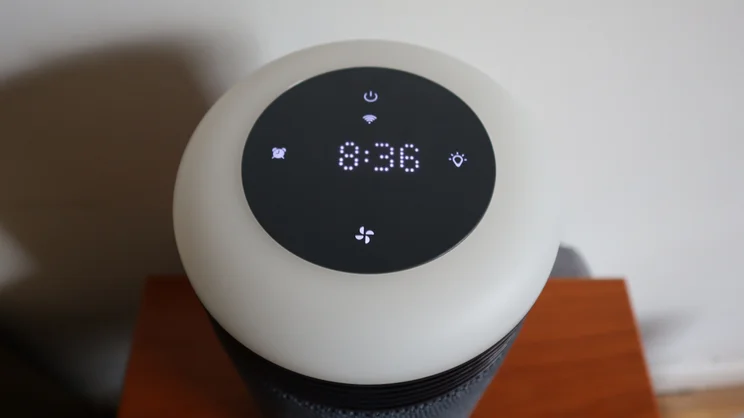
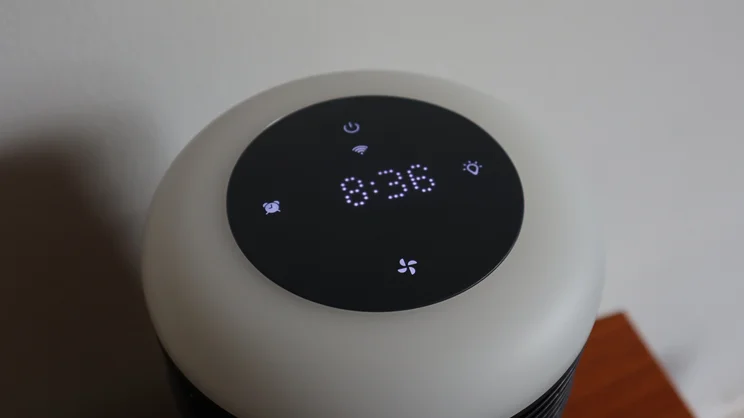
The Mini Restful has a small control panel on top, with a power button, child lock, fan speed controls and a button to switch on or dim the lights. There’s also an indicator that shows if your alarm is set for the morning.
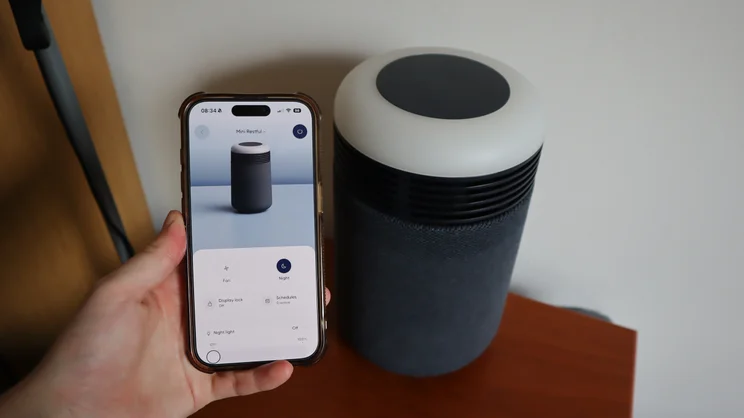
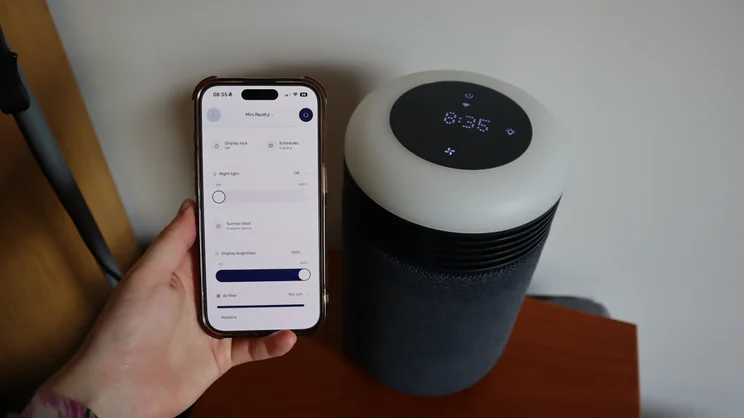
You can’t set the alarm on the purifier itself, although you can shut it up in the morning using the power button. Instead, alarms must be set up and controlled via the Blueair app, where you can also monitor the filter’s lifespan and set schedules.
How I tested the Blueair Mini Restful
When testing the performance of air purifiers, we use an air quality monitor and an awful lot of aerosol deodorant. After spraying the deodorant for five seconds, I timed how long it took for the air purifier to bring PM2.5 levels down to 25mg/m3. I also used a sound meter smartphone app to measure noise levels, in A-weighted decibels (dBA), for the air purifier’s various modes – including its night mode. Finally, I used a passthrough energy meter to measure energy consumption.
Since the Mini Restful is also a sunrise alarm clock, I made sure it remained a permanent fixture on my bedside table while I was reviewing it. I made note of how effective the light was in waking me up in the morning, how gentle it was, and how good the sounds were.
How easy is it to set up?
I always dread downloading apps for my home devices but was pleasantly surprised by how easy it was to get the Blueair Mini Restful up and running. The app talked me through each step and the whole process took around 10 minutes. It all works through your Wi-Fi network, and I was glad to see that the device connected without trouble, even in my bedroom where connection is infuriatingly patchy.
The app itself is easy to navigate, and allows you to set alarm times, schedules and light controls. Any time I made a change on the app, the device sprang into action reassuringly quickly.
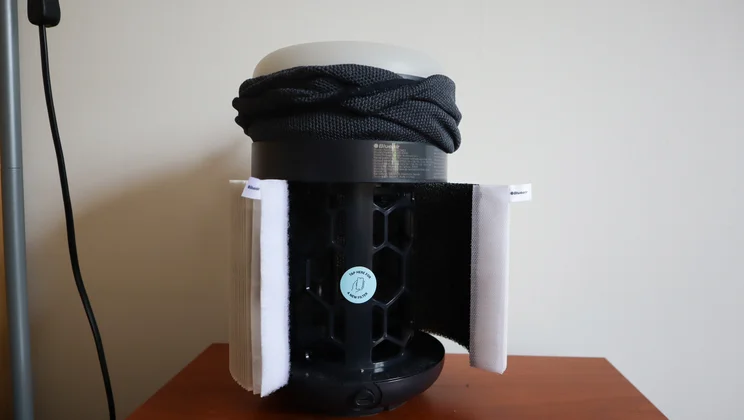
Unfortunately, while the fabric cover looks chic, it makes changing the filter quite fiddly. First, you need to remove the cover skin-a-rabbit style, and then open the HEPA filter, which is held together by remarkably strong Velcro. Inside, there’s an NFC tag that takes you straight to the Blueair website to buy a replacement filter. That’s handy, but if you aren’t dexterous with your hands, you’ll probably find this quite a tedious process to undertake every nine months.
What’s the air purifier performance like?
In my tests, the Mini Restful purified the air effectively. However, this wasn’t the fastest process. On its highest setting, the Mini Restful took 535 seconds to bring PM2.5 levels down to a healthier 25mg/m3. For such a small purifier, I wouldn’t expect the fastest results, but this took over twice as long as BlueAir’s next smallest purifier, the Blue Pure 511.
Admittedly, a big selling point of this purifier is its quiet sleep mode, and it’s unlikely to have to combat such high quantities of aerosol spray overnight as it did in our tests. As it stands, leaving the purifier constantly on low works well to purify the air during daily use. Anecdotally, I noticed it helped alleviate my hay fever symptoms and helped me to get a better night’s sleep as a result. Just don’t expect fast performance.
It’s also remarkably energy efficient, running at just 1.6w in night mode, and up to 12.5w on the highest fan and light settings. That makes it one of the most energy efficient air purifiers we’ve tested.
What about its sunrise alarm function?
As a sunrise alarm clock, the Mini Restful was great, and the dimmable light provided a calmer wakeup than my standard alarm, with no flickering or random jumps in brightness. You can set the timer anywhere between the two extremes, but I found the 30-minute wakeup far gentler than the 15-minute one, which felt a little rushed. I also much preferred the birdsong to the musical alarm sounds, but that’s down to personal preference.
How loud is it?
This depends. Most impressively, the purifier was near-enough inaudible when set to night mode. When I measured this, it increased the ambient sound levels in my flat by just 1dBA. The fastest fan setting is significantly louder (I measured this at 59dBA), but I found little use for that setting once the air in my flat was clean.
What was more annoying was the sound emitted by the Mini Restful’s light. This constantly emitted a high-pitched sound, which got louder as the bulb brightened. When it came to the sunrise function, this was frustrating but naturally quite short-lived. However, it was far worse when using the light as a bedside lamp for longer periods. The ambience was great but, for a few days, my fiancé and I truly believed we were suffering from tinnitus until we discovered the culprit.
And, to nitpick, the speakers are pretty poor too. Of course, this is designed to get you up in the morning, not to play high-fidelity sound, but those who despise tinny sound and like to wake up to a tune might want to avoid this.
Is there anything else that could be improved?
For the price, the alarm clock features mean you compromise a little on extras you might ordinarily expect in an air purifier. For example, the purifier doesn’t include a built-in air quality sensor, meaning it lacks an automatic mode to sense changes in air quality and alter the settings.
I would also have appreciated more tactile or textured buttons on the display. Instead these are touch sensitive and completely flat, which means they’re hard to find in the morning when you’re floundering around trying to turn off an alarm.
Should I buy the Blueair Mini Restful?
I had high hopes for the Blueair Mini Restful, and while it performed its basic functions well, I didn’t quite get the peaceful fairytale mornings I’d envisioned. That’s mainly thanks to the light’s irritating ringing sound, but the slow purification also dulls its sparkle. It certainly didn’t have as much finesse at each of its tasks as a standalone device would.
I’m still reluctant to evict it from my bedside. I appreciated the gentler mornings and definitely found the purified air alleviated my hayfever symptoms during sleep. As someone who lives in a teeny London flat, getting both benefits in one device was perfect for me. And while the controls need to be improved, and its ringing needs sorting, it still beats being greeted with the harsh glare of my phone screen every morning.