To help us provide you with free impartial advice, we may earn a commission if you buy through links on our site. Learn more
- Powerful airflow
- Nice accessories
- Solid battery life
- Loud
- Divisive design
- Expensive
Following the launch of its compact air purifier back in September 2025, Dyson has added a new device under the “HushJet” name. The Mini Cool handheld fan has had a well-timed release, and the review sample I received arrived just before the UK was hit with a 30°C-plus heatwave.
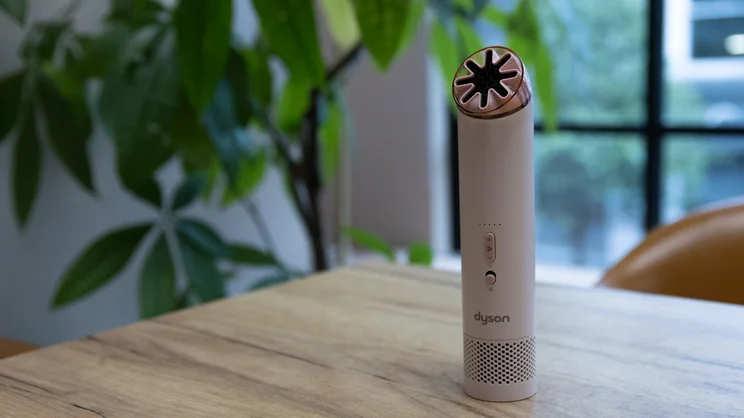
It’s an interesting-looking device (some might say a little suggestive, but more on that later), with a design that’s bound to be divisive, but to its credit it delivers powerful air speeds. Its main flaw, however, is how noisy it is: something that has put me off using it more often. Read on to find out how it fared in my tests.
Dyson HushJet Mini Cool fan: What you need to know
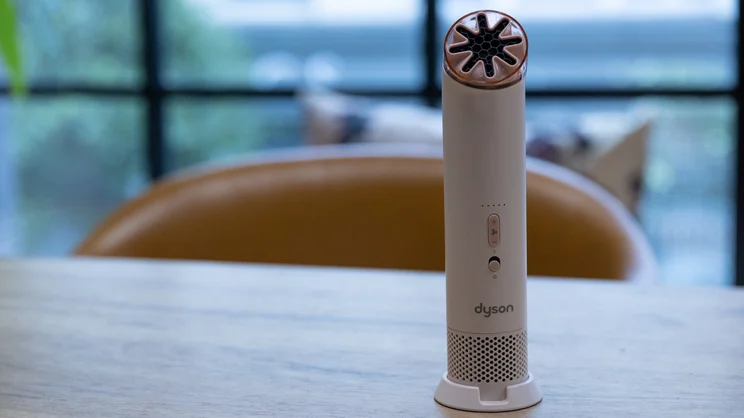
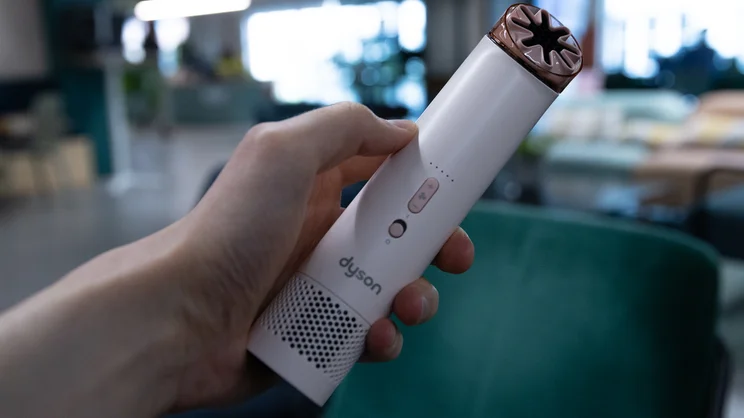
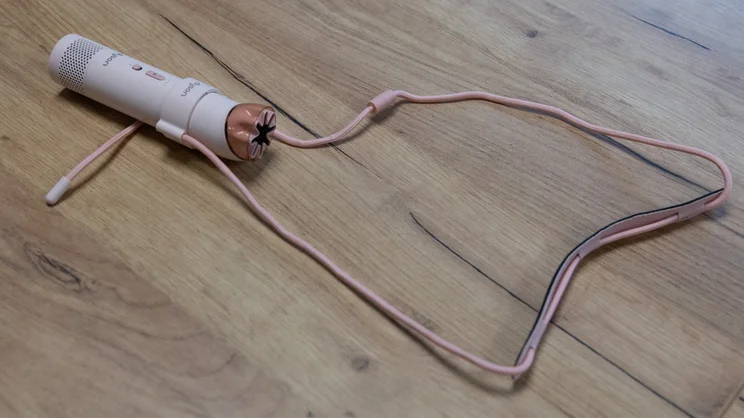
Compared to the modular Shark ChillPill I reviewed recently, the Mini Cool is pretty basic. It does one thing – blow air – and it can do so at five different speeds, with a fan head that can be rotated to direct airflow outwards or upwards. You use the former when the Mini Cool is on your desk, and the latter when wearing it around your neck with the included lanyard.
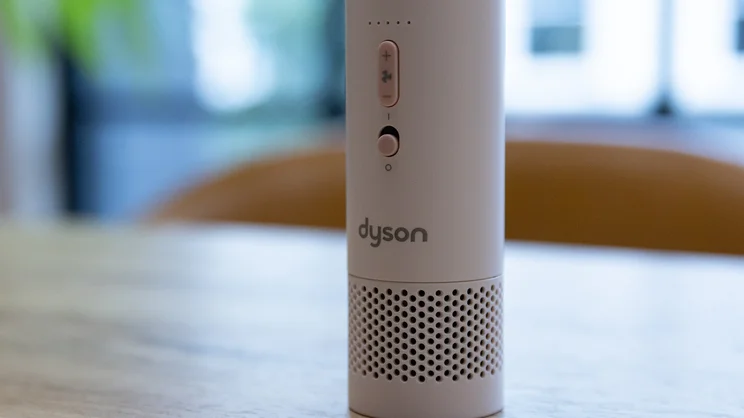
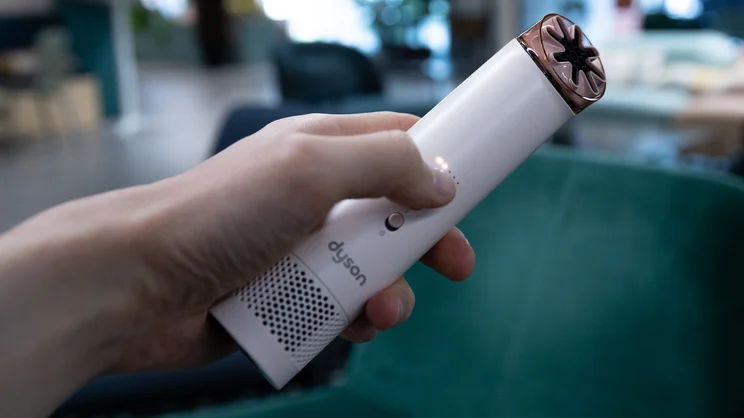
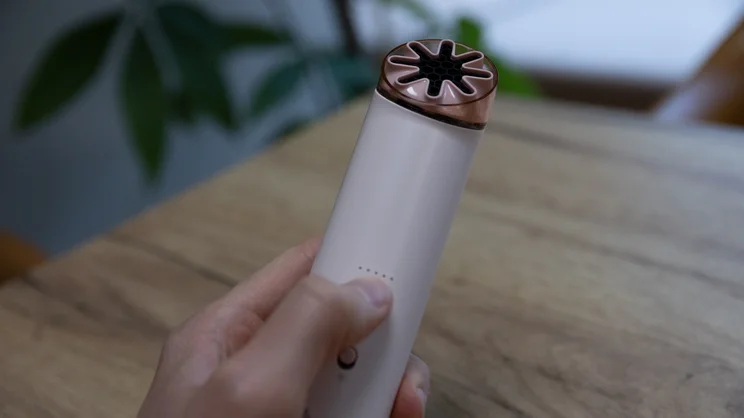
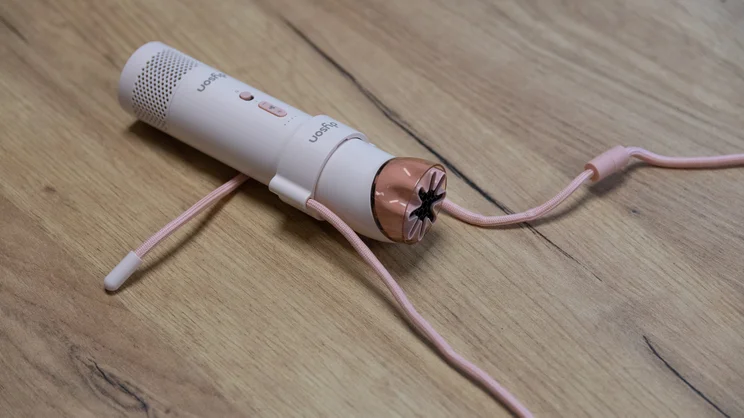
Controlling the Mini Cool is simple. A slide switch turns it on and off, while plus and minus buttons increase or decrease the fan speed, indicated by five lights on the front of the fan body. You can activate a “Boost mode” by holding down the plus button after the highest setting has already been reached. All front lights will flash while this is enabled.
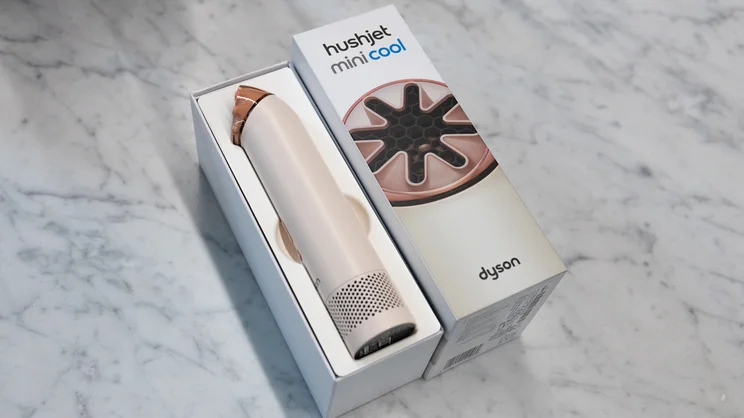
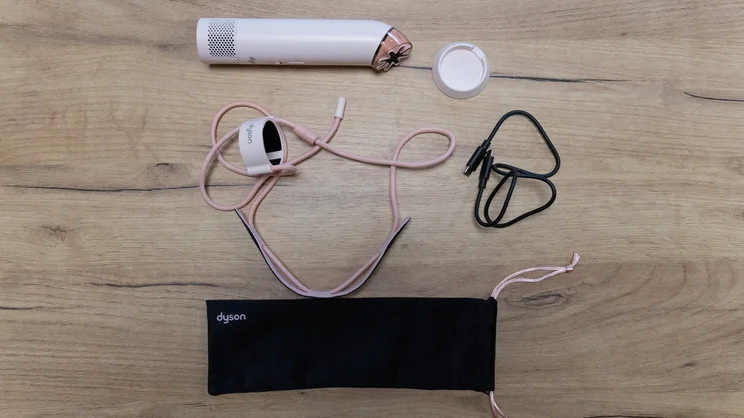
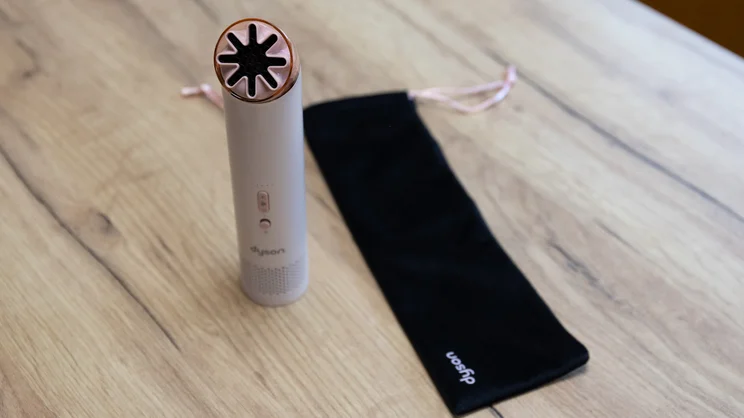
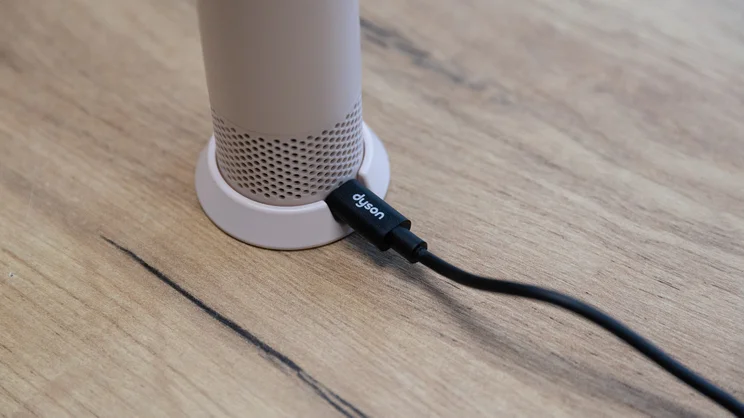
In addition to the lanyard, you get a drawstring pouch in the box, as well as a small charging base that doubles as a stand to keep it secure on your desk.
Speaking of charging, this is done via USB-C, and a cable is included in the box. Dyson’s quoted battery life is six hours (at its lowest setting) and the charge time is three hours. You can check the battery status by pressing the minus button while the fan is off, or look for a red light at the rear of the machine next to the charging port. This will be solid red when battery life is between 5% and 20% and will flash when below 5%.
The HushJet Mini Cool costs £100, which is cheaper than the ChillPill (£130) but still significantly more expensive than many decent handheld fans, such as the £12 John Lewis Handheld & Foldable Desk Fan. Ultimately, for a handheld device that just blows air, it’s quite an investment.
How did I test the Dyson HushJet Mini Cool?
I was fortunate enough to start testing the Dyson HushJet Mini Cool during a week-long heatwave, which gave me plenty of opportunity to put it through its paces. I used the fan day-to-day when I needed to cool down, whether I was sitting at my desk or travelling on the tube. I also took the fan on a short holiday to Cologne, during which I used it when walking about the city (where temperatures were also exceeding 30°C).
In addition to regular use of the fan, I also carried out some standardised tests. Firstly, I used an anemometer to record air speeds at different settings and distances, before using a smartphone sound meter app to measure sound output in A-weighted decibels (dBA). Lastly, I timed how long it took for the battery to run from a full charge to a dead battery.
While regular use of the fan allowed me to judge how effective and easy-to-use the HushJet Mini Cool was, these tests meant I could better compare performance with rival handheld fans.
How did it perform?
At 50cm, I recorded air speeds of 1.4, 3.2 and 4.3m/s at settings one (lowest), three (middle) and five (highest) respectively. This is significantly higher than the output of the Shark ChillPill, which – at the same distance – gave a maximum reading of just 1.3m/s: a weaker airflow than the HushJet achieved at its lowest speed. On its Boost mode, I measured 5.2m/s from 50cm and 2.3m/s from 1m away. By contrast, the John Lewis Handheld & Foldable Desk Fan (the benchmark for our anemometer tests) reached a maximum of 2m/s.
| Anemometer tests | ||
|---|---|---|
| Fan speed setting | Reading at 50cm away (m/s) | Reading at 1m away (m/s) |
| Low (1) | 1.4 | 0 |
| Medium (3) | 3.2 | 1.3 |
| High (5) | 4.3 | 2.4 |
Results were inevitably weaker at 1m distance, but my anemometer still picked up speeds of 1.3m/s at setting three and 2.4m/s at setting five, impressive results compared to the maximum readings for both the ChillPill (1m/s) and the John Lewis fan (1.3m/s).
Fan performance is great, then. It’s just a bit of a shame you can’t lock it to prevent it going off in your bag or pocket.
Noise output
As the title of this review indicates, all that airflow comes at an audible cost. At its lowest speed, I recorded an output of 45dBA from 50cm away and 42dBA from 1m away.
At setting three, these results were 54.4dBA and 51dBA and, at full tilt, 62.4dBA and 57.2dBA. That’s not quite as loud as the Shark ChillPill, which maxed out at 65.6dBA at 50cm distances but it’s still annoyingly noisy.
Boost mode, though, was a different story. I recorded 68dBA at 50cm and 63dBA at 1m. Granted, you’re not going to be using this mode constantly but, after seeing those readings, you might not want to use it at all.
| Sound meter tests | ||
|---|---|---|
| Fan speed setting | Reading at 50cm away (dBA) | Reading at 1m away (dBA) |
| Low (1) | 45 | 42 |
| Medium (3) | 54.4 | 51 |
| High (5) | 62.4 | 57.2 |
This sound isn’t a pleasant one either: imagine the jet engine of a tiny aeroplane or – coincidentally – the whine of a vacuum cleaner. On one occasion, I had it running during a Zoom meeting with my team and, while it didn’t exactly drown them out, it was loud enough to distract me from what they were saying. This is unfortunate, because if the Mini Cool wasn’t so strident, I could see myself wanting to use it much more frequently.
Battery
Dyson quotes a battery runtime of up to six hours “in fan speed 1”. Rather than running the Mini Cool on low in an attempt to verify this, I set it at its middle speed and timed how long the battery took to run from full to empty.
The fan ran for one hour and 57 minutes before giving up the ghost: not bad at all considering the 3.2m/s air speed reading.
Just under two hours should be plenty of juice, particularly as you’re not necessarily going to have the fan running constantly for this long. In day-to-day use, I switched the fan on for much shorter bursts of cooling whenever I felt particularly hot. And after several days of using it like this, I still didn’t need to charge it.
What did we think of the HushJet Mini Cool’s design and accessories?
In a word, the look of the Dyson HushJet Mini Cool is divisive. In appearance, it’s quite the phallic object: a fact that I’ve frequently been reminded of by friends and colleagues. I can only hope that unsuspecting members of the public haven’t taken me for a man waving a vibrator in his face on the London Underground.
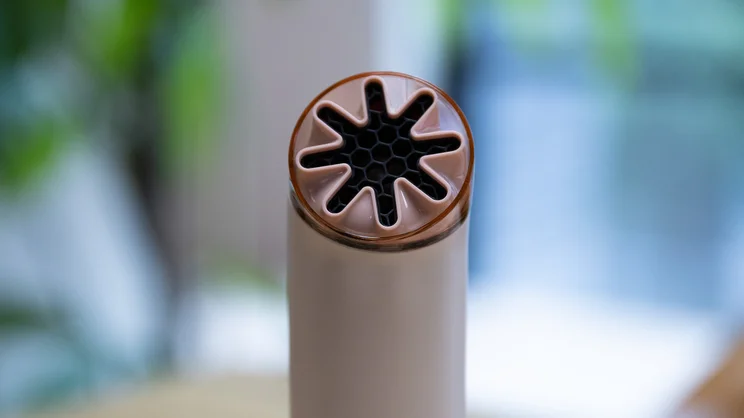
On the other hand, I can understand why Dyson has gone for the poppy seed pod-esque design of the fan head. It’s almost identical to that of the HushJet air purifier that precedes it. I have no issues with this aspect of the fan design but, as another journalist pointed out to me, its honeycomb face does risk triggering disgust in sufferers of trypophobia.
Enough about the questionable aesthetics, though. What of the Mini Cool’s accessories? Most notable of these is the lanyard, which allows you to hang the fan around your neck and, by rotating the head, direct the airflow upwards into your face.
I like this feature, and it served me particularly well on one hot Sunday afternoon walking through Cologne’s Rheinpark, that is until the noise of the fan began to spoil the otherwise lovely Teutonic atmosphere. I also found that the ring on which the lanyard fastens to the fan felt secure enough that I wasn’t worried about it falling off my neck – not that I’d want to tempt fate by swinging it around too aggressively.
The pouch and the charging base are useful additions, too. Kudos to the pouch in particular for being more than big enough to fit the fan, for the same can’t be said for the pouch that comes with the Shark ChillPill.
Should you buy the Dyson HushJet Mini Cool?
Putting aside any Freudian ideas about the HushJet Mini Cool’s design, the air speeds on offer here are truly impressive for a handheld fan. Its gusts are powerful and cooling, and I really like the lanyard attachment.
So why no award? The reason for this is two-fold. On the one hand you’ve got the price tag, which – while unsurprising for a Dyson appliance – is too high for a handheld fan. But for me, what ultimately holds the HushJet Mini Cool back from a higher score is its noise output. It’s loud, and it sounds bad, which has prevented me from using it as much as I would have liked – even in a heatwave.
This is a shame, because Dyson deserves commendation for the Mini Cool’s fan performance. But if you’re sensitive to noise, consider the John Lewis Handheld fan as a quieter, and cheaper, alternative.