To help us provide you with free impartial advice, we may earn a commission if you buy through links on our site. Learn more
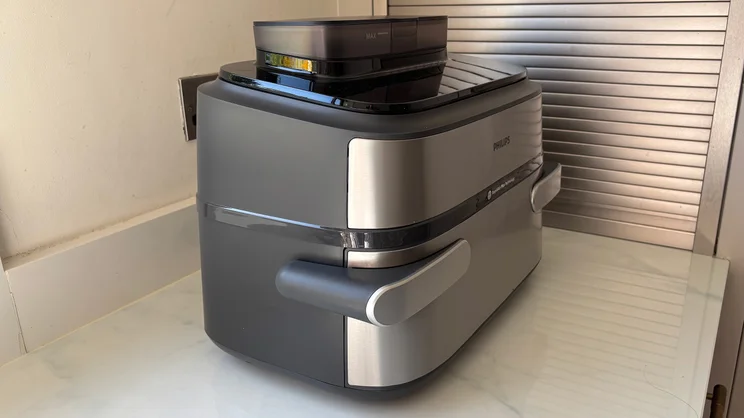
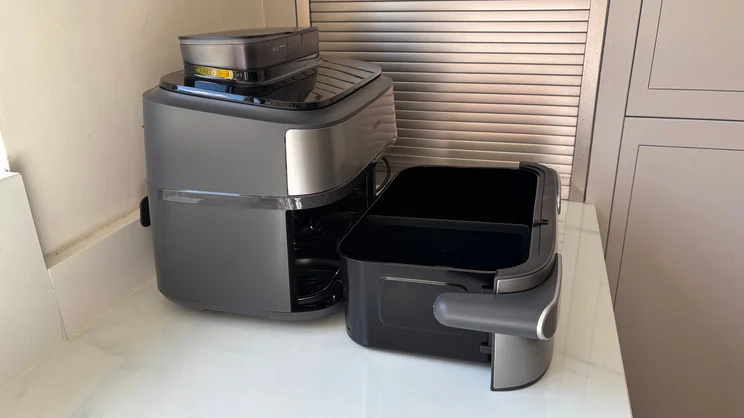
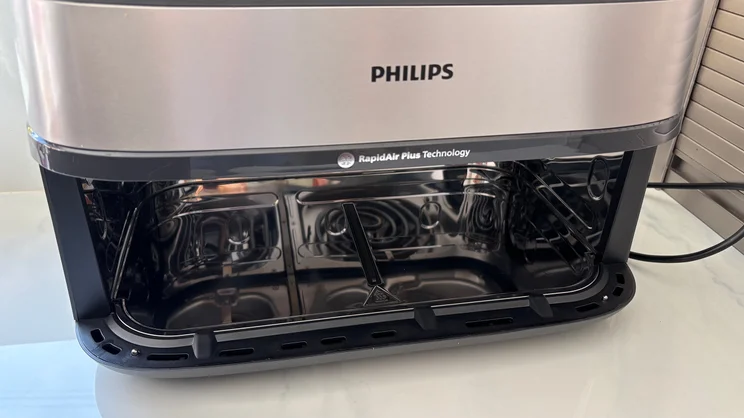
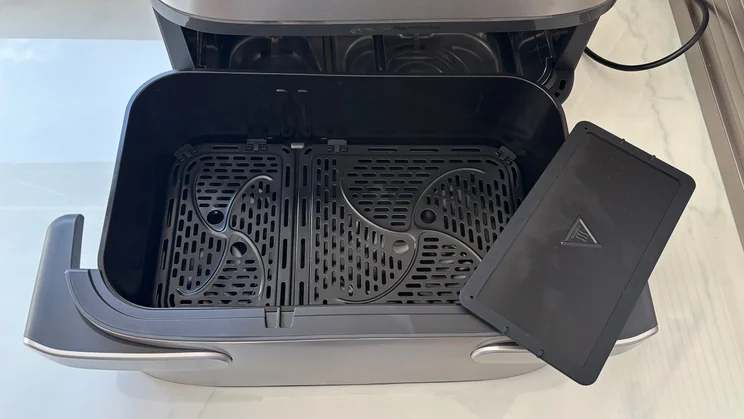
- Spacious 9.5L drawer with divider
- Dishwasher-safe parts
- Steam cooking
- Expensive
- No steam option for 3l compartment
- Maintenance requires descaling
The Philips Airfryer 5000 Series Megabasket with Steam isn’t the company’s first time adding the healthy cooking method to the tried-and-true formula of standard air frying. Its 5000 Series NA555/09 Dual Basket Steam Air Fryer already did that.
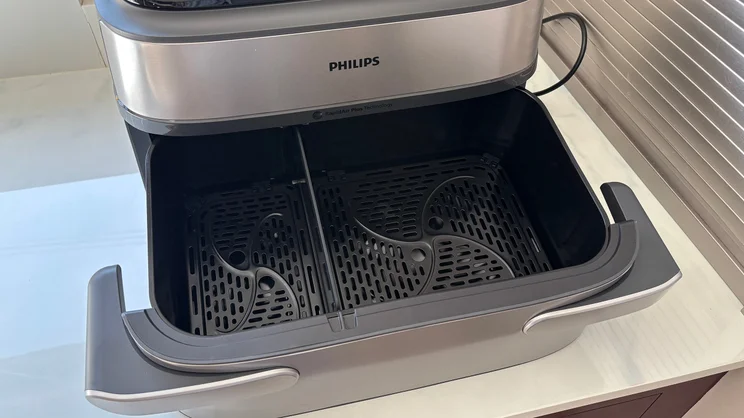
What’s new here is that, rather than separate individual drawers, the 5000 Series Megabasket with Steam air fryer has a 9.5L drawer that can be used as one large cooking space or divided into 6L and 3L compartments. This versatile arrangement effectively gives you three drawer options to complement three methods of cooking: air frying, steam, and air frying with steam (Steamfry).
Add to this eight presets, plus a favourite button for your most-used setting and a useful steam-clean option for making hand-washing effortless, and the Philips Airfryer 5000 Series (NA565/92) Megabasket with Steam really could change how you cook the majority of your meals. There’s even a pair of tongs included.
I loved the Philips 5000 Series NA555/09 Dual Basket Steam Air Fryer and selected it as one of the best dual air fryers, so I was keen to see if the NA565/92 Megabasket could impress me. It did – some aspects are even better – but a couple of the same niggles are present too.
Philips Airfryer 5000 Series Megabasket with Steam: What do you get for the money?
Firstly, and obviously, you get the “Megabasket” in which to cook. This is a large 9.5l basket, which can be split with a divider into separate 3l and 6l compartments – effectively giving you a choice of three drawer sizes.
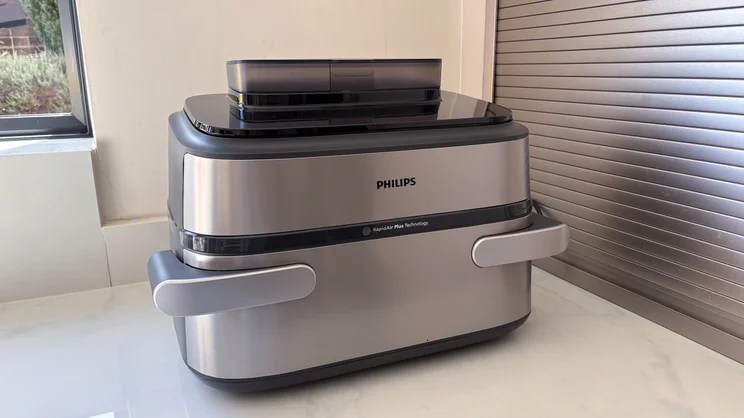
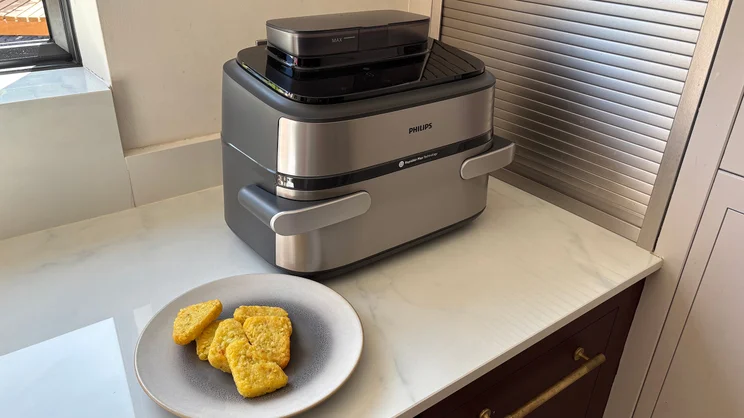
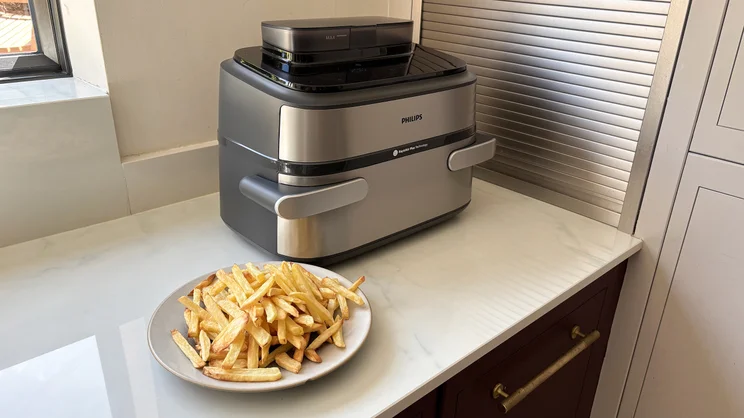
While this makes the air fryer fairly wide, the 5000 Series Megabasket isn’t as deep as the NA555/09: it measures 49.6 x 32.9 x 35.5cm (WDH) compared to the latter’s 44.4 x 38.3 x 35.5cm. This means you’ll be able to tuck it at the back of an average worktop when not in use. It’s slightly lighter too at 8.2kg (compared to 8.75kg).
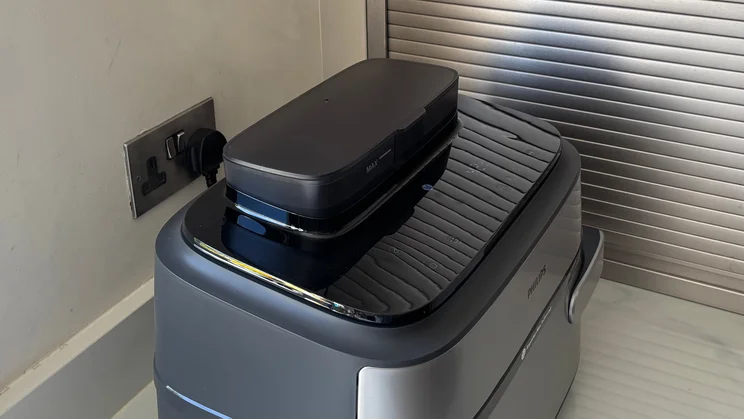
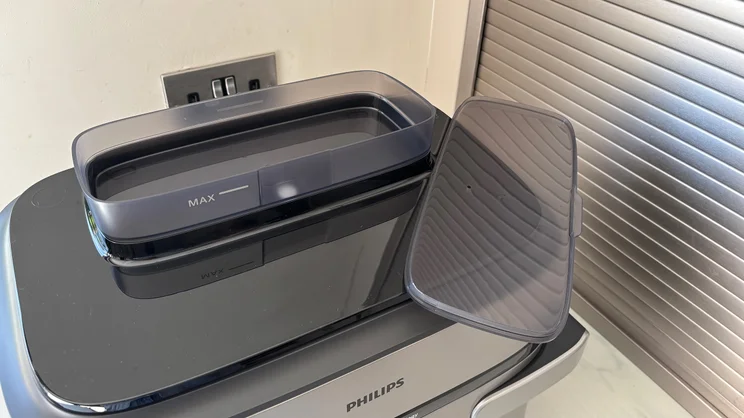
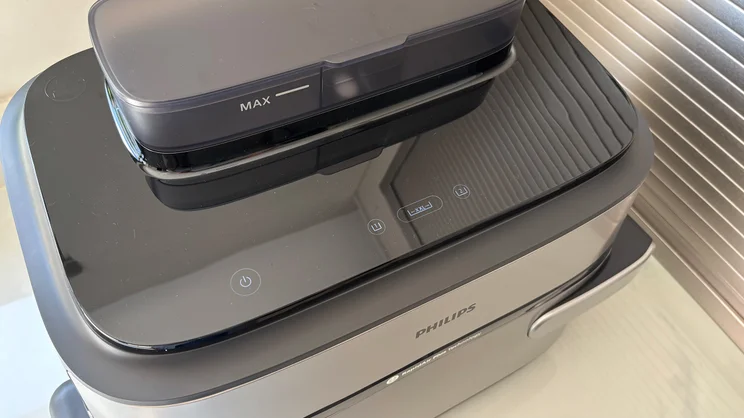
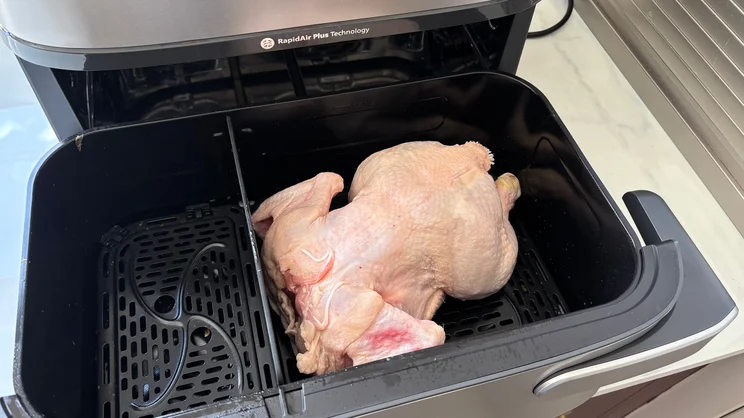
On top, there’s the same-sized 800ml water tank supplying its steam function, while the drawer has a pair of handles for removing it and shaking the contents. The drawer is home to two crisper plates in addition to the divider that slides between them, and there’s just enough height (13.5cm) to the drawer to roast a whole chicken (or two). While the included instructions are skimpy at best, a full manual can be downloaded and has times and temperatures for 1.2kg birds.
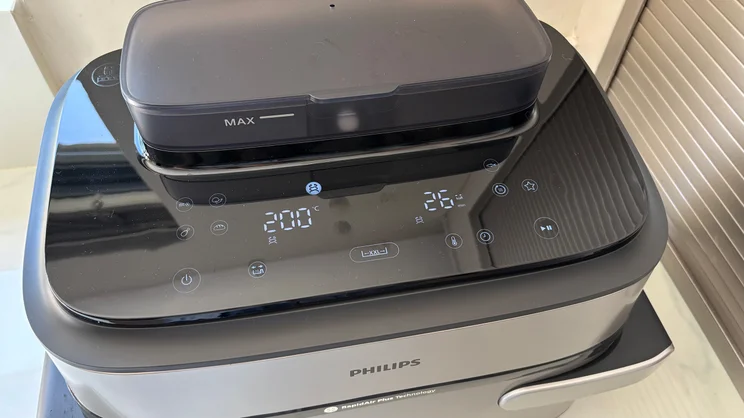
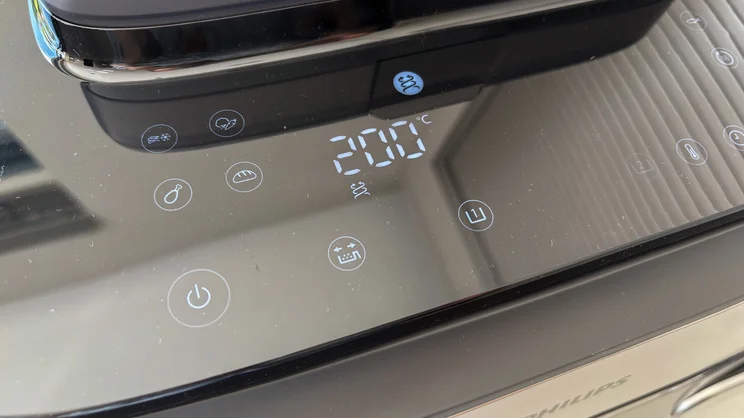
Even though the control panel has a lot of options, it’s more clearly laid out than the NA555/09. There are six cooking presets (though curiously, no dedicated setting for meat), plus a reheat function, a button to save your favourite setting and a back button that allows you to correct mistakes easily. Temperatures range from 40°C to 200°C, and the maximum run time is 24 hours if you’re dehydrating at the lower temperatures.
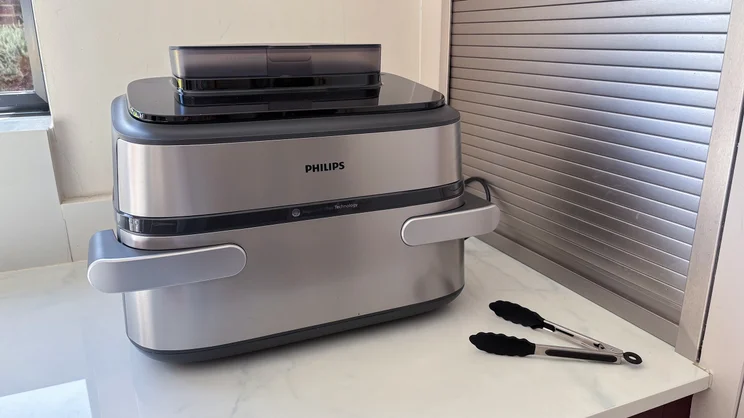
Additional features include: an optional shake/turn alert; a sync setting to finish cooking different foods at the same time; and a steam cleaning programme that loosens debris so it can be easily rinsed away. You get a two-year warranty with the air fryer, plus a pair of silicone-tipped tongs have been included.
Oddly, the instruction manual quotes guidance for different wattage options, but there’s only one 5000 Series Megabasket model available online. Even more confusingly, this is listed as 2,300W on Philips’ website, while the model I tested and reviewed is rated as 2,750W. We’re looking into this, and have emailed Philips’ representative for comment.
This is the same wattage as the NA555/0, yet running the whole drawer without the divider in place used slightly less power than both of the NA555/09’s drawers. One hour’s usage at 200°C consumed 0.699 kWh of electricity. At a rate of 25p per unit, this would cost around 17p.
How I tested the Philips Airfryer 5000 Series Megabasket with Steam
Before any cooking happens, the first thing I do is test the power consumption of the air fryer by running it empty for 1 hour at 200°C, using a plug-in power meter to record usage. If the air fryer has two drawers, I will run both. If it’s one large drawer, I’ll make sure I remove any dividers before running it.
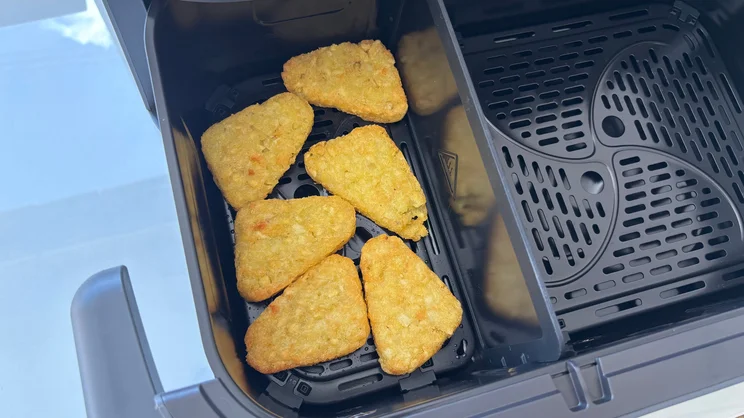
The first test is frozen food: I fill one section of the air fryer with frozen hash browns and note how many the drawer/s can comfortably fit. If the manufacturer provides cooking guidance, I will follow its recommended settings. Otherwise, I cook them for 18 minutes at 200°C, turning them over halfway through cooking. Once cooked, I note how soft or crispy the hash browns are, and how evenly they’ve been browned – if at all.
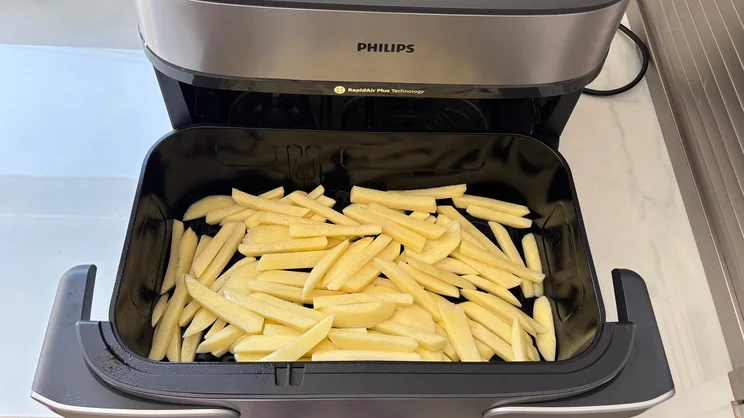
Next is homemade chips. After peeling and chopping potatoes into pieces, and soaking them for a few hours, they’re patted dry, and tossed in a small amount of oil (I use a blend of avocado and rapeseed oil). Again, if there’s cooking guidance for homemade chips, I follow it, but my go-to setting is 200°C for 30 minutes, shaking multiple times throughout cooking. I note how crispy the resulting chips are, if cooking is even throughout the batch, if any pieces are not cooked properly, and if they’re soft in the middle.
Finally, I’ll use the air fryer to cook chicken. A whole bird is ideal, usually at 180°C for 50 minutes, but I’ll opt for chicken legs if there’s limited space. I’ll turn the chicken over halfway through cooking. And once roasted, I carve the flesh, and note if the juices are running clear, if there is any pink flesh remaining, especially around the bone, and if the skin is crisp or brown.
In addition to my standardised cooking tests, I’ll make a note of how easy the air fryer is to use, how intuitive its settings and cooking instructions are, how quick and efficient it is, and how much space it takes up on my kitchen worktop.
What’s it like to use?
As is the case with a lot of air fryers, some of the preset icons are obvious (frozen fries etc), while others are heads-cratchers. The ‘Tray bakes’ setting, for example, looks like a loaf of bread. But whether this is intended for baking, bread or oven-style tray-bakes comes with no explanation in the basic instructions that are supplied. The wobbly lines to represent dumplings could also use a rethink.
As I’ve said, the included instructions are basic: there’s some guidance for food amounts for each programme, and how that varies between drawers, or when cooking with steam. More confusing is the guidance for the different wattages I mentioned previously, including 2,200W and 2,300W models as well as the 2,750W model that I reviewed. Glance away at your peril as it’s easy to forget which table you’re using as a guideline.
The manual also makes clear one of the issues that the 5000 Series Megabasket shares with the NA555/09: steam isn’t available when cooking with the 3L section alone. This smaller drawer will only cook by air frying, which makes it a bit less versatile.
The removable parts are dishwasher safe, but if you don’t have a dishwasher or don’t care to fill it with a huge air fryer drawer, the steam cleaning programme takes the effort out of hand washing. Not only does steam loosen the stubborn debris, but for lighter messes, you may be able to simply rinse after running it. On the downside, if you live in a hard water area, regular descaling is a must when it comes to maintaining the machine.
How well does it cook?
I was wowed with the chips turned out by the NA555/09 when I tested it. But if it’s possible, the 5000 Series Megabasket was even more impressive.
Six frozen hash browns fitted comfortably in the 3L drawer section – as this one only offers air frying, it’s useful for cooking small items of food from the freezer. The guidance suggested 25 minutes of cooking, which felt too long. One thing I noticed was that cooking with this single drawer was incredibly quiet, making this air fryer a good one to choose if you don’t want to wake the whole household when cooking snacks. The alert beep sounded halfway through – loud enough to be heard in another room but not an unpleasant sound – and the tongs came in handy for turning. The cooked hash browns were crisp all over, with some browning. Each one was soft in the middle, and not dry.
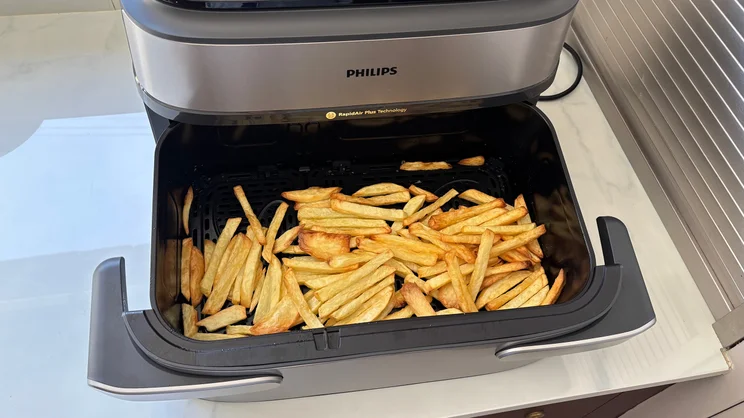
While the whole drawer can technically accommodate 2.5kg of fries, it’s telling that guidance (26 minutes at 200°C) is only offered for 1.3kg. Steam wasn’t suggested for this type of food though so I stuck to air frying across the whole drawer. The shake alert is only set to go off once throughout cooking but I shook the batch multiple times. At the end of the programme, the chips were golden brown, crisp at the ends, well bubbled and not too dark in colour. Smaller pieces were very crisp but still soft in the middle. Thicker chips were softer but still well-cooked and golden. All in all, it was an excellent batch.
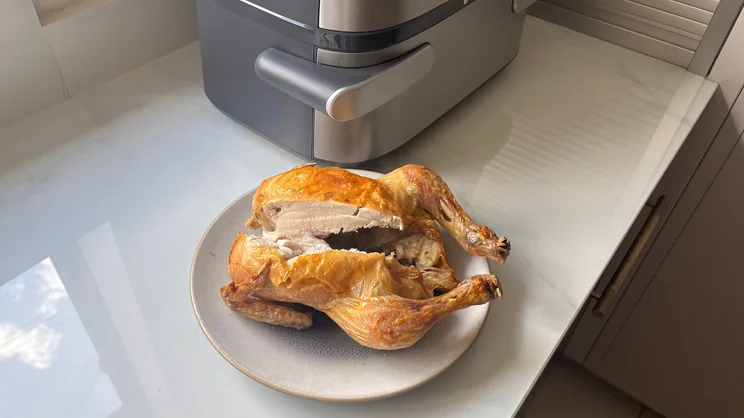
Cooking a whole chicken felt like a good opportunity to try out the 5000 Series Megabasket’s combination Steamfry setting. It’s tricky to find 1.2kg chickens at the supermarket; the smallest I could buy was 1.6kg, which the large drawer just about accommodated. I chose the chicken drumstick programme, setting the time to 50 minutes, which was in the middle of the suggested 45-55 minute duration in the full instructions.
The steam functionality makes a lot of noise at the beginning of cooking – presumably the sound of water being sucked out of the tank, then injected as steam into the basket. Some steam is emitted from the back of the unit too, which possibly makes this unsuitable for use below open shelving or kitchen wall units. After about 10 minutes of steam, I heard the air frying kick in. Steam resumed with about 22 minutes of cooking to go, before a final burst of air frying for the final 15 minutes.
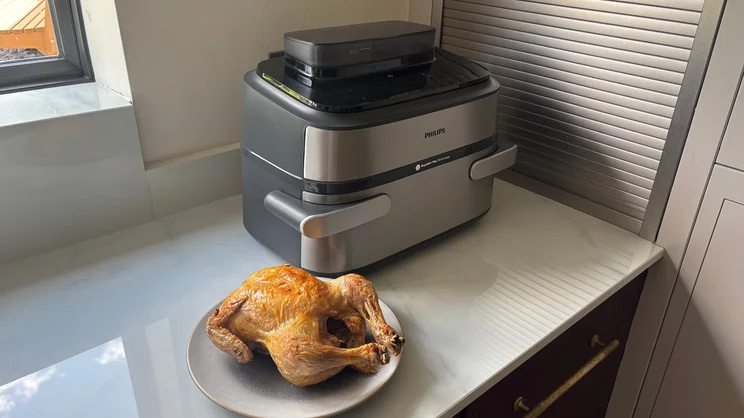
The roasted chicken emerged completely cooked through, with clear juices and golden-brown crispy skin. Most noticeable though, was the breast meat: while this has a tendency to go dry when overcooked, this was very moist.
Should you buy the Philips Airfryer 5000 Series Megabasket with Steam?
The Philips Airfryer 5000 Series Megabasket with Steam is a great successor to the 5000 Series NA555/09: there’s more versatility in terms of cooking space, it’s slightly less power-hungry, simpler to programme, and possibly easier to accommodate on the worktop as far as depth is concerned.
While there are things that could be better – its choice of programmes could be better, there’s no steam for the smaller section, and its shake reminder will only nudge you halfway through – they’re vastly outweighed by all the good stuff. This includes two healthier cooking methods in one appliance, enough space for family meals and a favourite button that, if used often, will be a time-saver.
However, at £260, the Philips 5000 Series Megabasket is pricey, competing with both Ninja and Cosori. If that’s a deal-breaker, and you can live without steam, it’d be worth checking out cheaper dual-drawer models, such as the Instant Vortex Plus Dual Drawer air fryer or the similarly designed Philips 1000 Series FlexDrawer Dual Basket Air Fryer.