To help us provide you with free impartial advice, we may earn a commission if you buy through links on our site. Learn more
- High-heat crisping
- Dishwasher-safe parts
- Affordable
- No reheat setting
- Crisper plate limits vertical space
- Minimal instructions provided
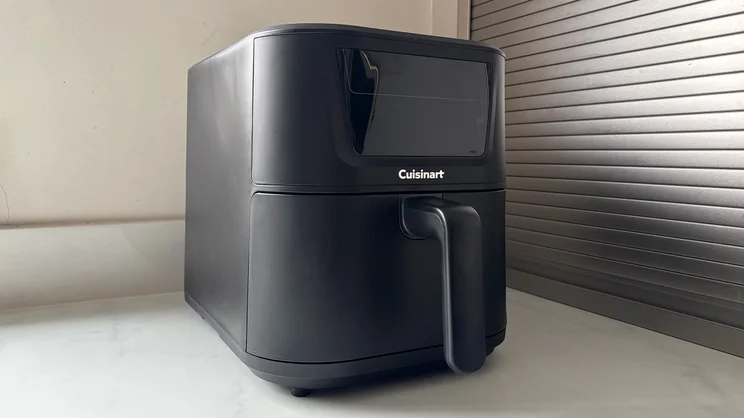
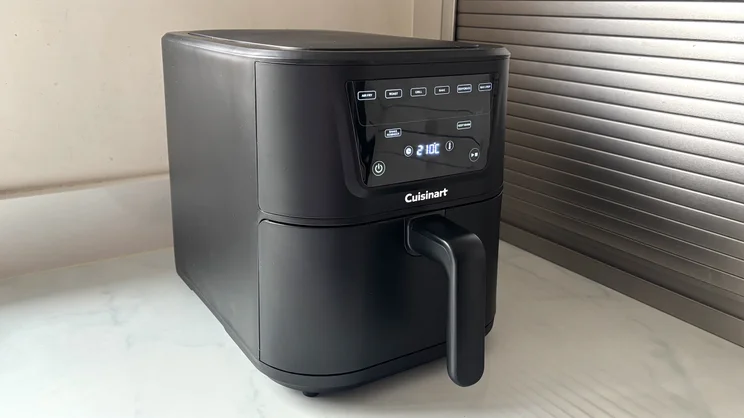
Compact air fryers are rarely a good fit for families: however, the Cuisinart Compact Max Air Fryer AFS8OBLU might just have turned that idea on its head. It offers a decent 7.6 litres of cooking space, but it’s how that’s configured that makes the difference.
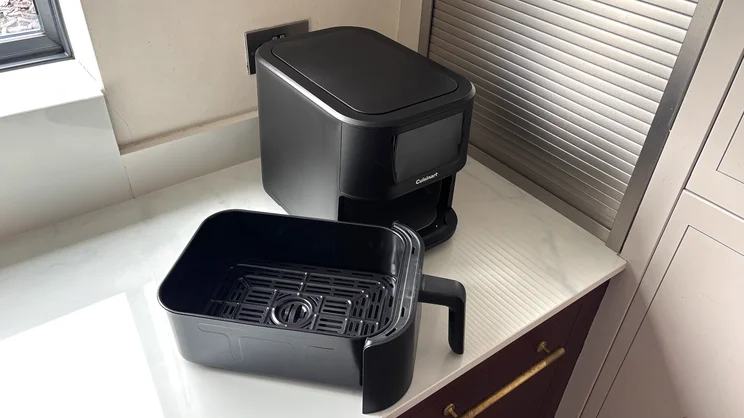
Instead of a tall-ish square-shaped basket or a wide drawer that’s a worktop hog, the Compact Max comes with a deep drawer that’s otherwise slim, offering a substantial cooking area. While tall space has been sacrificed, in real terms, this means you can cook a large batch of chips, a couple of small pizzas or fish fillets, which could make it one of the best small air fryers if it’s flat area you’re after.
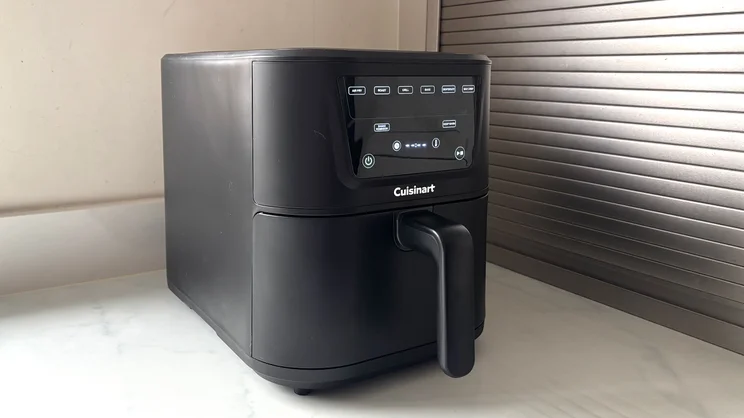
Programme-wise, it’s tailored for families too, with seven presets ranging from a handy Keep Warm to a high heat Max Crisp function. And in testing, the Cuisinart Compact Max Air Fryer showed that it was more than capable of delivering crispy food from the freezer and wowed when cooking homemade chips. However, I felt that it would have been improved with one or two more programmes and a smidge more vertical space.
Cuisinart Compact Max Air Fryer: What do you get for the money?
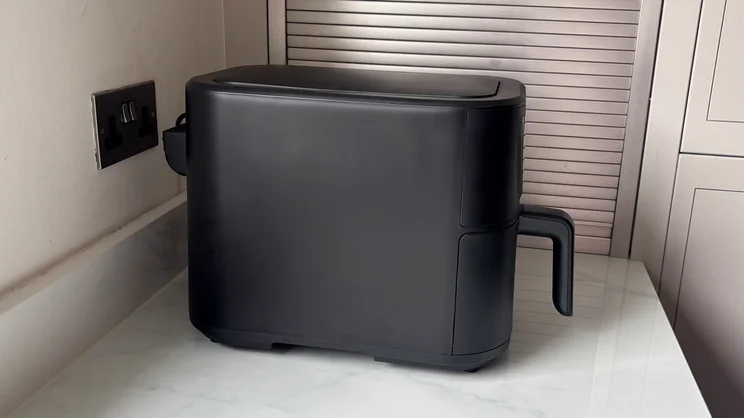
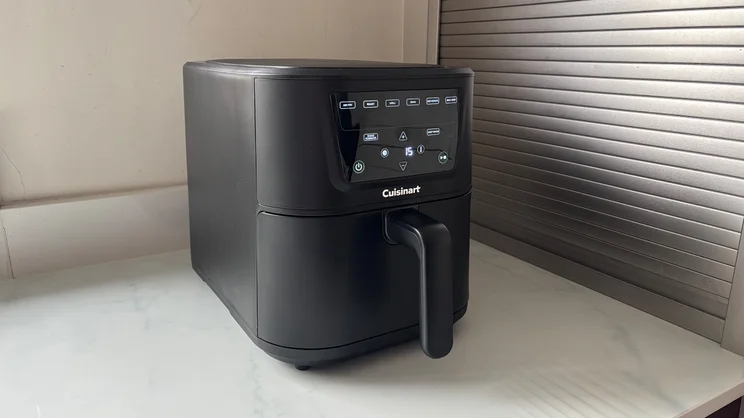
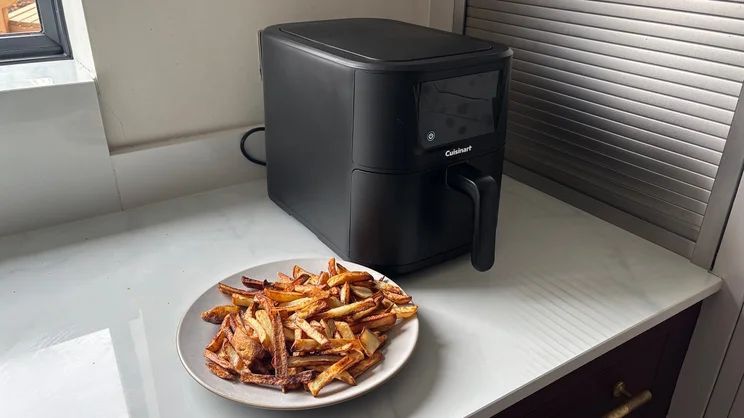
While relatively space-saving on the outside, it’s more capacious than you might guess – its makers claim that it’s 36% slimmer yet offers 33% more capacity than the AIR200. The overall appliance measures 25 x 37 x 30cm (WDH), while its 7.6-litre drawer has a cooking area of 31 x 20cm (without the ceramic-coated crisper plate in place), translating to multiple portions without overlapping food. The reduced width means it slots in easily on a crowded worktop. It’s not too heavy either (6.9kg), so you can easily move it around or store it in a cupboard when not in use.
The trade off here is that the drawer’s vertical space is less than than that of larger rivals: with the crisper plate in place, 12cm is reduced to 9.5cm, meaning that if you want to cook a whole chicken, you’ll need to find a particularly small bird – a limitation I also noted in my review of Cuisinart’s Tri Zone 13.6L Air Fryer & Oven.
It’s less limited in its choice of presets, all with named buttons rather than icons, which can sometimes be confusing. There are seven presets, including Air Fry, Bake, Dehydrate, Grill, and Roast. There’s also a Keep Warm setting, which runs at 60°C for up to an hour (the default time is 20 minutes after a programme has finished), and a Max Crisp function, which boosts its maximum temperature from 200°C to 210°C for up to 30 minutes (compared to the maximum one hour of the regular air fry function). The Keep Warm is particularly useful for making sure dinner is ready when you are, but there’s no reheat option.
These programmes can be adjusted in time and temperature within set parameters. The dehydrate setting, for example, runs for up to 12 hours with a low of 40°C. There’s a shake reminder that’s a default feature on the air fry setting but has to be added for others. It’s loud enough to hear without being shrill, though it won’t stop until you open the drawer. More annoying is that it only sounds once at around two-thirds of the way through cooking, rather than at the halfway point, which may be too late for some dishes to be evenly cooked.
At 2,000W, this air fryer isn’t as power-hungry as you might think: from cold, one hour’s usage at 200°C consumed 0.765 kWh of electricity in our tests. At a rate of 25p per kWh, this would cost around 19p. Another big plus is a three-year warranty, which gives you some confidence in the air fryer’s longevity.
What’s it like to use?
Seasoned air frying chefs may not miss the lack of guidance in this air fryer’s instructions. But if you’re new to this way of cooking, there’s not much to help you. Not only are the parameters for each programme not listed, but there are only a few for achieving good results, with no recipes and no idea of time or temperature for different foods. I felt that beginners may have to test out a few types of foods with the presets to gain an idea of how each would perform.
In the same vein, both the grill and bake settings have a preheat built in, but there’s no indication as to how long this takes – either in the instructions or on the machine’s display. I timed it at around two minutes for both. Another quirk is the rather loud fan that kicks in after cooking to cool down the air fryer. While this doesn’t run for long, it’s something to be aware of if you have an open-plan kitchen.
As with other Cuisinart air fryers we’ve reviewed, its parts are free from ‘forever chemicals’ such as PFAS. Both the drawer and crisper plate are ceramic-coated for easier cleaning, and are also dishwasher-safe. That said, I found that the drawer was still a little greasy after being cleaned in my dishwasher, and that better results were achieved by cleaning it by hand while it was still slightly warm.
Cuisinart Compact Max Air Fryer review: How well does it cook?
Whether it’s the expanse of flat space or the smaller cavity, one thing is certain: the Cuisinart Compact Max Air Fryer cooks incredibly well. Not only did I not have to extend times beyond what I’d estimated, in one instance I actually shortened it.
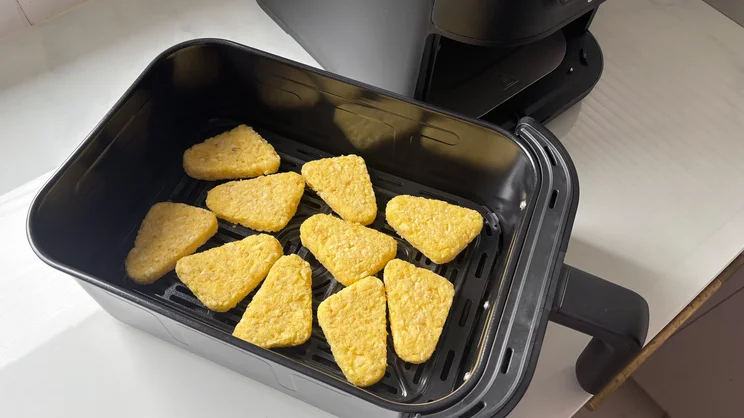
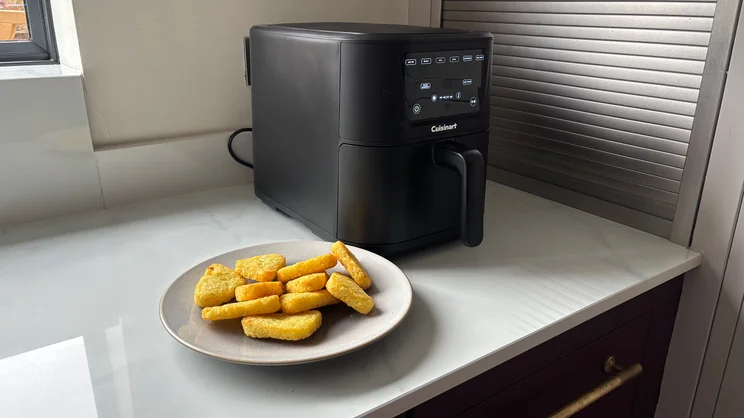
I started by cooking frozen hash browns. Here, the flat space was handy – the crisper plate comfortably fitted 10. I would normally opt for 18-20 minutes on 190/200°C, but considering higher heats are optimal for frozen food, I opted for the 210°C Max Crisp setting for 15 minutes. Despite the shake alert only sounding with five minutes left on the timer, I made sure to turn the hash browns over halfway through cooking. The hash browns emerged with light browning, crisp at the corners and edges. All were perfectly cooked, with good exterior crispiness and soft on the inside.
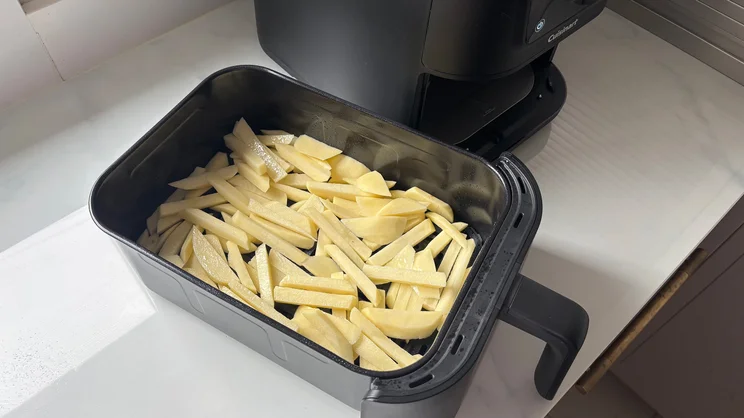
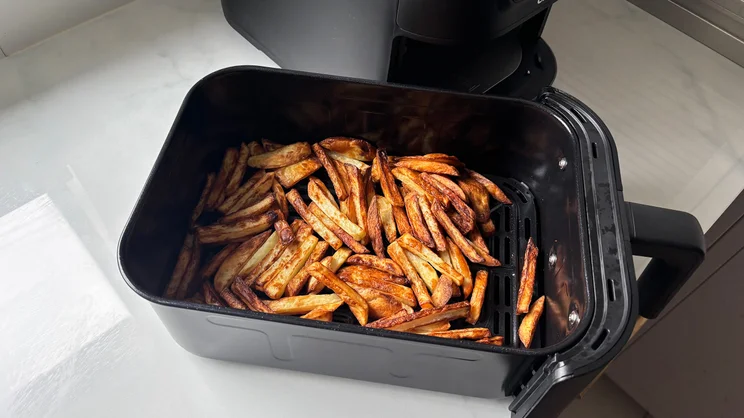
Next I made homemade chips using peeled, chopped and soaked potato pieces, dried and tossed in a small amount of oil. These were cooked on the air fry setting at 200°C, and the default time raised from 10 to 25 minutes. I shook them several times (even though the alert only sounded with nine minutes to go) and after just 23 minutes I decided that the chips were done. The chips were consistently cooked through with even browning: crisp all over and fluffy inside. Even the larger pieces browned well and were crisp.
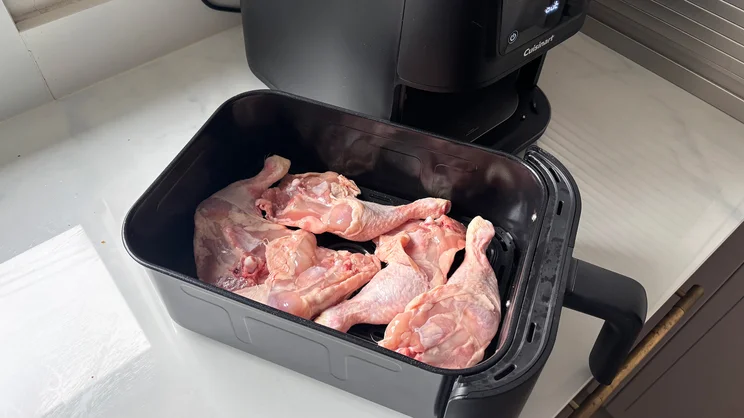
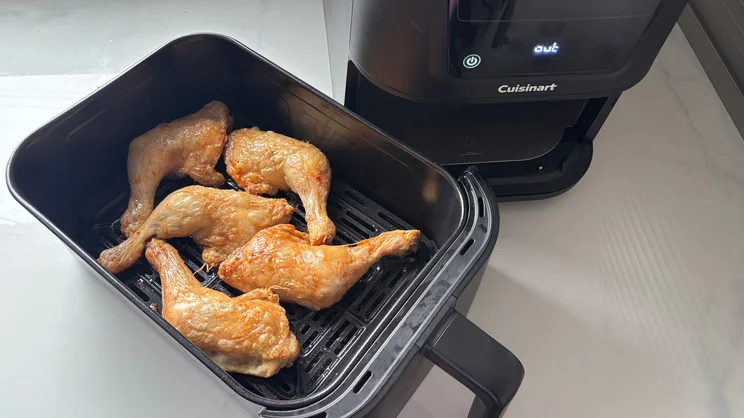
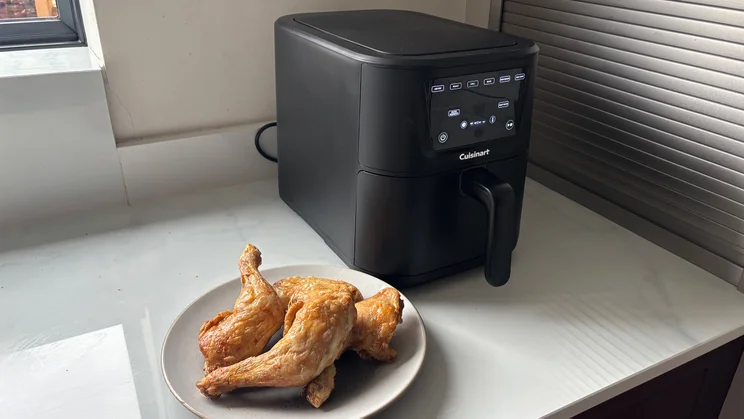
I felt that a whole chicken would have been hard to fit in the Compact Max’s drawer, so I opted to cook chicken legs using the roast setting. On other air fryers, this is set at a lower temperature than air fry, but here it’s the same 200°C. I lowered it to 190°C, and raised the default run time of 20 minutes to 30. The drawer fitted five legs without overlapping, and I turned them halfway through cooking. After the time had elapsed, the chicken came out with golden, crispy skin and the flesh was cooked through with no pink remaining.
Should you buy the Cuisinart Compact Max Air Fryer?
For space-poor kitchens and time-poor families, the Cuisinart Compact Max Air Fryer is a win. It performed brilliantly in testing, didn’t take up much space on my worktop, and isn’t especially power-hungry either. There’s more capacity than you’d expect for an air fryer of this size too, and it’s a doddle to programme.
It is a little costlier than other small air fryers, such as the Salter EK5876 Digital Air Fryer 6.5l, but you’re arguably getting a lot more for the price here: convenient cleaning, more capacity and, for some foods, better performance.
There is room for improvement. A lack of solid guidance means air frying newbies may initially struggle to get the best from the Compact Max, while grease build-up appears to need more than a spin in the dishwasher to get it sparkling. If you can work around that, the Cuisinart Compact Max Air Fryer is a great-value air fryer that offers a magic combination of capacity and compactness in one.