To help us provide you with free impartial advice, we may earn a commission if you buy through links on our site. Learn more


- Wide-angle 160-degree video feed
- Track and zoom motion detection
- Impressive bespoke AI detection features
- Local storage a costly extra
- Expensive price and subscription
Arlo’s latest Pro 6 security cameras are designed for both indoor and outdoor use and boast some new and impressively adaptable AI detection features. They ship with rechargeable batteries and can be powered via a solar panel for prolonged use without the need to recharge.
That’s the good news. The bad news is that, like other Arlo systems, they are more expensive than a lot of the competition, and you can’t make the most of them without a subscription to Arlo’s cloud service. Like its hardware, Arlo’s services are priced at the top end of the market.
The question with the new Pro 6 isn’t so much a case of is it any good, but is it good enough to justify the big outlay, both initially and ongoing?
What do you get for the money?
Price is the elephant in the room when it comes to the Arlo Pro 6. Buy one camera, and you will be parting with £170, which is a lot for a camera of this type.
The price per unit drops if you buy a pack of two, three or four cameras, in the last instance to £108 (or £430 for four), but that’s still at the upper end of the price spectrum. And you sill have to pay another £45 per camera to add Arlo’s solar panel.
Price comparison
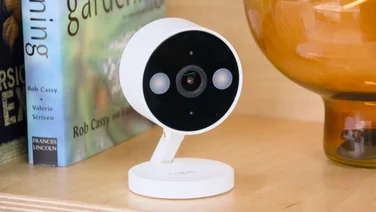
For comparison, my personal recommendation for a domestic security camera, the Tapo C120, can be bought for just £40. Reolink’s Altas outdoor camera costs around £110 and comes bundled with a solar panel.
At the time of writing, Arlo is offering a deal on its cameras if you pay for a 12-month subscription to its highest-level cloud service. That costs £200, and gets you a 50% discount, meaning you can get a single camera and 12 months of cloud storage for £285.
That’s certainly a little more palatable, but still fundamentally expensive for what is a single security camera, no matter how smart it is.
In the box
Considering the cost, the retail package is rather basic. You get the camera unit and housing, a rechargeable battery, USB-C cable, a basic screw-on wall mount with screws and wall plugs and an Arlo security sticker, and that’s it. You also get a free one-month subscription to Arlo’s top-tier Secure cloud service, which is barely enough time to give it a proper trial.
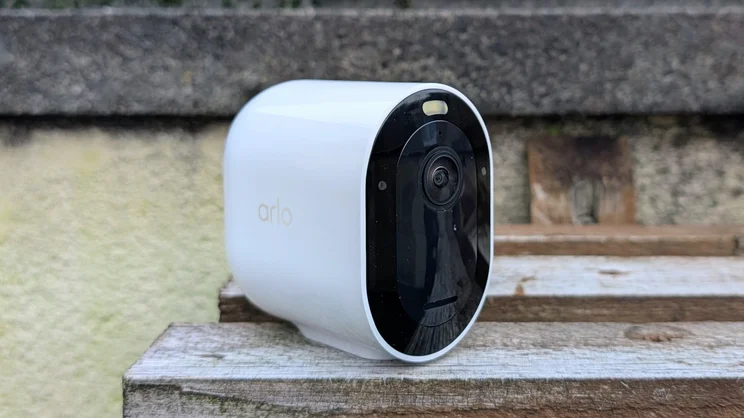
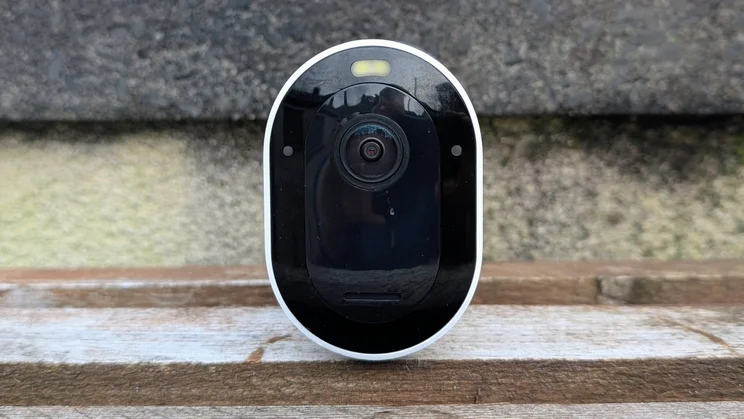
The camera unit is physically impressive and rather stylish. The white casing that holds the camera and battery has a lustrous gloss finish and, usefully, a flat bottom so you can pop it on a shelf without it falling over.
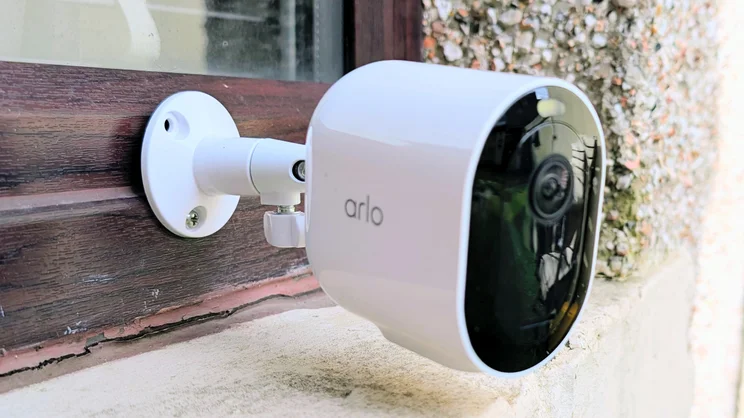
The rounded base of the camera housing is lined with a metal frame that holds the screw thread that connects the camera to the wall mount, or sticks it to the optional magnetic mount. It all feels very solid and likely to survive prolonged use and abuse.
The gloss black front of the camera unit houses the camera lens, a single white LED spotlight, a single PIR and two infrared lights. At a quoted 197g (but 245g by my scales) and 87 x 52 x 79mm, it’s a relatively light and compact unit.
Weather resistance
Arlo has built the Pro 6 to be IP65 resistant to water ingress, so it should survive anything short of being drenched with a pressure washer at point-blank range. Some of the competition, like the Tapo C120, are IP66 rated, but in the real world, I’d argue that makes no real difference.
An IP rating is provided as an indication that a product has been tested independently and indicates that it can be used in challenging outdoor situations without damage.
The testing standard, maintained by the IEC (international electrotechnical commission), comprises two numbers: the first indicates how resistant the product is to solid foreign objects, such as dust and sand; the second to how resistant the product is to liquids.
An IP65 rating, as used by the Arlo Pro 6, indicates that it is dust tight and that is able to survive “low pressure jets” of water without allowing mositure in.
How easy is it to set up?
The first thing you need to do after unboxing is to slide the camera unit out of its white plastic shell by pressing the button on the underside, install the bundled rechargeable battery, relocate the camera unit and charge it via the USB-C port.
Given the USB port faces downward, there shouldn’t be an issue connecting it to any small solar panel; indeed, the Pro 6 worked perfectly with my Reolink solar panel.
Connection to your home network is simply a matter of downloading the Arlo Secure app, setting up an account and then connecting the camera to the app and your Wi-Fi network and, usefully, the Pro 6 supports both 2.4GHz and 5GHz Wi-Fi signals, giving it extra flexibility over most rivals. Adding a camera automatically triggers your 30-day free trial of the top tier of cloud service for that camera.
Arlo has done good work making the Pro 6 IoT-compliant, so it works not only with Google Home and Alexa, but also with Apple Home, SmartThings and IFTTT. Connecting the Pro 6 to my Google account was straightforward, with the live feed appearing on the Cameras page of my Google Home app at first try.
Incidentally, Arlo reckons a full charge of the 5,505mAh battery will last for eight months, but clearly that depends on the usage scenario. In a week of intense testing, my battery charge dropped by 20%, though that did involve a lot of nighttime use with the LED spotlight on. In this case, a solar panel would almost certainly be a worthwhile addition – or look at a package that includes a solar charger like the Reolink Altas.
Arlo’s Secure App is generally well designed and easy to navigate. Accessing the basic functions like setting up zones to monitor or ignore, adjusting the duration of recordings, and adjusting the sensitivity of the motion detection system is straightforward.
What does it do well?
The camera records video at 2,560 x 1,440 and 20fps in optional HDR and has a very wide 160-degree diagonal field of view. The camera feed is of high quality, and I was impressed by the lack of distortion at the edges of the feed, given how wide the lens view is. There is some distortion, but it isn’t excessive.
It is worth pointing out that 2.5K live streaming is only supported over a local Wi-Fi network. When I opened a live stream over a cellular connection, the resolution dropped to 1,280 x 720. The Tapo C120 can stream over cellular at 2.5K.
The motion detection and zoom system works well, locking on to targets, zooming in and tracking with a high degree of accuracy. And the 12x digital zoom does a decent job of getting you up close to proceedings without an excessive loss of quality.
The two-way audio feed and siren performed well, the former sounding loud and clear both ways and cancelling out wind noise, the latter being piercing enough to startle any miscreants into rethinking their felonious activities. The Arlo Pro 4 performed poorly in this area, so it’s good to see an improvement.
Enhanched AI detection
Arlo’s big pitch for the Pro 6 is its AI-enhanced detection and alert system. Uniquely, to my knowledge, you can train the system to recognise bespoke situations, such as if you’ve left the garage door, garden gate or back door open, or a wheelie bin has gone missing. In fact, as long as you can snap a before-and-after picture in the Arlo app to train the AI, you can set just about any eventuality up to register an alert.
The system can also be set up to recognise specific people and vehicles, again by training the AI engine with captured and uploaded images and then telling it what is what and who is who.


Setting the system up to recognise my car and a friend proved to be surprisingly straightforward, and once set up, the system had no problem distinguishing the recognised from the unrecognised.
The system also supports fire detection in what’s described as beta mode. I wasn’t about to set fire to anything in or near my house and risk an interaction with Greater Manchester Fire and Rescue Service to test how well this works, so I’ll be taking Arlo’s word for it.
The Arlo 6 Pro will also notify you when any sound is heard or when specifically a smoke or carbon monoxide siren sounds. Presumably, more options will arrive as the system develops. Tapo’s equivalent system can already distinguish between a dog’s bark, a baby’s cry and a cat’s meow.
A final function that some may find useful is the option to load the contact details of three people into the app and set the system to send them direct alerts of certain events.
In our standard benchmarks, which measure reaction time to motion alerts and the time taken to launch video feeds, the Arlo Pro 6 performed well. In responding to motion alerts, it took an average of 1.4 seconds, and then further average of 1.4 seconds to launch into the live view of the incident for a total less than 3 seconds.
What could it do better?
With no local storage facility, the Arlo Pro 6 is entirely dependent on cloud storage. Unless, of course, you plan on coughing up an extra £109 for Arlo’s Smart Hub, which lets you record onto a USB thumb drive.
Arlo offers three levels of subscription: Early Warning (Secure Plus) for £20 per month (or £220 per year); Secure Multi-Cam for £12 per month (£130 per year); and Secure Single-Cam at £8 per month (or £88 per year).
The most expensive tier supports any number of cameras, 4K quality and 14-days of clip storage.The lesser tiers support four and one cameras respectively, seven-day video clip storage and 2K video quality. That’s on the pricey side when Google and Ring are charging £8 per month for unlimited camera support.
It’s especially irksome when you realise that the more advanced AI features, like the fire detection beta, the known person and custom AI scenario detection, are locked to the top Early Warning tier.
When our Muad’Dib of reviews, Jonathan Bray, reviewed the Arlo Pro 4 back in the summer of 2023, he summarised it as “useless without a subscription”, and you don’t have to be overly uncharitable to say the same about the new Pro 6 2K+.
Should you buy the Arlo Pro 6 2K?
There’s a lot to like about the Arlo Pro 6, especially the handy wide-angle camera feed, but there is no doubt it’s an expensive option. The Tapo C120 offers much the same core functionality but can be bought for under £40 and doesn’t require any sort of subscription to store your recordings.
The key selling point in the Arlo Pro 6, and the thing that distinguishes it from the competition, is the AI-enhanced detection and notification system, especially the option to set up your own specific alert circumstances.
There’s no denying the system is technically impressive, but those enhanced functions only work with the top-tier subscription package, so you will need to think carefully about how much you need them and if they are worth £20 a month.
Without those higher-level functions, you’ll have a camera with a similar level of functionality and performance to the much cheaper Tapo C120, and unless you are willing to forgo the ability to record and store content, you’ll never be free of some sort of subscription cost.