To help us provide you with free impartial advice, we may earn a commission if you buy through links on our site. Learn more
- 12L capacity
- Heats up to 230°C
- Dishwasher-safe parts
- Pricey
- Can burn food
- Minimal cooking guidance
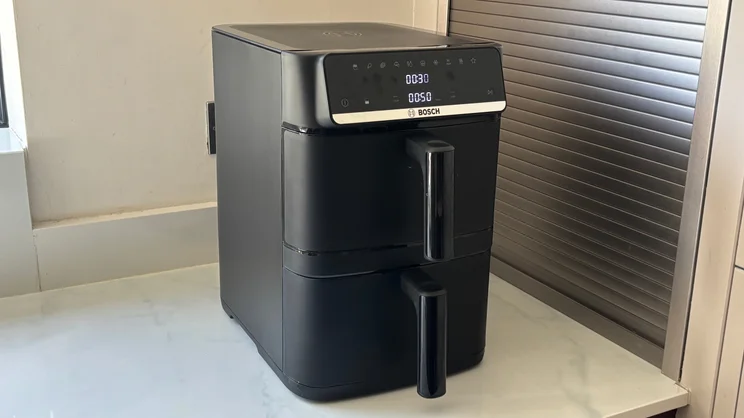
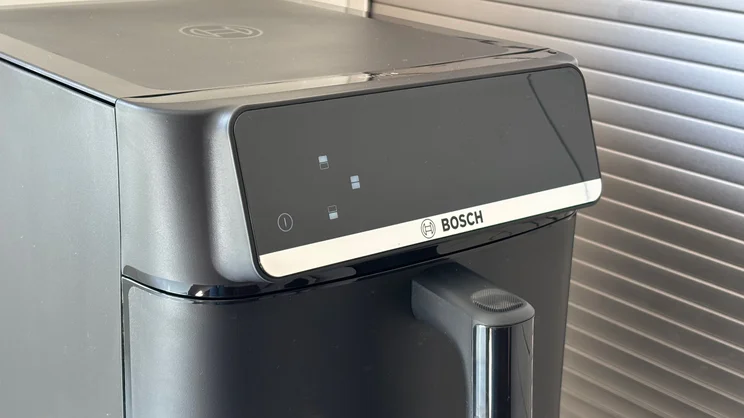
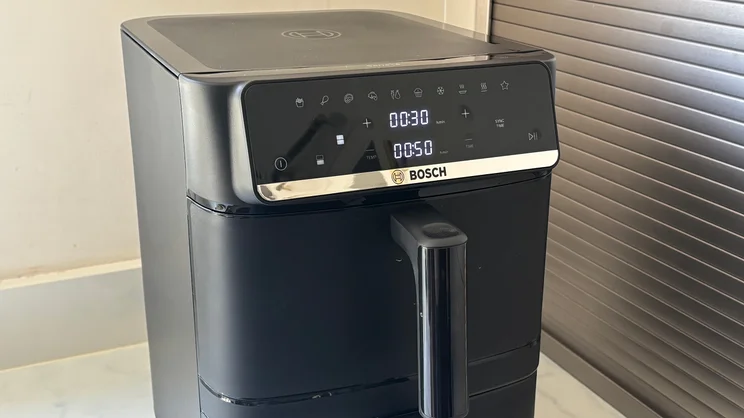
One thing that Bosch’s air fryers tend to have in common is great design, and the Bosch Series 6 Double Stack Drawer Air Fryer (MAFD661B0G) is no exception. Just like its smaller sibling, the Bosch Series 6 Air Fryer MAF671B1GB, the Double Stack is built for busy family life, thanks in part to its 12-litre capacity and personalised ‘MyFry’ option.
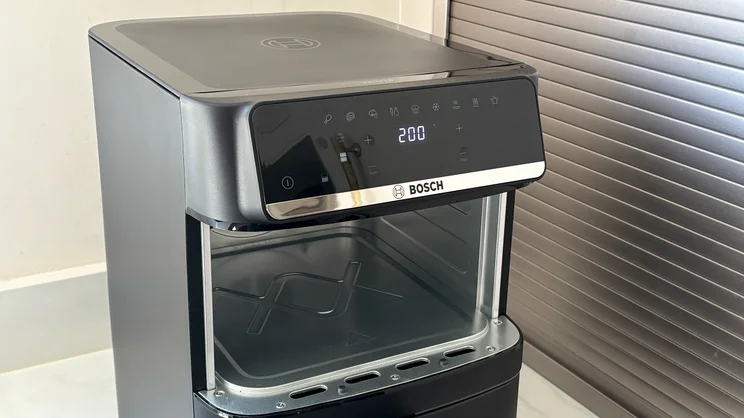
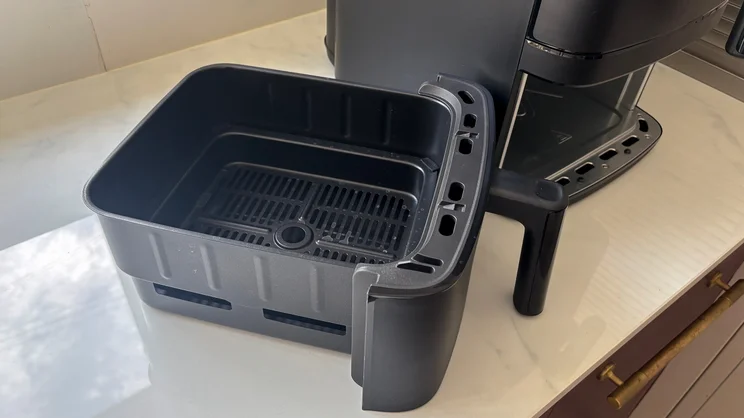
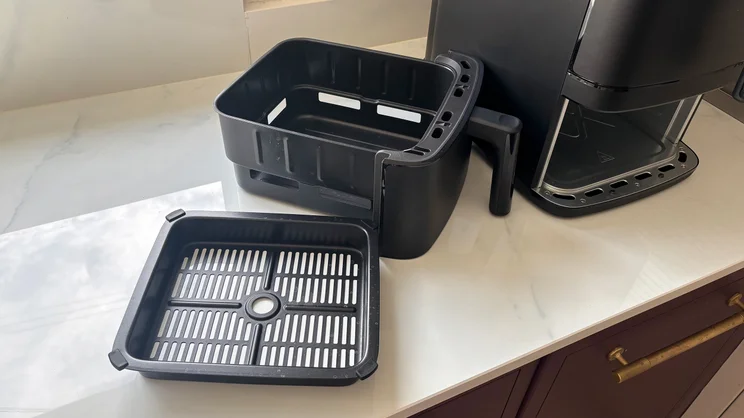
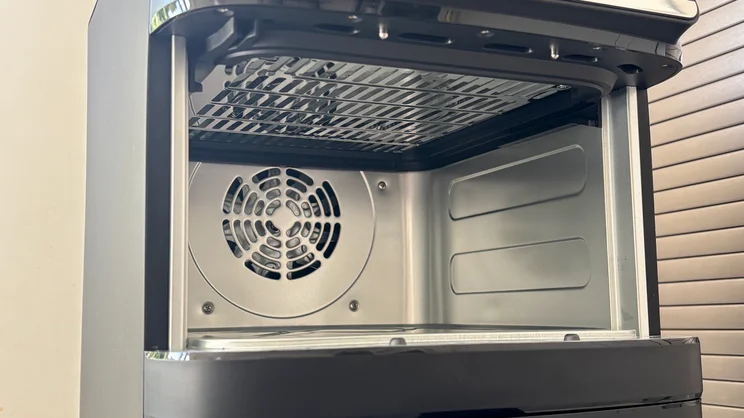
Its best features, however, are on the inside: two clever 6-litre drawers, both of which have cut-outs along each side for improved air flow, as well as crisper plates with raised edges to ensure food doesn’t slip down the sides. The smartest bit though, is the cavities into which each drawer slides. Rather than featuring an exposed element, the entire area is clad in stainless steel, so there’s no greasy coils to clean.
Nine presets cover six common food types, including poultry, fish and veggies, plus three programmes that busy families are sure to use often: defrost, reheat and keep warm. It’s been more than a year since the Series 6 Air Fryer was released, so I was keen to see how this latest stacked drawer model performed. While I felt that there’s still room for improvement, there’s a lot to like overall.
Bosch Series 6 Double Stack Drawer Air Fryer: What do you get for the money?
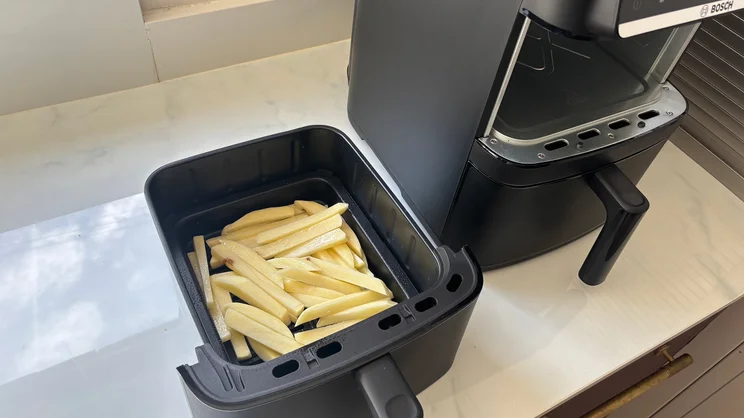
Cooking space is where the Bosch Series 6 Double Stack Drawer Air Fryer excels. It’s roomy in comparison to some of the best dual air fryers, with a pair of interchangeable 6-litre drawers making up its 12-litre capacity. Look closely and you’ll see that the design of these drawers differs slightly to those of many rival air fryers: letterbox-shaped gaps have been cut into the sides of each to improve air flow, while the raised edges of the crisper plates ensure that no food falls through the gaps.
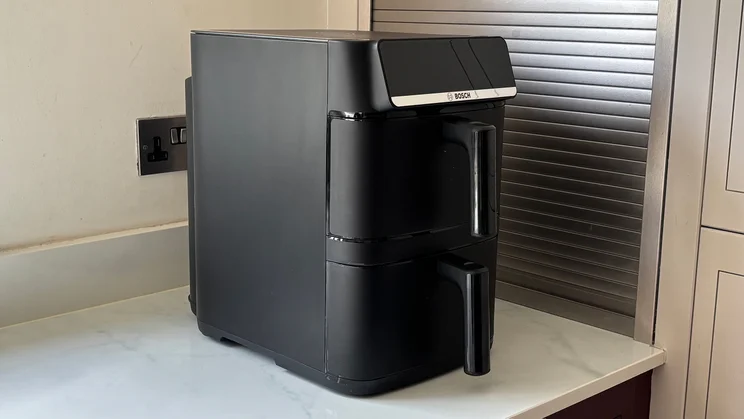
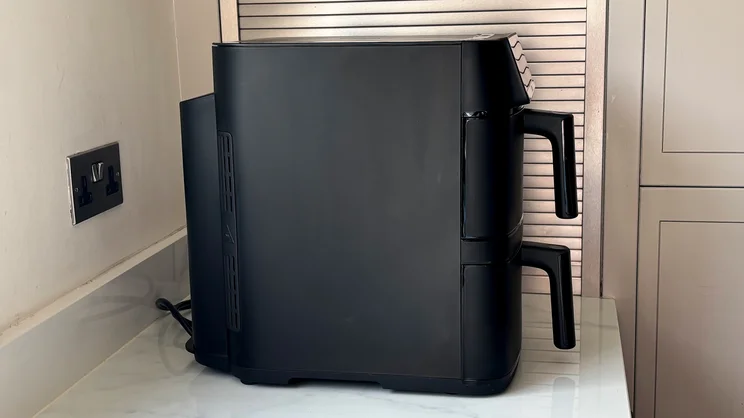
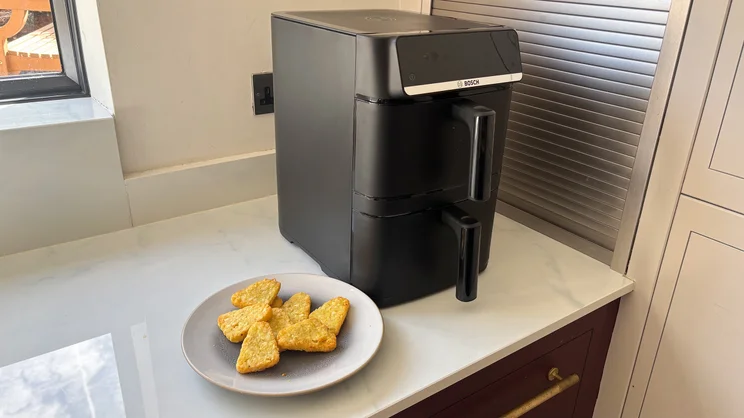
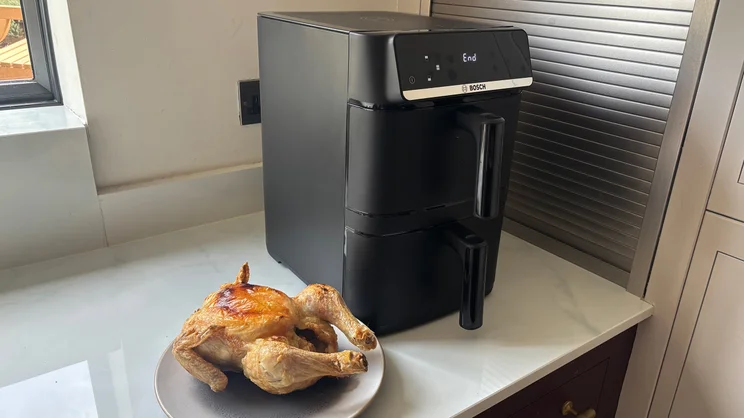
The drawers are stacked to minimise worktop footprint, but it’s still a sizeable appliance at 2.5 x 41 x 42.5cm (WxDxH), with an additional protruding section at the back. The Double Stack feels well-built and robust and, unsurprisingly, this translates to it being a fairly weighty 10.2kg.
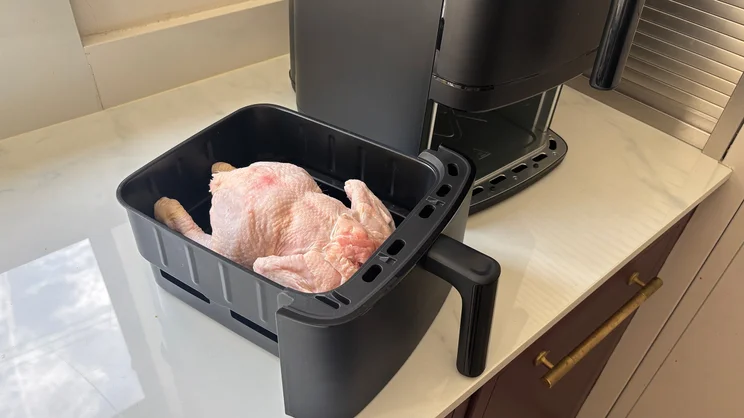
Each drawer has a crisper plate with raised edges. With this plate in place, there’s just enough height (10.5cm) to squeeze in a small chicken, but it’s a snug fit. It’s better suited to the examples of food capacity in the instructions: six chicken legs, two steaks or fish fillets, or 500g of grilled vegetables.
As is often the case with dual air fryers, the control panel is busy: there are six presets for cooking, three for ambient heat and a favourite button. There’s also the option to match the settings of both drawers, and to sync their finishing time, plus a shake alert. A low of 40°C allows the air fryer to be used for dehydrating – but only for a maximum of eight hours.
At higher temperatures, the maximum is one hour. Many air fryers only tend to reach top temperatures of 200°C, but the Bosch Series 6 Double Stack Drawer Air Fryer offers up to 230°C. Its wattage is accordingly higher too at a thirsty 2,800W. One hour’s usage at 200°C consumed 1.201kWh of electricity – at a rate of 25p per unit, this would cost around 30p.
How I tested the Bosch Series 6 Double Stack Drawer Air Fryer
Before any cooking happens, the first thing I do is test the power consumption of the air fryer by running it empty for 1 hour at 200°C, using a plug-in power meter to record usage. If the air fryer has two drawers, I will run both. If it’s one large drawer, I’ll make sure I remove any dividers before running it.
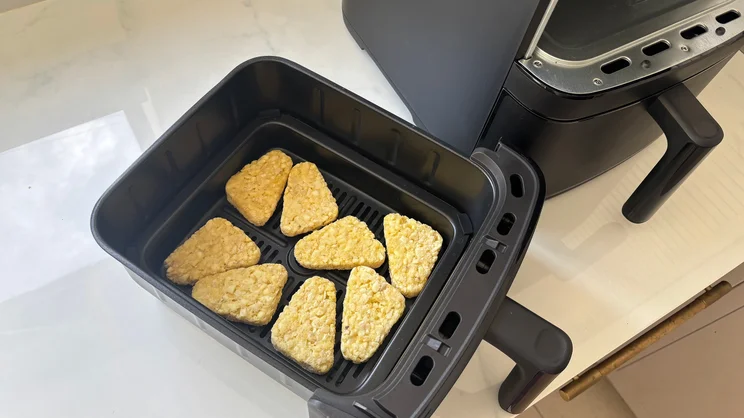
The first test is frozen food: I fill one section of the air fryer with frozen hash browns and note how many the drawer/s can comfortably fit. If the manufacturer provides cooking guidance, I will follow its recommended settings. Otherwise, I cook them for 18 minutes at 200°C, turning them over halfway through cooking. Once cooked, I note how soft or crispy the hash browns are, and how evenly they’ve been browned – if at all.
Next is homemade chips. After peeling and chopping potatoes into pieces, and soaking them for a few hours, they’re patted dry, and tossed in a small amount of oil (I use a blend of avocado and rapeseed oil). Again, if there’s cooking guidance for homemade chips, I follow it, but my go-to setting is 200°C for 30 minutes, shaking multiple times throughout cooking. I note how crispy the resulting chips are, if cooking is even throughout the batch, if any pieces are not cooked properly, and if they’re soft in the middle.
Finally, I’ll use the air fryer to cook chicken. A whole bird is ideal, usually at 180°C for 50 minutes, but I’ll opt for chicken legs if there’s limited space. I’ll turn the chicken over halfway through cooking. And once roasted, I carve the flesh, and note if the juices are running clear, if there is any pink flesh remaining, especially around the bone, and if the skin is crisp or brown.
In addition to my standardised cooking tests, I’ll make a note of how easy the air fryer is to use, how intuitive its settings and cooking instructions are, how quick and efficient it is, and how much space it takes up on my kitchen worktop.

What’s it like to use?
While it’s far from the worst example I’ve seen, the control panel has the potential to be confusing without the instructions to hand. Selecting the drawer you want to cook in – top, bottom or both – is easy enough, but from there it becomes more complex. For example, some icons could easily be confused with others: the snowflake icon for its defrost mode could easily be interpreted as ‘cook from frozen’, while the meat icon for ‘roast’ could be mistaken as a steak setting. Saving your favourite setting under the ‘MyFry’ button also involves going through a series of steps – it’s not just a case of choosing a time, temperature and saving it.
Sync is another function that involves pressing a series of buttons in the right order – select one basket, set it, select the other basket, set it, hit sync, then hit start. It’s a bit of a puzzle, but I did like that the sync function could be deactivated if you change your mind during cooking.
There were other peculiarities I discovered during the testing period. For example, when I synced the drawers to cook different foods, it removed the shake alert from both programmes. It’s also quite noisy when cooking with both drawers – I found it difficult to have a conversation over it – and it made my worktop and the surrounding areas very warm.
Its instructions provide some guidance but it’s skimpy. While there are examples of foods you can cook on each programme, it’s advisable to refer to its recipe book online via a QR code. Thankfully, however, things are much simpler when it comes to maintenance: the removable parts all have a PFAS-free coating, are dishwasher safe and equally easy to clean by hand.
The interior of the air fryer’s cavities are clad in stainless steel, shielding the element from splashes of grease and debris, and making clean-up easy: just wipe it out once the air fryer has cooled. Cleaning these flat areas is far easier than the awkward degreasing that a lot of air fryers require, while small holes in the cladding ensure that heat can penetrate.
How well does it cook?
Treat the presets of the Bosch Series 6 Double Stack Drawer Air Fryer as a starting point rather than the be-all-and-end-all. Not for nothing do the instructions advise that if food isn’t cooked, you should extend cooking or increase the temperature. I found myself doing exactly that for almost everything.
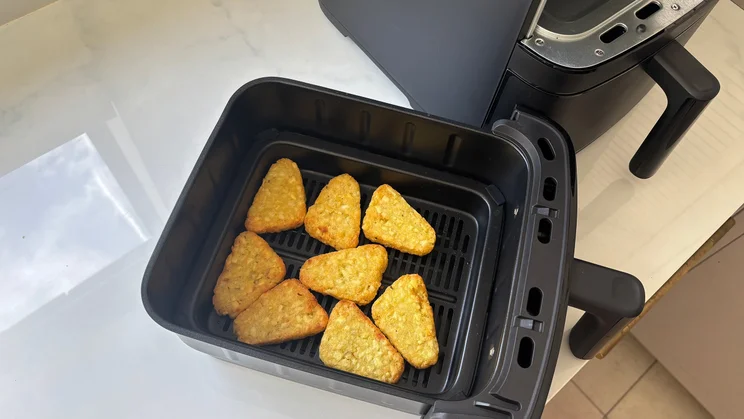
Eight hash browns fitted comfortably in one drawer. The shake alert is a default on most presets, so there’s no option for turning it on or off, or when it will sound. I found that with a cooking time of 18 minutes, the alert sounded with 10 minutes left to run (rather than halfway through), and again with a minute to go. The results were good with browning at the corners and they were crisp overall.
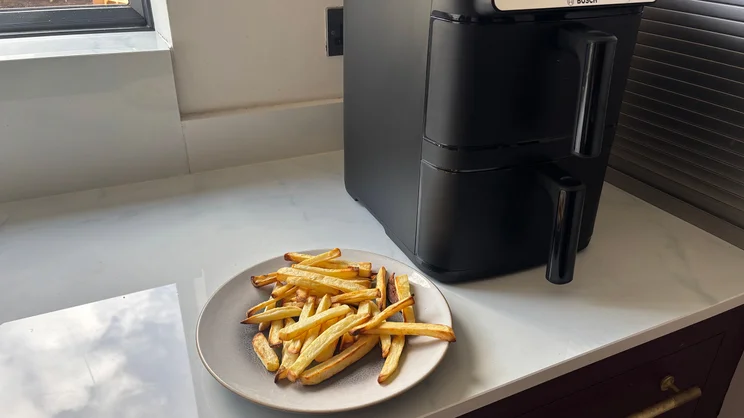
The fries preset is designed for frozen French fries, so I opted for my usual time and temperature. This resulted in the chips being mostly crisp and crunchy, with a few ends burnt. Inside, they were fluffy but smaller pieces were dried out. This wasn’t the best batch I’ve made so I tried again, with another batch at 180°C for 25 mins. This was better – paler but without burnt pieces and not as dry.
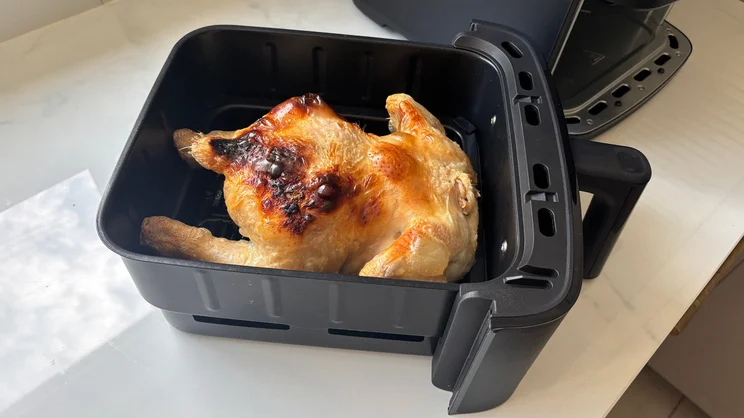
While there’s just enough space for a whole chicken (mine was 1.6kg), the guidance and preset are tailored to pieces. When I came to turn the bird over, I noticed that the bottom had started to burn. After reducing the temperature to 170°C, and rotating the bird in the drawer, the chicken was still burning with 10 minutes still left on the timer. Reducing the temperature again to 150°C finally stopped the blackening of the skin.
Fortunately, the meat underneath wasn’t burnt, but it did have a slight charred flavour. My conclusion was that even though there is room for a whole chicken, this air fryer may not be suitable for cooking it unless you choose a low and slow method.
Should you buy the Bosch Series 6 Double Stack Drawer Air Fryer?
The Series 6 Double Stack Drawer Air Fryer represents a real progression since Bosch dipped a toe into the air fryer market with its Series 6 Air Fryer MAF671B1GB. It has more capacity than many similar models, is easier to keep clean, and is competitively priced when compared with similarly sized models from mid-range brands. I also liked the option of higher heats, even though I didn’t use them during testing.
However, as I experienced, even the standard heats it offers can be prone to burning or drying out food. For this reason, I’d mainly recommend this model to those who are already familiar with air frying. A better model for newbies would be the versatile Philips 1000 Series (NA150/09) FlexDrawer Dual Basket Air Fryer. Alternatively, if you don’t need two compartments, the Cuisinart ClearView 9-in-1 AFC9U Air Fryer is especially beginner-friendly.