To help us provide you with free impartial advice, we may earn a commission if you buy through links on our site. Learn more
- Beautifully made
- Versatile range of grind sizes
- Consistent grinding
- Counterintuitive adjustment
- Expensive
The AeroPress is revered and respected by coffee lovers the world over. Just take a look at the World AeroPress Championships, in which 7,925 competitors from 70 different countries competed last year.
But when the AeroPress Manual Coffee Grinder launched in November 2025, many of the folks over on the Reddit coffee forums wrote it off as a cash grab. The price doesn’t dispel that notion. At £199, it’s very expensive for a manual coffee grinder, but I’ve been spending time with it over the past few weeks and have to admit that I’m a fan.
It’s a largely accurate and consistent grinder that can handle anything from espresso fineness to the coarsest cafetiere grind. And while the confusing nature of its grind size adjustment got on my nerves, it’s slim design won me over.
AeroPress Manual Coffee Grinder review: What do you get for the money?
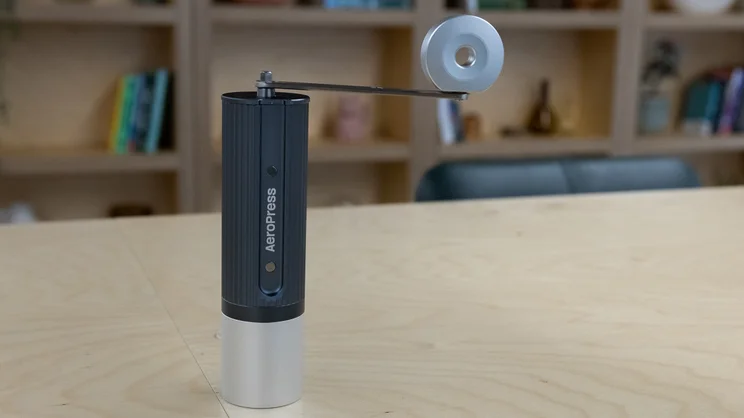
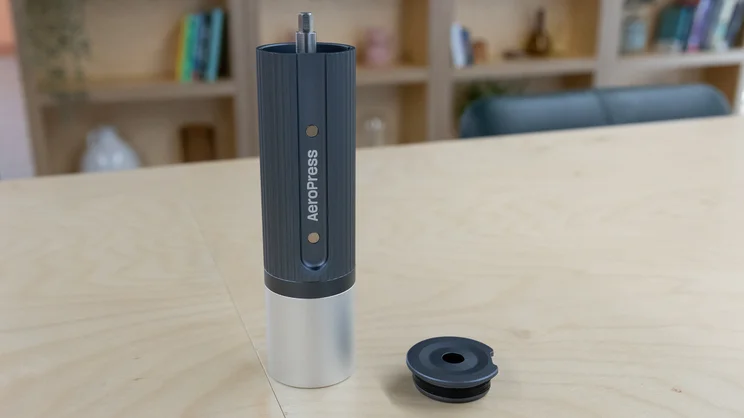
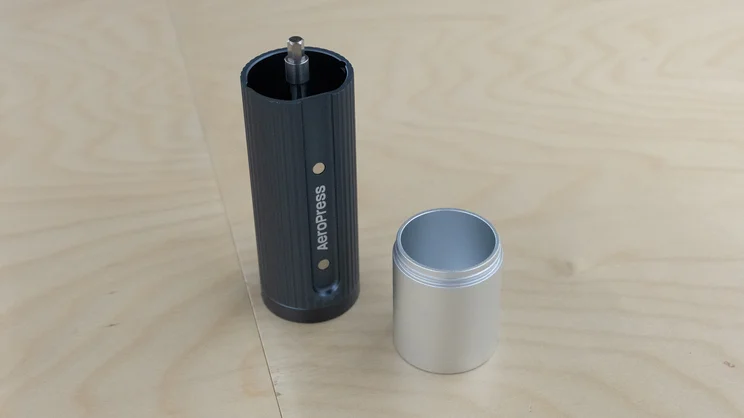
The Aeropress Manual Grinder has an attractive, slim build, a design that’s pretty in vogue for manual coffee grinders right now. Its cylindrical metal body is made up of a hopper, stainless steel burr grinder, detachable handle and a small grounds container that screws onto the bottom. This container holds 20-25g of coffee, while – according to my measurements – the hopper holds about 30g of beans. The main body and container are made of anodized aluminium, while all other parts – including the handle – are stainless steel.
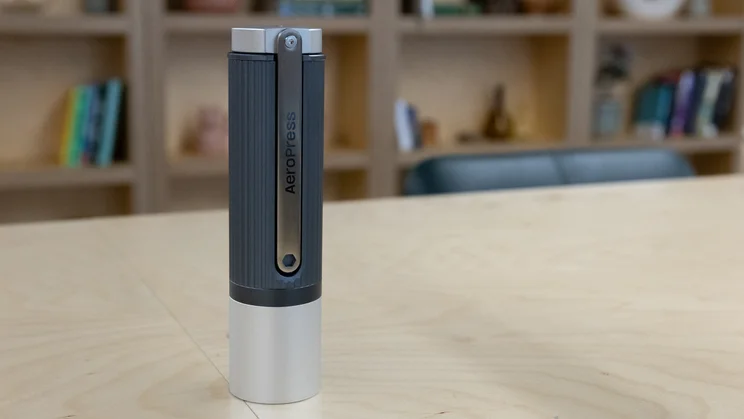
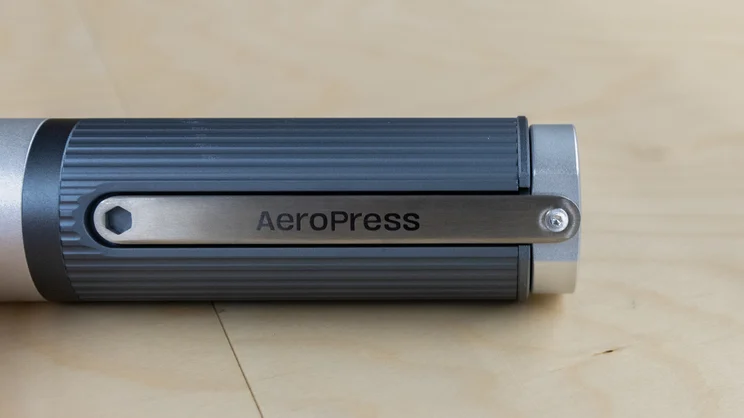
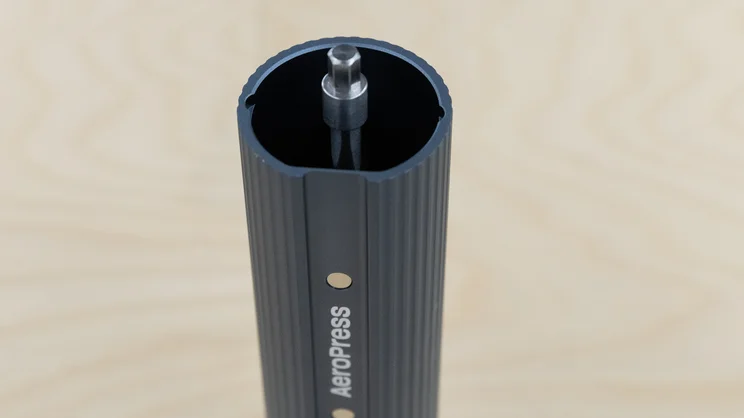
The handle slots loosely onto the top of a rod that runs through the grinder. And when not in use, it attaches to the side, running flush along a magnetic groove.
This is a neat design that means, when it comes to storing it away, you can keep all of the parts together without the handle jutting perpendicular to the grinder. Not only that, but the AeroPress Manual Grinder fits neatly into the plunger of the Aeropress itself. It’s not alone in this respect (manual grinders such as the 1Zpresso Q2, TimeMore Slim and Knock Aergrind are also sufficiently slim), but it’s nonetheless a very satisfying space-saving solution for AeroPress users.
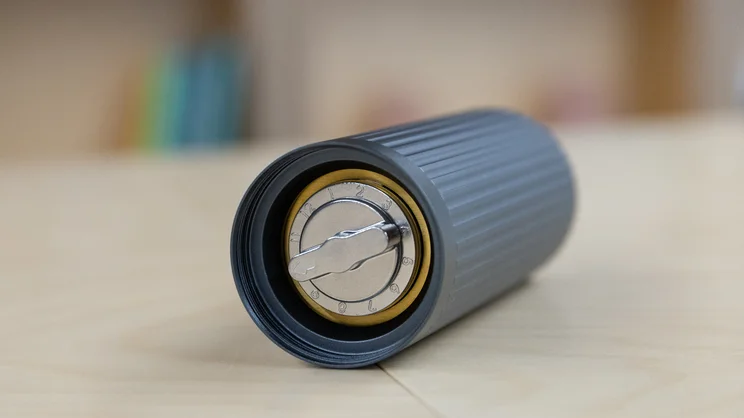
Grind size is adjusted via a dial on the base of the grinder, which can only be accessed with the grounds container removed. This dial is numbered from 1 to 12, and works on a system of “rotations” and “clicks”. I’ll explain this process, which I found quite convoluted, in more detail in the next section. But essentially, you turn the dial clockwise to grind finer, and anti-clockwise to grind coarser.
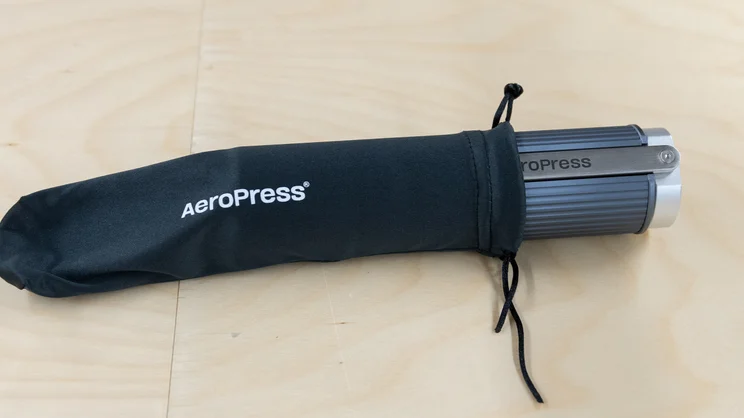
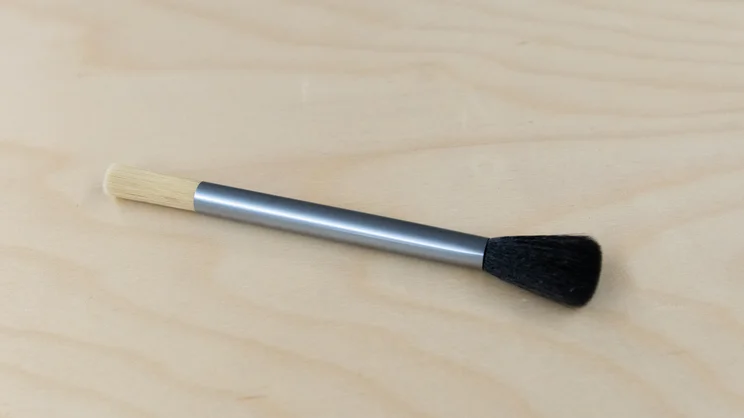
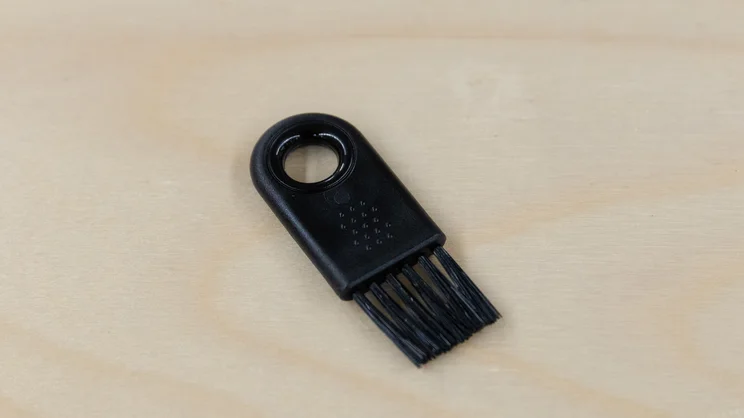
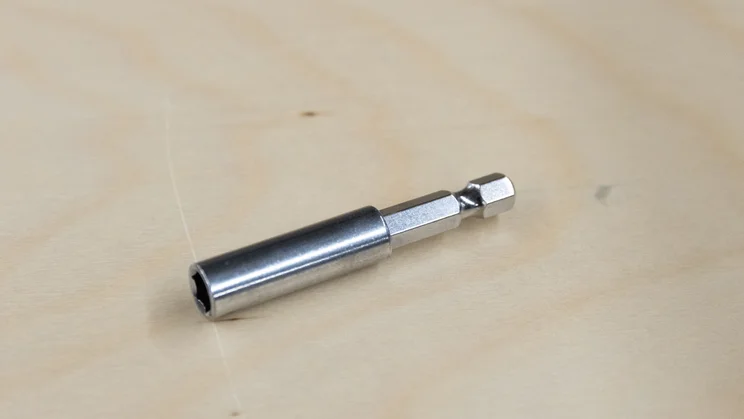
You get a few useful accessories included with the AeroPress Manual Coffee Grinder: two cleaning brushes, one of which is a small crevice tool and the other a larger, double-sided brush; a power drill adapter that slots on top of the grinder in place of the handle; and a drawstring travel pouch.
How did I test the Aeropress Manual Coffee Grinder?
To test the range and consistency of coffee grinders, I use a simple tool: the Kruve Brewler. This allows me to get a measurement of grind size along a scale of 200-1600 micrometres (μm).
As the Brewler is little more than a thin ruler, perforated with holes of various sizes, there’s a fair amount of eyeballing involved. Nevertheless, it allows me to at least approximate grind accuracy and consistency.
Beyond the Brewler test, I use the grinder to prepare coffee for a variety of brewing methods – including espresso, Aeropress, pour over and cafetiere – while making a note of how well it’s suited to each.
I also consider how easy the grinder is to use and clean, and whether it’s good value for money when weighed up against the competition.
What is it like to use?
Grinding coffee with the Aeropress Manual Coffee Grinder
Manual coffee grinders inevitably require more effort than electric ones. Nevertheless, I didn’t find grinding with the AeroPress Manual Coffee Grinder to be too laborious. Obviously, the finer the grind, the longer and more difficult the grinding process – and when grinding espresso-fine coffee, the hand with which I gripped the main body of the grinder did get sore after a while. I would expect as much from a manual grinder though, and I was able to rest my thumb comfortably enough in the groove along the main body.
The chunky medallion-like handle is a decent size and feels comfortable in the hand, too. However, because it sits pretty loose on its axis, it can come off if you’re not careful. This happened to me on a couple of occasions, and I recommend not grinding too aggressively and making sure you keep the grinder level as you do – as AeroPress recommends in its instruction manual.
Adjusting the grind size
This is where things get a bit more tricky. Grind size is adjusted by rotating a dial, located on the base of the grinder between the main body and the grounds container. You need to insert the handle on the top of the grinder and hold it in place to prevent the whole mechanism rotating as you turn the dial. This can be a bit fiddly.
What’s more, because the dial is so close to the burrs of the grinder, you’ll probably want to brush away any loose coffee stuck to the bottom before you make any adjustments – unless you want to get coffee all over your hand. That said, you might want to do this anyway when switching grind sizes, to avoid any old grinds contaminating your next dose.
Physically adjusting the grind size is the easy part. What I found much more difficult was understanding Aeropress’ instructions regarding grind setting recommendations for various brewing methods.
As I mentioned above, grind adjustment works on a system of “clicks” and “rotations”. Essentially, the grinder allows you to rotate the adjustment ring fully five times, and within each full “rotation” are 12 clicks (or steps), each setting indicating a given round fineness. For instance, clicks within “rotation one” will be finer than those within “rotation five”, while “rotation one, click eight”, is four clicks coarser than “rotation one, click four”.
Where it gets confusing is how Aeropress presents the numbers on the dial itself versus its instruction manual. The dial is numbered 1-12 around the circumference, ascending in a clockwise direction as grind size gets finer. However, in the instruction manual, the higher the click number, the coarser the grind. That’s because “click number” in this context refers to how many steps you’ve turned the dial by, not the number indicated on the dial.
So, “rotation three, click six” – the brand’s recommended setting for Aeropress brewing – corresponds with the adjustment dial pointing to number seven: six clicks in an anti-clockwise direction from the beginning of rotation three.
Get it? It took me a while.
Why have a numbered dial at all then? The numbers do serve one purpose: they indicate where the beginning of each new rotation is. But I can’t fathom why you wouldn’t have the numbers on the dial ascending in the same direction as the “click” direction (i.e. anti-clockwise).
What’s more, there’s no way of telling, at a glance, what rotation the grinder is currently set at. So if you happen to forget, the best thing to do is to dial all the way back to rotation one and work your way through to your desired setting from there.
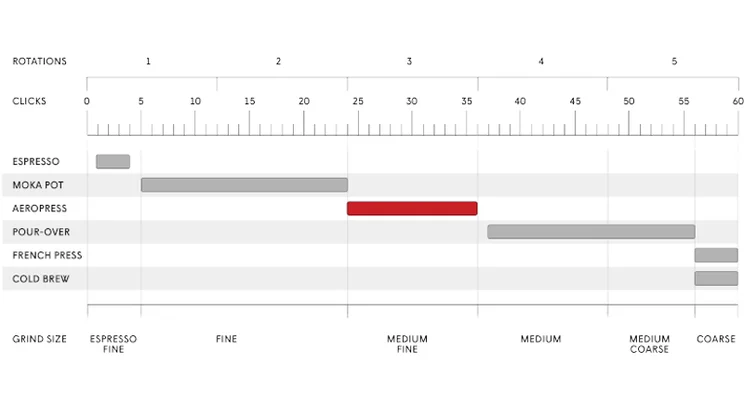
Interestingly, the grind size adjustment chart on AeroPress’ website presents things a little differently. Here, you’ve got the number of clicks set out as a single range from 0-60. I think this is a much better way of framing it, and I don’t know why the brand didn’t stick with the same chart for the manual.
How well does it grind?
Grind accuracy test
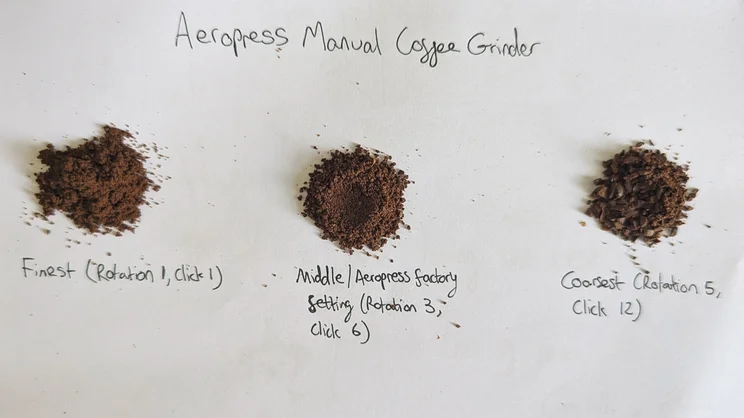
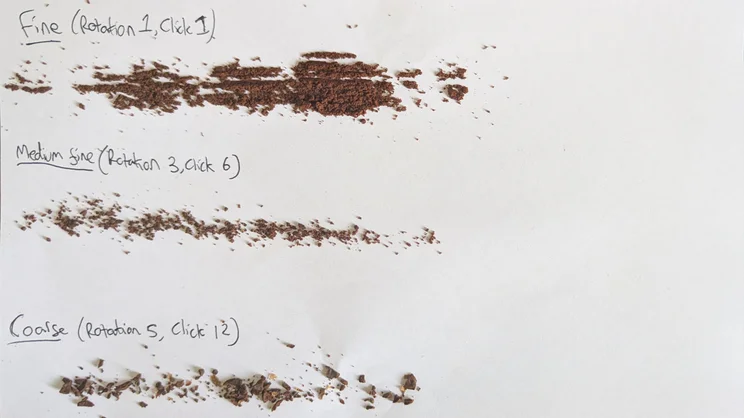
Despite the difficulties I had deciphering the grind size settings, I carried out my usual grind accuracy tests, using the Kruve Brewler to measure consistency and accuracy for three grind sizes: finest (rotation one, click one), coarsest (rotation five, click 12) and the recommended medium fine setting for Aeropress coffee (rotation three, click six).
The AeroPress Manual Coffee Grinder does a great job of grinding for espresso, achieving a fine and largely consistent 300-500 micrometres (μm), which is well in line with Kruve’s espresso recommendations. Rotation three (click six) produced a grind size around 600/700μm, the upper end of “medium/fine” on the Kruve scale and accurate to both AeroPress’ and Kruve’s recommendations for AeroPress brewing.
The grinder was just as capable at the coarse end of the scale, with the chunky grounds produced at rotation five (click 12) exceeding the 1600μm on Kruve’s scale. These were impressive results that almost made me forgive the AeroPress Manual Coffee Grinder’s convoluted grind settings.
Taste tests
I used the AeroPress to grind coffee for a range of brewing methods, with mixed – but largely positive – results. I happened to be testing the AeroPress Steel around the same time as the AeroPress grinder, and I managed to get some very nice brews using both in tandem. This is also testament to the AeroPress’ ability to produce great-tasting filter coffee with (relative) ease.
Espresso was up next, which was less of a triumph. While the AeroPress Manual Coffee Grinder could grind a very fine, even consistency (as seen in my grind tests above), I found that the brand’s recommended settings for espresso choked my machine. I’ll put my hands up and say this could also be down to user error on my part: I’ve been brewing espresso with the Ninja Cafe Luxe Pro, which is a bit tricky to get good results from when you’re avoiding the in-built grinder for which it’s optimised. I think that with some trial-and-error, I could have had better success in finding the sweet spot without recourse to AeroPress’ recommended settings. Nevertheless, I moved on from espresso after this disappointment – largely in an effort not to use up all of my beans.
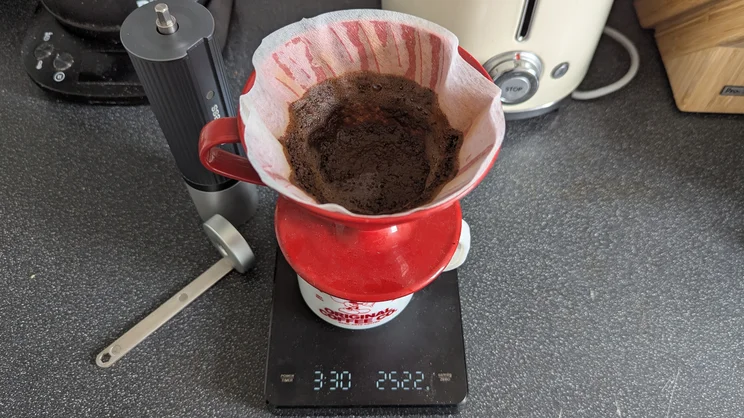
Thankfully, I was much, much happier with my following filter attempts. Coffee brewed with a Hario V60 took a couple of runs to get spot on, but I found that grinding a little finer than the recommended pour over consistency produced a perfectly timed brew, a tasty cup and a nice even, flat bed of leftover grounds.
Brewing for my cafetiere was a success too: I ground coarse (at the finer end of the french press recommendation, within the fifth rotation of the grinder’s adjustment dial), and allowed the coffee to brew for around 10 minutes – with a nice, evenly extracted cup of coffee as the result.
How easy is it to clean?
With the provided brushes, the AeroPress Manual Coffee Grinder is simple to clean. For daily cleaning, you can easily brush around the adjustment dial and shaft of the hopper.
The grinder comes apart for deep cleaning, which AeroPress recommends you do every few months – or whenever you feel that it needs a particularly good clean. It comes apart easily enough, but I highly recommend watching this video before you get into it yourself. There are three different types of washer and it’s important not to lose track of where they go and which way round they’re positioned. I went about this by lining up the parts so they could easily be put back in reverse order once I’d brushed them down (AeroPress cautions against washing the parts with water).
Putting everything back together is simple, provided you’ve kept the parts together and know which order you removed them in. Screwing the dial back on is a bit more fiddly, as you’ll need to keep a hold of the handle and push down on the dial to ensure the spring is depressed.
Is it worth the price?
Whichever way you cut it, £200 is very expensive for a manual coffee grinder. Yes, it can grind at an impressive range of consistencies, but it’s not alone in this. The KinGrinder K6 was a favourite of our former coffee expert, Sasha Muller, who praised it as a great option for espresso in his De’Longhi Stilosa review. What’s more, you can pick this up for half the price on Amazon.
And considering that other hand grinders I mentioned can also fit into the AeroPress plunger, this feature is not quite the unique draw that AeroPress would perhaps like it to be.
As I mentioned in my introduction, I’ve come across plenty of sceptics while trawling the coffee subreddits online. Accusations of a “cash grab” on the part of AeroPress are common. And while this is a rather extreme accusation that I’m not endorsing here, there’s no ignoring that price – particularly when you can buy the fully automatic Baratza Encore ESP Pro for only £50 more.
Should I buy the AeroPress Manual Coffee Grinder?
I can’t hide my fondness for the AeroPress Manual Coffee Grinder. It grinds well, looks and feels lovely, and its magnetic handle storage solution is very satisfying.
But there are two major barriers standing in the way of a wholehearted recommendation from me. The first is understanding the grind adjustment settings. With a bit of trial and error, I’ve found you can get some great coffee from this manual coffee grinder, but it takes some time getting there. The second is the high price, which at £200 is, I’m afraid, just too high.
As it is, it’s an option worth considering if you’re in the market for a manual coffee grinder, but not without considering all of the other options first.