To help us provide you with free impartial advice, we may earn a commission if you buy through links on our site. Learn more
- More accurate PID-based temperature setting
- Brass boiler
- Simple and intuitive
- Water level is difficult to see
- Tank is a pain to remove
The Gaggia Classic UP is the latest model in what has become a legendary marque in the world of domestic coffee machines. Debuted way back in the early 1990s, the bombproof Gaggia Classic and the Classic Pro have powered millions of morning coffees for home espresso enthusiasts for decades. But things change, and in the recent global obsession with espresso nerdery, this much-loved machine has felt a little stuck in the mud.
Gaggia has slowly but surely been fighting back. Last year’s launch of the premium Gaggia Classic Pro GT signalled a new era of home coffee machines for the company, introducing a whole tranche of modernisations, from dual brass boilers with accurate PID temperature monitoring, to customisable pre-infusion, shot timing and manually adjustable brew pressures. But it also brought a very high price along with it, a monster £1,999 (though this has since dropped to around £1,500).
The Gaggia Classic UP attempts to bridge the affordability gap. It brings some of those features in at a considerably lower price, while building on the capabilities of the company’s previous “low end” consumer offering – the Gaggia Classic E24.
What you need to know
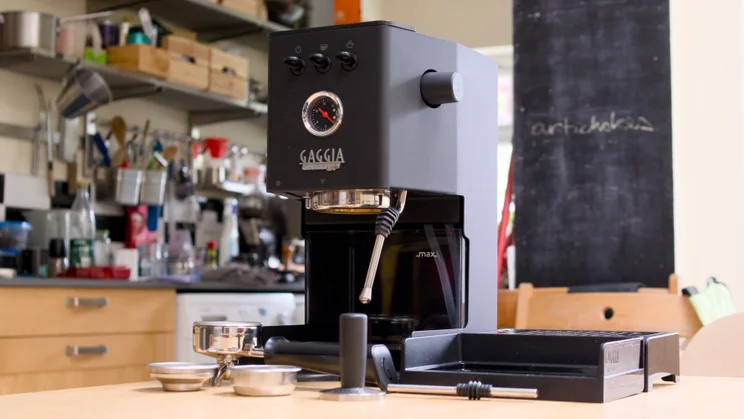
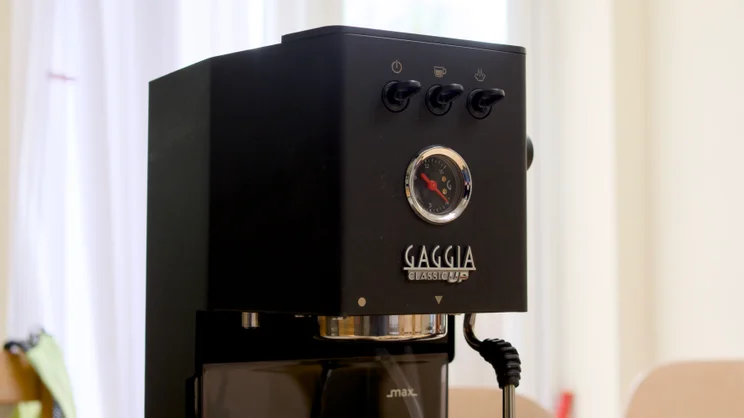
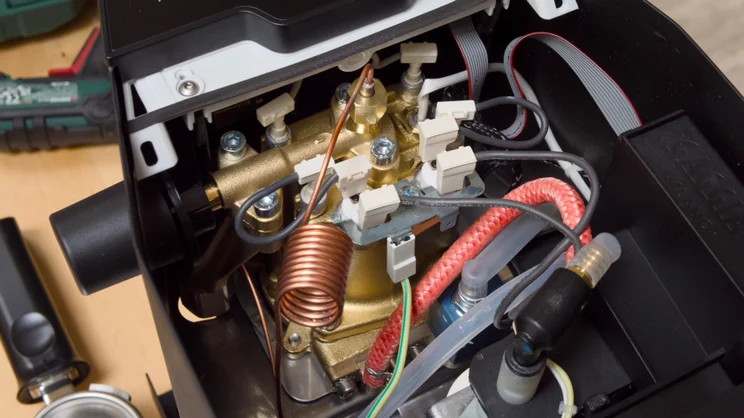
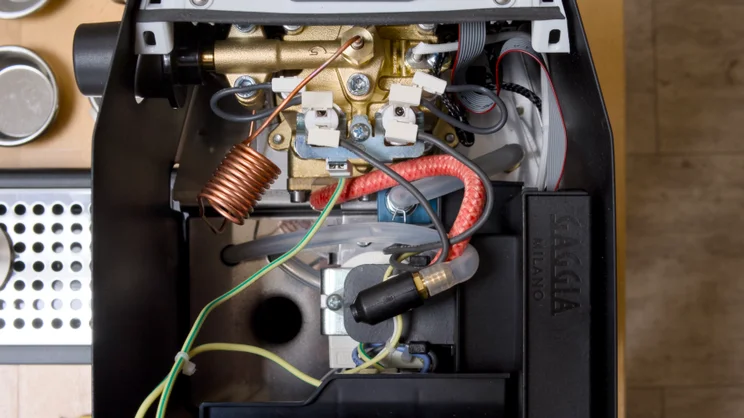
The Gaggia Classic UP doesn’t throw out the baby with the bathwater, though. It uses the same thick-gauge stainless steel chassis the Classic has used for years, with the same compact footprint and super-solid build. Like the E24 introduced last year, the Classic UP has an upgraded brass boiler and grouphead, but no second boiler like the Classic GT.
The biggest upgrade is that instead of a standard thermostat for temperature sensing, the Classic UP comes with PID temperature control for both coffee brewing and steam generation. A PID (Proportional-Integral-Derivative) controller enables much more precise temperature control, in one-degree increments, making consistent shots much easier to produce.
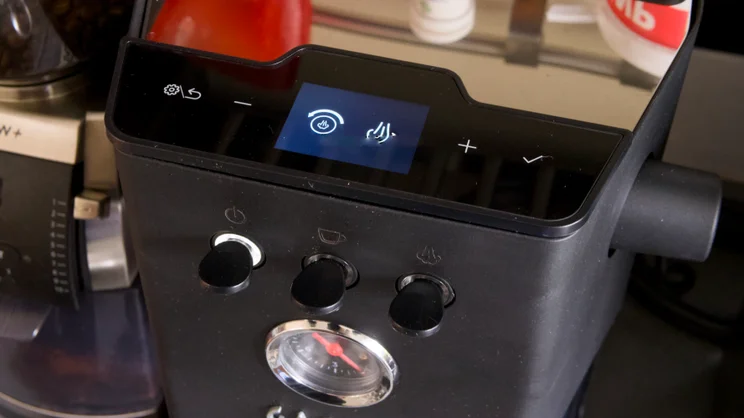
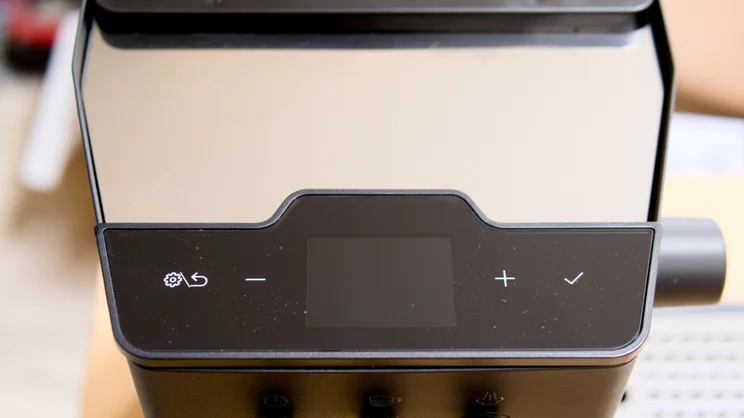
Other improvements include a bright white-on-black LCD screen fitted into the top edge of the machine, which provides access to the UP’s settings. You can now add a burst of “pre-infusion” before the machine gets to pulling the shot proper. This is a process in which the machine lightly wets the coffee in the portafilter to stabilise it and prevent a phenomenon called channelling, where water under pressure forces channels in the coffee puck, ruining the steady flow that makes for great espresso.
This model also gets a modicum of automation, should you want it: you can set timed shots – with previous machines, you’ve always had to start and stop the machine manually. You can also now set a time for the machine to wake up in the morning, so when you stumble into the kitchen bleary-eyed, it’s ready to go.
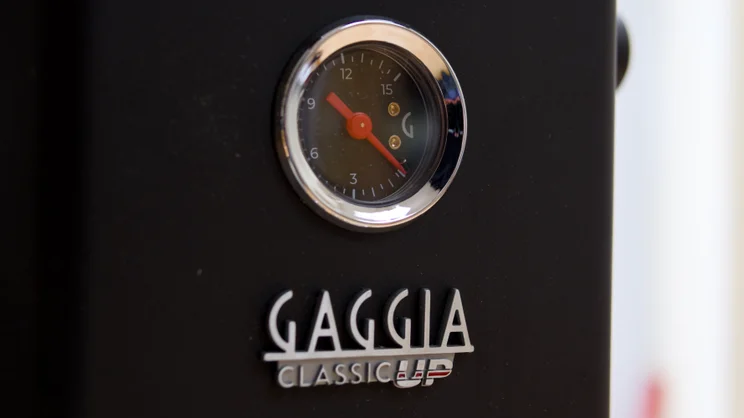
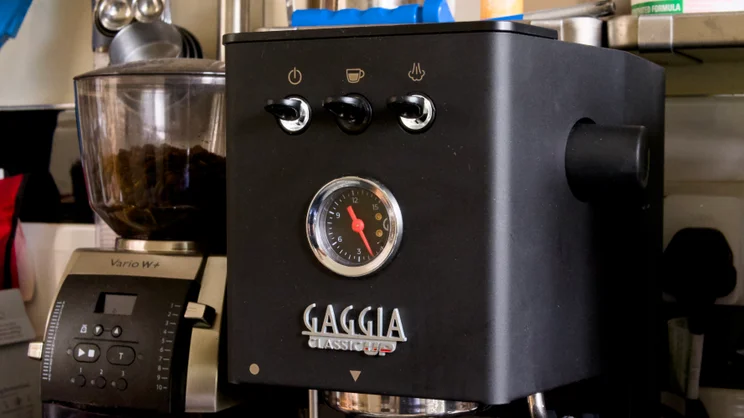
What you don’t get, alas, is any pressure adjustability; it’s set to the industry standard 9 bar. The pressure dial on the front, which is also new, is useful only as a diagnostic aid or to tell when the machine has built up enough pressure to start steaming.
Price and competition
For all of these upgrades, Gaggia is charging a healthy fee: £850, around £350 more expensive than the Classic Pro E24 – until now, the go-to Gaggia model for espresso enthusiasts.
If that sounds expensive, it’s important to note that this isn’t exorbitant in the context of coffee-machine exotica. The aforementioned Gaggia Classic GT has a list price of £2,000 (although you can get it for around £1,500 now), and our current pick of the semi-automatic espresso machines – the Sage Oracle Jet – costs £1,700. A cheaper model of this is available – the Sage Barista Touch Impress – but it’s still £1,200.
You don’t have to spend this much, of course. We quite like the Ninja Cafe Luxe Premier. It’s a bit gimmicky, and I’d prefer to have a separate grinder. Still, it will handhold you through the process of making espresso for under £500, eliminating much of the guesswork involved in using a more serious machine like the Gaggia Classic UP. And there are innumerable budget choices in the £200 to £400 price band, one example being the excellent £200 ProCook Espresso Coffee Machine.
There’s plenty of choice in the Gaggia’s price bracket, too. Rivals include the Profitec Go at around £849, and the Lelit Victoria at £760, both PID-based machines with brass boilers and roughly equivalent feature sets. Alternatively, you could go for a pre-modded Gaggia Classic Pro E24 for upwards of £755, although if you’re buying new, do check that you’re getting a decent warranty, as modifications void the factory offering.
Finally, as a more budget-conscious alternative, you could pick up a second-hand Gaggia Classic or Classic Pro and mod it yourself, as I did a couple of years ago with the Gaggiuino system. Beware, though: you may have to repair or recondition the machine as you go and potentially replace parts, so it might not be as cost-effective as it first appears.
Design and ease of use
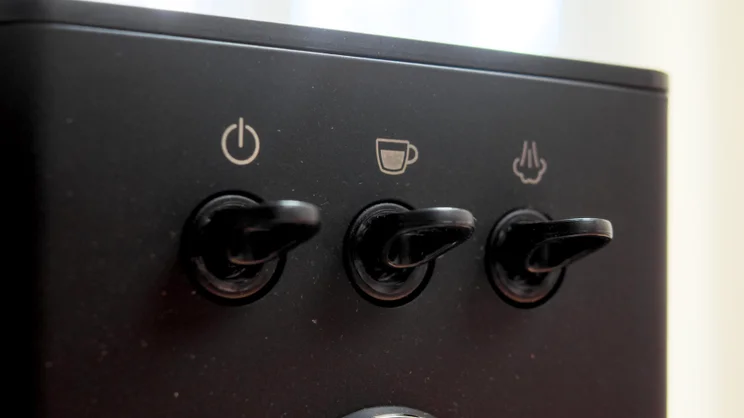
If you’ve ever seen or come across a Gaggia Classic or a Classic Pro, then the Classic UP will be a familiar sight. Finished in tough, matte-black paint over a robust stainless steel chassis, the body of the machine is the same as ever, despite the pressure gauge up front, that LCD screen up top and the new trio of toggle switches on the front panel.
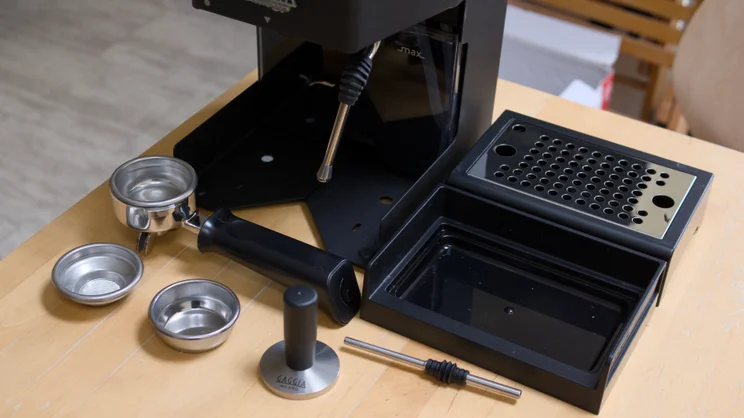
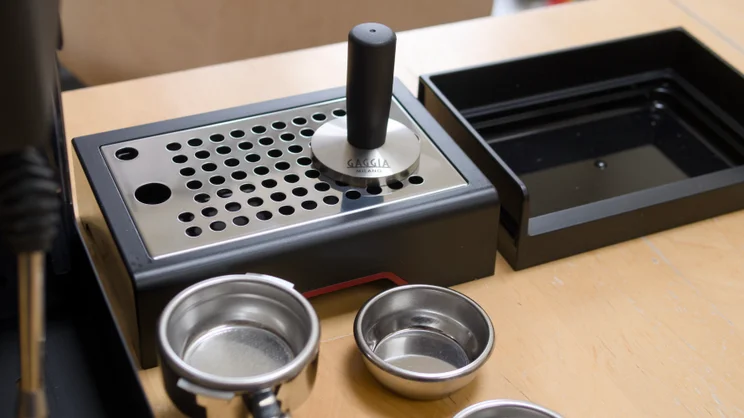
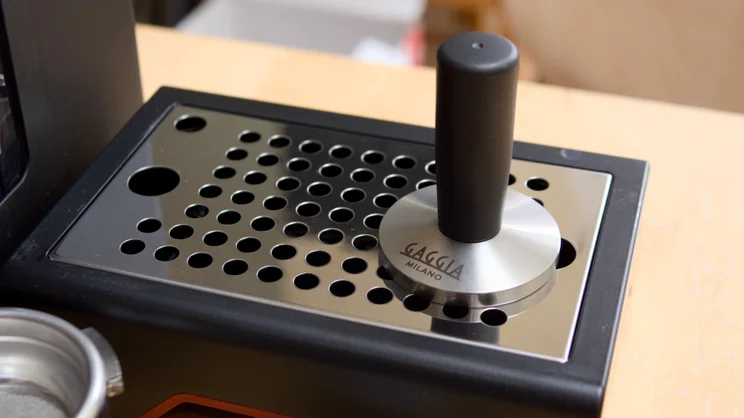
In some ways, this is a good thing. Gaggia has put all the upgrade investment into things that matter to making quality coffee, rather than shiny extras. And everything feels built to last, down to the heavy stainless steel 58mm portafilter and bundled Gaggia-branded steel tamper. The machine also comes with a fully articulated steam wand and a low-profile drip tray, giving you the clearance needed for taller cups and a bit more room for those using scales.
The more techy upgrades have been carefully judged, too. The capacitive touch buttons on either side of the LCD screen are sensitive, making the system’s simple menus very easy to navigate. And the simplicity of it all is on point. To adjust the target temperature, simply tap the plus and minus symbols. The pre-infusion settings are just as easy to access and offer you three choices: low, medium or max.
It’s a breath of fresh air, and in a world where every new device and domestic appliance seems to get more complicated with each subsequent release, it’s particularly great to see that you don’t have to connect this thing to the internet.
And yet, I do find myself wishing Gaggia had been a little more ambitious. I would have liked to adjust the pre-infusion timing on a more granular level, and some control over brew pressure would be welcome, too.
Frustrations and niggles
I was also disappointed to see that Gaggia hasn’t resolved some of the frustrations with the original. Most of these concern the water tank, which is situated at the back of the machine behind the drip tray. It’s fillable via a spout on top of the machine, but if you want to remove it for cleaning or descaling, you have to remove both the drip tray and lift the telescopic drain tube before you can slide the tank out.
Replacing the tank when it’s full of water is annoying, too. If you’re not gentle, water can slop out the back onto your work surface, and lifting the inlet tubes into place is a faff, as they tend to snag on the side of the tank. And if the machine is hot, you’ll have to be careful not to burn your hand as well.
What’s worse than this is that there’s no way to easily see how much water is left in the tank other than bending down and eyeballing it through its clear perspex walls. You’d think that Gaggia would have worked out a simple solution by installing a simple LED light, maybe, or a float indicator. It’s not just an inconvenience, either. If you ever miss that the water is low and pull a dry shot, it can create an airlock in the system and damage the pump.
One final irritation I have is that the machine remembers which mode you used when you switched it off. So, if you leave it in steam mode, that’s how it starts up the next time you turn it on. Instead of heating to your target brew temperature, it will overshoot and need cooling before you can brew your morning flat white.
How did we test the Gaggia Classic UP?
I used the Classic UP as my main machine for two weeks before writing this review. But in addition to my routine of brewing two coffees for myself and my wife every morning, I also carried out several more formal tests, comparing the machine with my own 1990s Gaggia Classic, modded with the PID-based Gaggiuino system.
With each machine dialled in, I measured the temperature of the puck immediately after pulling each shot, and the time taken to produce an espresso with a coffee-to-liquid ratio of 2:1. A gap of around three to five minutes was left between shots. The target temperature here is not the main aim; it’s stability and consistency. Once you’ve dialled in, you only want to make small tweaks. I also timed how long the machine took to steam 150ml of milk from fridge temperature to 60 degrees.
Performance
As you’d expect from a machine with a brass boiler and in-boiler PID temperature control, that consistency is excellent. Even my computer-controlled 1990s Gaggia Classic (aluminium boiler) can’t maintain the same levels as the Classic UP. However, it does show what can be done with a relatively simple upgrade and some clever algorithmic control, as it’s not far off.
It doesn’t take an awful long time to heat from cold to 94 degrees, either – around five minutes – though for best performance I’d advise leaving it a touch longer. It’s quick to steam milk, too. For 150ml of milk, it took just over 40 seconds to hit 60 degrees. The provided steam tip has a single nozzle, which can be removed and replaced with a multi-hole nozzle if you prefer.
What these numbers indicate, if you needed any persuading, is that the Gaggia Classic UP is a solid performer. What it isn’t, however, is particularly forgiving. As with the Gaggia Classic Pro and E24 models, the UP is capable of superb results, but you will need a decent grinder, and you do need to know roughly what you are doing.
You won’t get far without a set of accurate scales, either, and good-quality beans are a must. Whatever you do, don’t go out and buy pre-ground espresso and expect mind-blowing coffee, because it just won’t happen.
| Gaggia Classic UP | Target temperature | Final puck temperature | Shot time (seconds) |
|---|---|---|---|
| Espresso 1 | 94 | 91 | 27 |
| Espresso 2 | 94 | 90 | 27 |
| Espresso 3 | 94 | 91 | 23 |
| Espresso 4 | 94 | 90 | 26 |
| Espresso 5 | 94 | 91 | 25 |
| Gaggia Classic (Gaggiuino) | Target temperature | Final puck temperature | Shot time (seconds) |
|---|---|---|---|
| Espresso 1 | 94 | 88 | 27 |
| Espresso 2 | 94 | 87 | 24 |
| Espresso 3 | 94 | 88 | 27 |
| Espresso 4 | 94 | 86 | 27 |
| Espresso 5 | 94 | 87 | 22 |
Gaggia Classic UP review: Verdict
Like the rest of the Gaggia Classic stable – the Pro, E24 and GT – the UP is a solid, likeable machine that is capable of producing tasty espresso time after time, and it’s built to last. And if it requires fixing at any point, there are so many Gaggia machines that parts are relatively easy to come by.
It has its quirks, and other machines in the same price range offer comparable – if not superior – feature sets. You can buy machines for less money that make the espresso-brewing process a far simpler affair, and hardcore enthusiasts may be better served by purchasing a pre-modded machine.
But if you have around £850 to spend, this is not a purchase you’re going to regret. It’s a classic design, beautifully crafted and as long as you look after it, it should keep you supplied with quality coffee for many years to come.