To help us provide you with free impartial advice, we may earn a commission if you buy through links on our site. Learn more
- Mops and vacuums in one
- Floors dry quickly
- Simple to empty and keep clean
- Struggles with really stubborn dirt
- Charging base is bulky
Mopping the floor, let’s face it, is a pain. You’ve got to break out the vacuum or sweep the floor first to get rid of dust and debris. Then dig out your mop and bucket, push increasingly dirty water around the floor for what seems like an age … then wait for it all to dry before you can walk on it again. It’s not backbreaking work, but it’s tedious and messy – and Karcher’s FCV 3 is designed to make it easier.
As it says in the name, the FCV 3 is a combination vacuum and mop that’s designed to save you the hassle of having to sweep (or vacuum) the floor before mopping. Its two-tank clean and waste water system ensures you’re not always pushing dirty water around the floor, and because it doesn’t leave too much water behind as it cleans you won’t have to wait long before your floors are walkable again.
I was skeptical before I tried it out, but now I’m sold. Every home needs a device like the Karcher FCV 3.

What do you get for the money?
Previously, what always put me off devices such as these was the price, and the Karcher FCV 3 isn’t super cheap at £199. But it is £100 cheaper than the Dyson PencilWash, adds vacuuming into the bargain, and it’s only £50 more expensive than the Philips OneUP 5000: a much simpler device that doesn’t have a motorised roller. In my view, it’s worth paying the extra over the Philips, for that extra convenience.
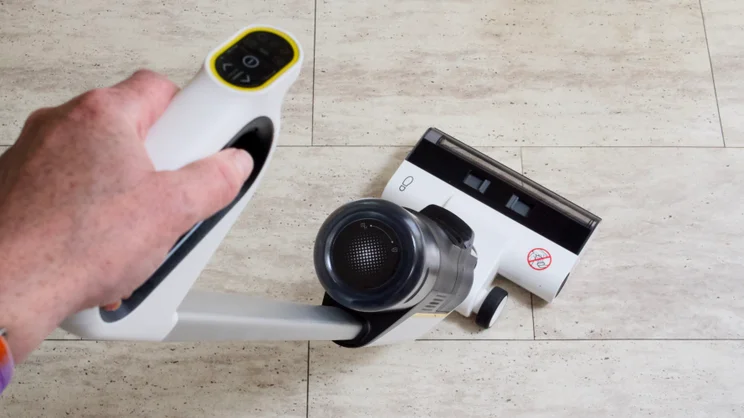
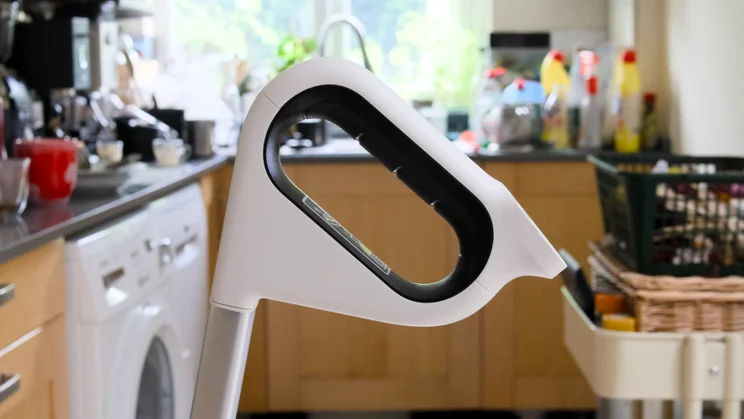
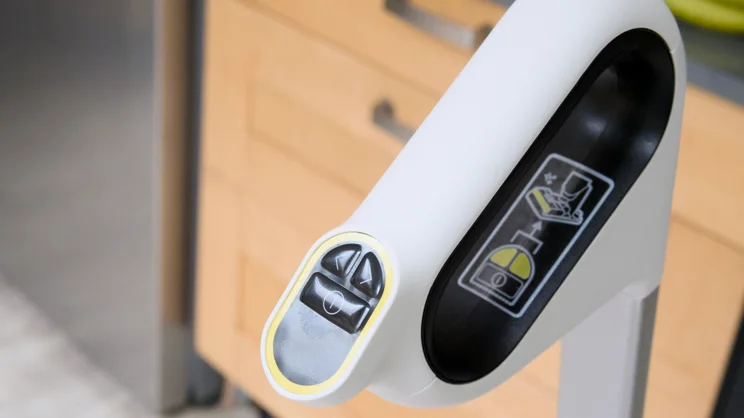
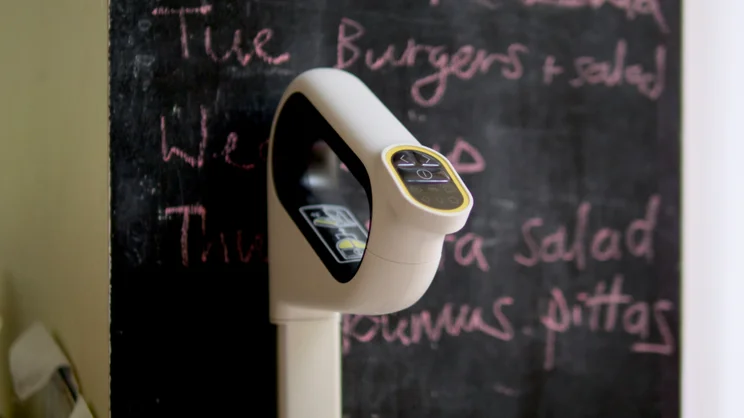
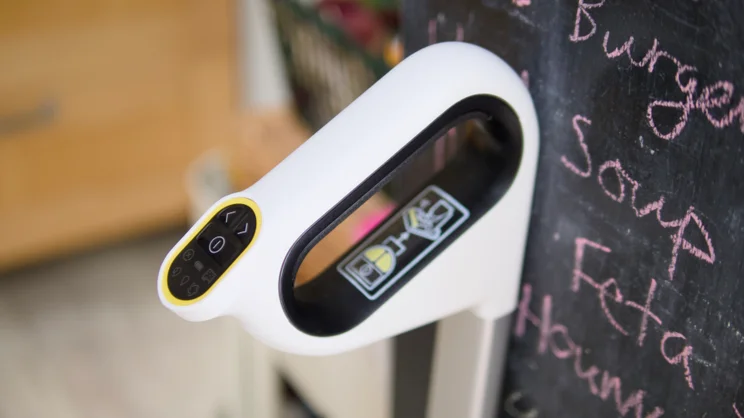
Part of its charm is its simplicity. Unlike most modern vacuums, it doesn’t come with a vast selection of add-on tools and it doesn’t need a mobile app or a Wi-Fi connection to operate, either. All the controls are accessed on top of the handle, where you’ll also find a series of status LEDs for the battery level, the mode you’re in and so forth.
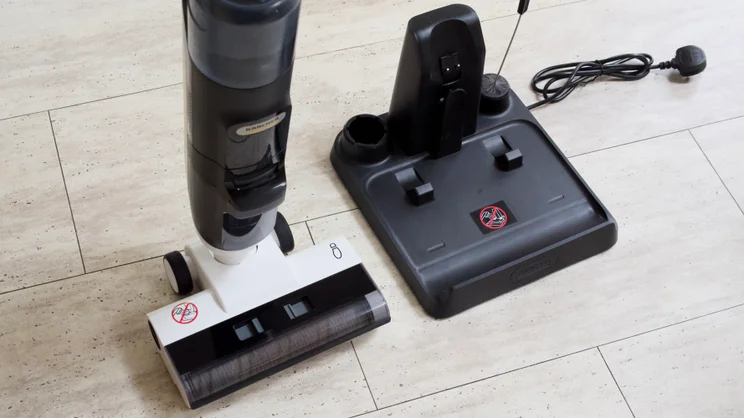
There’s not much in the box. You get a 500mm bottle of Karcher’s Natural Floor Cleaner solution in the box, a large (rather ugly) black plastic base plate that does double duty as a charger and cleaning station, and a brush to help dislodge blockages. That’s it. That’s all you need.
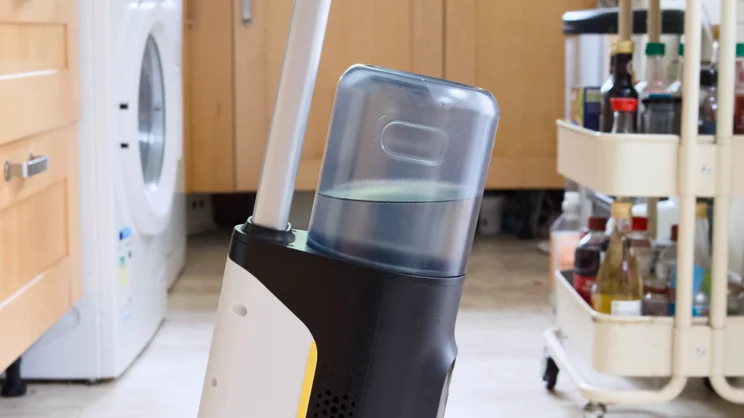
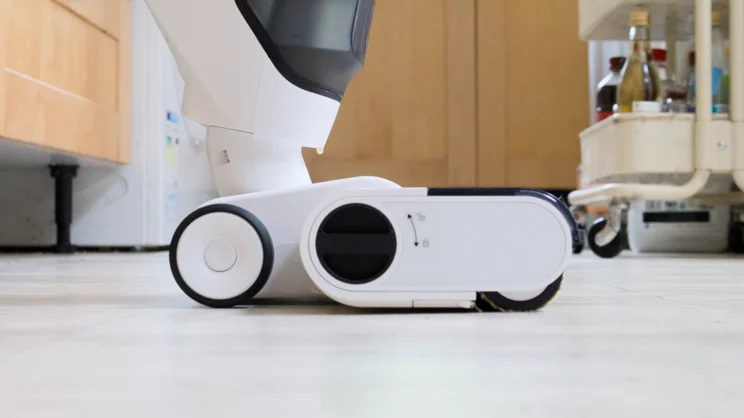
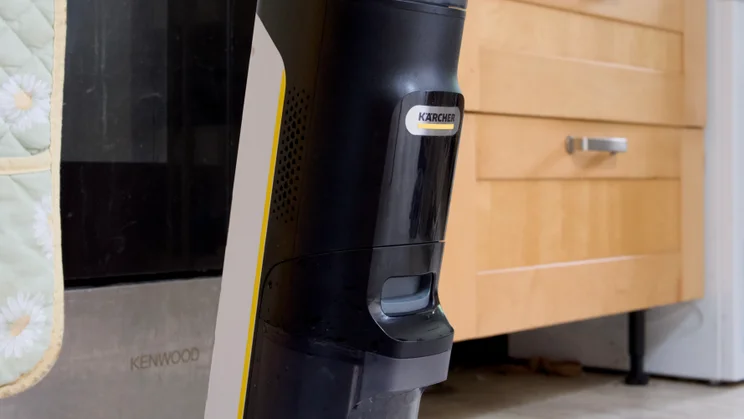
It’s also a rather well-made thing. Clad in glossy white plastic, it feels robust and built to last. It stands 1.13m tall and weighs 3.8kg (without water, 4.6kg when full), which isn’t insignificant, but you do get a pair of rubber-shod wheels at the bottom to help you roll the thing around. Even better, the two water tanks – one for clean water/detergent and one for waste water – are towards the bottom of the machine, just above the floor cleaning head, so the weight is down low, which helps with manoeuvrability.
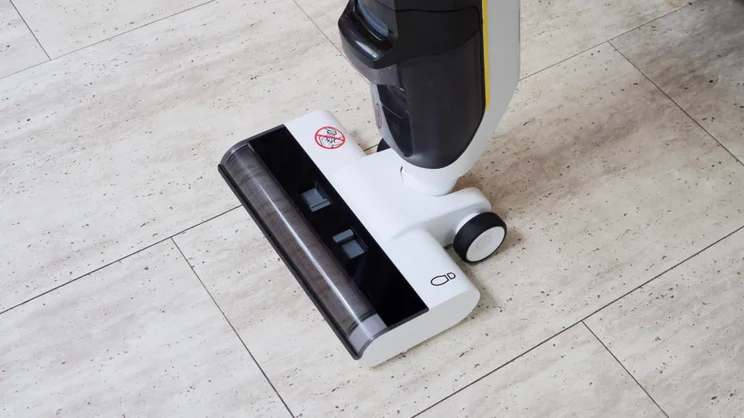
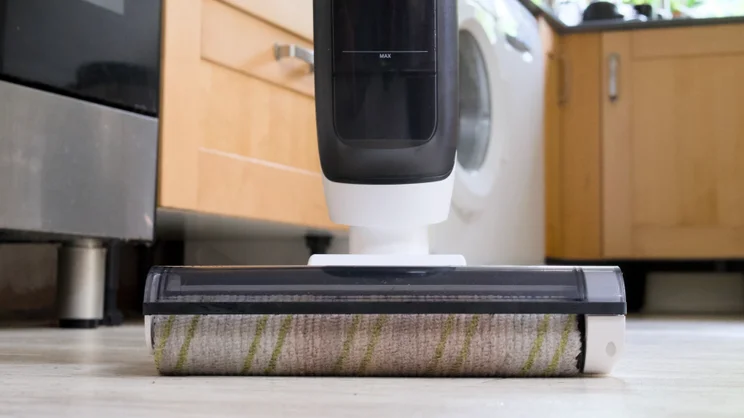
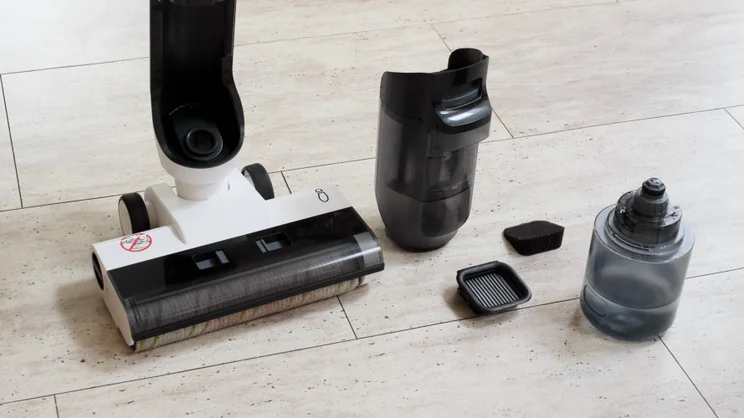
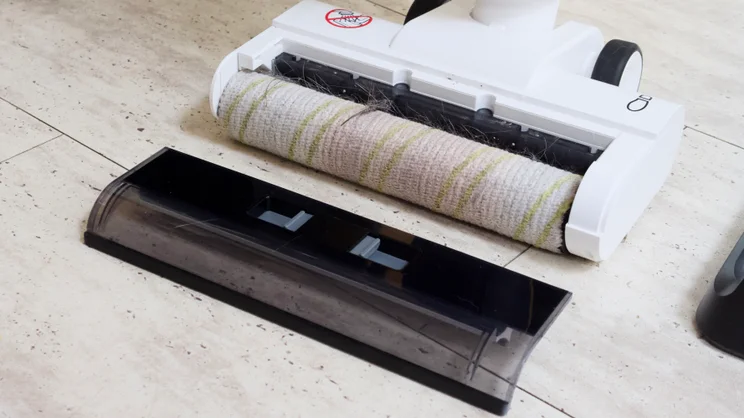
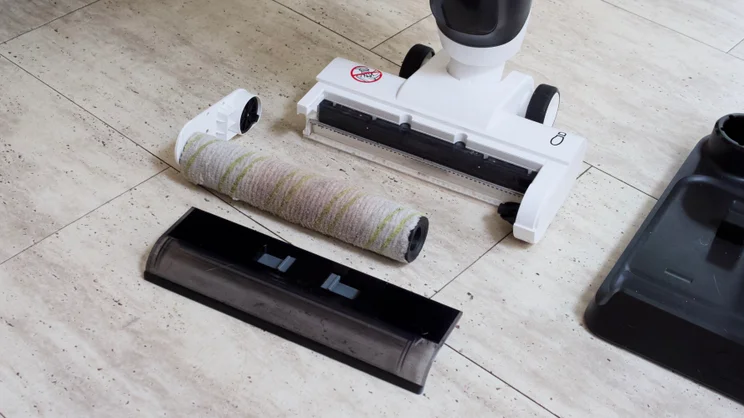
The business end of the FCV 3 is pretty self-explanatory and comprises a 240mm-wide microfibre mop roller. Again, it’s the only attachment and can’t be swapped out for something else. The machine works by feeding water from the 800ml clean water tank onto the rotating mop roller, and dirty water, dust and so on is squeezed from the roller and sucked into the 425ml-capacity dirty water tank.
How easy is it to use?
Set up is mostly straightforward. Just extract everything from the box, clip the handle into place, fill the clean water tank with water and a capful of the included detergent and you’re pretty much ready to go, although you will need to top up the battery the first time you use it. A full charge takes more than three hours, too, so you’ll need to have some patience.
The only complaint I have is that the neck of the clean water tank is a little narrow, so lining it up with the tap can be a little hit and miss. Once filled, though, and clipped in place, operating the Karcher FCV 3 is as easy as running a vacuum cleaner across the floor. Just press the power button and mop away; the only thing you need to worry about is selecting between the two power levels – or “dry mode”.
I found it easy to manoeuvre. It glides around the floor very smoothly and, if you need to pause during cleaning, that low-down weight means it can stand on its own two feet without needing to lean against a wall or work surface. I also like that when you press the power button to turn off the FCV 3, the roller runs dry for a few seconds, so you don’t end up with a big puddle of water all over your floor.
How easy is it to clean and empty?
Once you’ve finished mopping, cleaning the machine and emptying the dirty water is simplicity itself. Just pop it back on its base and engage the self-cleaning mode (something the more expensive Dyson PencilWash lacks, by the way) and wait 80 seconds while it sucks the remainder of the water from the roller. It doesn’t leave the roller completely dry, but I could detect no evidence of nasty niffs after a few days left to dry off.
After you’ve done this, all that remains to do is empty and rinse out the dirty water tank. Again, that’s really straightforward. It lifts out nice and easily, and because it’s small, it’s easy to transport to the drain or the toilet for emptying out. Be prepared for a shock, though; it’s amazing how much grime this thing lifts off what may look like clean floors.
After a couple of cleans, you will also need to remove the filters and give those a rinse because they tend to get clogged with hair and dirt quite quickly. They’re held at the top of the dirty water tank, so they’re easy to get at, but it’s quite messy.
I also found that, after cleaning some particularly dusty corners under the stairs, the inlet behind the roller got clogged with fluff. Again, accessing the head for cleaning and declogging is pretty easy, but it’s not what I’d call a particularly pleasant job.
How do we test hard floor cleaners?
We test all the hard floor cleaners we review in Expert Reviews in the same way. We run a series of cleaning tests on hard flooring, with dried-on ketchup, mud and mustard. With each stain, we pass the cleaner over it forwards and backwards once, and take before and after photos; then we keep cleaning, counting the number of forward/backward passes it takes to fully remove the stain from the floor.
We also test battery life, running the device on its max and minimum power modes to give you an idea of how long it takes before running out. We time how long it takes to fully charge the battery from empty. And we test noise levels in dBA.
How well does it clean?
Before I get to the results of our formal tests, it’s worth noting that this cleaner is incredibly effective as a day-to-day floor cleaner. I’ve always found sweeping and mopping our kitchen floor an incredibly tedious job. Sweeping first is boring. Changing the water in the bucket is annoying. Waiting for everything to dry is tiresome. And it’s all made more onerous because I have to move various items out of the way before I can access the floor underneath, resulting in me having to clean the floor in sections.
It takes ages and I hate doing it.
With the Karcher FCV 3, the job is much easier. The cleaner sucks up dirt, dust and fluff and cleans most light marks in a single pass. I’m finished in just a few minutes – far quicker than I would ever be with a brush, a mop and a bucket. What’s more, the floor is cleaner because I’m not pushing increasingly dirty water around.
It struggled a little with bigger stains and it took a fair amount of going back and forth to fully clean our toughest dried-on muck. It took 60 passes to remove a teaspoon of Coleman’s English Mustard (the powdered stuff, mixed with water), which had dried to a concrete-like consistency. A palm full of caked-on mud took nine passes to remove. And a tablespoon of ketchup smeared into a patch 12 x 16cm in size was gone in 49 passes. These aren’t particularly realistic scenarios, so I’ll cut it some slack here, but what these tests do show is that even quite major, messy spillages are well within the FCV 3’s compass.
| Stain (dried on) | Passes to remove |
|---|---|
| 1 tsp Coleman’s mustard | 60 |
| 1 tbsp Heinz ketchup | 49 |
| Mud patch | 9 |
The only area where the FCV 3 failed to impress me was carpets. You’re supposed to be able to “refresh” rugs and short-pile carpet using this mode, but while it will lift light debris, you’ll need a proper vacuum to give carpets a proper clean. The suction just isn’t strong enough – I measured it at a mere 7kPa – and its mop roller isn’t aggressive enough to lift stubborn dirt and dust from deeper in the fibres. Having said that, I was surprised at how much cat fur ended up in the bin when I opened it up for inspection, so it’s not entirely useless.
As for battery life, I was never in a position where I ran out of charge during day-to-day use. Whenever I finished a job it went straight back onto its charging dock and was ready to go as soon as I needed it. In tests, I found that in light use mode, it delivered a runtime of 28mins 42secs, which dropped to 19mins 48secs in max mode and 19mins 43secs of cleaning in Dry mode.
| Test | Result |
|---|---|
| Battery run down (dry mode) | 19mins 43secs |
| Battery run down (standard mode) | 28mins 42secs |
| Battery run down (maximum mode) | 19mins 48secs |
| Charging (0-100%) | 3hrs 28mins |
| Noise level (standard mode) | 76dBA |
| Noise level (max mode) | 78dBA |
Should you buy the Karcher FCV 3?
If you’ve had it with mopping, and you’ve got the space to keep the base plate plugged in, the answer to this question is yes, absolutely. The Karcher FCV 3 is quick and effective, and very easy to maintain and keep clean.
It will even do a little light vacuuming if you want to give your carpets a quick once-over and can’t be bothered getting out the Dyson. It has larger water tanks than the Dyson PencilWash, and a self-cleaning mode – a feature the PencilWash lacks.
It is a touch on the expensive side, but if you have a reasonably large expense of hard floor at home, you owe it to yourself to at least consider buying one of these. It will save you hours and hours of time.