
To help us provide you with free impartial advice, we may earn a commission if you buy through links on our site. Learn more
After taking over 26 Leake Street in London to launch four new speakers in March last year, JBL had a hard act to follow as Club JBL headed to Amsterdam.
Part-product launch, part 80th anniversary celebration, the American brand hosted journalists and influencers from across Europe at its Harman’s EMEA HQ, and I was lucky enough to get an invite.
I’d seen a press release covering the products being launched ahead of time and was a bit underwhelmed. Most are next-gen iterations of existing ranges that promise all the usual upgrades, such as enhanced noise cancellation, better sound quality, improved voice calls, etc.
I get that there’s pressure on brands to keep producing new models to remain in consumers’ minds. However, unlike when JBL brought its Smart Charging Case to market four years ago, the lineup of products debuting at Club JBL didn’t strike me as moving the needle forward much.
Having had the chance to see what was launched up close and spend some time testing the JBL Live 780NC, I’m warmer on them, and one product stood out from the crowd: the JBL EasySing Mic Mini.
On-the-go karaoke has never been so easy
The EasySing Mic Mini is going to be karaoke lovers’ new best friend and has the potential to be a very useful tool for content creators.
It’s a microphone and USB-C dongle package that will cost £130 when it releases next month and, when plugged into a laptop or smartphone, captures audio as any regular microphone would.
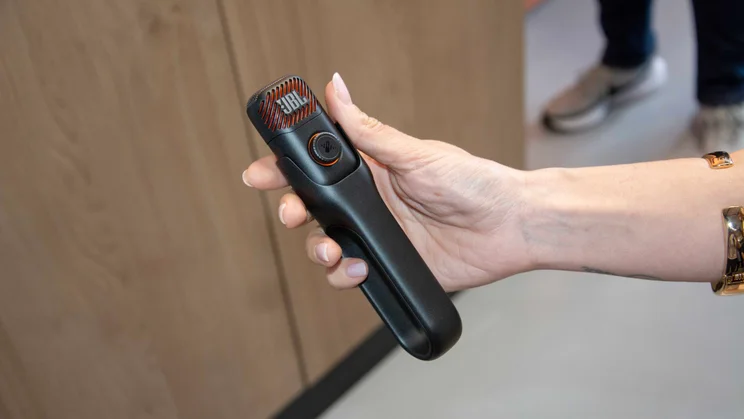
However, its AI capabilities set it apart from other take-anywhere recording devices. When connected to a compatible JBL portable or PartyBox speaker, the Mic Mini can remove lyrics from tracks, enabling you to turn any song into a karaoke sing-along at a moment’s notice.
I heard the EasySing Mic Mini, which has an AUX output and supports Bluetooth, in action, and it worked wonders. You can choose between three levels of lyric removal (25%, 50% or 100%) depending on how much assistance you require. There’s also an option to artificially enhance your voice using Vocal Boost, though this feels a bit too much like cheating if you ask me. Karaoke isn’t about singing perfectly; it’s about giving it everything and owning what you bring to the table.
There’s no influencing Italian influencers
Sadly, I didn’t get the chance to try the EasySing Mic Mini myself, as an Italian influencer commandeered it for the entirety of our very brief hands-on session. Short of prising it from her cold, dead hands, no one was getting it off her, but I did manage to employ her as a hand model for a quick snap.
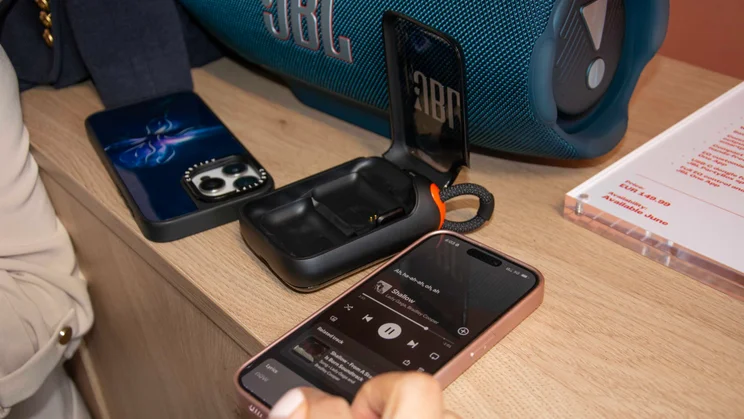
Regardless, I think the Mic Mini is a really neat gadget that I could definitely see myself using to record audio while at events. And, given I already have a couple of the speakers it’s compatible with – the JBL Flip 7 and JBL Grip – I imagine I’ll be serenading my neighbours with dodgy renditions of some of my favourite tunes soon enough.
The full list of compatible speakers is as follows: JBL Charge 6, JBL Boombox 4, JBL Go 5, JBL Xtreme 5, JBL Grip, JBL PartyBox On-The-Go, JBL PartyBox Encore 2, JBL PartyBox Encore Essential 2, JBL PartyBox Club 120, JBL PartyBox Stage 320, and JBL PartyBox 520 and 720.
Neat new features for the JBL Go 5 and JBL Xtreme 5
Two of those speakers, the JBL Go 5 and Xtreme 5, were announced a month or so ago, and the Club JBL event in Amsterdam was the first opportunity I got to experience them in the flesh. They’re 10% louder than their predecessors, their designs have been tweaked slightly, and both now feature ambient lighting. It seems the JBL Grip has paved the way for LED lighting on the full JBL portable lineup.
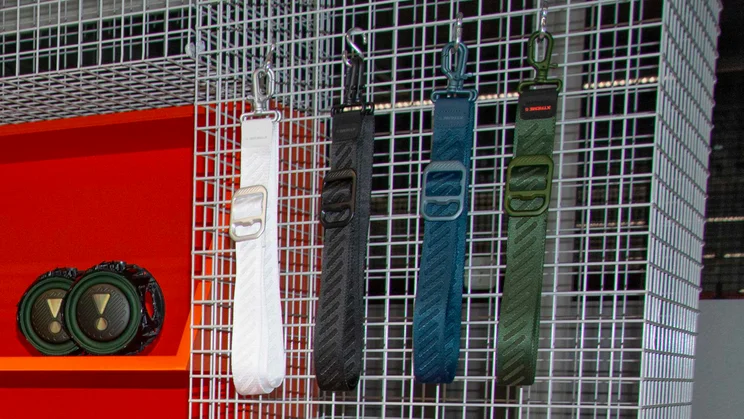
These changes are all positive, but my favourite new additions were more novel. First, the Xtreme 5’s carrying strap now has a bottle opener built in. This is a small but practical inclusion and one that fits with the target audience for this kind of powerful, rugged speaker. To me, it shows that JBL is thinking of meaningful ways of enhancing the lived experience with their latest range.
A lot of thought has gone into one of the JBL Go 5’s new features, too. The Go is JBL’s most popular portable speaker series, with sales exceeding 3 million a year, according to the brand. Many users own two or more Go 4s, and roughly 40% regularly use Auracast to synchronise audio on multiple speakers. Interestingly, however, only 7% use the JBL Portable app’s stereo pairing option.
Stereo pairing made easy with AirTouch
Enter AirTouch. With this feature, you can pair two Go 5s in stereo by bringing them together physically like a technological fist bump. Once paired this way, the speakers will remain in stereo until you choose to unlink them, so you don’t have to repeat the process every time you turn them off and on again.
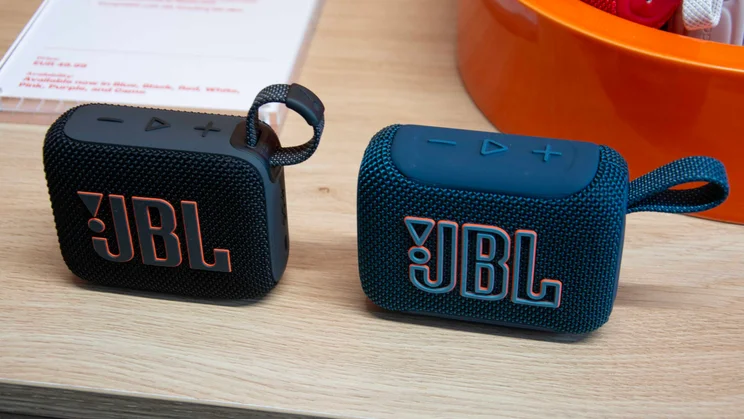
I gave the new functionality a whirl; there’s a knack to it – you have to touch the speakers side by side for a bit longer than I initially anticipated – but once I’d worked this out, the process was smooth and successful. And the resulting audio experience was louder and more engaging. I posted a video showing the process and effect on the Expert Reviews Instagram channel, and I definitely see that 7% figure shooting up thanks to AirTouch. Hopefully, it’s something that gets rolled out to other JBL portables in due course.
Upgraded PartyBox speakers make their debut
JBL’s PartyBox speakers may look and sound impressive, but I find them the least interesting offering within the brand’s range. I’m not the party boy I once was; if I want loud music and an LED light show, I’ll go raving. But for those who want that experience at home, the PartyBox 130 and PartyBox 330 look very appealing. New woofers and tweeters deliver deeper bass and clearer highs than the previous models, and the speakers support JBL AI Sound Boost with Smart EQ to optimise sound based on volume.
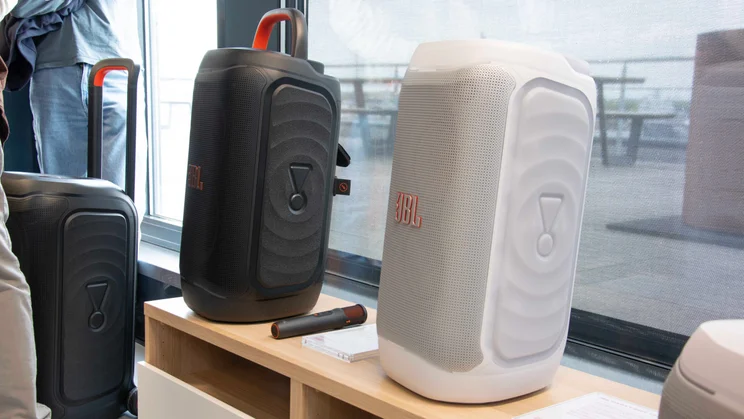
The PartyBox 130 outputs 200W and has 15 hours of battery life. The 330 is more powerful (280W), has longer battery life (18 hours), and has a periscopic handle. They’ll be available in June, priced at £350 and £530, respectively.
A colourful collection of new on-, over- and in-ear headphones
JBL’s range of headphones covers every style, and we’re getting no fewer than five new entries into its Live series, which sits below the top-tier Tour Pro models.
All five will be available in seven colours, and to show them off, JBL had models clad in each of the colours (purple, orange, green, blue, black, white and stone) strut a makeshift catwalk at Harman HQ. It was certainly memorable; you can check it out on this Instagram reel and make up your own mind as to whether it hit the mark.
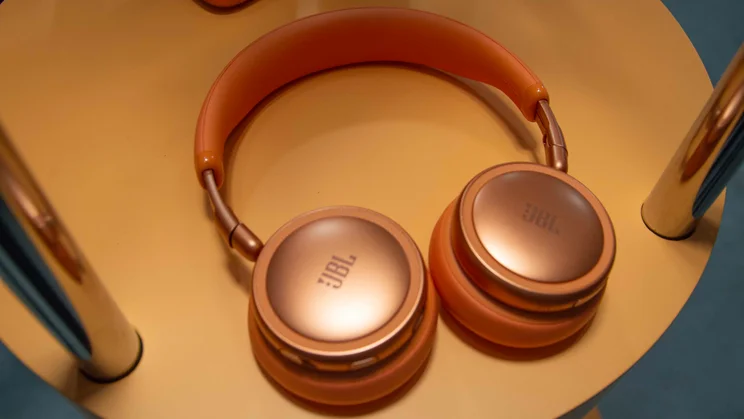
I personally liked the colours more than the dance moves, and currently have a pair of orange JBL Live 780NC over-ears in for testing. Those headphones are already available to buy for £180, and my review will be live soon. The on-ear JBL Live 680NC cost £130.
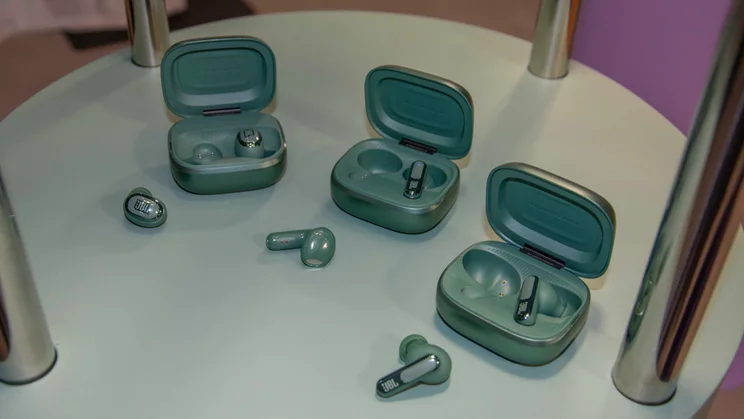
Meanwhile, there are three new true wireless options: the JBL Live Buds 4, JBL Live Beam 4 and JBL Live Flex 4. The Buds and Beam seal your ear canals with silicone tips; the former are bean-shaped, the latter have AirPods-like stems. The Flex are semi-open earbuds offering noise cancellation, a la the AirPods 4 ANC or Samsung Galaxy Buds4.
Colour and fun over innovation
All three come in JBL’s Smart Charging Case, which is one of my favourite innovations in headphones in recent years. JBL isn’t bringing anything quite as exciting to the table this year, but its new lineup is certainly fun and vibrant.
As were the influencers bopping away on the dancefloor as artists from the JBL Music Academy performed at the after-party. The Music Academy initiative encourages open applications from across the globe, then enrols top talent and provides musicians of diverse skills and backgrounds a platform to learn, exchange ideas and perform. And the performers’ enthusiasm and energy impressed me. One particularly confident young lad had a great set of pipes and stage presence, though I found it pretty awkward when he repeatedly called out that he could see a lot of people over 50 in the room and dedicated an Elvis song to them. Still, the more senior members of the UK press gang didn’t seem to mind; they were too busy playing Jenga.


