
To help us provide you with free impartial advice, we may earn a commission if you buy through links on our site. Learn more
- What are the Shokz OpenDots Air and Shokz OpenDots 2?
- How much do the Shokz OpenDots Air and Shokz OpenDots 2 cost?
- What are the advantages of open-ear headphones?
- Who are the Shokz OpenDots Air and OpenDots 2 for?
- What competition do they have?
- Shokz OpenDots Air vs Shokz OpenDots 2: How do they compare?
- Shokz OpenDots Air vs Shokz OpenDots 2: Which should you buy?
I recently spent a few days in Shenzhen, China, visiting the bone-conduction and open-ear headphones brand Shokz. It was an action-packed trip during which I heard from its co-founder, Ken Chen, exchanged ideas with highly articulate and engaging employees, and attended a Q&A with global ambassador and former marathon world record holder, Eliud Kipchoge.
I also toured the Shokz showroom, laboratory, production line, and silicone factory (where it produces the material coating its headphones), which provided me with fascinating behind-the-scenes insights into the manufacturer’s processes.
There will be a separate article covering what I can discuss about that side of my Shenzhen adventure. For now, I’m breaking down the details and my initial experiences with the brand’s new open-ear headphones, the Shokz OpenDots Air and Shokz OpenDots 2.
What are the Shokz OpenDots Air and Shokz OpenDots 2?
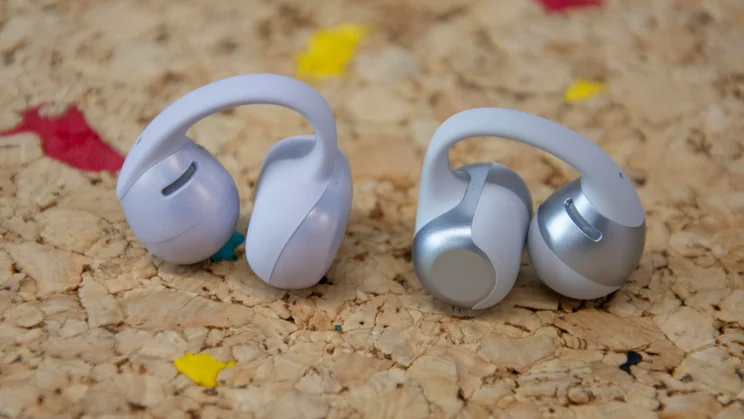
The OpenDots Air (pictured below) and OpenDots 2 are clip-on open-ear wireless earbuds and the successors to Shokz OpenDots One, which I gave the Expert Reviews Recommended award last year. The former is the entry-level model, while the latter takes on flagship status thanks to a range of upgrades, including better water resistance, battery life and wireless charging.

How much do the Shokz OpenDots Air and Shokz OpenDots 2 cost?
There’s a £50 price difference between the OpenDots Air and OpenDots 2. The Air, available from today (4 June) in Daybreak Purple and Black, cost £129. The OpenDots 2, which come in Pearl White, Grey and Black, and cost £179, are also available from today.
What are the advantages of open-ear headphones?
Shokz has been a pioneer of open-ear headphones technology since its foundation in 2011. At that time, it was AfterShokz and focused exclusively on producing bone-conduction headphones. It has since led the way in that field with exceptional options like the Shokz OpenRun Pro.
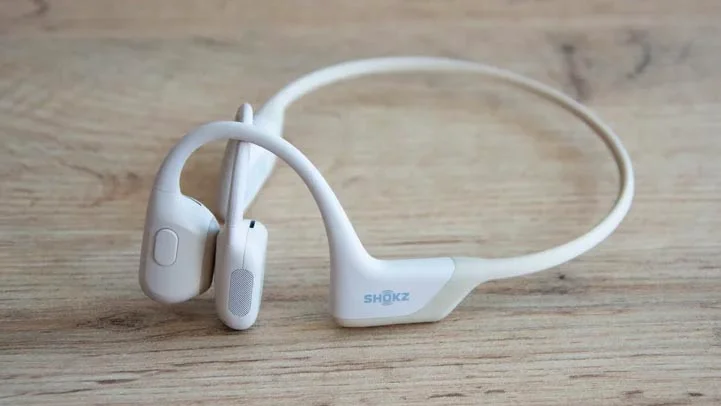
In 2023, it branched out into a new form of open-ear headphones with the Shokz OpenFit, a model its refined with second-gen models and a Pro version (pictured below). Although the earhook design of the OpenFit was very different from the bone-conduction models that came before them, the overall design brief remained the same: to allow users to enjoy audio while still being able to hear the world around them.
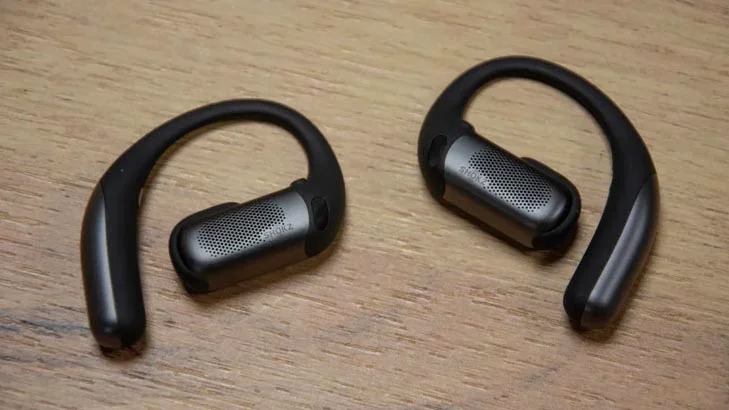
It’s this freedom that’s at the heart of Shokz’s offering. But open-ear headphones have a couple of other advantages over wireless earbuds that use silicone eartips. First, open-ear earbuds are incredibly comfortable; it’s often easy to forget that you’re even wearing them. Secondly, they’re more hygienic. By leaving your ear canals clear, there’s less chance of moisture building up, leading to bacterial growth that can cause ear infections.
The new OpenDots Air and OpenDots 2 bring all of those advantages to the table. However, like the first clip-on earbuds the company produced – the Shokz OpenDots One – they also have an aesthetic more in line with a younger audience. From a distance, these clip-on earbuds look like a fancy pair of earrings.
Who are the Shokz OpenDots Air and OpenDots 2 for?
Headphones offering ambient awareness and high levels of comfort are perfectly suited to physical activity. As a result, Shokz has gained a loyal following of athletes, specifically cyclists and long-distance runners.

Its bone-conduction models are the only headphones officially permitted for use in road races under UK Athletics (UKA) rules of competition, and, as official headphones partner of the Abbott World Marathon Majors, it has a captive target market of exercise enthusiasts.
The OpenDots Air and OpenDots 2 are designed for a different type of user. They’re intended for a more casual audience of park runners, gym goers and personal trainers, or those aspiring to be more active. Of course, you don’t need to have exercise goals in mind to reap the benefits of their open-ear design; perhaps you just want to tune into office conversations more quickly at your desk or hear the doorbell when working from home.
What competition do they have?
Plenty. We’ve tested several pairs of clip-on earbuds at Expert Reviews, the first of which were the Huawei FreeClip. When I reviewed them, I had no idea how quickly demand for what I described as “earbud couture” would grow. Huawei has since released the FreeClip 2 (£159), which Jon Bray described as “the ultimate in comfort”. Some of the audio industry’s biggest players have also entered the open-ear arena.
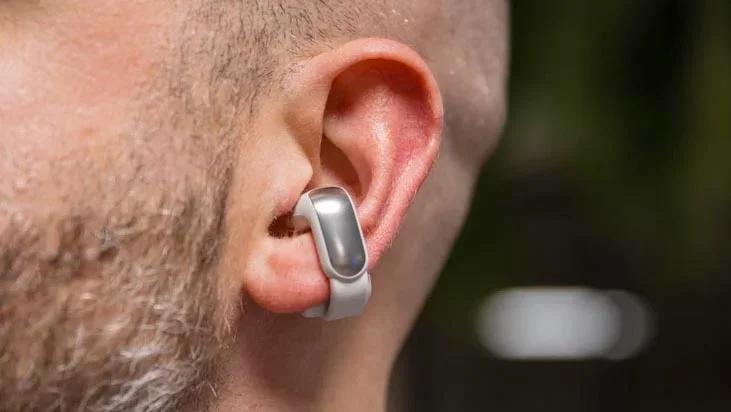
Bose has the Ultra Open Earbuds (£299) – pictured above – Sony has the LinkBuds Clip (£180), and JBL has the Soundgear Clips (£120). Smartphone manufacturers like TCL have got in on the action with the CrystalClip (£70) and Moto Buds Loop (£130), and there are lots of other cost-effective rivals around, including the Soundcore AeroClip (£100), Skullcandy Push 720 (£100) and JLab Flex (£50).
Shokz’s reputation for being a class-leading manufacturer of open-ear headphones goes a long way toward helping it stand out in a crowded field, but only gets it so far. It still needs to deliver on the product front. So, without further ado, let’s take a look at what the Shokz OpenDots Air and OpenDots 2 offer, and how they compare.
Shokz OpenDots Air vs Shokz OpenDots 2: How do they compare?
Design
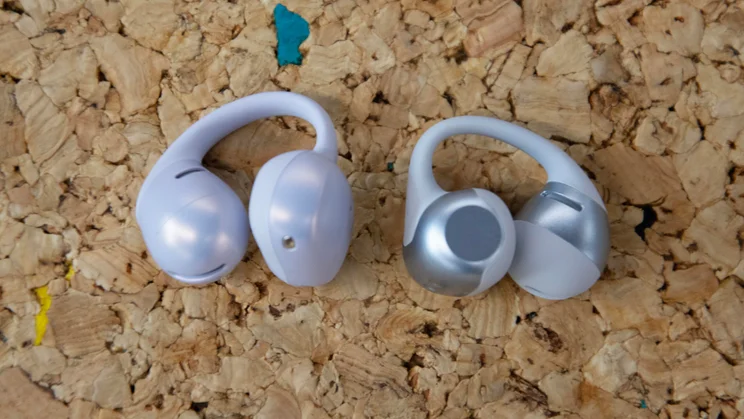
The most obvious difference between the two pairs of earbuds is their design. Both have battery sections linked to speaker sections via flexible “JointArcs”, and their speaker parts are nigh-on identical. However, the more expensive OpenDots 2 have a chunky battery cylinder, whereas the Air’s batteries are located in flatter housings. The impact on the buds’ weight is minuscule, with the OpenDots 2 weighing just 0.1g more than their stablemates at 6.4g.
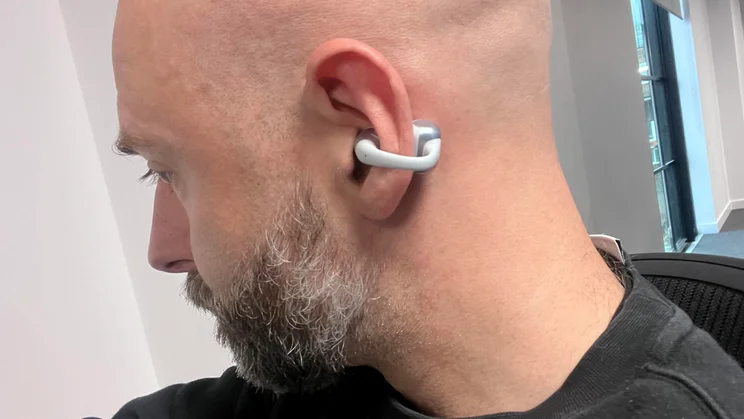
Another minor difference is the silicone covering the buds. The OpenDots 2 use “contoured” silicone with soft cushioning at the points that come into contact with your ears, while the Air use more basic “soft-skin” silicone. Having worn both pairs for several hours at a time, I can’t say I noticed much of a difference in comfort: both are very comfortable over extended periods.
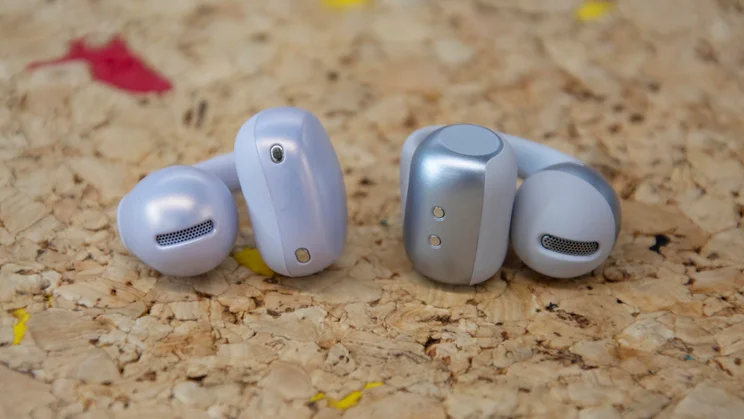
I prefer how the Air look overall, but this is largely due to the Daybreak Purple finish on the review sample I received. The OpenDots 2 in grey and silver have a more mature and premium aesthetic, but the pearlescent shimmer of the Air really did it for me.
Water resistance and durability
One clear advantage the OpenDots 2 have over their stablemates is a superior IP rating. The OpenDots 2 are IP57 certified, meaning they’re dust-tight and can withstand immersion in shallow water for up to 30 minutes. This rating gave me peace of mind when the heavens opened as I was walking along the Thames to a Scouts meeting at Teddington Lock. It’s not just the buds that are protected against the elements, either. The case has an IP54 rating, too, so I felt confident that it was safe in the pocket of my semi-waterproof jacket.
In contrast, the Air’s IP55 rating means it’s only able to withstand water jets. That’s good enough for most outdoors pursuits, but I’d have been a little more concerned about them in the aforementioned torrential downpour. And their charging case has no dust or water resistance rating, so you’ll have to be more careful when carrying them around.
Microphone quality
I’ve not got around to testing this on the new OpenDots, but in theory, the OpenDots 2 should have the advantage here, too. In addition to dual mics, they house a bone-conduction mic in each earbud, which should pick up your voice more precisely and result in better clarity on calls.
Battery life and charging
Again, the OpenDots 2 win out here. Not by much, but an extra hour takes total playtime on a single charge to ten hours, which is seriously impressive. Both charging cases have enough charge for three full top-ups, meaning you’re looking at 36 hours total for the Air, and 40 hours total for the OpenDots 2. At the speed and regularity at which I run 5km, that’s roughly 20 weeks of running covered.
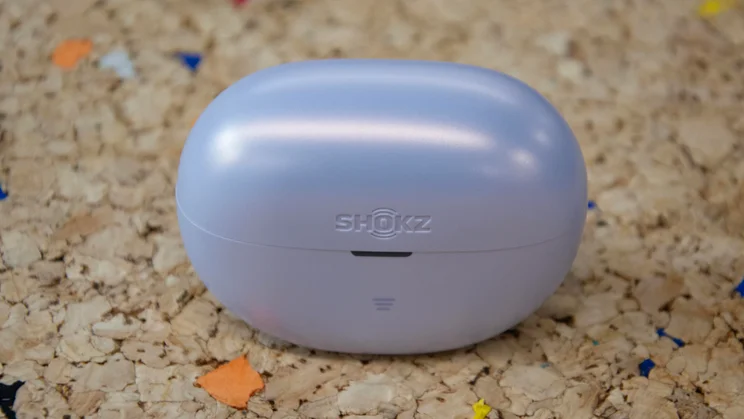
It’s worth bearing in mind that Qi wireless charging is only supported on the more expensive model, though topping up the case this way takes a lot longer than using the supplied USB-C cable. Without a wire, a full charge takes 3hrs 30mins, while hooking the case up to a power source reduces this to just two hours. That wired charging time remains the same whichever model you go for. I should note that the case of the Air has a flat bottom, meaning it can stand up on its own with the buds inside and the lid open; the underside of the OpenDots 2 case is more rounded, meaning it topples over in the same scenario.
Sound quality
This is where you’ll probably notice the biggest discrepancy between the OpenDots 2 and the OpenDots Air. Where the Air use Shokz’s patented Bassphere technology, the 2 use Bassphere 2.0, and also get MirrorPitch, something that wasn’t included on the original OpenDots.

Bassphere sees each speaker unit house two transducers that face each other to create a single, spherical sound module capable of a bass response equivalent to that produced by 16mm dynamic drivers. Version 2.0 is said to reduce distortion by 70% while being able to hit louder volumes. MirrorPitch, meanwhile, seeks to improve the buds’ audio quality (and reduce sound leakage) by using mirrored acoustic lenses to focus sound more accurately into your ear canals.
An obvious difference in performance
Having spent a decent amount of time listening to both pairs side-by-side, there’s veracity to these claims. The funky bassline on baritone rapper Chali 2na’s Comin’ Thru was tighter and better defined, and although the difference was relatively minor, the output was a bit louder when I turned up the volume to maximum. Overall, the OpenDots 2 sounded more cohesive because of their more robust bass response. Listening to the MK Vocal Edit of Look Right Through, the Air sounded more lightweight and insubstantial.
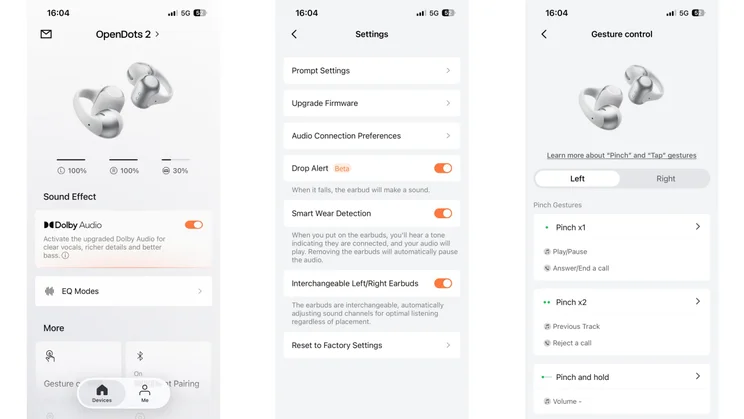
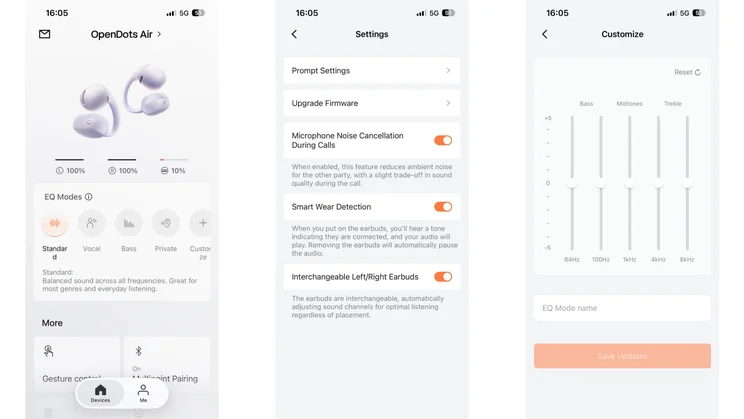
Both pairs of earbuds are compatible with the Shokz app, which allows you to choose from four EQ presets (Standard, Vocal, Bass and Private) and customise your own using a five-band graphic equaliser. However, the OpenDots 2 have another trick up their sleeve in the form of Dolby Audio support, and this is a bit of a game-changer.
Jamie Webster’s vocals on Days Unknown take on more presence and character as a result, while each of the individual instruments on the track was more easily identifiable. Flicking Dolby Audio on while listening to a variety of test tracks always felt like the right thing to do. The soundstage was larger, more detailed and created a more convincing stereo image. This “bigger” sound was corroborated by a colleague when doing a blind listening test of the buds with and without Dolby Audio.
Sound leakage
I need to do a bit more testing to make a conclusive judgment on this aspect of the OpenDots Air and OpenDots 2’s performance, but initial tests suggest that the more expensive model reduces leakage more effectively.

While sitting in a relatively quiet office, playing the same song and raising the volume incrementally, a colleague sitting next to me started hearing audio from the Air at around 70% volume. With the 2, it wasn’t until I’d raised the volume two extra notches that the song I was listening to became audible. My colleague said that, at maximum volume, it was a lot easier to hear just about every component of the songs I was playing on the Air compared to the 2.
Controls
The touch controls are very similar on the OpenDots Air and OpenDots 2. Both let you control audio playback via tap or pinch gestures that can be customised within the Shokz app. However, the OpenDots 2 get one gesture that the Air don’t: pinch and hold. By squeezing the top and bottom of the battery drum on the left or right earbud, you can reduce or increase volume, and this works very well. The larger battery section of the OpenDots 2 is slightly easier to interact with on the whole, though the difference is small enough not to be an issue.
Additional features
The OpenDots Air and OpenDots 2 share key features, but there are a couple of less noteworthy ones that only the flagship model gets. Both have wear detection, both allow you to wear the left and right buds interchangeably, and both support Google Fast Pair as well as Microsoft Swift Pair. However, only the OpenDots 2 are compatible with the Google Find Hub, so if you’re prone to misplacing your earbuds, that’s worth considering.
They also support a pretty neat Beta feature I’ve not come across before: Drop Alert. This causes the buds to emit a noise if dropped. I like the idea a lot, but I had to strain to hear the noise even when just dropping a bud on my desk in the office, so I can’t see it being much use if one falls off your ear on a busy street. It’s great for the cinema or library, though.
Both the OpenDots 2 and the Air operate over Bluetooth 6.1, but on the 2, you’re able to prioritise low latency or stability. I, and I imagine most others, will stick with the default Standard mode, which balances the two, but those who wander from their source device or are heavily into mobile gaming may get some mileage out of the other options.
Shokz OpenDots Air vs Shokz OpenDots 2: Which should you buy?
Based on the week or so of testing I’ve done on Shokz’s two new pairs of open-ear earbuds, it’s pretty clear to me which I’d choose. The OpenDots 2 sound better, last longer, have a broader range of features, are better equipped against the elements, and are less likely to annoy those around you thanks to more effective sound leakage protection.
I wish they were available in the Daybreak Purple finish I’ve become enamoured with on the OpenDots Air, but even taking into account what I consider a less appealing aesthetic, it’s hard to argue that the OpenDots 2 don’t justify the additional £50 spend.
I’ll be publishing individual reviews of both earbuds soon, so keep an eye out for my final verdict on them. In true Shokz fashion, I’m open to having my mind changed after more testing, but I’d be surprised if my feelings move too much.


