To help us provide you with free impartial advice, we may earn a commission if you buy through links on our site. Learn more




Screenshot
- Stylish, portable design
- Engaging audio quality
- Possesses plenty of smarts
- Unconvincing stereo presentation
- Stereo pairing limited to other Plays
- Some functionality requires accessories
It took Sonos a while to bite the bullet and start making battery-powered Bluetooth speakers, but, since doing so with the Sonos Move in 2019, it’s produced some cracking options. The Sonos Play is the newest of these and is designed to be the brand’s Goldilocks model: compact and robust enough to take with you on adventures, but sleek and sonically refined enough to cosy up with in your lounge.
I’ve spent the past few weeks testing the Sonos Play, both as a standalone speaker and as a stereo pair, and it lives up to its billing. It looks and sounds the part, has all the Sonos ecosystem features you’d expect, and transitions between portable speaker and smart home speaker – and vice versa – effortlessly.

What do you get for the money?
The Sonos Play costs £299, and is positioned between the Sonos Roam 2 (£179) and Sonos Move 2 (£449) in the manufacturer’s battery-powered speaker lineup. It’s sandwiched between that pair in size and weight, too. Here are the trio’s vital statistics:
- Sonos Roam 2: 62 x 60 x 168mm (WDH), 0.43kg
- Sonos Play: 113 x 77 x 192mm (WDH), 1.3kg
- Sonos Move 2: 160 x 127 x 241mm (WDH), 3kg
Like its stablemates, the Sonos Play supports both Bluetooth and Wi-Fi, as well as Apple AirPlay 2, with Wi-Fi being the preferred option as it enables you to stream audio losslessly. When streaming over Bluetooth, your codec options are limited to SBC and AAC – there’s no high-resolution option available.
Nor is there the Dolby Atmos spatial audio you’ll find on the Sonos Era 300. The Play is a stereo speaker that houses two angled tweeters and one mid-woofer, each powered by a separate Class-H digital amplifier. I recommend you temper your expectations where the “stereo” part of that description is concerned, but more on that later.
Screenshot
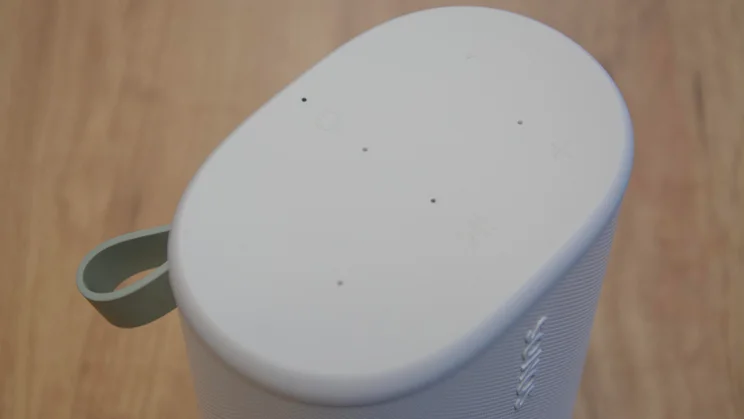
Elsewhere, you’ve got a far-field microphone array that serves a couple of purposes. Firstly, it’s used for Trueplay tuning, analysing your environment in real-time and automatically adjusting sonic output for optimal audio quality. Second, the array is on hand to listen out for voice commands. You’ve got a choice here: you can go with Sonos Voice or Amazon Alexa, or have both at your beck and call at all times.
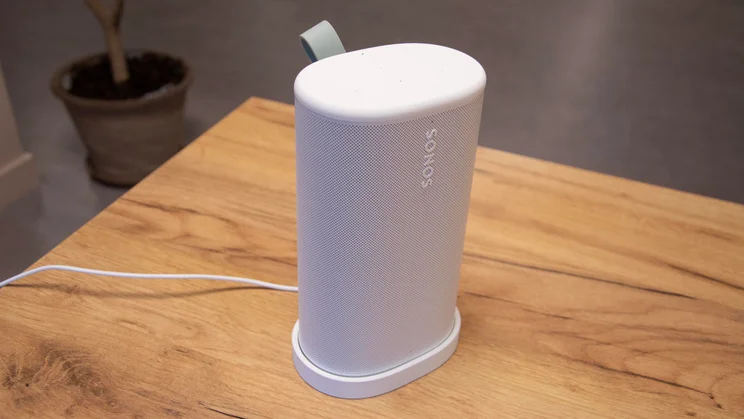
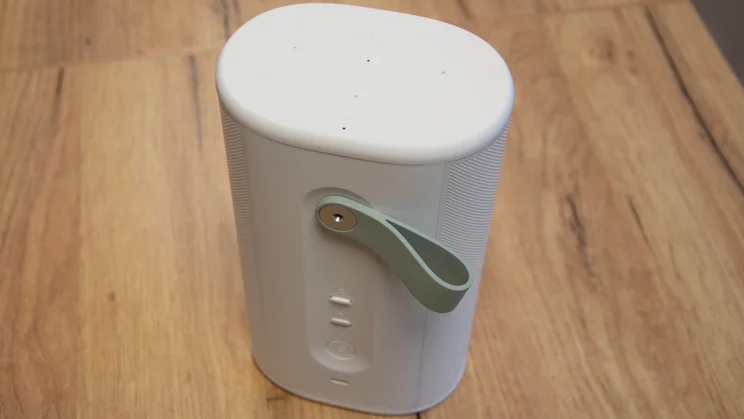
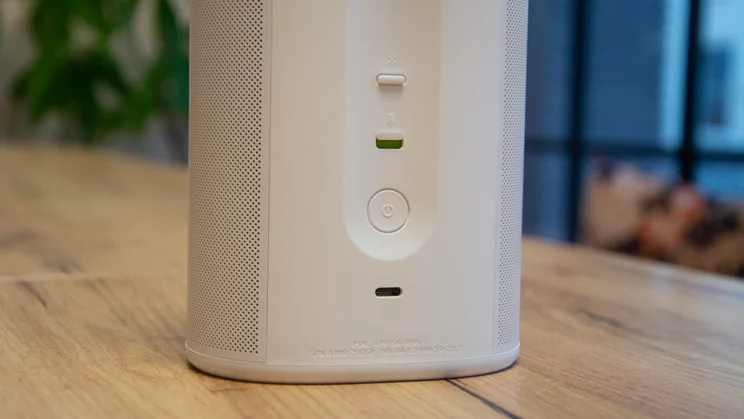
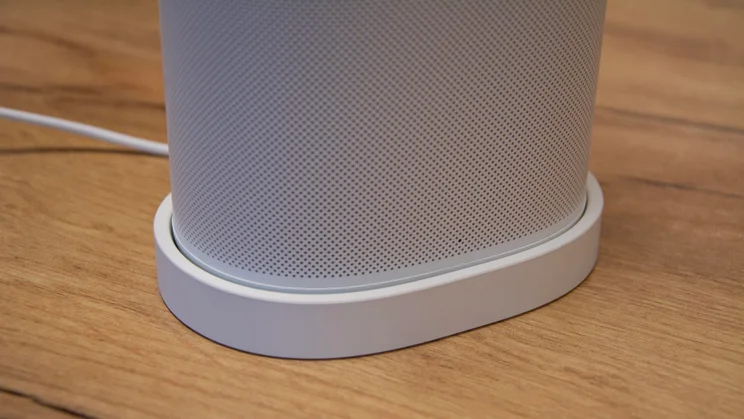
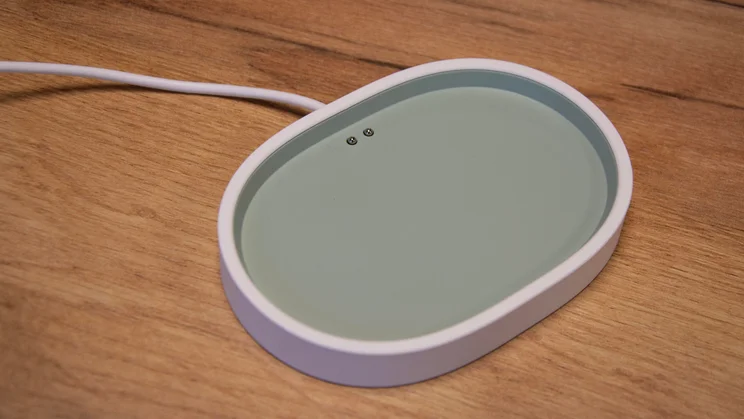
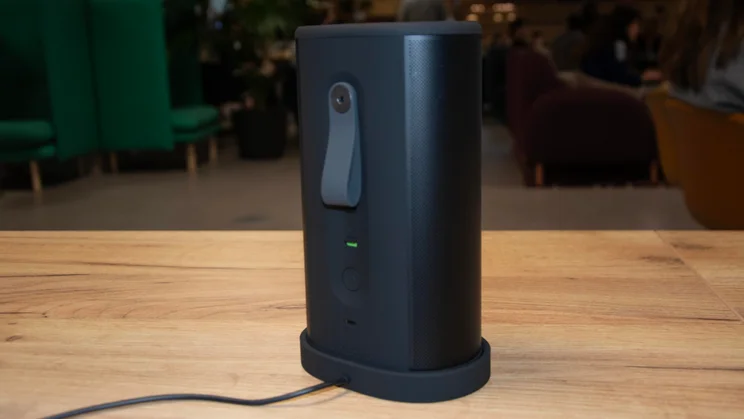
Your fourth option is to turn off the mic switch on the rear of the Play. There you’ll also find the Bluetooth pairing button and power button, along with a USB-C port. You can plug a USB-C cable straight into this to top up the Play, but Sonos supplies a rather neat charging base complete with an in-built 2m USB-C cable. It doesn’t include the USB power adapter to plug into a wall socket, though, so you’ll need to source one of those yourself.
Running on its 35Wh battery, the Play should last you roughly 24 hours on a single charge, depending on the volume level and the connection you’re using. That’s on par with the significantly larger Move 2, and more than double the juice you’ll get from the Roam 2.
Screenshot
The Sonos app has gradually got back to something resembling what it was before its fateful redesign in May 2024, and it’s here that you’ll likely spend much of your time when using the Sonos Play. You can connect your favourite streaming services to access their content directly through the Sonos app, select a preferred service to stream from, or delve into Sonos Radio’s extensive catalogue of music.
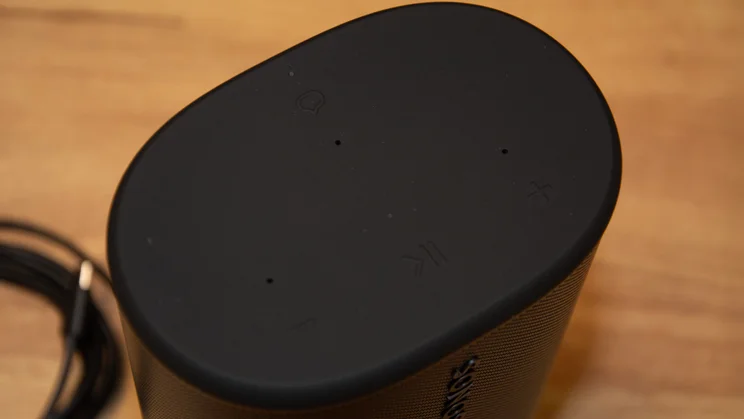
And, naturally, you can take advantage of Sonos’ home audio ecosystem to group speakers, assign specific products to certain rooms, and control what they’re playing at any given time. Those of a more old-school disposition can use the depressible buttons on top of the speaker to execute essential playback controls.
What does it do well?
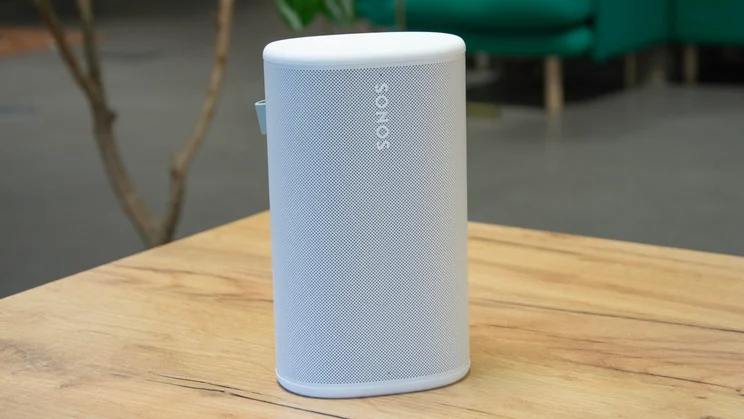
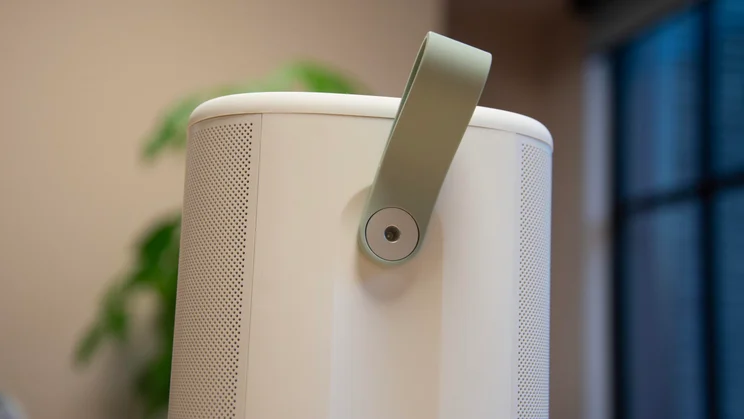
The Sonos Play is very elegantly designed. Its smooth edges are consistent with the brand’s Move models, but the more slender structure is much easier on the eye, and the rubberised plastics are somewhat more tactile. I prefer the white variant, but both colourways look sleek and are built to an extremely high standard. Black shows fingerprints more obviously, while white is going to get grubby if used a lot outdoors, so it’s a case of picking your poison. Either way, this speaker is plenty resistant to the elements thanks to its IP67 dust-tight and waterproof certification.
Screenshot
I mentioned Goldilocks earlier, and the Play’s size felt “just right” to move around at home, and it fitted easily in my backpack when I took it further afield. I often took it downstairs with me to continue listening to what I had on, and doing so never felt like a chore. This often isn’t the case with larger speakers that claim to be portable, but are more aptly described as transportable.
I like the addition of the charging cradle, too. Knowing the Play was charging when nestled in the base meant I never had to worry about plugging it in or topping it up, and could simply grab it and take it to the kitchen to enjoy some tunes with my morning coffee.
Sound quality
Given I have speakers in almost every room of the house, I wouldn’t have bothered to cart the Play around if I wasn’t thoroughly enjoying what it delivers sonically. I found it a compelling listen that I appreciated more each time I fired it up. It may not be particularly expansive at lower volumes, but it’s detailed and well-balanced, and it really started to express itself as I increased the volume.
Screenshot
The synths and vocals on Moontalk’s Hot Line 84 were projected coherently into my bedroom, but it was the punch of the juicy bassline that really caught my attention. As the track dropped, the Play came to life, reproducing the throbbing low-end in an assured manner that’s rare among take-anywhere speakers. In a bid to sound as loud and energetic as possible, such speakers often lose composure, but not so the Play. With one foot firmly in the “speaker for home use” camp, it never felt in danger of over-exerting itself. Yet it still has the raw output to function as a relatively polite but impactful party speaker.
The speaker handled the instrumental arrangement on Amble’s Moral Victory excellently, too. The level of detail the Play reproduces ensured the more subtle percussive elements had space to shine in a cohesive way, and the vocals were oozing with wistful character. I was equally impressed by how smoothly and delicately the Play handled shifts in dynamics and tempo on iloveitiloveitiloveit by Bella Kay, and the speaker demonstrated this even-handedness across pretty much every genre I threw at it.
Voice control
Speaking of throwing things at the Play, I found it responded very well to voice commands aimed at both Sonos’ own smart assistant and Amazon Alexa. I was a little surprised to find I couldn’t adjust the bass or treble via the EQ settings using the former, but this was the only time I felt disadvantaged by using my voice rather than the app. In general, commands were picked up accurately, executed quickly and didn’t require me to raise my voice much, even at around 80% playback volume.
I also want to touch upon the battery. I’ve already mentioned that the charging base ensured the Play was pretty much always topped up at home, but running on its battery alone, Sonos’ battery life claims proved pretty much spot on.
Screenshot
It says the speaker will last up to 24 hours; I got roughly 19 hours of use out of it on my first cycle, but I was listening to music at above-moderate volume for a few extended periods, and employed the speaker’s USB-C port to charge external devices on a couple of occasions, too. The long and the short of it is that the Play has ample stamina for a portable speaker of its size.
Its battery is also replaceable. So, if after 750 full charges, which Sonos reckons should see you good for around five years of use, you want to breathe new life into your Play, you can flip off part of the rubber base and switch out the cell for one sold as part of the Play Replacement Battery Kit for £49.
What could be improved?
Underwhelming single-speaker stereo sound
Describing the Play as a stereo speaker may be technically accurate, as it has distinct left and right channel outputs, but these did little to create a true stereo experience. The left/right separation wasn’t pronounced, and despite the soundstage being detailed and adeptly knitted together, I never got a sweeping sense of breadth.
This didn’t tarnish my experience of the Play, though; it’s a consistently agreeable and engaging listen. And, if you’re willing to splash out on two Sonos Plays, you won’t be disappointed by the stereo experience delivered in that case.
Screenshot
With one Play on each side of my room, the stereo imaging on Zach Bryan’s Plastic Cigarette did a great job of demonstrating the immersive capabilities of two satellite speakers handling a stereo mix. I wouldn’t buy two Plays just to stereo pair them, but it’s a nice option to have. I could see couples having one each, or parents buying two and giving one to their teenage kids on the proviso they’d pair them up on special occasions.
Unfortunately, the Play can only be stereo paired with another Play; if you were hoping to buy a Play and enjoy stereo sound with the Move 2, think again. You can still group them and synchronise audio output, you just won’t get the same left/right separation.
Screenshot
Minor grumbles
That’s a relatively small grumble in the grand scheme of things, and although there are some other foibles, those are equally minor. I found the small LED indicators on the speaker quite confusing, even after rereading the instruction booklet, and I would have liked Sonos to make the physical buttons on top of the speaker more defined. I can understand the brand wanting them to fit the speaker’s understated look, but a bit of tactility would have made them easier to interact with.
Finally, I don’t love the fact that you need an adapter to connect the Play to your router or an audio source that uses a 3.5mm jack. It’s hard to say how much the design of the Play would have been compromised by including Ethernet and 3.5mm ports, but I suspect the brand’s primary reason for avoiding doing so is to push people towards its range of accessories, which include the Combo Adapter (£39), Line-In Adapter (£19) and the 45W USB-C Power Adapter (£29) that can be used to power the charging base.
Should you buy the Sonos Play?
The Sonos Play is a stylish, best-of-both-worlds Bluetooth and Wi-Fi speaker that delivers fantastic performance both at home and further afield. It’s not the most compact portable speaker, but it’s just the right size to pick up and play, and it’s built to withstand all manner of environments.
The Play is at its very best when hooked up to Wi-Fi and giving it some welly in the volume department, but I’ve been happy to have it by my side wherever I’ve been while testing it. It’s Sonos, so the square inch of speaker per pound spent ratio isn’t as appealing as with less prestigious brands, but the Play’s quality and versatility make it well worth the outlay.