To help us provide you with free impartial advice, we may earn a commission if you buy through links on our site. Learn more
- Big, energetic and engaging sound
- Useful specification and some very interesting engineering
- Good choice of well-realised finishes
- Doesn’t enjoy very big volumes
- Can overplay its hand with bass
- Not short of great competition
You’re not short of choice when it comes to wireless stereo speaker systems designed to turn your desktop or workstation into a viable source of music (and thus a much nicer place to be). With its first go, Cambridge Audio’s L/R S system has comprehensively put the cat amongst the pigeons.
It’s well-made and looks good in any of the many finishes available. It features some single-minded engineering that’s far from common in this area of the market; here’s a genuinely active system where almost every rival is merely powered. It’s got every sensible connection, both wired and wireless, and 100W of Class D power would seem ample to rock your desktop’s socks off.
In practice, it almost all works extremely well indeed. The Cambridge Audio L/R S is a vibrant, engaging listen that’s rich in detail and dynamism, while also striking a good balance and showing refinement. If it weren’t quite so enthusiastic at the bottom of the frequency range, and if it didn’t get overexcited when asked to play at the biggest volume levels, it would be even more of a no-brainer than it already is.
What do you get for the money?
The Cambridge Audio L/R S are one of three pairs of active speakers the UK brand is releasing this year, and the first to market. They’re also the cheapest at £399, or £499 if the idea of a real walnut veneer finish appeals to you, and the smallest at 134 x 180 x 226mm (WDH). The desktop would seem the obvious place for them – the larger L/R M and the larger-still L/R X are designed for those who want a bit more poke and scale – but the system isn’t so tiny that it looks out of place on a pair of slender speaker stands.
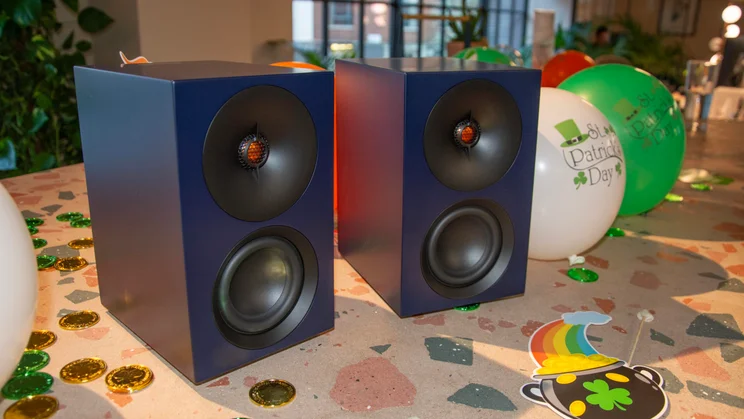
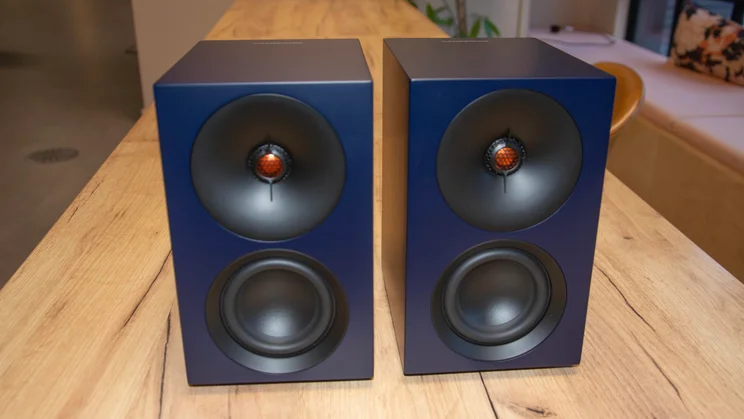
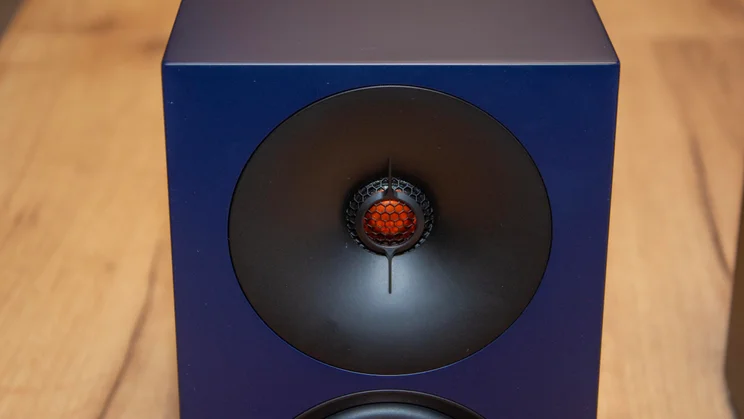
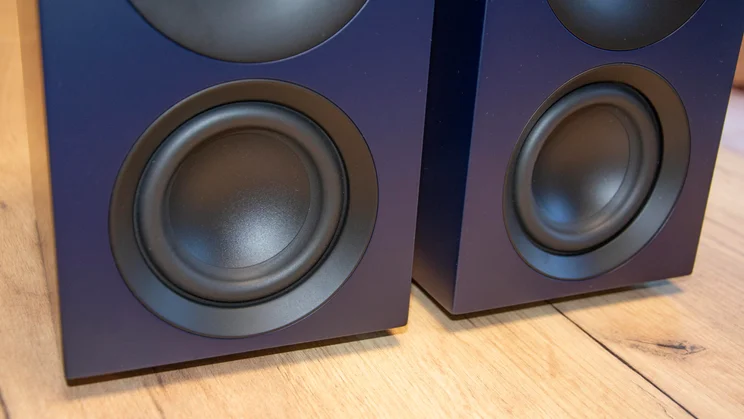
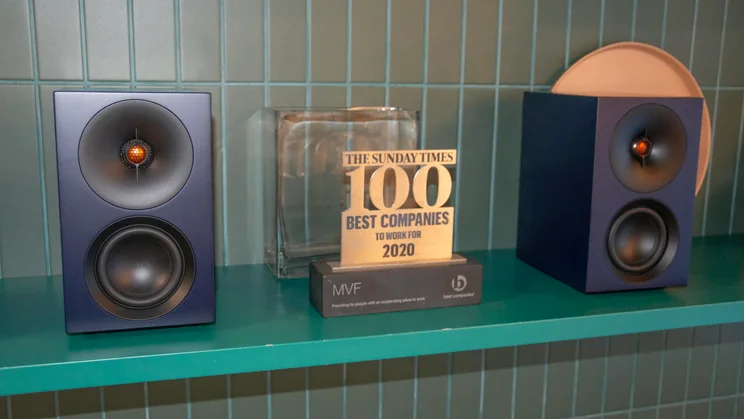
No matter where you position your L/R S, you’ll be looking at two identically sized black circles on the baffle – no grilles are supplied. Inside the upper circle, there’s an orange-coloured 21mm hard-dome tweeter behind a waveguide and phase cap, while the lower circle surrounds a 76mm mid/bass driver.
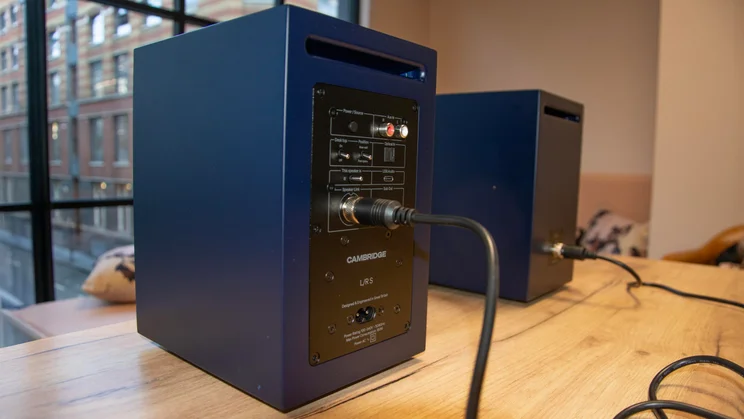
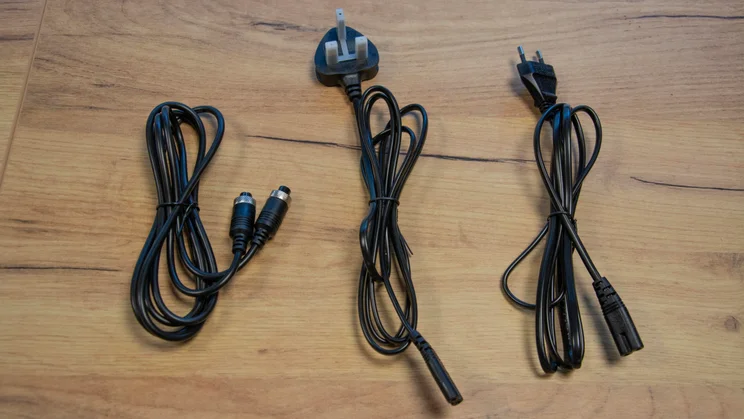
Although only one of these speakers requires mains power (it handles almost all functionality), this is a fully active, rather than a powered, speaker system. There are two discrete amplification channels per speaker (100W total, equally divided among the four drivers), and a full DSP crossover that delivers a pulse-width modulation signal to each amplifier. A custom four-core cable connects the boss to its subsidiary; all power and audio signals are sent through it. By prevailing standards at this price point, it’s an admirably thorough and remarkably complex solution.
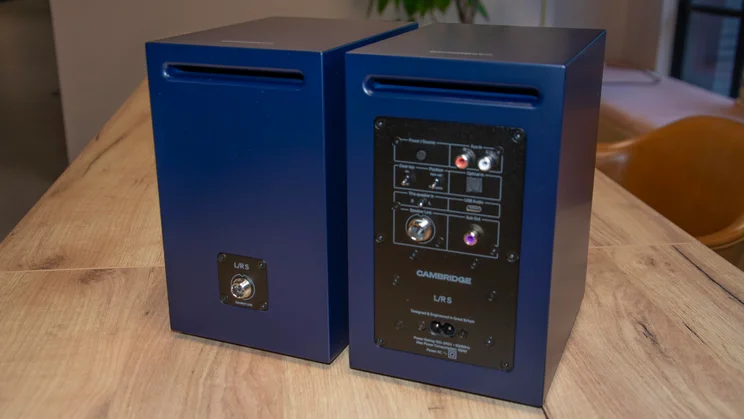
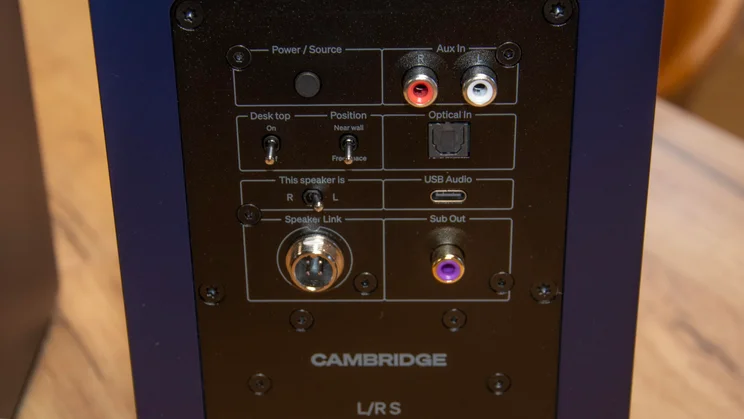
The rear of the secondary speaker features a screw-down connection for the inter-speaker cable, and there’s a bass-reflex slot across the top of the rear panel. The primary speaker has both of these features, too, but it also has plenty more going on. It includes Bluetooth wireless connectivity with aptX HD codec compatibility, and several physical connections too: a Toslink optical socket, a USB-C slot, and line-level stereo RCA analogue connections comprise the inputs, and there’s also a pre-out for use with a subwoofer. Both digital inputs support resolutions up to 24bit/96kHz, but every incoming signal, whether digital or analogue, is resampled to 24bit/48kHz in the DSP before it is sent in PWM form to the amps.
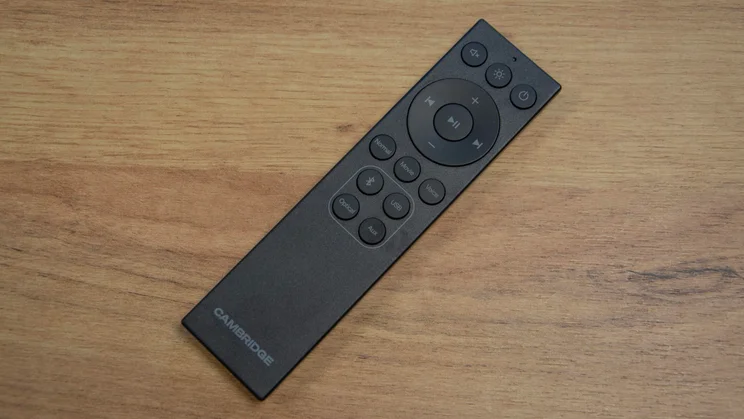
The main speaker also has a trio of toggle switches that help the system orientate itself. One lets the speaker know whether it’s the left or right channel in the system, one tells it whether it’s against a wall or in open space, and one tells it whether it’s actually on a desktop. All other controls are handled by the supplied Bluetooth remote; it’s quite small, feels unremarkable, and could really use some backlighting. But it covers all aspects of functionality and lets you access three EQ presets (Normal, Movie, and Voice). Because it’s Bluetooth rather than RF, it’s much less dependent on line of sight to the main speaker.
Cambridge has also included its DynamEQ technology here, in a gesture towards automated usability. It’s described as “intelligent optimisation” and makes real-time bass and treble adjustments in response to any volume changes you dial in.
What did we like about them?
Even before I get to a discussion of sound quality, there’s plenty to like about the Cambridge Audio L/R S. There’s the admirably thorough nature of its functionality and the remarkably single-minded engineering that makes this an active system, of course. But it doesn’t stop there.
The standard of build and finish is very impressive. The edges and corners of the cabinets are crisp and sharp without being pointy, and the kind of semi-matte finish is beautifully applied. In addition to the cost-option walnut veneer, the Cambridge Audio L/R S is available in black or white, a dark blue, a slightly less dark green or an in-no-way dark orange. Even the recently refreshed brand logo on top of each cabinet looks confident.
It’s with sound, though, that this Cambridge system confirms its status as a front-runner. For starters, it’s gratifyingly neutral in terms of frequency response and tonality. There’s the tiniest suggestion of heat at the bottom end, but otherwise the tone is natural and convincing. The same is true of the frequency response, where beyond some low-end enthusiasm, there’s a smooth sweep all the way to the top end. Crossover is basically imperceptible, and the overall balance the system strikes between balance and attack is very pleasant indeed. This is a confident and energetic listen, but there’s nothing feral about the way it goes about its business.
Detail levels are high, and dynamic headroom is more than sufficient to track big up- or downshifts in volume or intensity without alarms. And no matter whether it’s a dense, foggy recording like Kamasi Washington’s Clair de Lune or a wide-open tune like Switch Over by Horsegirl, the Cambridge Audio L/R S can identify the little dynamics of harmonic variation in an instrument or a voice and give them their proper weighting in the overall presentation.
Perhaps best and most enjoyable of all, though, is the remarkable scale this compact system generates. It’s not just a big sound for the sake of it, either. Its ability to describe an organised, focused and entirely convincing soundstage contributes to both the unity of its sound and the vigour of its overall attitude. There’s a decent amount of separation to the sound, but it never sounds disjointed or remote.
What could be improved?
I get the strong impression that Cambridge is so pleased with the amount of low-frequency presence and substance it’s been able to liberate from the L/R S that it has failed to take into account the fact that too much bass can sometimes be problematic.
The low-frequency reproduction here is far from fatally flawed, I must emphasise, but there’s an undeniable little bloom at the very bottom of the frequency range that can make bass seem a little too prominent. The L/R S controls its low-end activity carefully enough, mind you, so it has no problem expressing rhythms confidently – bass information is never allowed to create any drag.
It’s also worth noting that all the very many flattering things I’ve said about the way the L/R S sounds apply when you’re listening at a volume level somewhere between modest and really quite loud. Winding the volume up to very loud indeed territory can result in a slight loss of composure; the nicely open stage starts to sound a little flat and two-dimensional, and the overall character of the system can begin to sound rather relentless.
Other than this, though, it’s only the lack of on-system controls that strikes me as a bit strange. The remote control will do everything you need, but somehow the omission of a volume control on the system itself seems slightly odd.
Should you buy the Cambridge Audio L/R S?
The short answer here is yes. If you’ve read this far, I imagine it’s because you’re interested in a product of this type at this sort of money, and where products of this type at this sort of money are concerned, the Cambridge Audio L/R S is currently one of the very best around. It sounds great, it looks good, it’s very serious indeed when it comes to engineering… I’m tempted to ask what else you want – jam on it?