To help us provide you with free impartial advice, we may earn a commission if you buy through links on our site. Learn more
- Good airflow and low noise levels
- Solid, adaptable design
- Simple to use and cheap to run
- Display needs to be turned off manually in Sleeping mode
- Cheap-feeling remote control
- No control over oscillation angle
Devola’s new Platinum pedestal fan brings some of the style and features we’re seeing on premium pedestal fans down to a lower price point. Like the Duux Whisper Flex 2 or the Dreo Smart TurboPoly 765S, it can work as either a tall pedestal fan or as a shorter floor fan, while its four way oscillation means it can rotate both left to right and up and down.
Like the best pedestal fans we’ve reviewed, it also has a quiet, energy-efficient DC motor, not to mention an easy-on-the-eye design. With most of the competition coming in at £150 or more, its £95 price tag makes it look like a bargain, but how does it measure up in practice? I put this fan through its paces in an August heatwave, where if anything it exceeded my expectations.
Devola Platinum 8in DC Pedestal Fan review: What do you get for the money?
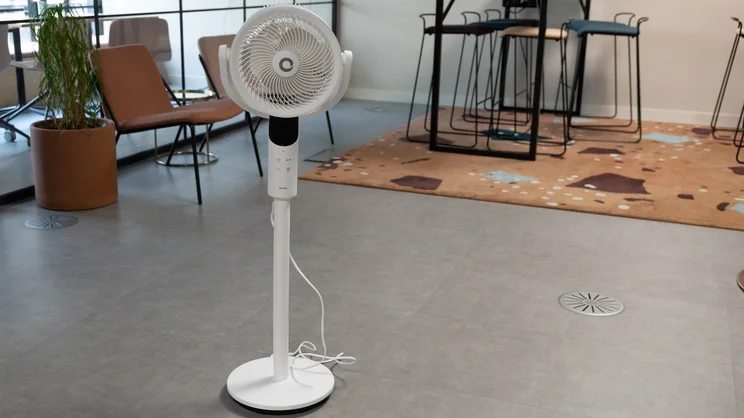
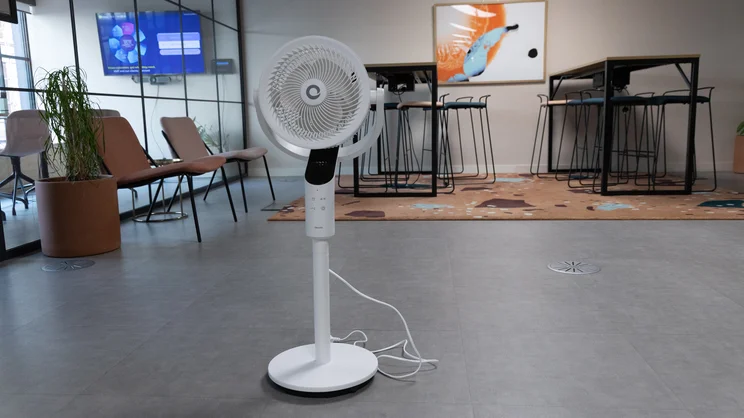
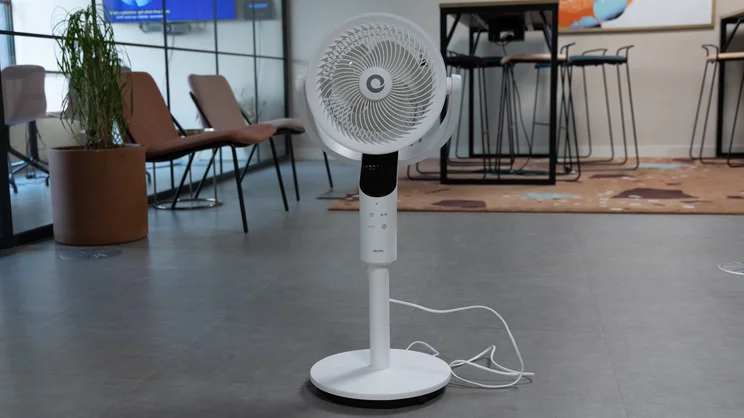
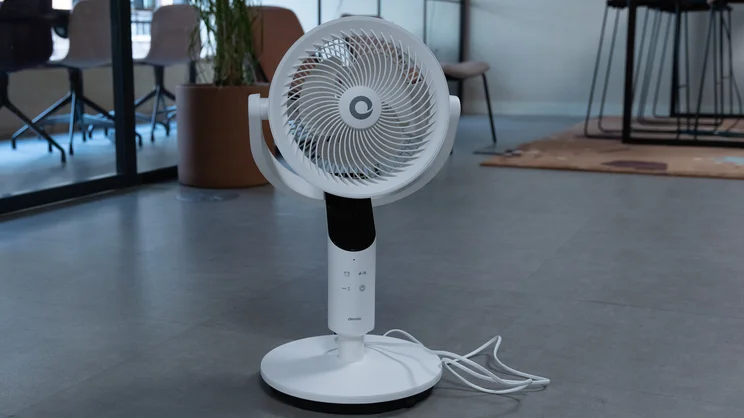
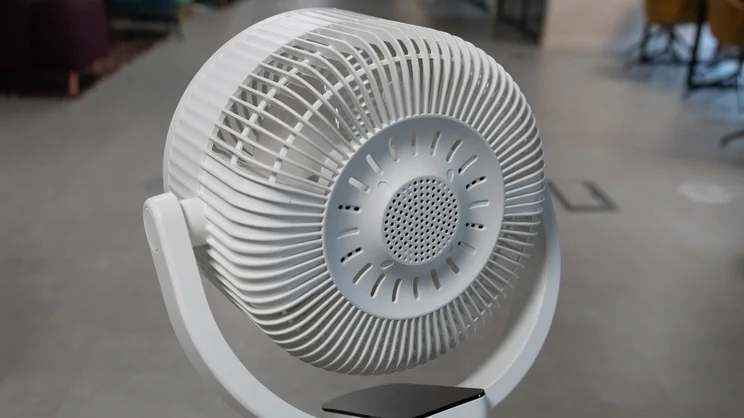
The Devola Platinum pedestal fan is available in a choice of black or matt white finishes and is built mostly from robust plastics, including its three-part stand. The fanhead itself can screw into the heavyweight round base, where it’s secured by a chunky threaded plastic nut, giving you what’s effectively a 586mm high floor fan. By adding either or both of the two additional stem sections, one longer than the other, you can run the fan at 762mm, 881mm and 1058mm heights. The conversion process isn’t as quick as with Dimplex’s more ingenious DuoCool 2-in-1 fan, but it makes the Devola a bit more versatile and an easier fit in a range of different spaces.
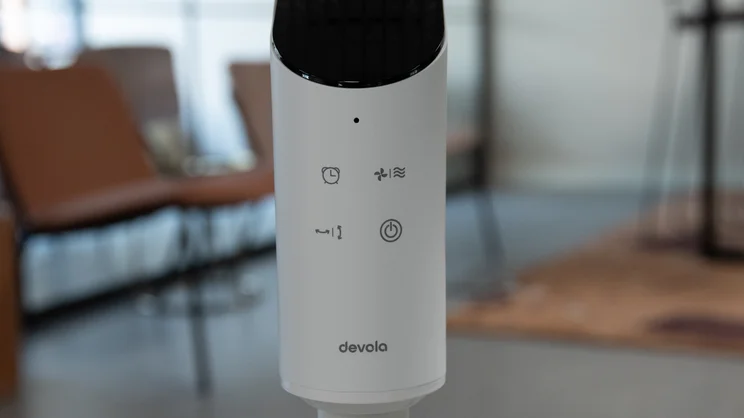
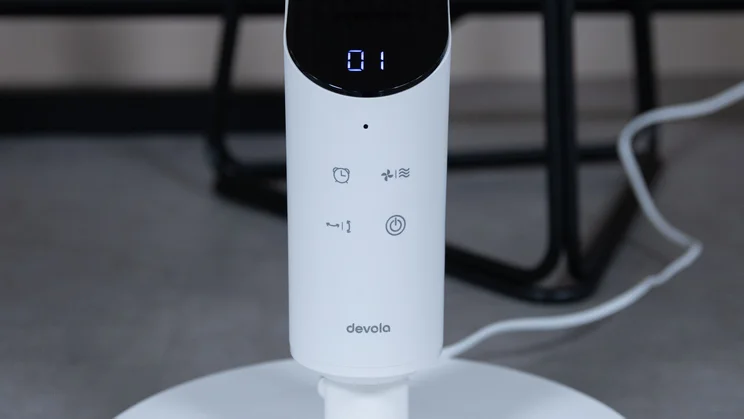
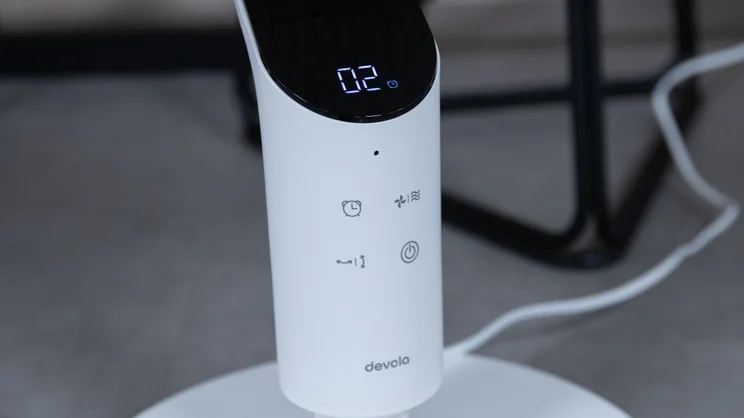
However you assemble it, the fan feels robust. Even though the base is fairly compact, at 30cm in diameter, there’s no wobble while the fan runs or oscillates, and only a little when you prod the touch-sensitive buttons on the front. There are just four of these, covering power, fan speed, oscillation and the timer – while some functions, such as switching modes, are activated through a longer press. I’m not a huge fan of this, but it makes for a simpler control panel. A digital display and indicators in the gloss black section above display the current speed and mode.
Fully assembled, the fan weighs 4kg, a lightweight design partly because the two stem sections weigh barely anything. Because of this, I found it easy to carry around the house in any of its configurations, short or tall, and can forgive the lack of any carrying handle in the fan head.
What features and settings does it have?
The Platinum 8in DC Pedestal Fan has twelve speed settings, taking you from a gentle, whisper-quiet breeze to a fairly noisy but still respectable blast. Mode-wise, you have the standard manual mode, a Nature mode which varies the fan speed and a Sleeping mode which slowly reduces the fan speed by one step every thirty minutes while you’re nodding off.
The timer works to switch the fan on while it’s in standby, or to turn it off if it’s running. Either way, it works in one hour intervals with a maximum of 15 hours. In addition to the fan’s static setting, you have a choice of three oscillation settings: horizontal and vertical, horizontal only and vertical only. There’s no way to adjust the oscillation angle, so you’re looking at 70 degrees left and right and 80 degrees up and down. There’s only roughly ten degrees of downwards angle in its vertical oscillation, which is a little odd when the airflow goes nearly vertically towards the ceiling; this only comes in useful when you have the fan right next to you in its floor configuration.
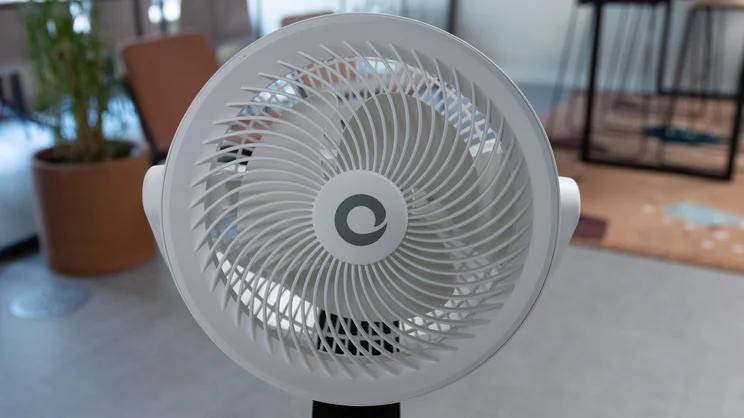
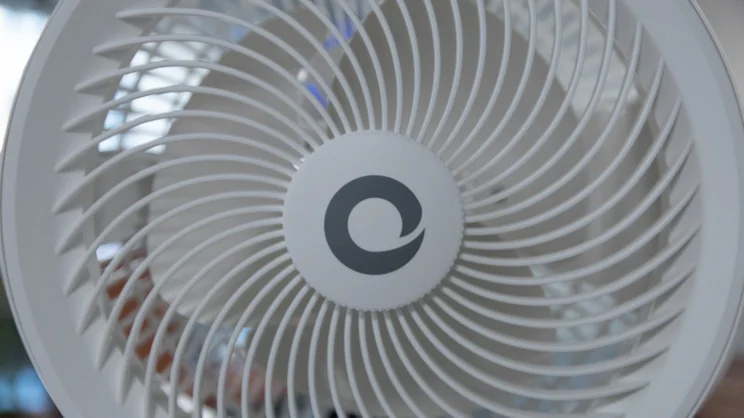
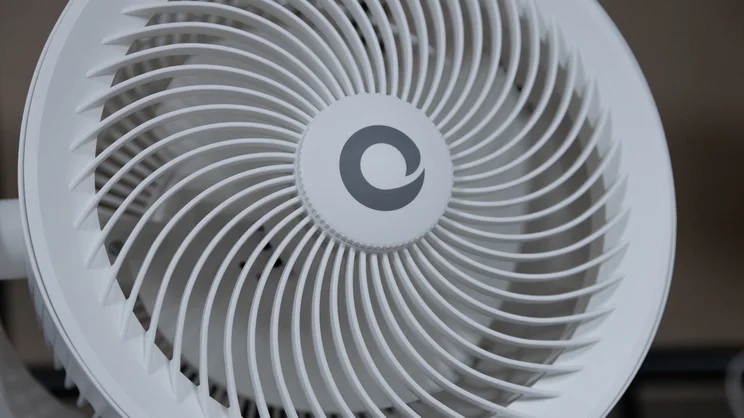
The Platinum also has an unusual feature where you can unscrew the cap in the centre of the fanhead and drip a fragrance or essential oil onto the absorbent pad concealed within, for the fan to then spread the scent. I didn’t find this hugely effective, but it might be a plus point for those who like aromatherapy.
How I tested the Platinum 8in DC Pedestal Fan
I carry out the same tests across all of the fans I review, measuring air flow, noise levels and power consumption.
I use an anemometer to record air speeds (in m/s). With the anemometer positioned a metre away from the fan, I take readings for its lowest, medium and highest settings, plus any settings I want to check for additional data. I then use a smartphone meter app to record sound levels (in A-weighted decibels, dBA) at the fan’s lowest and highest settings, also from one metre away. Finally, I use a plug-in energy meter to measure power consumption.
These standardised tests allow me to better compare fan performance across different brands and models. However, I also make sure I test each fan in everyday use, taking note of how well it keeps me and my family cool on hotter days, how easy it is to use and how effectively it can spread its airflow around. I also run through the different modes to see whether they work effectively or just get in the way.
How well does it perform?
The Devola can’t produce the kind of airflow we’ve seen from Meaco’s Sefte range or the Dreo Smart TurboPoly, but it’s powerful enough to cover large rooms and cool from a distance of two to three metres. Even at its lowest setting, you can feel the 1.4m/s breeze from over a metre away, and that ramps up to 2.2m/s by the time you reach speed setting 4. At the midway mark you’re looking at 2.6m/s, while the highest speeds in the 10-12 range reach 3.4m/s to 3.7m/s. The Meaco and Dreo fans go further – 4.6m/s to 5.5m/s – but you’re only going to need that kind of power in larger spaces.
Importantly, it’s a quiet fan. At setting one I couldn’t record anything above the ambient noise level in my living room at night, which was 25dBA. And even on the next setting up it’s barely audible at 30.8dBA. By the time you hit medium settings the sound output rises to 38.1dBA, but the low hum isn’t any more distracting than my fridge. That changes on the higher speed settings, reaching a maximum 48.4dBA, but even that’s quiet compared to the Dreo Smart TurboPoly, and just a little higher than the Meaco Sefte fans.
I was even more surprised by the power consumption figures. On its lowest setting the Devola uses just 2.15W, and on its medium setting that rises to 5.62W. At top speed it uses a mere 11.4W, where some rivals go up to 30W. Of course, they’re spinning those blades faster and whipping through more air, but the Devola is about as energy-efficient as pedestal fans get.
Is there anything we didn’t like?
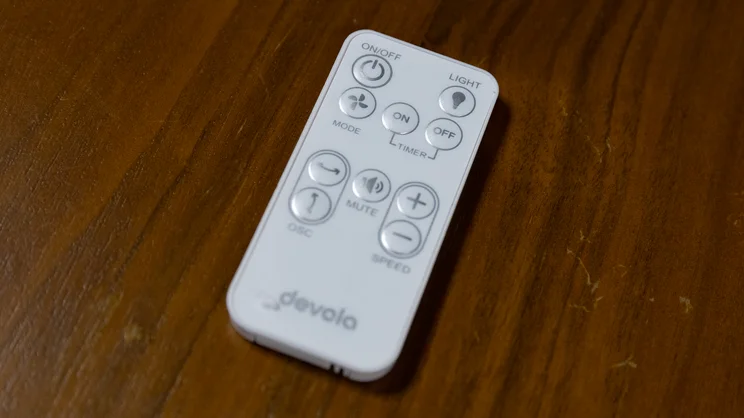
The remote control isn’t brilliant. It’s a small, lightweight effort with membrane style buttons and there’s nowhere to stash it on the fan.
I also found it a bit annoying that the Sleeping mode doesn’t turn off or even dim the lights. You can only do so manually using the button on the remote control.
Should you buy the Platinum 8in DC Pedestal Fan?
Is the Platinum 8in DC Pedestal Fan as good as the Duux Whisper Flex 2, the Dimplex DuoCool, the Dreo Smart TurboPoly or the Meaco Sefte Pro? Not quite. These rival fans are more powerful, more innovative and more packed with features worthy of their premium price tags.
However, the Devola is significantly cheaper, and it covers all the basics well. It’s powerful enough for most people in the average UK home, plus it’s quiet, energy-efficient and surprisingly versatile. If you’ve got just £100 to splash out on a pedestal fan, it’s one of the best options out there.