To help us provide you with free impartial advice, we may earn a commission if you buy through links on our site. Learn more
- Affordable
- Effective cooling
- Mammoth battery life
- Takes a long time to charge
- Fan head position is fixed
Over the past five or so years, the £12 John Lewis Handheld and Foldable Desk Fan has been an astonishingly popular item: a “viral summer hack”, I might say if I was an influencer with a limited vocabulary. You’d do well to find a media outlet that hasn’t fawned over it, and I’ve recommended it as an affordable alternative to the Shark ChillPill and the Dyson HushJet Mini Cool.
But it may be that the Handheld and Foldable Desk Fan’s time in the spotlight is coming to a close – only to be replaced by the John Lewis High Power Handheld Fan.
The new fan improves on its predecessor with a sleeker design, a digital display and USB-C charging. Airflow is just as impressive and, at £20 (or £25 if you opt for the aluminium model), it’s still strikingly affordable. I put it through its paces at the tail-end of London’s nth consecutive heatwave.
John Lewis High Power Handheld Fan review: What do you get for the money?
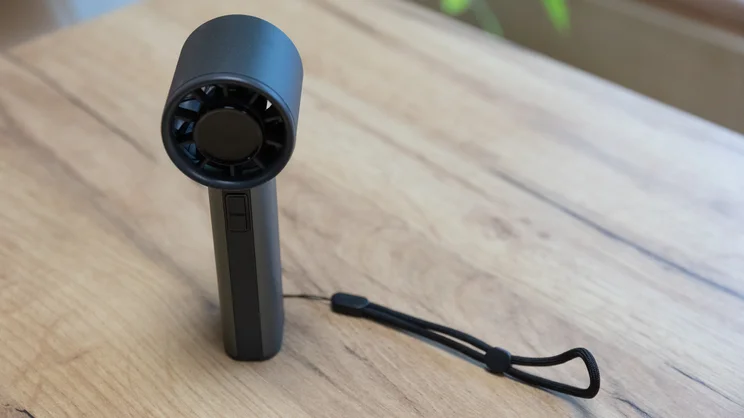
The design of the John Lewis High Power Handheld Fan might look familiar to you. That’s because this design is a little bit in vogue at the moment. During this year’s summer heatwave, I’ve noticed a whole array of fans that all slightly resemble one another: a rather small but chunky fan head mounted on a columned handle, with a digital display either above the controls on the on the handle or in the middle of the fan head itself.
Sure, there are only a few manifestations a handheld fan can take, but it’s actually quite striking just how many fans sold by unrecognisable Chinese Amazon brands – I’m talking about “gaiatop”, “JISULIFE” or “Deyhoc” – are out there.
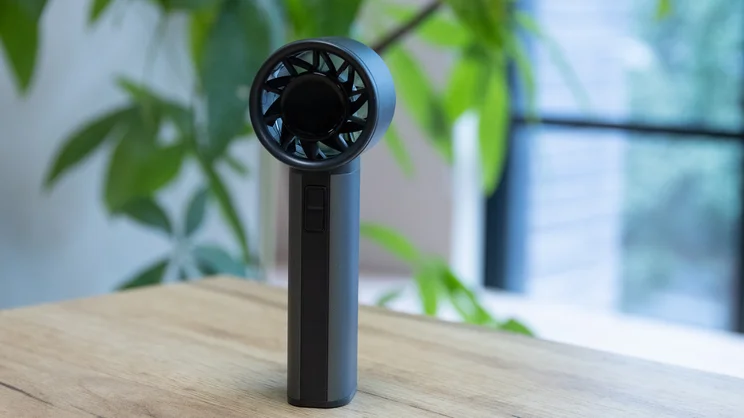
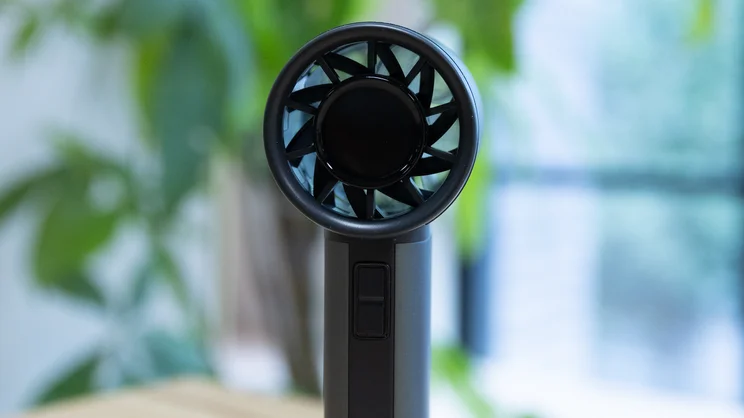
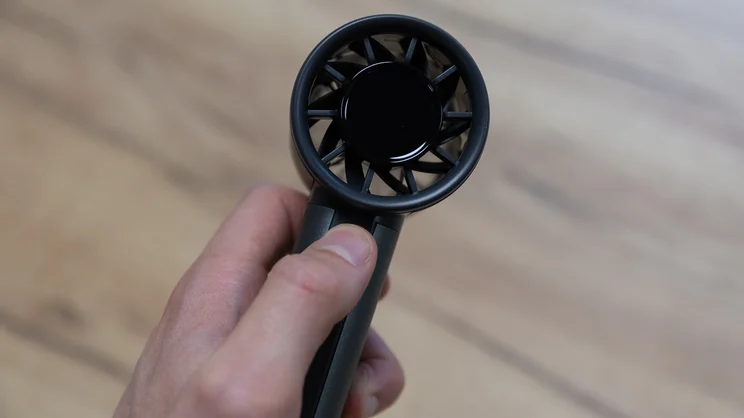
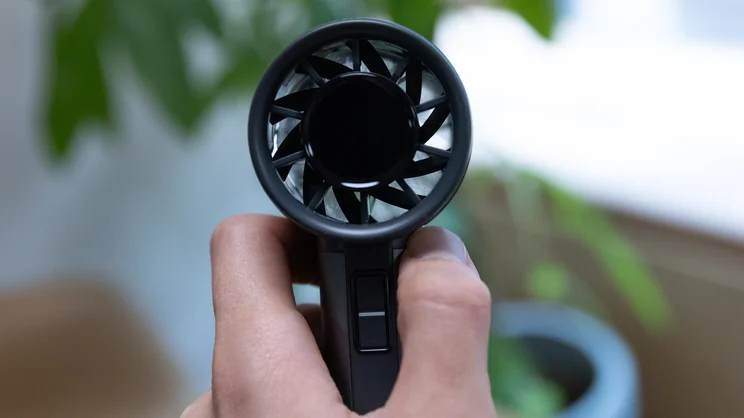
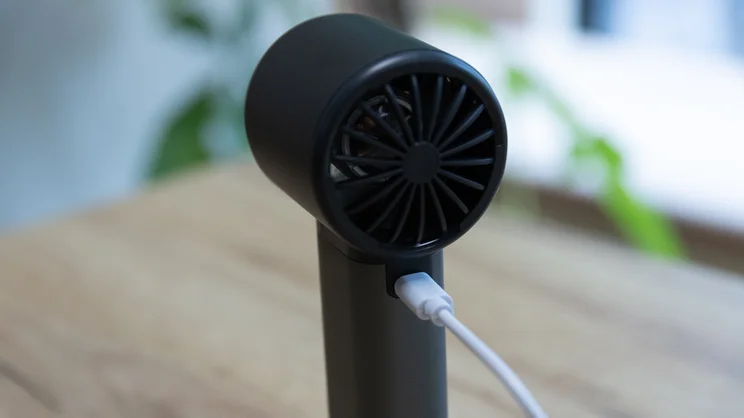
John Lewis’ High Power Handheld Fan adopts a similar design: a static bladed fan head, measuring about 2in in diameter, on top of a handle that’s around 11cm tall.
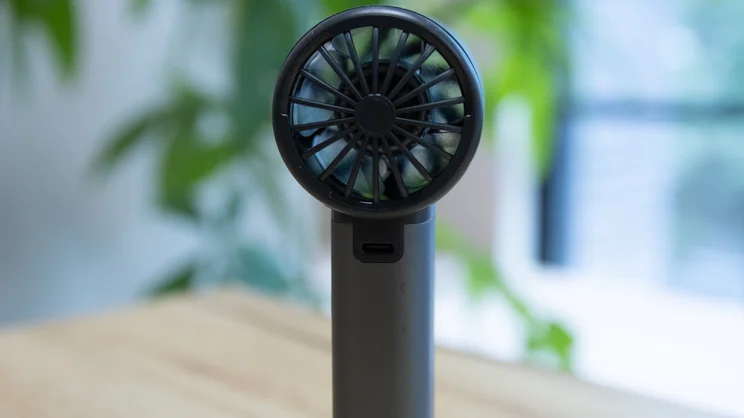
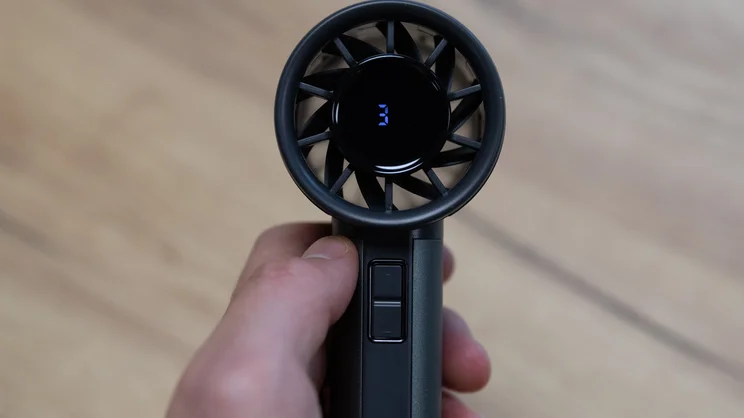
“Up” and “down” buttons on the face of the handle toggle between the fan’s four speed settings, while a digital display in the middle of the fan head shows the current speed setting and remaining battery life. John Lewis quotes a battery life of up to 15 hours and it’s rechargeable via USB-C, which is a huge improvement over its predecessor’s miro-USB charging.
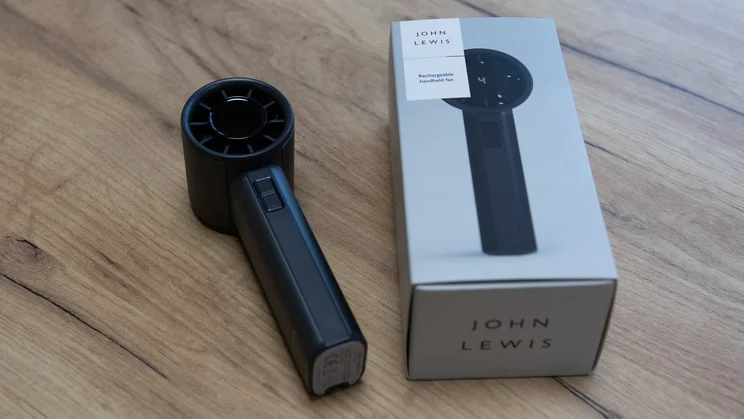
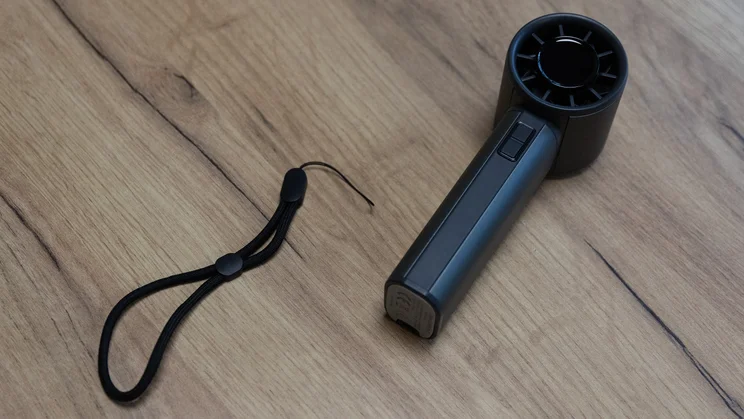
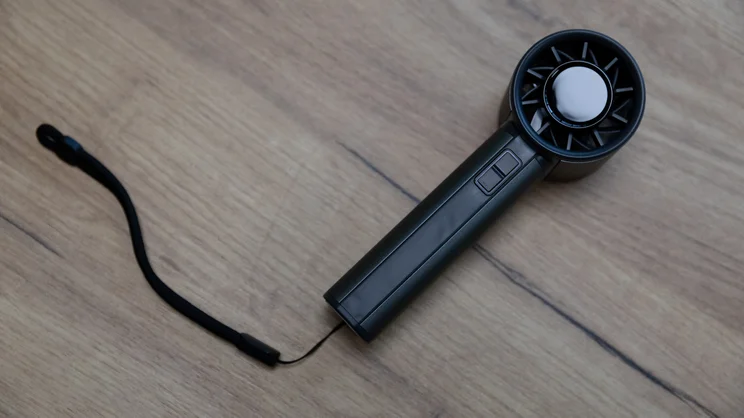
The fan comes in a choice of two materials and five colours. The plastic variant costs £20 and comes in “Mint” (green), “Petal” (a pale salmon pink) or “Beach” (yellow), while the aluminium clad version I tested will set you back an additional £5 and comes in black or silver. Also included in the box is a small hand strap that attaches to the base of the handle.
How did I test the John Lewis High Power Handheld Fan?
I started testing the High Power Handheld Fan around the middle of August, towards the end of a series of quite intense heat waves. This allowed me to test it in temperatures exceeding 30°C as well in the milder climes that followed. I used the fan day-to-day, whether I was sitting at my desk or out and about, as well as during the night on my bedside table.
In addition to regular use of the fan, I also carried out some standardised tests. Firstly, I used an anemometer to record air speeds at different settings and distances, before using a smartphone sound meter app to measure sound output in A-weighted decibels (dBA). Lastly, I timed how long it took for the battery to run from a full charge to a dead battery.
While regular use of the fan allowed me to judge how effective and easy-to-use it was, these tests meant I could better compare performance with rival handheld fans.
What’s it like to use?
Operating the fan is very easy. You’ve only got two buttons to worry about: an “up” button which increases the fan speed, and a “down” button that decreases the fan speed. To turn it off, you simply double tap the down button. And that’s pretty much all there is to it.
My one complaint is that its static fan head can’t be rotated or tilted. I often find myself using handheld fans as desk fans, and this feature was sorely missed. This is one area in which the Shark ChillPill excels, thanks to its hinged design allowing you to direct airflow at a range of angles. John Lewis’ Handheld & Foldable Desk Fan – as its name suggests – also allowed you to adjust the angle of airflow on a vertical axis.
How powerful is it?
Even at its lower settings, you get a decent breeze from the High Power Handheld Fan. And, considering its relatively small radius, the spread of airflow is surprisingly impressive. You don’t need to have the fan pointed squarely at your face to feel a benefit.
Its cooling wasn’t quite as effective at the worst peaks of the heatwave, when temperatures were pushing well into the mid 30s (°C). But that’s simply a limitation of fans in general; in this kind of heat, all it can do is circulate hot air.
At 50cm away, I recorded air speeds of 1.6m/s (setting one), 2m/s (setting two), 2.3m/s (setting three) and 2.9m/s (setting four). At one metre away, my anemometer couldn’t pick up a reading for the fan’s weakest setting, but still picked up a decent 1.6m/s at full tilt.
These speeds are more powerful than the Shark ChillPill, which peaked at 1.3m/s from 50cm away, while – at least in terms of raw power – the John Lewis fan fell short of the Dyson HushJet Mini’s 4.3m/s gusts.
But how does its performance compare to the £12 John Lewis fan I’ve lauded in the past? Well, airflow is just as impressive and, at certain settings, even better. Take a look at the tables below for a closer comparison.
| Air speed (in m/s), recorded from 50cm away | ||
|---|---|---|
| John Lewis Handheld & Foldable Desk Fan | John Lewis High Power Handheld Fan | |
| Lowest setting | 1.3 | 1.6 |
| Middle setting/s | 1.8 | 2/2.3 |
| Highest setting | 2 | 2.9 |
| Air speed (in m/s), recorded from 1m away | ||
|---|---|---|
| John Lewis Handheld & Foldable Desk Fan | John Lewis High Power Handheld Fan | |
| Lowest setting | 0.8 | 0 |
| Middle setting/s | 1.1 | 0.8/1.2 |
| Highest setting | 1.3 | 1.6 |
The differences here are pretty marginal, but for just an extra £10 or so, that’s not to be sniffed at.
How loud is it?
The John Lewis High Power Handheld fan is not inaudible, but neither does it sound like a jet engine. At its lowest speed, I recorded 48dBA from 50cm away and 45dBA from 1m away. Taken in isolation, this is one of the loudest results I’ve recorded, albeit by a small margin: at their lower settings, the Shark ChillPill registered 43.1dBA from 50cm away, the John Lewis Handheld & Foldable Desk Fan registered 45.1dBA, and the Dyson HushJet MiniCool 45dBA.
However, at its more powerful speeds, you’re looking at a different picture. At setting four, I recorded noise levels of 59dBA (from 50cm away) and 53dBA (from 1m away). While these readings are only slightly louder than the John Lewis Handheld & Foldable Desk Fan (53.7dBA from 50cm away and 48.8dBA from 1m away), it’s quieter than the Shark ChillPill’s max settings (65.6dBA and 60dBA) and the Dyson HushJet Mini Cool (62.4dBA and 57.2dBA).
Is the battery life good?
In short, the battery life on the John Lewis High Power Handheld Fan is astonishing. To gauge the maximum battery life, I ran the fan at its lowest speed setting, and timed how long it took to run flat.
Given John Lewis’ 15-hour claim, I had a feeling this would take a while. So, at 10pm, I started the fan and left a timer running while I went to bed. By 2pm the following day, the fan was still chugging along with no sign of stopping. When the battery finally gave in, the time was 16 hours and 29 minutes, beating John Lewis’ claim by almost one and a half hours. High power, indeed.
Of course, in daily use, you’re likely going to be switching the fan on and off, and toggling between its settings rather than letting it run indefinitely at its lowest speed. However, as an indication of its peak battery performance, this is still mightily impressive.
By comparison, the Dyson HushJet Mini Cool has a quoted battery life of up to six hours on its lowest setting (I measured almost two hours at its middle setting), the Shark ChillPill up to 11 hours, and the John Lewis Handheld & Foldable Desk Fan up to nine hours.
For all the strength of its battery, the John Lewis High Power Handheld Fan does take a fair while to charge. However, considering you could be using it for up to 16.5 hours before you’ve run out of juice, having to charge it overnight every now and then is a piddling sacrifice.
Should you buy the John Lewis High Power Handheld Fan?
That said, if the biggest issue with a handheld fan is that its head doesn’t rotate or tilt, then there can’t be an awful lot else that it does wrong. Airflow is good, it’s not too loud and – crucially – it doesn’t cost a bomb.
Yes, the Dyson HushJet Mini Cool is more powerful, but it’s also a lot louder and costs £100. And while the Shark ChillPill might offer more fancy features, it’s also loud, expensive and its airspeeds are underwhelming.
On the balance of its features and price, the John Lewis High Power Handheld Fan is a winner. Where handheld fans are concerned, this is the one to beat.