To help us provide you with free impartial advice, we may earn a commission if you buy through links on our site. Learn more
- Compact and unobtrusive
- Plenty of drying power
- Quiet and fairly cheap to run
- Water tank slightly tricky to empty
- Needs some distance from the wall
For a while, Meaco’s Arete series dehumidifiers have been our go-to recommendations for those with a reasonable budget who need something compact, quiet and effective. Now, however, there’s a new contender.
ProBreeze – manufacturers of the excellent PB-08 – has a new line of OmniDry dehumidifiers, promising high extraction rates, energy efficiency and a decent laundry mode without a massive, noisy unit. What’s more, a bigger-than-usual 4l water tank means less emptying when your moisture levels need some urgent action. Throw in smart app controls and compatibility with Google Home and Alexa, and you’ve got a serious rival to the Arete series – and at a lower cost too. But how does it compare in practice? I’ve spent the last few days with the OmniDry 20L finding out.
ProBreeze OmniDry 20L: What do you get for the money?
The OmniDry 20L is a compressor dehumidifier with a 20l extraction rate, designed for rooms up to 30m2 in size. The water extracted from the air ends up in a 4l tank, which is a little larger than the 2.5-3.5l tanks usually found in 20L models – though still not as large as the Arete Two 20l’s 4.8l tank. It works at temperatures ranging from 5°C to 32°C and ProBreeze claims a low noise output of just 36dB.
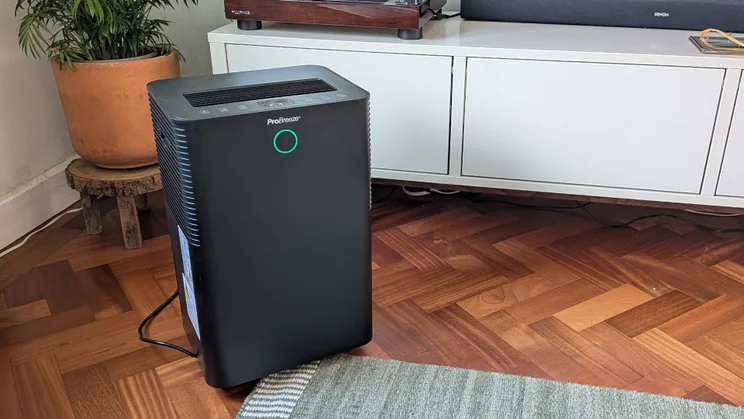
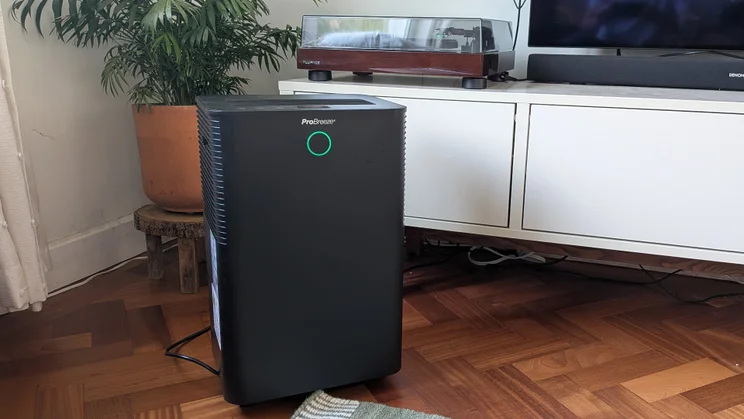
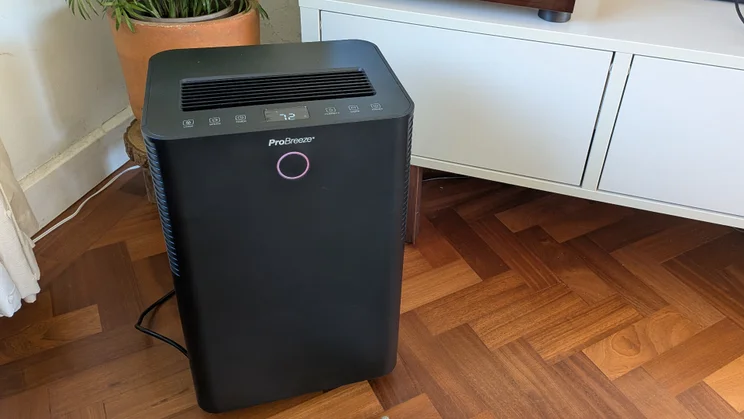
The OmniDry 20L is fairly compact for a 20L dehumidifier, standing just under 50cm tall and measuring only 30.5cm across the front. At 12.5kg unfilled, it’s reasonably easy to move around the house, with inset handles on either side to make it slightly easier to lift. The black version I tested had a nice habit of almost merging into the background of the room, while some white dehumidifiers can stick out like a sore thumb.
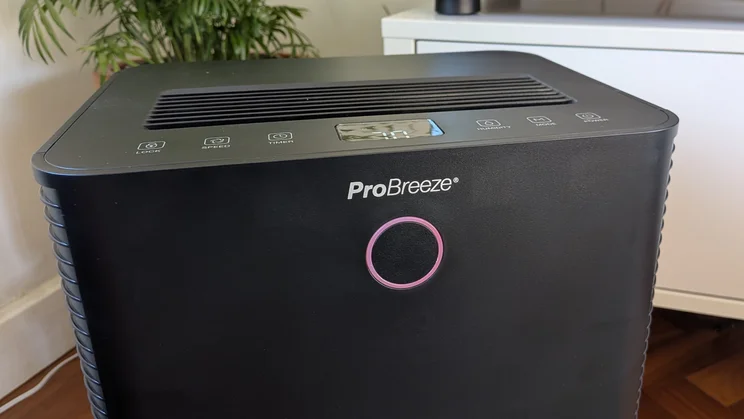
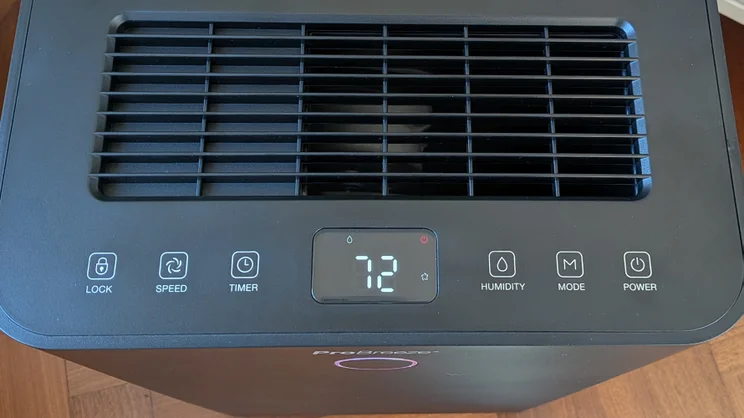
In fact, the only things to draw your attention are the top-mounted digital display and an illuminated ring on the front of the unit that glows blue, green or red according to the current relative humidity. Thankfully, both are dimmable.
It’s controlled through six membrane-style buttons, with three on each side of the display. They’re responsive and fairly intuitive, making it easy to switch between modes and to toggle through the fan speeds or target humidity options. Alternatively, you can manage all this through ProBreeze’s smartphone app, which also enables voice control through Amazon Alexa or Google Home.

What features does it have?
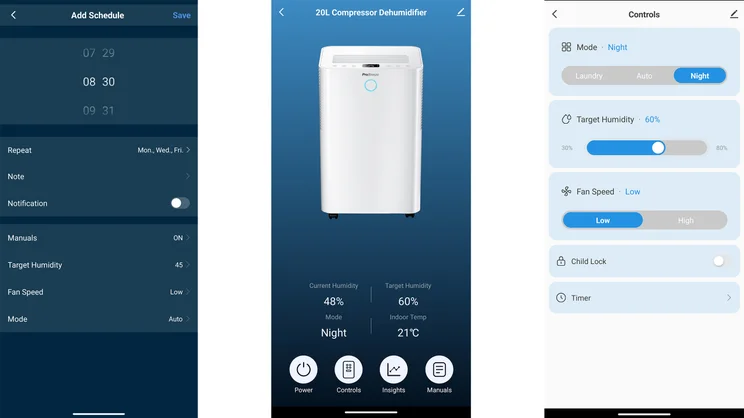
The OmniDry 20L has high and low fan speeds plus a choice of three modes: a default Auto mode, which keeps it running at the optimal levels to hit your set target humidity; a Laundry mode, which runs continuously at high fan speed; and a Night mode, which dims all the lights and keeps the fan speed set to low. Beyond that you have a timer, which turns the dehumidifier on from standby after one to 24 hours, or off if it’s already turned on.
The app gives you remote control over the unit, plus a more sophisticated timer with daily or weekly schedules. You can also set up routines so that, for instance, should the humidity drop below 55%, the fan speed will switch to low. There’s a bit of exploration required to find these more complex options in the app, but it’s reasonably intuitive and straightforward to set them up. You can also integrate the OmniDry 20L within Alexa or Google Home routines, as well as use voice controls for the basic functions. It’s not the first smart dehumidifier we’ve seen, but it’s one of a few where the smart features are actually useful.
How did I test the ProBreeze OmniDry 20L?
I test all dehumidifiers over several days inside a three bedroom house, allowing me to make meaningful comparisons on their performance, features, energy consumption and noise. I test the 20L to 30L models in a large living room that’s prone to damp and mould, especially in wet winters.
I try to keep both rooms at a comfortable 19-20°C temperature while I’m testing, and use a wireless air-quality monitor backed up by a temperature and humidity meter (hygrometer) to measure relative humidity (RH). I set the humidifier to run on the highest setting with a 50% RH target, and measure RH before testing, after one hour and then again after a second hour. I’ll also use the dehumidifier in other rooms around the house, and test any laundry drying features to judge how effectively these work. Finally, I use a smart plug with energy monitoring and a smartphone noise meter app to check power consumption and noise levels during use.
How well does it work?
It’s an effective dehumidifier in larger spaces. When I set it to work in my living room with the temperature at 20°C, the relative humidity was 68%. Within an hour that had dropped to 60%, and after two hours it hit 59%. The OmniDry 20L struggled to get the relative humidity much lower – after a third hour it was static at 58% – but that’s not unusual for 20L models in this room. It’s often quicker to reduce RH from 75% down to 65% or less than it is to reduce it from 60% to nearer 50%.
In a smaller upstairs room it was even more useful, dropping the relative humidity down from 65% to 54% within an hour, then 54% to 51% within a second hour. That’s not a bad effort for what’s still a relatively compact unit, and it’s definitely an improvement on what we’ve seen with smaller 12L models.
The ProBreeze is also a star at drying clothes. I had it set to Laundry mode while working on a rack full of mixed washing, and after four hours it was close to dry. By six hours it was comfortably cupboard dry and I went on to rack up another load. Even jeans and some thick sweatpants didn’t pose any problems for the OmniDry 20L.
Noise output from the OmniDry 20L isn’t far off the claimed 36dBA, but only with the fan on low, where it hovers between 36 and 38dBA. On high, you’re looking at around 42-44dBA. Still, that noise isn’t what you’d call a racket; more a low hum you can just about hear through intervening walls or floors. I’ve heard smaller dehumidifiers like the VonHaus 12L make a significantly more disturbing low-pitch rumble.
The OmniDry 20L is also one of the most energy-efficient 20L dehumidifiers that I’ve tested, using around 226W with the fan on high and the compressor working hard. That drops to around 33W with the compressor idle and the fan just ticking over. That’s competitive with the Arete Two 20L, which uses roughly 224W on full power and around 38W running quietly in the background.
What could be improved?
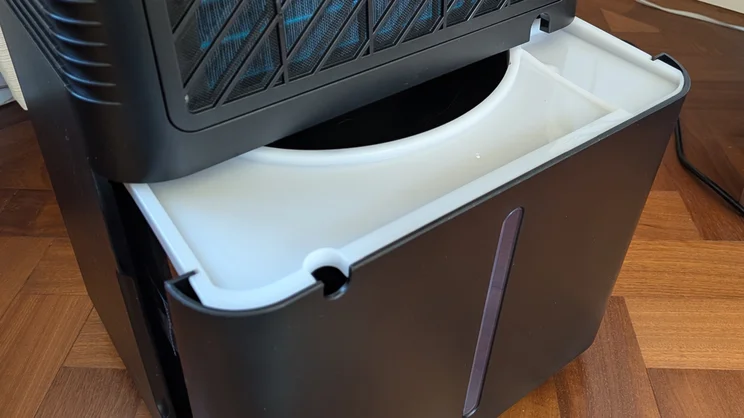
Not much, but it’s not quite as flexible in its positioning as the Meaco Arete One or Arete Two dehumidifiers. Where they can be placed flush against a wall or a piece of furniture, the ProBreeze manual recommends a 20cm distance. Also, I found the water tank a little tricky to empty without water spurting out at speed. Gently does it would be my advice.
Should you buy the ProBreeze OmniDry 20L?
Yes. It’s one of the best mid-sized dehumidifiers I’ve tested in the last few years. Performance isn’t quite as good as the Arete Two 20L and the Meaco has the edge on noise, but the ProBreeze is still quiet and effective, slightly easier to use, smaller and a good £50 cheaper. It’s as energy-efficient as the class-leaders, and its smart features are genuinely useful. All in all, it’s an excellent buy.