To help us provide you with free impartial advice, we may earn a commission if you buy through links on our site. Learn more
- Effective in small rooms
- Can stretch to drying laundry
- Easy to carry and store
- Noisy rumble that carries through floors
- Small water tank means regular emptying
VonHaus’ 12L dehumidifier might be the smallest 12L model that we’ve ever tested. Standing just over 43cm high, it’s even tinier than the Devola DVH12L and only slightly more imposing than the titchy Meaco Arete One 6L.
At under 10kg it couldn’t be much easier to carry around the house. Better still, it couldn’t be much more affordable, retailing at £120 yet consistently selling for around £100 or less. Could this be the compact dehumidifier that you’ve been looking for? I’ve spent the last few days testing its moisture-reducing powers, and I think this little monster punches above its price and weight.
VonHaus 12L Dehumidifier: What do you get for the money?
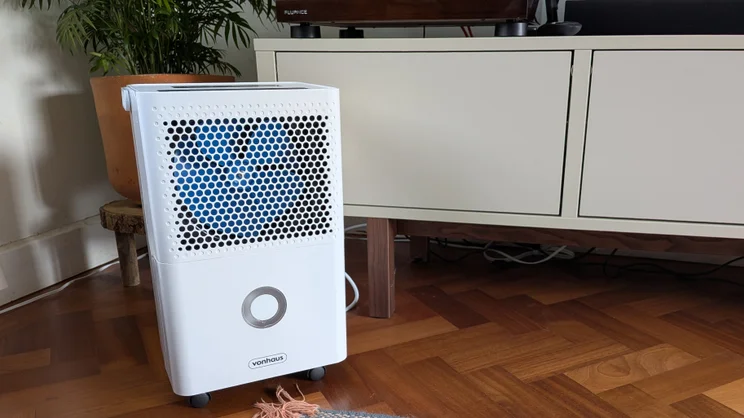
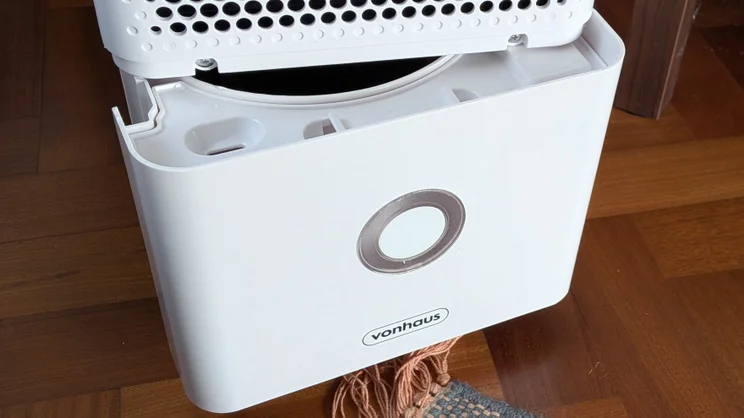
This is an extremely compact dehumidifier with a 12L/day extraction rate. It’s 25.6cm wide, 20.3cm deep and 43.4cm tall, making it one of the few 12L dehumidifiers you could squeeze away in a cupboard or under the stairs during the summer when it’s not in use. VonHaus suggests it can handle rooms of 12 to 15m2 in size, and the only obvious limiting factor is its small 1.5L water tank. Even the Meaco Arete One 6L outdoes this with 1.8L. Still, it pulls out neatly enough from the front of the unit, and empties very quickly into the nearest sink or drain. There’s also the option of continuous drainage into a drain or bucket, and VonHaus supplies the unit with a short transparent hose.
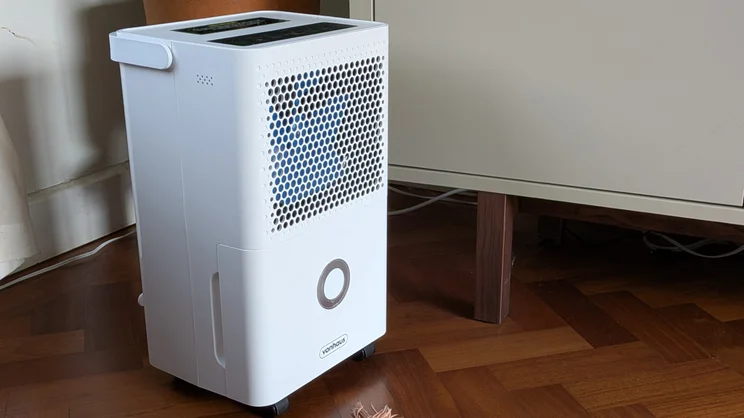
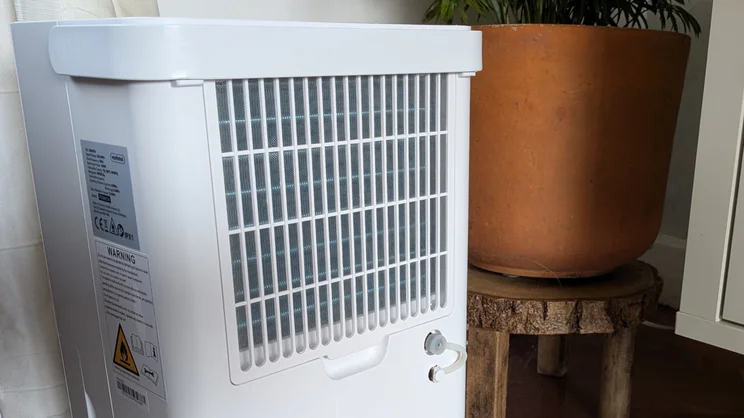
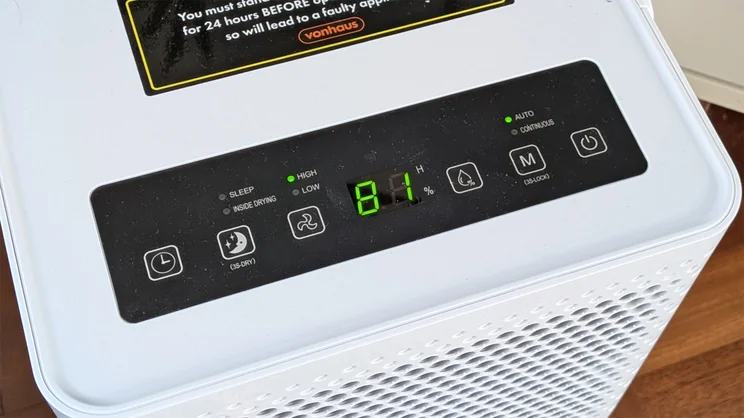
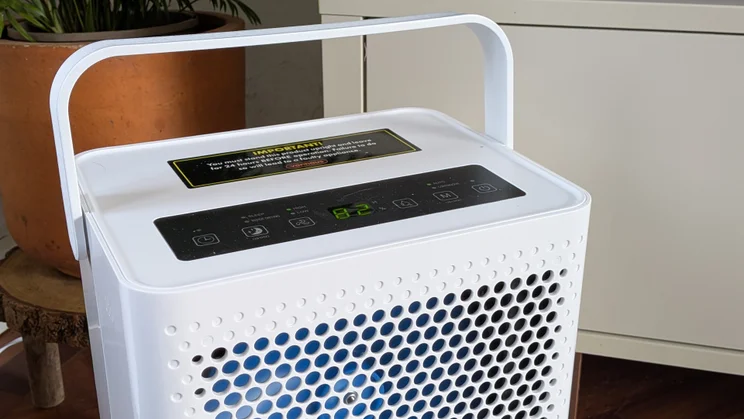
The design is simple, offsetting a rectangular shape with rounded corners, with air sucked in through a filter at the rear and pushed out by the fan through a hexagonal grill at the front. The control panel sits up top, with buttons to activate the timer, select special modes, set the fan speed and humidity level, flick between manual, auto and continuous settings and finally switch the unit on or off.
A small digital display in the centre indicates the current humidity level, while a series of LEDs point to the current settings. VonHaus also gets bonus points for the carrying handle at the top, which makes this unit much easier to lug around than the Devola DVH12L.
What features does it have?
You can set the target humidity level anywhere between 30% and 80% (though most of us prefer to keep it in the healthy 40% to 50% region) and choose from Manual, Auto or Continuous operation. The Auto mode starts up the fan and compressor once the relative humidity rises more than 5% above the target. On top of that you have high and low fan settings, plus a sleep mode which dims the display and LEDs and keeps the fan running on low.
Weirdly, VonHaus’ marketing implies that this model has a laundry mode, but you’ll struggle to find any such thing on the control panel or mentioned in the user guide. There is what’s called an Inside Drying mode, but this runs the fan without the compressor to dry the internals out, ready for storage. Instead, your best bet is to simulate a Laundry mode by running the fan at full tilt on its Continuous setting with an off timer. This runs in hourly increments for up to 24 hours, though six to eight should be enough to dry your washing.
How did I test the VonHaus 12L Dehumidifier?
I test all dehumidifiers over several days inside a three bedroom house, allowing me to make meaningful comparisons on their performance, features, energy consumption and noise. We use two rooms for specific tests: a large living room that’s prone to damp and mould, plus a smaller bedroom in the north east corner of the house that doesn’t get much sun.
We try to keep both rooms at a comfortable 19-20°C temperature while we’re testing, and use a wireless air-quality monitor backed up by a temperature and humidity meter (hygrometer) to measure relative humidity (RH). We set the humidifier to run with a 50% RH target on the highest fan setting, and measure RH before testing, after one hour and then again after a second hour. We’ll also use the dehumidifier in other rooms around the house, and test any laundry drying features to check how effectively these work. We also use a smart plug with energy monitoring and a smartphone noise meter app to check power consumption and noise levels during use.
How well does it work?
Compact dehumidifiers tend to work best in compact spaces, so I wasn’t surprised to see the VonHaus 12L do well in our small back bedroom. Starting at a 70% RH level, the VonHaus had it down to 60% within an hour and 57% within two hours. We left it running for another hour and the humidity level dipped to 55%. That puts it in roughly the same ballpark as the Devola DVH12L: itself a compact 12L dehumidifier, though a slightly more expensive one with a larger 2.7L tank.
What did surprise me was that the VonHaus 12L could still be effective even in larger spaces. In our lounge it managed to reduce humidity levels from 72% to 65% within an hour, then down to 63% in the second hour. I left it running for another hour, but 61% was about as low as this titchy tyke could go.
Despite its lack of a dedicated laundry mode, the VonHaus 12L isn’t bad at the whole garment drying caper. I left it running continuously for six hours with the fan on high and came back to a rack of dry socks, underwear and T-Shirts. Only a pair of jeans and some heavy joggers were in need of further dehydration. It’s not quite as strong here as the competition from Devola, but it can definitely do the job.
Power consumption is roughly in line with what I’d expect from a modern compact dehumidifier, with the unit using up to 168.5W at maximum settings, dropping down to around 28.5W while cruising with the compressor off in Auto mode.
What could be improved?
The VonHaus falls down in just two areas. Firstly, that water tank is small. I didn’t find it much of a problem during testing, but after one stint of dehumidifying followed by a stint of laundry drying, I found it had filled up before my drying cycle was complete. The Devola gives you more scope to just turn it on and leave it running.
Its other problem is noise. On paper, this isn’t terrible. I measured a maximum 44.7dBA with the compressor active and the fan on high, which dropped to 40dBA with fan on low. However, the low pitch rumble of the unit had a habit of travelling through our walls and floor, making that noise more disturbing than on the Devola, which itself had an audible dull hum when heard from another room. Both are significantly noisier than Meaco’s smaller and less powerful Arete One 6L too.
Should you buy the VonHaus 12L Dehumidifier?
Luckily, the VonHaus has something extra going for it – an extremely competitive price. There are loads of people out there who need a dehumidifier for occasional use in the autumn or the winter, often in a relatively small space.
This one’s cheap to buy, easy to stow away and effective in small spaces. It can even take the moisture levels down in larger rooms, though there’s a definite point at which it can’t do any more. I’d still recommend a larger and more versatile dehumidifier if you have the space and budget, but if you’re looking to spend the bare minimum, this isn’t a bad option at all.