
To help us provide you with free impartial advice, we may earn a commission if you buy through links on our site. Learn more
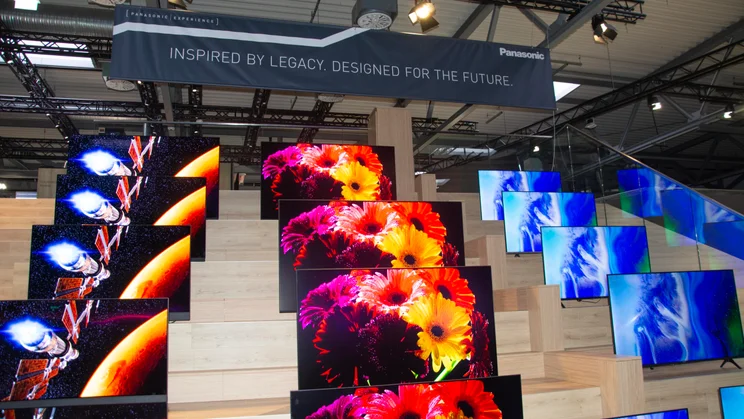
Panasonic’s television business was talked about in hushed tones at CES in January. I heard industry insiders discussing whether it was planning to pull out of Europe, speculation fuelled by the fact that the brand didn’t reveal its new flagship OLED and Mini LED sets.
However, the real reason Panasonic was keeping tight-lipped about its latest television lineup was revealed at the Panasonic Experience 2026 in Ottobrun, Germany, this week, and it took many in attendance by surprise.
A best-in-class TV business in Europe?
Following in the footsteps of its Japanese counterpart, Sony, which agreed a joint venture with TCL earlier this year, Panasonic has secured a “strategic partnership” with Shenzhen Skyworth Display Technology.
The partnership, which comes into effect on 1 April, will see TVs continue to be produced under the Panasonic brand, but “take the limits off” what can be delivered “in terms of ambition and vision,” according to Paul Darch, CEO at Chuangwei RGB, Skyworth’s parent company.
Specific details of the partnership remain under wraps. However, Skyworth will handle the manufacturing of Panasonic TVs in both Europe and the US, as well as looking after the sales and marketing of its televisions going forward. Panasonic, meanwhile, will provide after-sales support to those with older Panasonic sets, as well as new ones produced moving forward.
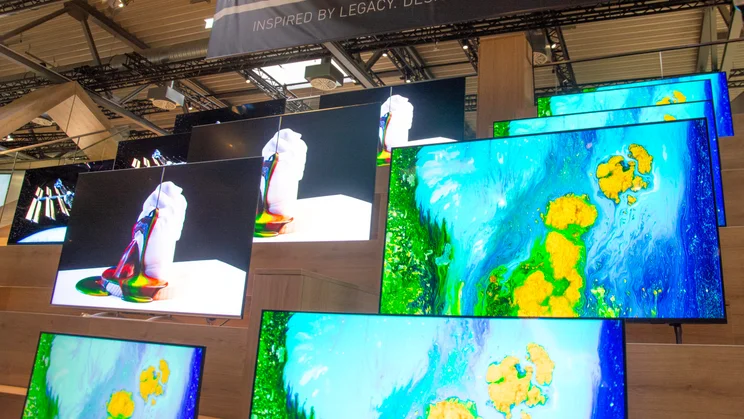
We’ve been incredibly impressed by Panasonic’s flagship TVs over the past couple of years. The Z95B OLED was crowned TV of the Year at our Product of the Year Awards in January, and the Mini LED W95B also picked up our Recommended award in 2025.
Darch said that there’ll be no change in the quality of what Panasonic offers, and is optimistic that, by bolstering capabilities across key areas, the brand can secure a “double-digit market share in Europe”.
“We, as a partner, bring real power and global skill for TVs. We’re a top-five global TV brand, and that matters because it gives us confidence and drives real momentum behind Panasonic TVs,” he explained.
“With world-class manufacturing capabilities, we can scale innovation efficiently and bring what is great to more European homes, with Panasonic DNA evident in every detail. Put simply, we’re building the reach to match the reputation.”
No new OLED or Mini LED flagships coming this year
Perhaps unsurprisingly, given the importance of the Skyworth announcement, the reveal of Panasonic’s 2026 TV range felt a little underwhelming. This was in no small part due to the absence of new flagship options in the UK.
The Z95B and Z90B OLEDs are being carried over from last year, with the first new entry in the OLED lineup, the Z86C, available in 55in and 65in screen sizes. There’s no replacement for last year’s W95B Mini LED option set for the UK, either. “Continental Europe” is getting new Google TVs in the form of the W97C and W95C (with the only difference being the colour of the finish), but we don’t look likely to get these here.
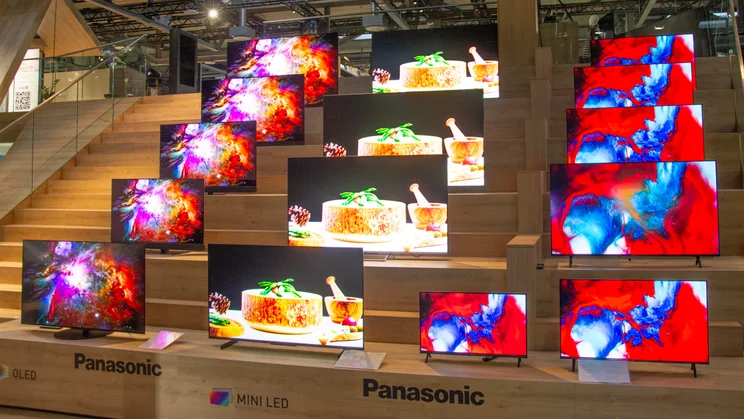
Instead, Panasonic is slotting in the W94C just below the W95B in three sizes (55in, 65in and 75in) and propping up its Mini LED offering with the W91C; the only TV in its lineup to run Roku and the only 60Hz refresh rate Mini LED option.
On the quantum dot LED front, the W80C replaces the W80A. Meanwhile, the basic 4K LED W61A will be phased out and replaced by the W60C. To cater to the increasing demand for large-screen TVs, both the W80C and W60C, which run the TiVo operating system rather than the Amazon Fire TV OS found on models above them, will be available in 75in, as well as 43in, 50in, 55in and 65in.
Further updates are found in the non-4K portion of the Panasonic TV range. The S55A makes way for the S65C, which uses a 2K QLED panel, is available in 40in and 32in sizes and runs Fire TV, while the HD-Ready, TiVo-powered S45C and S40C replace the S45A.
Fewer reflections for a superior viewing experience
One thing Panasonic was keen to push this year was its new anti-reflection technology. This will feature in different forms on different sets, with the W94C and W91C both featuring Glare Free Ultra. Models further down the range, like the W80C, get a slightly less effective anti-reflection solution in the form of Glare Free Max, while the W60C, S65C, S45C and S40C make do with basic Glare Free technology.
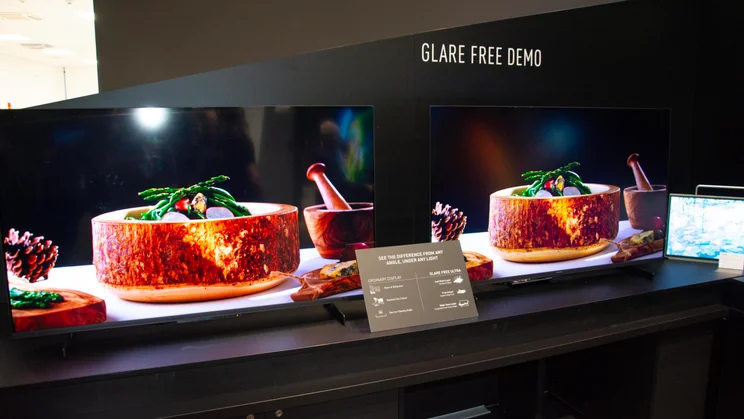
As you’ll likely have deduced, these are designed to reduce pesky reflections while maintaining clarity and contrast. Based on an initial demo of the Ultra version, it works very well, though without side-by-sides with rivals, it was impossible to judge how it measures up to similar approaches used by the likes of Samsung and TCL.
“Inspired by legacy. Designed for the future”
Alongside the Panasonic TVs that will be available to buy this year were several prototypes intended to showcase the kind of innovative ideas the brand plans to bring to life now that it’s partnered with Skyworth.
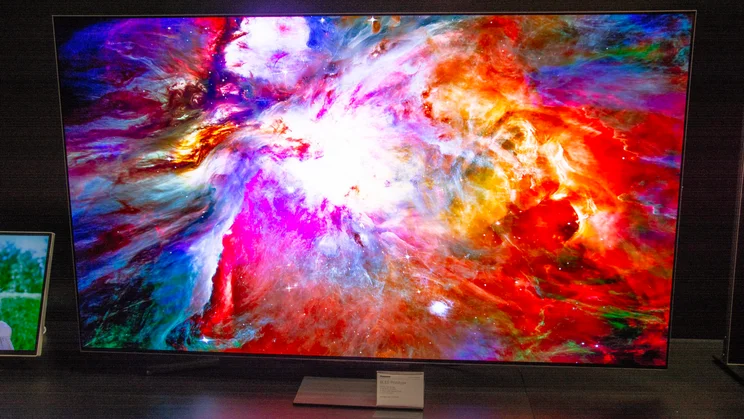
There was a 77in OLED with an ultra-thin design, detachable subwoofer base, 6.1.2-channel audio system and integrated secondary display below the panel, another OLED, this time with 4.1.2-channel sound and detachable speaker base, and an RGB Mini LED TV.
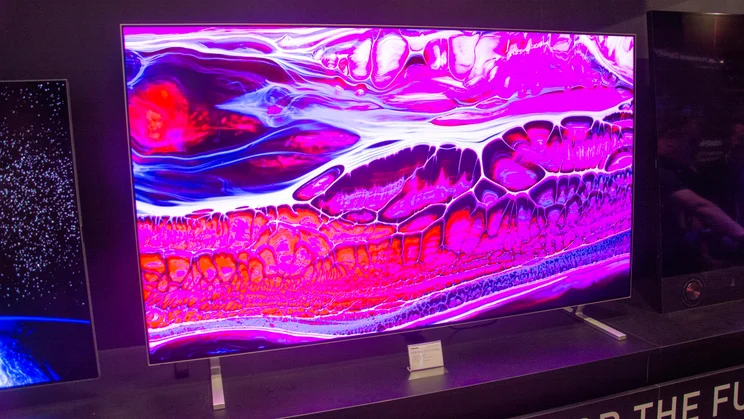
Panasonic is already lagging behind the competition on the latter front, with Hisense, TCL, Samsung and more all either having RGB Mini LED TVs already in the market, or coming to market in the next few months.
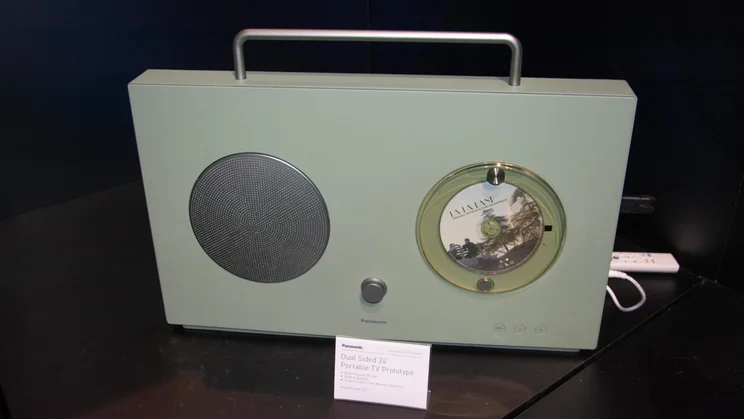
I was particularly intrigued by a two-sided compact TV that had a screen on one side and a CD player and speaker on the other. It was pointed out that this CD player could potentially be replaced by a DVD or Blu-ray player later in the product’s development cycle, which would be neat. There was also a portable 24in TV, which seems inspired by the design of Skyworth’s own portable telly, but incorporates a multi-function stand and leather cover.
Exciting times ahead?
Overall, while I didn’t come away wowed by what Pana is bringing to the TV table this year, it’s still got a very robust range that caters to a broad cross-section of people.
It will be fascinating to see how the various entries are priced; I imagine the partnership with Skyworth will see Panasonic TVs priced more aggressively moving forward, but I’d be surprised if we see considerable movement on that front until next year.
I am hopeful, however, that we see a tidy discount on the Z95B. As our favourite TV of 2025, I can understand the rationale behind keeping it going for another year, but I’d love it to get a price cut to make it more accessible.
Either way, I’m glad that the rumours I heard at CES proved false. How Panasonic’s TV business looks in a year, let alone five years, is anyone’s guess. But if its partnership with Skyworth brings more TVs like the W95B and Z95B to a wider audience at more affordable prices, the latest Japan-China alliance will be a win in my book.


