
To help us provide you with free impartial advice, we may earn a commission if you buy through links on our site. Learn more
- Excellent dark scene handling by LCD standards
- Punchy, room-filling sound
- Comprehensive smart TV features
- Pictures can lack consistency
- Detail and colour loss in dark scenes
- Some minor backlight instabilities
Not to be confused with Hisense’s non-Pro U7Q range, the U7Q Pro benefits from some seriously promising specifications and features, despite being much more aggressively priced than Hisense’s U8Q step-up models.
Can the U7Q Pro turn all of that on-paper promise into real-world excellence, though, or will it succumb to more of the foibles that have chipped away at Hisense’s previous premium TV efforts?
Hisense U7Q Pro: Key specifications
| Screen sizes available | 55in (55U7QT Pro), 65in (65U7QT Pro), 75in (75U7QT Pro), 85in (85U7QT Pro) and 100in (100U7QT Pro) |
| Panel type | VA-type quantum dot LCD, with Mini LED lighting and local dimming |
| Resolution | 4K/UHD (3,840 x 2,160) |
| Refresh rates | Native 120Hz (up to 165Hz gaming) |
| HDR formats | HDR10, HLG, Dolby Vision, HDR10+ |
| Audio enhancement | 2.1.2-channel system (50W), Dolby Atmos, DTS Virtual:X, Hi-Concerto |
| HDMI inputs | 4 x HDMI 2.1 (one with eARC, all with advanced gaming support) |
| Freeview Play compatibility | No (but carries Freely) |
| Tuners | Terrestrial Freeview HD |
| Gaming features | Up to 165Hz frame rate support, ALLM, VRR support (AMD FreeSync Premium), Game Bar, Dolby Vision gaming mode |
| Wireless connectivity | Bluetooth, Wi-Fi, Apple AirPlay |
| Smart assistants | VIDAA Voice, Amazon Alexa via the remote |
| Smart platform | VIDAA |
What you need to know
The single most important thing you need to know about the U7Q Pro is that it is not Hisense’s non-Pro U7Q; there are significant differences between the two models.
The Pro version I’m testing here supports 165Hz gaming vs 144Hz on the non-Pro, and supports the full range of today’s gaming features across all four of its HDMI ports, rather than just two of them. Its panel has an anti-reflection coating, the audio system is more advanced and includes a pair of up-firing drivers for a better Dolby Atmos effect, and the local dimming system is far more sophisticated.
Beyond these differences, the Hisense U7Q Pro is probably best described as a potential premium Mini LED TV at a lower mid-range price, which puts it slap-bang in the same part of the market as the wildly successful TCK C7K series.
Price and competition
The U7Q Pro series comes in five different screen sizes, which are, at the time of writing, priced as follows: £699 for the 55in, £899 for the 65in, £1,199 for the 75in, £1,499 for the 85in, and £2,499 for the 100in. Those prices for the biggest three screen sizes look especially appealing if you’ve got enough space to accommodate them.
The main competition for the U7Q Pro series comes from the TCL C7K range. The 65in model costs £849, and joins the U7Q Pro in combining a VA panel with local dimming, quantum dots, comprehensive HDR support and wide-ranging gaming features.
You won’t typically find an OLED TV at quite such a low price as the U7Q Pro unless you catch one in a special end-of-line deal or something, but there’s the Philips OLED760, which is around £200 to £300 more than the U7Q Pro, depending on the screen size.
Design, connections and control
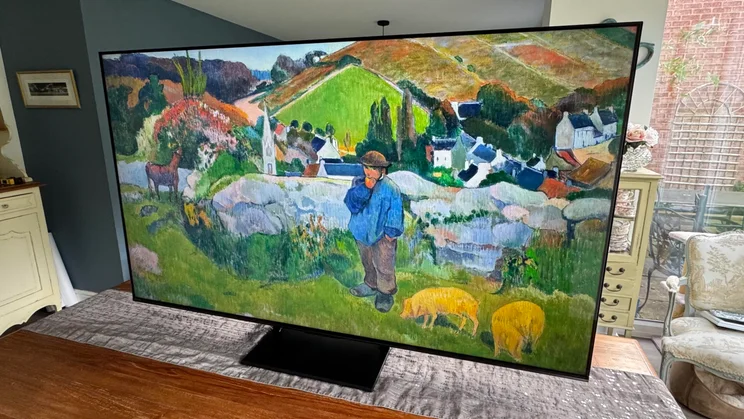
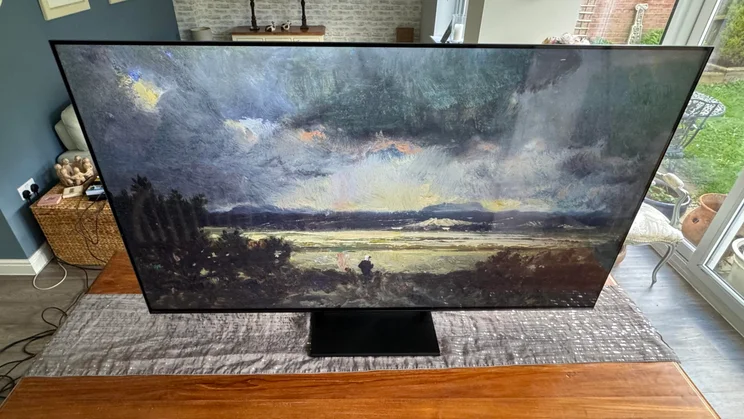
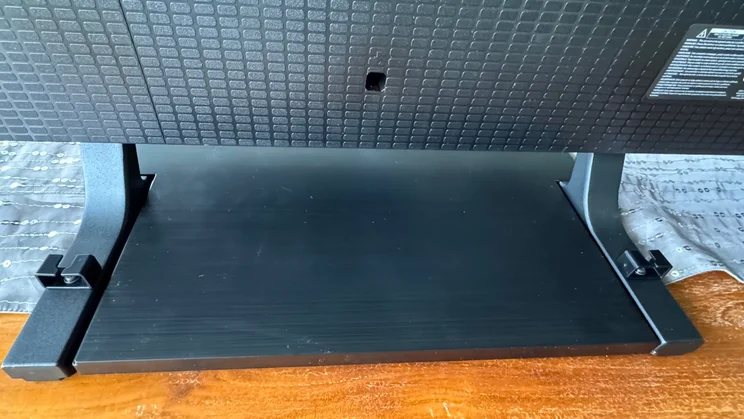
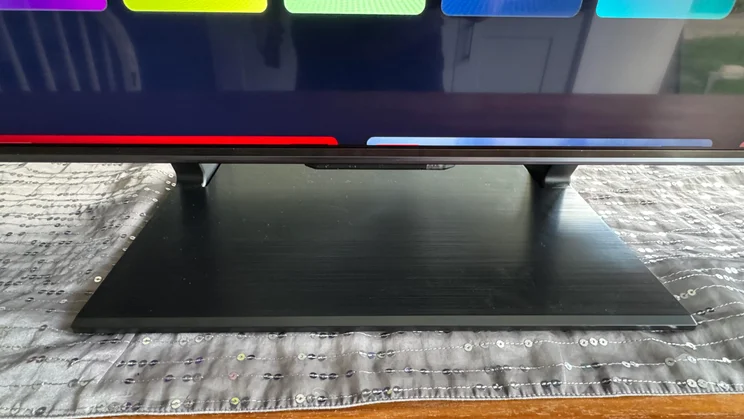
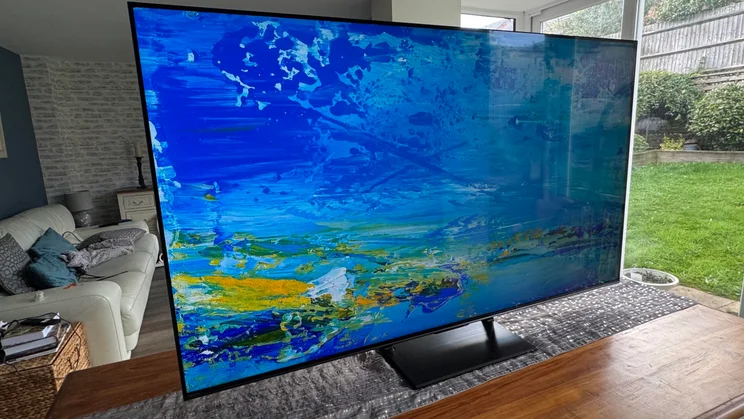
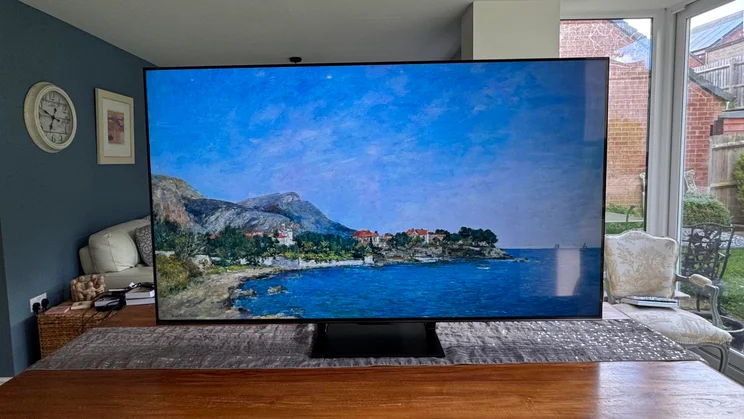
The U7Q Pro is, in most ways, an attractive-looking TV that exudes more premium flair than you might expect for the money. Its centrally mounted stand enjoys a premium metallic finish, while its open neck creates the illusion that the TV is much lighter than it actually is.
The screen bezel is respectably rather than insanely narrow, but its gleaming, polished grey finish further contributes to the sense that you’ve got your hands on a pretty premium bit of kit.
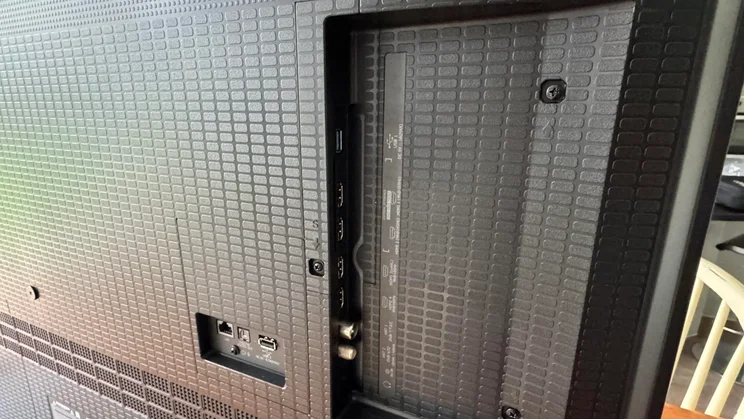
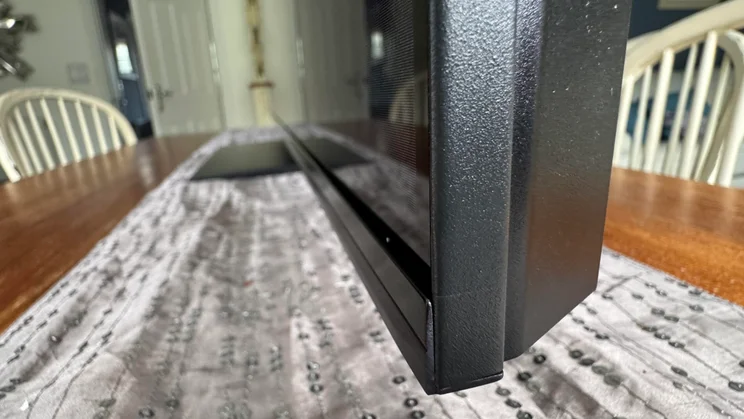
The only mild bum note in the U7Q Pro’s looks is the 75mm that sticks out around the back. That’s a lot of rear for a modern TV, and makes it a slightly ungainly wall hanging option.
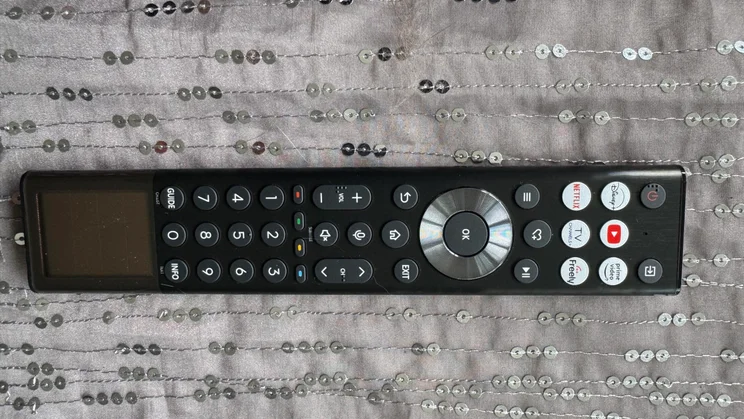
The U7Q Pro further signals its premium intentions with its remote control, which boasts a tactile metallic black finish with a crisply contrasting silver navigation circle at its heart. There’s even a solar panel built into the bottom half of the remote’s front edge to save you the trouble of ever having to replace its batteries.
As well as looking and feeling good, the U7Q Pro’s remote control is pretty straightforward to use. The layout is sensible, and button labelling is reasonably clear. Though you can also skip the remote control if you wish, and control a moderate level of functionality by talking to the TV.
Connections on the U7Q Pro’s rear are dominated by four full-fat HDMI 2.1 ports, each capable of delivering the full suite of cutting-edge gaming features the TV supports. I’ll come back to these later, but the main point here is that it’s excellent to find such an affordable TV offering advanced gaming across all four of its HDMI ports rather than just a couple.
Smart TV platform
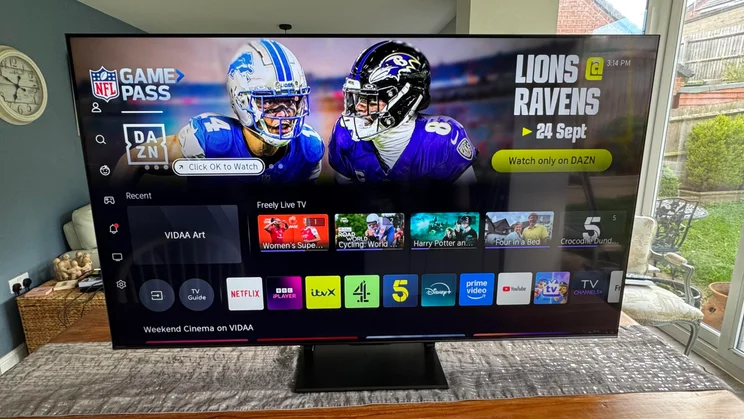
The main smart system on the U7Q Pro is Hisense’s home-grown VIDAA system. Which is fine with me, given how straightforward it is to follow. There’s a trade-off for this simplicity when it comes to the sophistication of its intelligent content recommendations system and the reach of its AI features. Its presentation is a little basic compared with the most powerful smart TV systems, too. But honestly, I and, I suspect, many other smart TV users would readily choose simplicity over complication, however well-meaning that complication may be.
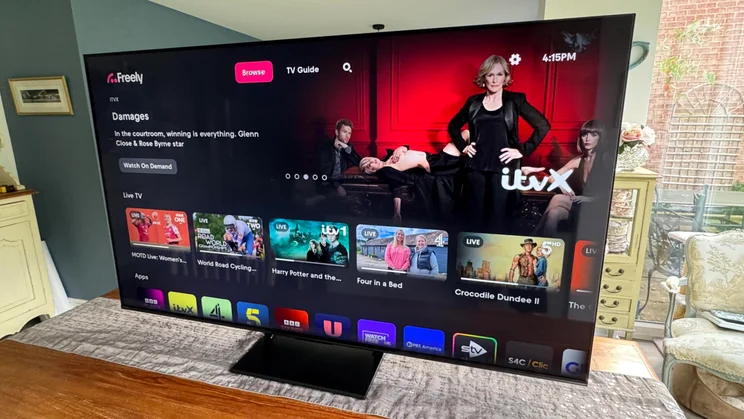
The U7Q Pro has a handy extra trick up its smart sleeve in the shape of support for Freely, the new(ish) UK streaming platform that lets you watch the majority of the Freeview broadcast channels live over your broadband connection. As well as removing the need for an aerial on your house, Freely lets you pause and rewind its live streams, and access tens of thousands of hours of on-demand content.
Image quality
While the U7Q Pro is, like all premium TVs these days, built with high dynamic range video in mind, Hisense has certainly not abandoned the SDR video that most of us still spend the majority of our TV-viewing lives watching.
It gets off to an excellent start with the accuracy of its Filmmaker Mode, giving AV purists plenty of measurable reassurance that this mode is working hard to preserve the video standards used by most content creators. Tests performed using Portrait Displays’ Calman Ultimate software, G1 signal generator and C6 HDR5000 colour meter reveal a pretty much exemplary set of results.
Two-point and multi-point greyscale tests score Delta E 2000 average errors of just 2.8 and 2.3, respectively, and these numbers fell under two when I checked for colour accuracy using Calman’s Colour Gamut, Saturation Sweep and Luminance Sweep tests. No Delta E 2000 average error of under three should be noticeable to the human eye, but Hisense has pushed closer to absolute accuracy than many more expensive models do.
The Filmmaker Mode doesn’t deliver quite such an immaculate subjective viewing performance, however. On the upside, its baseline brightness feels pitched about right, despite peaks measuring slightly high for SDR at 297.2cd/m2. Black levels are excellent by LCD TV standards too, getting deeper and less affected by general greyness than even those of the TCL C7K. Decent upscaling of native HD sources to the screen’s native 4K resolution rounds out the strong first impressions.
Colours in dark scenes can look a little washed out in Filmmaker Mode, though, and traces of shadow detail sometimes get lost in the darkness. Though on this latter point, the lost details are subtle enough to count as a very small price to pay for such excellent, consistent and rich black tones and colours.
If you’re keen to see more of the U7Q Pro’s capabilities infused into its SDR pictures than you get with the Filmmaker Mode, the Standard preset does a pretty good job of ramping things up without straying unrecognisably from the spirit and tone of the source material. Images no longer measure accurately, but colours still generally feel balanced and nuanced in their new, more vivid context, details and textures look slightly sharper without looking artificial, and black levels still look generally impressive.
There is a bit more visible interference from backlight clouding and haloing in Standard mode, though, and while colours are bolder, they’re not as heavily saturated as those of TCL’s C7K in the same mode. Shadow details can occasionally become a bit too visible in Standard SDR mode, too, revealing image noise that remains hidden in Filmmaker Mode.
For the most part, though, the U7Q Pro’s Standard mode is engaging and dynamic without going absolutely nuts, which counts as a good result.
HDR performance
The U7Q Pro comes into its own with HDR, though at the same time, the greater demands HDR places on the TV’s fundamentals can cause a glitch or two.
Brightness is fairly impressive. In Standard mode, it hits peaks of a fraction under 2,300cd/m2 on a 10% HDR test window, and holds on to 600cd/m2 on a 100% window. This latter figure is substantially higher than even the most premium OLED TV can manage (though OLED TVs can now hit brighter peaks and deliver pixel-level light controls, of course).
Peak brightness in Filmmaker mode drops to 1,650cd/m2 (again on a 10% window), but that’s still high for a sub-£1,000 TV. Especially a sub-£1,000 TV that still sticks pretty eagerly to the established video standards used in professional mastering. Calman Ultimate’s Multipoint Greyscale HDR test only scores a Delta E 2000 average error of two in Filmmaker Mode, while ColorMatch HDR, Colorchecker HDR, BT.2020 Saturation Sweep and DCI-P3 Saturation Sweep tests record Delta E 2000 average errors of 3.0, 1.6, 2.7 and 2.1, respectively. All under or bang on the key 3.0 level.
Looking beyond the numbers by settling down to watch some well-mastered HDR movie content, the U7Q Pro mostly continues to impress, but with one or two more obvious strings attached than I noticed with SDR content. On the upside, black levels still do very well, reaching deeper into darkness than the TCL C7K does in its Filmmaker Mode, with significantly less grey mist hanging over proceedings.
Dark scenes are scarcely troubled by backlight clouding either, even where a bright highlight appears against a dark backdrop. Colours look slightly more refined in bright scenes than they do in the TCL C7K’s Filmmaker Mode, too. That said, the bright highlights of mostly dark shots look less punchy in Filmmaker Mode than they do on the TCL, costing the Hisense a little HDR impact. Quite a few shadow details disappear into the darkness in Filmmaker Mode, too. Ramping up a Dark Detail feature can retrieve some of these details – but not all.
One final Filmmaker Mode issue is that colours in dark and even a few mid-dark shots can look quite desaturated. So much so that I’m actually a little surprised the set measured as accurately as it did with our Calman Ultimate tests.
The U7Q Pro’s Standard picture preset delivers a significantly more vibrant and eye-catching HDR image than the Filmmaker Mode. It’s well-suited to bright room viewing, but also holds up well in dark rooms if you prefer punchy and dynamic HDR images over accurate and restrained. Black levels still look compelling and deep despite the extra brightness applied to this mode, and colours wear their extra saturation and range well for the most part, avoiding gaudiness and the sort of cartoonish look you get when bold saturations are pushed without enough tonal subtlety behind them.
Intensely bright highlights hold on to good levels of shadow detail in Standard mode too, clipping out less shading and toning details in these areas than the TCL C7K does. Meanwhile, very dark scenes enjoy good neutrality, avoiding the green or reddish undertones often seen on LCD HDR TVs as affordable as this Hisense model is.
The U7Q Pro’s native 4K playback is impressively sharp and detailed, including in dark areas of the picture, and its subtlest motion processing options do a good job of slightly softening judder without leaving the picture looking soft or like a cheap soap opera.
While it creates an excellent first impression, though, and is always very watchable, again, over time, one or two Standard preset glitches make their presence felt. Colours during dark scenes can still wash out quite noticeably, and you can sometimes see marked areas of backlight blooming around stand-out bright objects. The backlight system can flicker or cause a brightness ‘jump’ from time to time, too, as it struggles to settle on the best configuration for subtle changes in a particular shot. Complex dark and light images can look a little misty, as well as sometimes revealing a bit more shadow detail than we’re supposed to be seeing.
The pros of the U7Q Pro’s HDR pictures in Standard and Filmmaker Mode outweigh the cons, to be clear, but there’s just enough inconsistency to stop you from fully settling into an HDR movie without distraction.
To test the Hisense U7Q Pro, I used Portrait Displays Calman colour calibration software.
Gaming
I enjoyed gaming on the U7Q Pro. Its combination of bold brightness, potent contrast, strong sharpness and generally vibrant but balanced colours works very well with today’s HDR gaming experiences. I’d probably argue that it manages to paint vivid, three-dimensional, detailed and involving gaming worlds with more consistency than the TV achieves with video sources.
The 13.2ms input lag achieved with 60Hz games, which more or less halves with 120Hz titles, isn’t absolutely the lowest I’ve measured on a TV, but gaming always feels responsive and crisp, and there’s no sense of lag or blur even during the fastest pans around your game world. Especially if you’re using the U7Q Pro’s variable refresh rate features, which include the AMD Freesync Premium system.
Sound quality
The U7Q Pro’s sound joins its pictures in taking a bold, aggressive approach, which, for the most part, pays off well. The use of a 2.1.2-channel speaker system contributes to a larger sound stage than most TVs provide. The up-firing drivers lend a sense of height and verticality to the wall of sound the TV produces, helping provide an extra dimension to Dolby Atmos tracks. The width of the soundstage is striking too, with the scale of the sound being emphasised by how well specific sound effects are placed within the splay of sound.
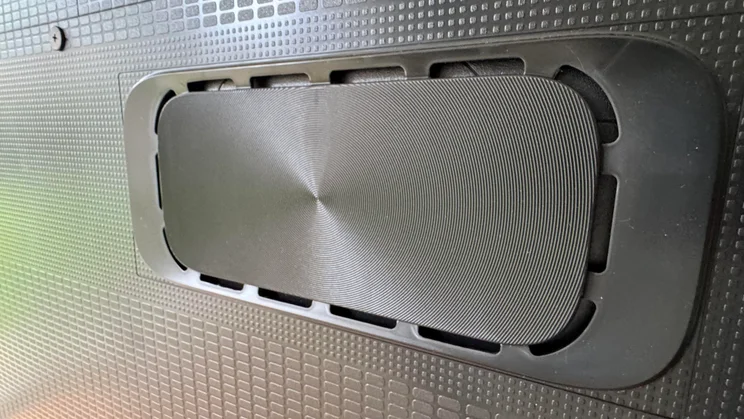
There’s enough power behind the sound to keep expanding the scale and density of the presentation as action and horror scenes shift through their gears. The sound doesn’t collapse in on itself when the going gets really tough, and peak treble sounds are seldom harsh or tinny. The built-in rear-mounted subwoofer that delivers the .1 part of the 2.1.2 channel count is effective to a point, too, pumping out low-frequency depths beyond the scope of most integrated TV speaker systems and providing a helpful counterpoint to the treble end of the spectrum.
The U7Q Pro’s sound lacks a little forward impact, though, leaving some hard-edged details feeling rather swallowed. Voices can feel a bit stuck in the centre of the screen, too, rather than sounding like they’re coming from the location an actor is speaking from, and the movie world’s most bombastic bass rumbles and drops can occasionally cause the subwoofer to suddenly crackle and break down quite alarmingly, distracting you from what you’re watching.
As with the U7Q Pro’s pictures, its sound is mostly good but ultimately falls short of five-star greatness due to a couple of slightly careless niggles.
Hisense U7Q Pro review: Verdict
The U7Q Pro is, for my money, the all-round best TV Hisense has released to date; it’s competitively priced for a TV with so many features, and such impressive specifications and capabilities. Even better, it generally exploits those capabilities very well, especially when it comes to contrast and (at least during bright scenes) colour.
There are just enough little niggles scattered around the U7Q Pro’s pictures and sound to break that sense of immersion you get with the absolute finest TVs, however. Despite this, it’s still good enough to confirm Hisense’s status as much more than just the budget brand it started as.


