
To help us provide you with free impartial advice, we may earn a commission if you buy through links on our site. Learn more
- Bold, strangely immersive design
- Fantastic, ultra-bright and colourful pictures
- Stunning gaming display
- Expensive
- Some Tizen interface issues
- No Dolby Vision support
Samsung’s emergence onto the OLED TV scene with its quantum-dot twist on self-emissive screen technology hit the ground running in 2022. Since then, it’s set a rapid pace of annual evolution, forcing the engineers at arch rival LG Display into a flurry of innovation to keep up.
Samsung’s flagship OLED TV for 2026, the S99H, keeps the thunderous rate of progress going, hitting performance peaks that would once have been unthinkable for OLED technology. And to ensure you won’t miss the S99H as you prowl the TV aisles of your local electronics store, Samsung has adorned its flagship with a striking outer frame design which – for better or worse – nobody can ignore.
Samsung S99H: Key specifications
| Screen sizes available | 55in (55S99H), 65in (65S99H), 77in (77S99H) and 83in (83S99H) |
| Panel type | Quantum dot OLED |
| Resolution | 4K/UHD (3,840 x 2,160) |
| Refresh rates | Up to 165Hz |
| HDR formats | HDR10, HLG, HDR10+ |
| Audio enhancement | 4.2.2-channel 70W system, Object Tracking Sound, Amplify mode; Voice Enhance feature |
| HDMI inputs | 4 x HDMI 2.1 built-in, plus four more via optional extra Wireless One Connect box |
| Freeview Play compatibility | No |
| Tuners | Terrestrial Freeview HD |
| Gaming features | VRR (AMD Freesync Premium Pro and Nvidia G-Sync), 4K/120Hz and 165Hz support, ALLM, AI game mode |
| Wireless connectivity | Bluetooth, Wi-Fi, Apple AirPlay 2 |
| Smart assistants | Bixby and Amazon Alexa |
| Smart platform | Tizen |
What you need to know
The S99H is Samsung’s flagship OLED TV for 2026. It’s the successor to last year’s Samsung S95F, and will be sold as the S95H in the US, but gets a different model number in the UK following a decision made by the brand’s regional team over here.
It earns its status as Samsung’s top-of-the-range TV by having both the brightest screen the OLED TV world has seen and fitting that screen into a bold, frame-extending ‘FloatLayer’ design concept.
The S99H also takes connectivity where no other TV has gone before by being compatible with an optional wireless One Connect box, which lets it support up to eight HDMI devices at once.
Price and competition
Samsung had only revealed pricing for the 65in and 77in S99H at the time of writing, with the former costing £3,499 and the latter, which I tested, priced at £4,599. That positions the S99H range right at the top of the premium TV market.
As we’ll see, though, it’s a TV that boasts a striking array of flagship features and delivers a sensationally premium performance.
The closest rivals are the LG G6 OLED, which uses an RGB Tandem OLED panel and looks set to push Samsung close on brightness and colour response, while benefiting from a decade of class-leading OLED experience.
Panasonic’s current flagship, the Panasonic Z95B, was released last year and is being carried over into 2026, and remains a fantastic option. It draws on the brand’s long experience with self-emissive displays and provides an unusually potent multi-channel Dolby Atmos sound system. Meanwhile, the Sony Bravia 8 II OLED applies the brand’s ever-impressive XR image processing technology to one of Samsung Display’s 2025 QD-OLED panels.
Design, connections and control
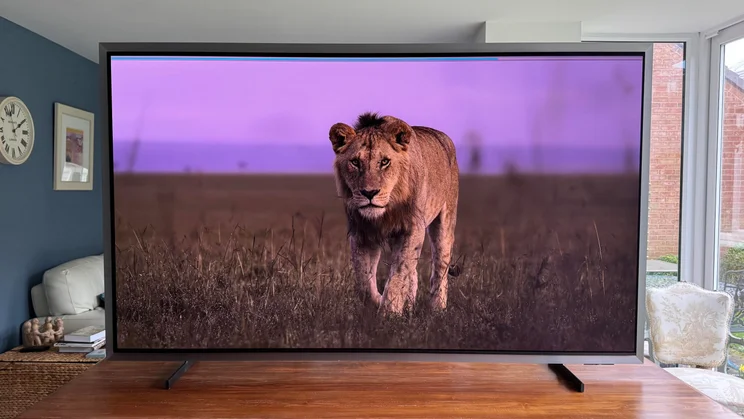
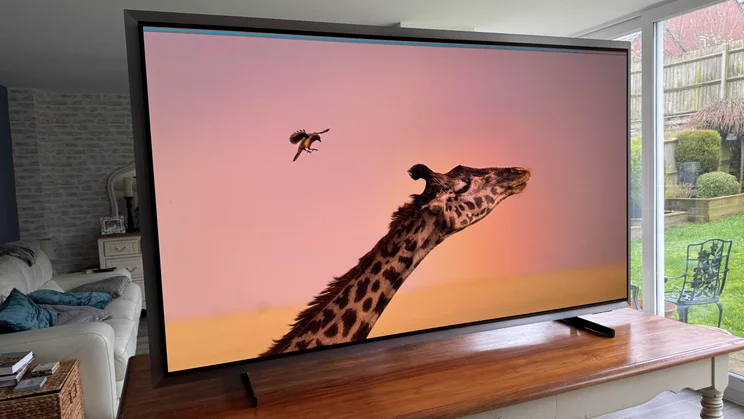
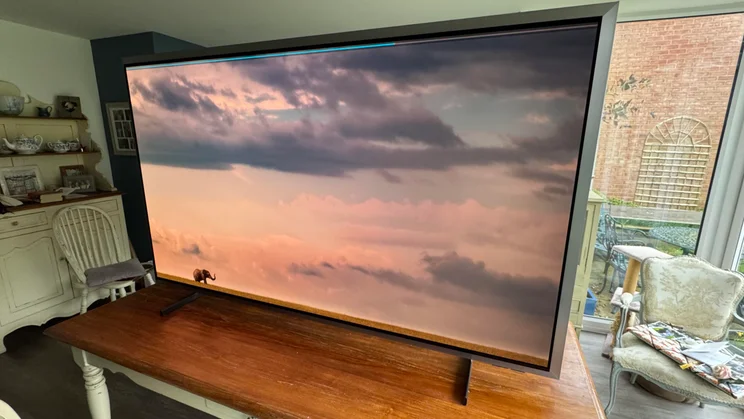
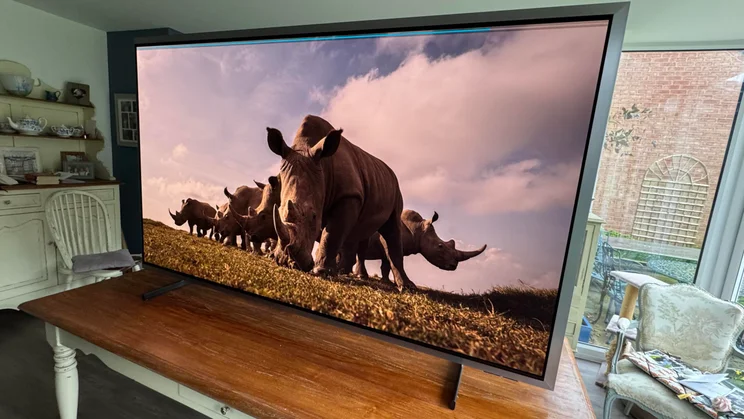
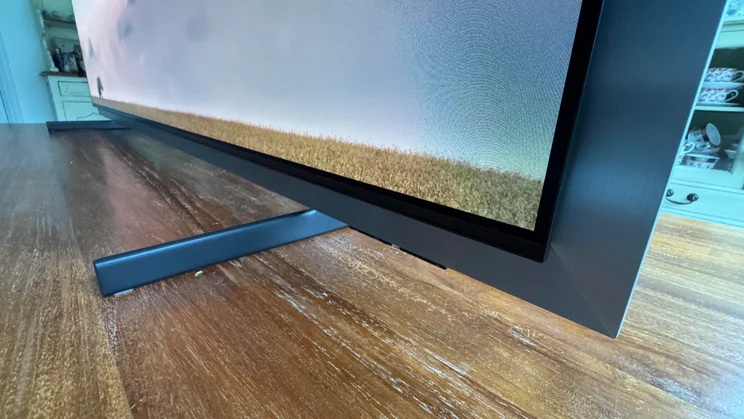
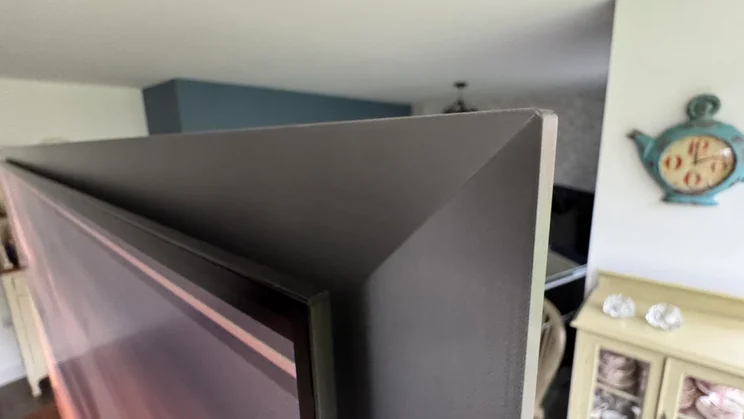
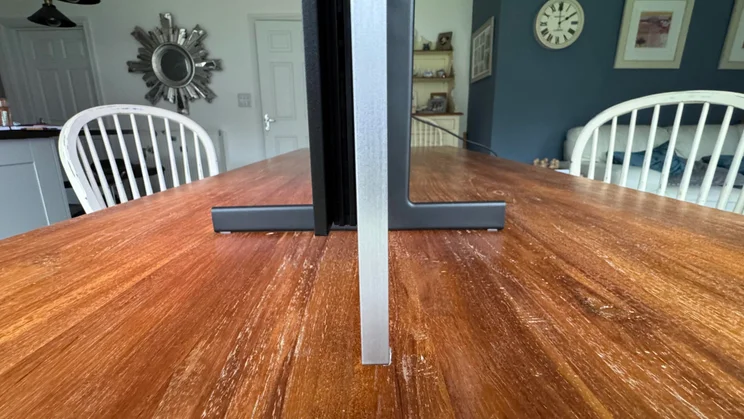
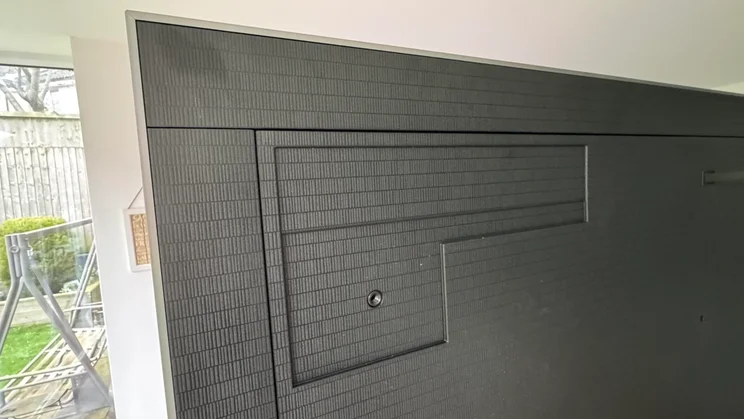
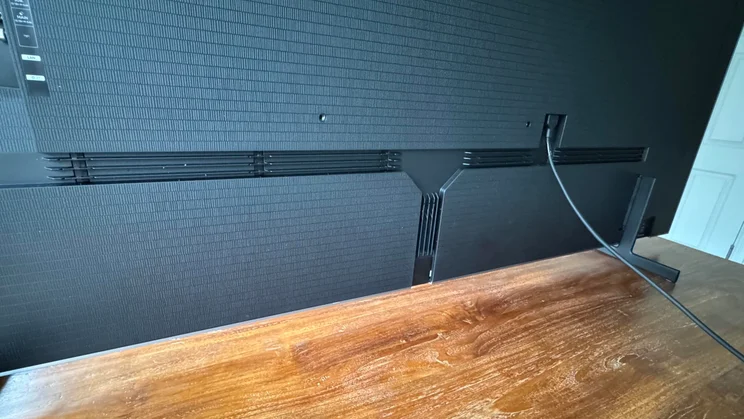
The S99H features a unique FloatLayer design that positions its trim-bezelled screen proudly on an outer frame that extends a good inch beyond the main panel. The frame is made of dark grey metal and extends from all four sides of the TV.
The way this frame adds considerable depth, width and height to the TV’s dimensions is likely to be controversial. Some will find it an unnecessary expansion of the TV’s impact on their living rooms; others will find it a stylish and well-finished way to enhance the aesthetics of something that will inevitably dominate any room it’s in.
I initially found the extra size more of an imposition than charming. The design grew on me over time, though, especially how it made watching a film feel more immersive and cinematic. Kind of like having curtains around the screen in a cinema.
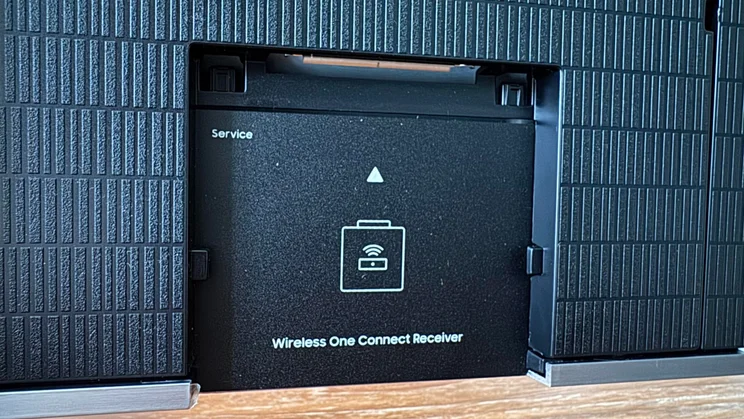
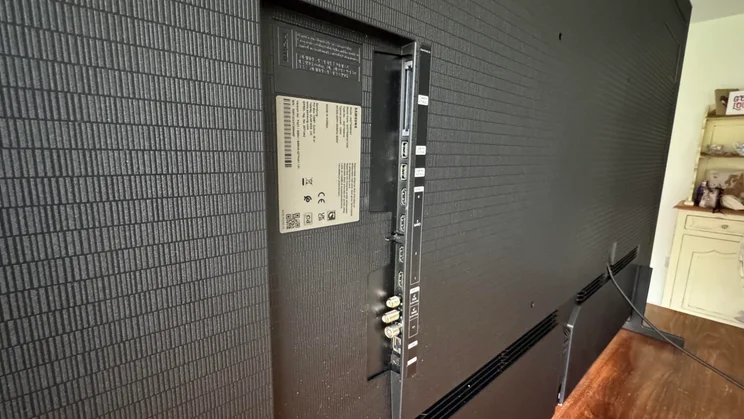
The S99H also stands out from the crowd with its connections. The TV has four HDMI 2.1 ports and two USB ports, but also has a wide slot under the bottom rear-left corner of the screen. This can house a transmitter that brings an optional extra version of Samsung’s Wireless One Connect boxes into play. Add one of those, and you can double the HDMI count to eight.
These are all full-bandwidth HDMI 2.1 ports too, capable of handling the latest premium gaming features. I’d recommend that gamers use the four HDMIs on the main TV and leave the One Connect box for other sources, since there’s more input lag via the wireless HDMIs than the built-in ones. More on this later.
Naturally, the S99H supports both Bluetooth and Wi-Fi, as well as Apple AirPlay content sharing.
Control of the S99H can be achieved in multiple ways. First, the TV ships with two separate remote controls: a standard button-filled one, and a much slimmer, stripped-back ‘smart’ one with a built-in solar panel. Samsung has fitted the S99H smart remote with a higher-capacity battery than the previous generation, and the slight bulge this adds to the bottom half makes it more comfortable to hold.
Both remotes feature sensible, helpful button layouts, though most people will gravitate toward the smart one for day-to-day use, as it features a built-in microphone and dedicated AI button. The latter can be used to execute different information requests via either Co-Pilot or Perplexity.
A degree of control is possible via Samsung’s SmartThings app, and the S99H even supports limited gesture control if you happen to be wearing a reasonably up-to-date Samsung Galaxy Watch. I imagine most people will try this gimmick once before returning to the remote controls.
Smart TV platform
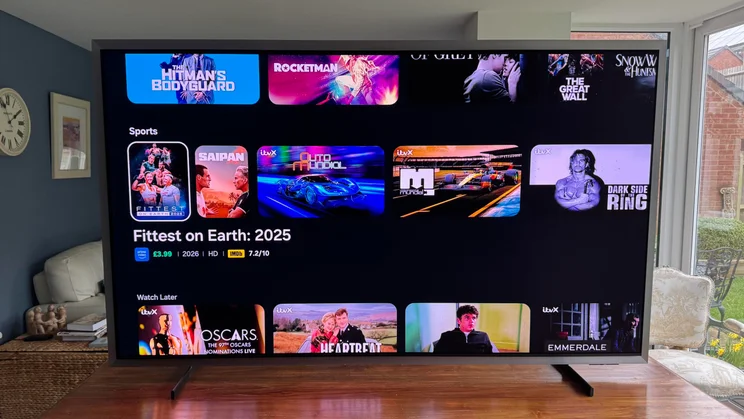
The S99H uses Samsung’s Tizen smart system. This is packed with content, and now features some impressively intelligent systems for learning the sort of stuff you like to watch and tailoring content suggestions accordingly. This can work across multiple different family member profiles, too.
Dedicated Game and Art hubs are easily accessible from the main home screen. The former brings together all your connected gaming devices and a wide selection of streamed gaming apps. The latter provides digitised artworks you can use to turn your TV into a painting when you’re not watching anything else.
The new AI home screen does a good job of alerting you to the AI potential now built into Tizen, and I like how the new Tizen home screen design places its menu choices along the top of the screen rather than down the side. This makes the home screen feel much less cluttered.
My only gripe with Tizen now, other than that it takes a little time to learn your way around, is the way its menus are designed for adverts. You can choose to have the TV not show ads, but if you do, the third of the screen area where ads would have appeared is often filled with text or an unnecessary graphic, rather than the screen rearranging its design in an ad-free environment to show more content options.
Image quality
It seems almost perverse to start my analysis of a TV like the S99H with standard dynamic range, HD images. Such sources still occupy a large amount of most households’ viewing time, however, and how well premium 4K, HDR TVs handle them can be a very good indicator of their processing power and understanding of picture quality.
In its Filmmaker Mode, the S99H delivers incredibly accurate measurements during tests using Calman Ultimate software, a Klein K10-A colorimeter and Portrait Displays’ G1 signal generator. Two-point grayscale, multi-point grayscale, colour gamut, ColorChecker, Saturation Sweep and Luminance Sweep tests didn’t just score under the 3 Delta E 2000 average error level, where inaccuracies are considered imperceptible to the human eye, but scored less than 1.5 across the board.
This would be a fantastic set of results on a TV with much less extreme capabilities than the S99H, so for a TV like the S99H to be able to rein in its extremes so immaculately to hit SDR’s requirements is phenomenal.
The S99H’s SDR images don’t just measure well in Filmmaker Mode, either – images look subjectively lovely. They’re full of gorgeous contrast, infinite colour-shading subtlety, impeccable shadow detail, and appear consistently crisp and clean. There’s absolutely nothing flat or dull going on, despite white levels just under 250 nits – a mere fraction of what the screen is capable of.
For those who like the idea of seeing the S99H unleash more of its capabilities onto SDR content at the expense of accuracy, Samsung’s Standard preset has got your back. This increases the core SDR presentation white level to more than 430 nits while maintaining immaculately deep black levels, and expands the colour gamut in a startlingly natural manner. The results always feel connected with the source material rather than any tones feeling over-egged and out of kilter with the rest.
Even an option Samsung provides for converting SDR sources to HDR works rather well, using AI machine learning to expand SDR brightness, light range and colour volumes with surprising sensitivity. There’s a little clipping of subtle details in the brightest parts of HDR-remastered images, but for the most part, I found the HDR upgrade effect quite enjoyable once I’d acclimatised to it.
While two-point and multi-point greyscale Calman Ultimate measurements in the S99H’s Standard preset are way out, with Delta E 2000 average error levels of more than 14, other key measurements, such as luminance and saturation sweeps, colour gamut accuracy and Colorchecker tests, come in with average Delta E 2000 error levels of under 10. This is actually impressive considering how punchy Standard mode SDR images look.
One last very noticeable charm of the S99H’s SDR picture performance is how little your viewing experience is affected by reflections. The screen is fitted with the latest edition of Samsung’s anti-reflection technology, which does an uncannily effective job of keeping both ambient and specific light sources from appearing on the screen’s surface.
The matte finish the filter creates may take a little while for some AV fans to get used to, and very bright light conditions can reduce the image’s black levels a little (though less so than with last year’s equivalent Samsung models). But if you’re anything like me, the benefits of no reflections quickly become hard to be without.
HDR performance
Unexpectedly outstanding though the S99H’s SDR pictures are, things come to glorious life with HDR images. They’re delivered with a level of vibrancy, dynamism, control and finesse that’s a consistent joy to behold. Once again, the experience is equally enjoyable, albeit for different reasons, whether you’re watching in the super-accurate Filmmaker Mode or the spectacular Standard mode.
As with its SDR Filmmaker Mode, the S99H’s HDR Filmmaker Mode doesn’t just sneak below the key Delta E 2000 average error level of 3; it cruises below it, never registering an error result with any of our Calman grayscale and colour test signals higher than an outstanding 1.5.
You can truly feel this attention to detail and mastering standards in every pixel of every HDR Filmmaker Mode image, too. Not a hue seems out of place, no shade of grey or black feels forced or strained, and even the smallest details feel natural and perfectly pitched alongside their neighbours.
The result is a picture that lures you in with its consistency and delicacy so completely that you can’t tear your eyes away from it. Especially as the immaculate black levels and gorgeous intensity of the S99H’s pure RGB colours ensure there’s still plenty of impact to go with the nuance and balance.
It comes as little surprise to find the S99H managing to cover just under 89% of the vast BT.2020 colour spectrum, and exactly – as in, not even a tenth of a nit out – 100% of the DCI-P3 spectrum used for the vast majority of HDR mastering.
If you’re watching HDR in a bright room setting or you simply prefer visual drama over pinpoint accuracy, the Standard preset puts on a show like no other TV I’ve seen. Brightness levels rise from the 2,800cd/m2 nits or so achieved up to a 10% test window in Filmmaker Mode to a ground-breaking 4,450cd/m2 on 1% and 2% Standard mode windows, delivering HDR highlights with fearsome intensity.
This intensity never becomes overwhelming or distracting, though, as Samsung’s latest AI processor takes great care to ensure that the maximum brightness is only reserved for the sort of extremes of light you also see in the real world, such as sunlight reflecting off glass, metal, wet leaves, stars and the like. So the extreme light peaks just feel like they’re expanding the light range to create a more lifelike vision rather than pushing content to places that look unnatural or forced.
Helping the Standard mode’s extra brightness feel more natural, too, is the S99H’s ability to expand its colour volume in line with all that extra brightness. Things look vibrant, but always feel balanced with each other and retain enough blend and tonal shift subtlety to avoid looking cartoonish.
The remarkable accuracy recorded in Filmmaker Mode is gone in Standard mode, of course. Here, I measured Delta E 2000 average errors of well over 30 across all of my Calman Ultimate tests (though this drops to under 10 with luminance errors removed from the equation). This is really besides the point, though, when you’ve already got a Filmmaker Mode that caters so brilliantly for creative intent fans. The Standard mode is there to show off, and it does this so well, without throwing up distracting issues, that it’s almost irresistible.
The S99H isn’t absolutely perfect. No TV probably ever will be. As ever with Samsung TVs, it doesn’t support Dolby Vision HDR, sticking with HDR10, HLG and HDR10+. Other small issues include a touch of black crush in very dark scenes in Filmmaker Mode (though you can improve this via the provided Shadow Detail and ST.2084 picture settings); slightly overcooked skin tones during some dark scenes in Standard mode; minor red fringing of sharply defined lines caused by the TV’s unusual triangular RGB sub-pixel structure; unnatural looking default motion processing settings; and a little clipping in the brightest peak areas in the Standard and Movie presets.
These small flaws rarely show up at the same time, though, and so typically do very little to take the edge off a picture performance capable of combining spectacle and accuracy more effectively than any other TV I’ve tested to date.
To test the Samsung S99H, I used Portrait Displays Calman colour calibration software.
Gaming
All the picture features that make the S99H such a stellar video performer make it a dazzling gaming display. The brightness and colour response it’s able to achieve with today’s HDR games breathes new life into graphically stunning titles, while sharpness and responsiveness are as good as I’ve seen on a TV. I wasn’t surprised to find input lag measuring just 9.7ms even with 1080p/60Hz feeds when using the TV’s on-board HDMI ports.
Note, though, that input lag rises to 37.7ms if you’ve got your gaming source connected to an optional extra wireless One Connect box rather than directly to the TV.
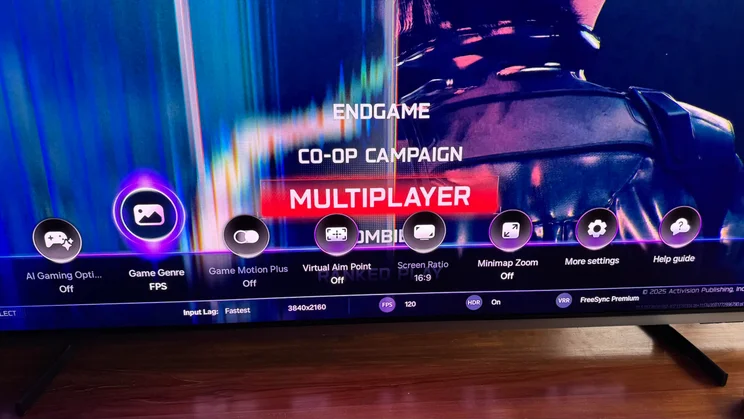
The S99H automatically detects when your console or PC is feeding it a game or a video source, and if it’s a game, it will allow you to access a dedicated gaming feature menu. This carries a good blend of information on the gaming feed and various gaming aids that include mini-map detection and zoom; a superimposed target crosshair; the ability to raise the brightness floor of dark areas without affecting the rest of the image; and options to introduce various levels of motion smoothing at the expense of slight increases in the screen’s response time.
The fact that all four onboard and all four extra optional HDMI ports support all of the S99H’s potential gaming features is welcome, too.
Sound quality
A combination of a cleverly integrated multi-channel speaker system and Samsung’s Object Tracking Sound Plus processing delivers an audio performance which, while not quite as impressive as the TV’s pictures, is still involving and convincing.
The star of the show is how well the OTS system places and tracks specific sound effects on and beyond the screen. It’s almost uncanny how accurately different voices are tied to the onscreen position of different actors, or how tightly the sound of, say, a car accompanies its visual reference as it travels across the screen.
The S99H’s understanding of sound helps it place ambient and scoring sounds slightly beyond the main action details, too, creating a convincing soundstage that adds to the immersion achieved by the pictures.
The speakers can struggle with the lowest and highest frequencies. The deepest extended bass rumbles can start to crackle, while slight sibilance and buzzing can creep into shrill treble sounds. This only happens at high volumes, though, and with genuinely extreme content.
Samsung S99H review: Verdict
The S99H is as dazzling an introduction to Samsung’s 2026 TV range as I could have hoped to see. It takes OLED technology to new levels of brightness and colour extremes, yet delivers class-leading levels of accuracy and control.
The result is pictures that are as consistent and immersive as they are spectacular and vibrant – and thanks to Samsung’s anti-glare screen technology, you don’t even have to worry about reflections coming between you and the S99H’s ultra-immersive charms.
Those fantastic pictures are joined by a cleverly designed and engaging sound system, and the TV carries features galore, including the ability to expand its connections to an unprecedented eight HDMI 2.1 ports. The S99H is challenging on your wallet, but if you can afford it, it’s very much worth it.


