
To help us provide you with free impartial advice, we may earn a commission if you buy through links on our site. Learn more

- Excellent clarity and superb colour performance
- Benchmark-setting 2.1 audio
- Flexible setup and auto-configuration
- Big, blocky and heavy
- All that tech comes at a steep price
This is an exciting time for projectors. While I’ve always been convinced that they’re the best way to get the authentic big screen cinema experience in the home, up until this year, they’ve trailed behind OLED and Mini LED TVs in some key respects. Even expensive home cinema projectors couldn’t match the bright whites and deep blacks of the best TV tech. Their HDR performance was second best, and the image was near unwatchable during daylight hours without all blinds or curtains drawn.
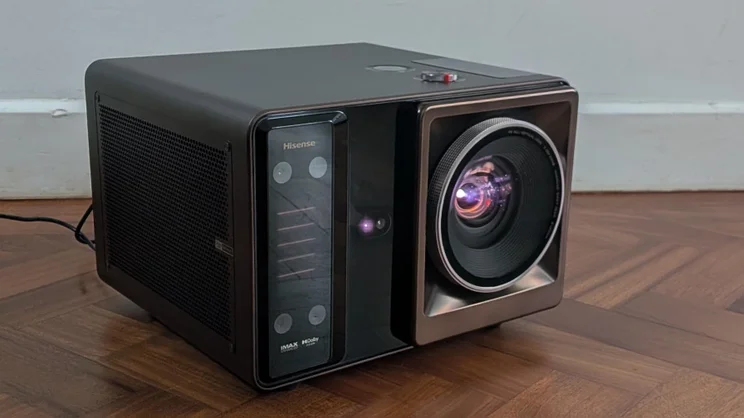
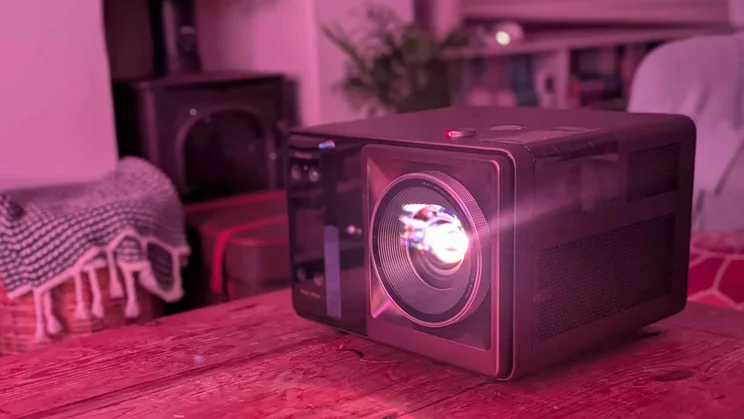
In the last few months, I’ve had that thinking overturned. The XGIMI Titan upped the light output to 5,000 ISO Lumens, changing the game on HDR and contrast while rendering in stunningly rich colour. The XGIMI Horizon 20 Max did much the same for Dolby Vision and IMAX Enhanced content on a smaller scale at a lower price point. And now, the Hisense XR10 is here to say, “Think that’s bright? Hold my beer.” This hulking brute of a projector can dish out 6,000 ANSI Lumens, courtesy of a brand new RGB triple-laser engine and a 17-element all-glass optical system. What’s more, it matches superb picture quality with some strong streaming capabilities and seriously impressive sound.
What do you get for the money?
Sadly, such technological prowess doesn’t come cheap; the Hisense XR10 will set you back a cool £5,999. For that hefty outlay, you’re getting a 4K HDR projector with a 6,000 ANSI Lumens triple-laser light source, based on a 0.47in DLP chip. This uses pixel-shifting techniques to construct a 4K resolution image from a 1080p native resolution, and, as usual, the effect is so convincing that you’d be hard-pressed to spot any difference.
The 17-element, all-glass zoom lens system gives you an extremely flexible throw ratio of 0.84-2.00:1, with the image size going from 65in all the way to a whopping 300in. You can get a 100in image with a 1.86m throw or a 200in image with 3.73m at full zoom. You lose a little sharpness and risk more distortion at that extreme, but it makes the XR10 more practical in many living rooms than the XGIMI Titan, which needs a minimum 2.66m to fill a 100in screen. The fact that Hisense quotes ANSI lumens for brightness, while XGIMI quotes ISO lumens, makes it tricky to make direct comparisons on brightness, but take my word for it: both can go ludicrously bright.
Practical design and Dolby Atmos audio
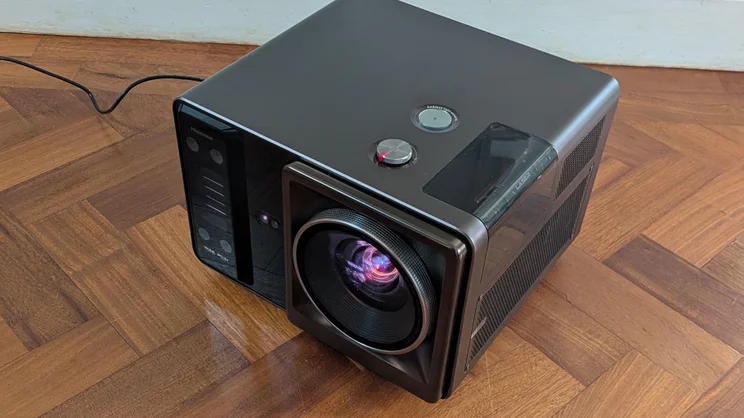
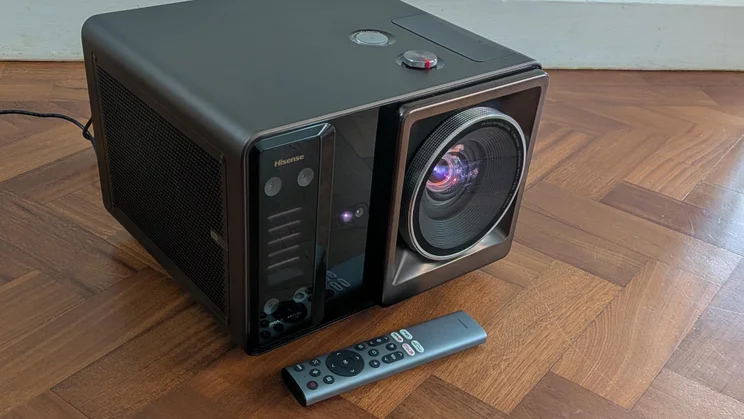
The Titan excelled in larger, dedicated home cinema spaces, but the XR10 seems to have been designed with living room practicality in mind. Don’t get me wrong; like the Titan, it’s a bit of a bruiser, measuring 29.2 x 27.2 x 21.3cm (WDH). It weighs in at 10.6kg, so you’ll want a sturdy table or a very solid wall or ceiling mount to support it. However, its 130% vertical and 46% horizontal lens shift means it doesn’t need to be placed at the perfect height, dead-centre to your screen, and the auto-focus, auto-alignment and auto-keystone controls do a solid job of straightening and sharpening up the image, though making heavy use of the lens shift can disable the auto-keystone.
The built-in 2.1-channel audio system has been designed by Devialet, and features two 8W drivers and a 15W subwoofer for beefy yet detailed Dolby Atmos and DTS: Virtual X pseudo-surround sound. Meanwhile, you have Wi-Fi 7 and Hisense’s well-established VIDAA software to give you a full range of streaming services, including Freely channels. You’ll find none of my normal ‘no BBC iPlayer’ moans with this one.
Modern connectivity and vintage style
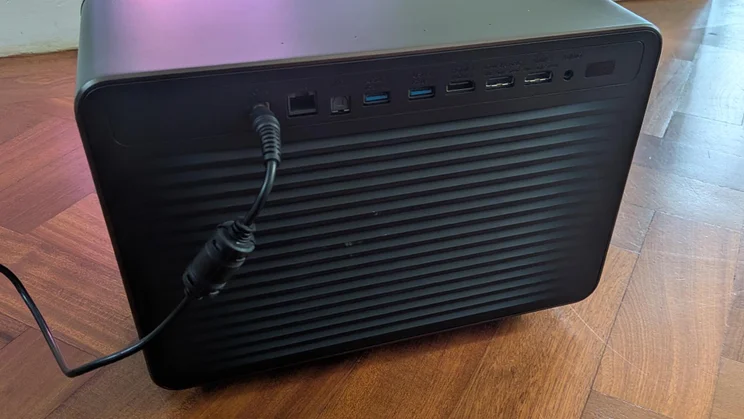
For external sources, you have two HDMI 2.1 ports, both with ALLM and one with eARC support, plus a single HDMI 2.0. Meanwhile, there are USB 3.0 and 2.0 ports, plus a Gigabit Ethernet port for a wired network connection.
You’d expect HR10+ and Dolby Vision support for this kind of money, and the XR10 doesn’t disappoint. It also has IMAX Enhanced certification.
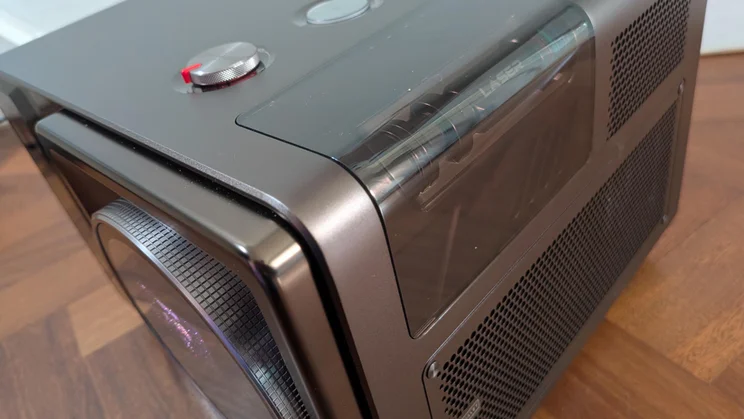
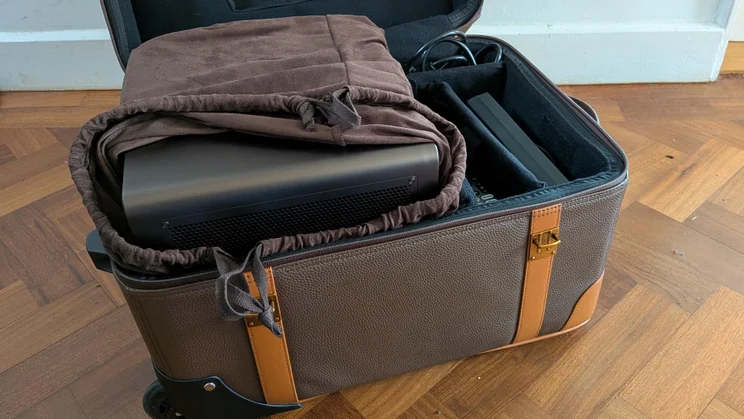
While there’s a lot to love about the XR10’s design, modelled on a vintage camera with an appealing mix of bronze metallics and transparent plastics, you might not want it out on display all the time. And, if you plan to take it to a friend’s for movie night, you’re going to need something to transport it in. To these ends, Hisense bundles in a rather impressive leather carry case with compartments to stow away the power brick, mains cable and remote control. It’s solid, luxurious and very well padded, and even makes the XR10 vaguely portable, with the wheels and pull-out handle making it easier to manage the projector’s reassuring bulk and weight.
What does it do well?
Simple to use, easy to adjust
Hisense now has a few years under its belt in the UK TV market, and you can see that experience in the setup and overall ease-of-use. The auto screen-sizing, alignment and focus routines get a decent picture up and running quickly, and all the key streaming apps I work with come pre-installed, including iPlayer and catch-up TV services from Freely. Provided you can sign in with the aid of smartphone apps or QR codes, you can go from unboxing to actually watching in roughly half an hour.
Hisense has also got the balance right on controls and adjustments. The picture modes do much of the heavy lifting, and you can stick to the Standard and Enhanced modes for most things, then switch to Filmmaker mode where the content supports it. Further and more in-depth adjustments for colour, contrast and AI enhancements are only a few remote control keypresses away, and you can make adjustments without losing sight of the content you’re actually trying to watch. I wish all projector manufacturers understood why this might be important. The XGIMI Titan goes deeper and more technical here, but at the expense of more complexity. The XR10 gives you a good range of adjustments without making it feel too technical for anyone who’s not a hardened home cinema buff.
Out-of-this-world picture performance
Hardened home cinema buffs will be delighted with the image quality. Details are a bit scant at the time of writing on what Hisense’s new triple-laser engine involves, but the resulting picture has all the super-sharp clarity you’d expect from a laser projector, combined with spectacularly vibrant colours. At times, in the Standard and Enhanced (ACR) picture modes, they’re even a little too vivid and saturated for my tastes, but that’s nothing that a quick switch to the two Cinema modes or Filmmaker mode can’t fix. With more recent films and streaming shows on Netflix, Disney+ or Amazon Prime Video, the presentation as it is was close to perfect.
I watched a range of material during my time with the XR10, including Christopher Nolan’s Tenet and Interstellar, episodes of Star Wars: Andor and sequences from Avengers: Endgame, John Wick 3, Spider-Man: Across the Spiderverse and Robert Eggar’s Nosferatu that I often use for testing. In all cases, the Hisense did a fantastic job, delivering a gorgeous, natural-looking picture and pulling detail out of darker scenes without over-brightening areas of the picture. The intense highlights of the rain-soaked Manhattan streets in John Wick 3 are as bright and colourful as you could wish for. The stygian gloom of Nosferatu didn’t hide texture, form and detail as it can on lesser projectors. I didn’t feel like I was missing out on the HDR experience at all.
Viable for daytime viewing
What’s more, the picture is genuinely visible even when you’re not sitting in total darkness. I had YouTube videos and The Devil Wears Prada running in the early evening in a light room with curtains open, and everything was visible and watchable, if slightly soft on contrast. I started watching Interstellar before the sun went down, and though I closed the blinds and curtains to cut out some of the ambient light, there was still plenty in the room. The movie was still completely absorbing and looked great, though it helps that the space scenes don’t kick in right from the start.
Magnificent measurements
Subjectively, it’s hard to fault the XR10’s performance, but my colorimeter test results back that up. In Standard mode, it covers 99.6% of the sRGB colour gamut with an amazing 208% gamut volume. DCI-P3 coverage is fantastic, at 96.9% with a 147.4% gamut volume. That puts the Hisense ahead of the XGIMI Titan (90.1% DCI-P3 with a 117.8% gamut volume) and the Horizon 20 Max (94.3% and 172.3%). The two XGIMI projectors pull slightly ahead on clarity, while, from memory, the Titan can do deeper, darker blacks with some adjustments. Still, there’s really not much in it. The XR10 is a phenomenally good projector.
It also beats both when it comes to audio. The XR10’s 2.1 system has serious amounts of power, to the extent that I couldn’t go above 40 to 50% without risking hearing loss and getting angry remonstrations from other members of my household. The output stays clean throughout that range and even further, and there’s a nice balance of mid-range and treble detail and thumping bass to make sure action movies sound good. A dedicated soundbar will do a better job of steering virtual surround effects around, but there’s enough of a stereo soundstage to make Interstellar’s score sound awe-inspiring and Nosferatu authentically creepy. I suspect the audio system contributes a certain amount to the sheer weight of the box.
Great gaming chops
I also took the XR10 for a spin with a gaming laptop, both for high frame rate high-jinx at 1080p in Doom: The Dark Ages, and some 4K gaming action in Sonic Racing: Crossworlds and Avowed. The dedicated game mode kicks in when it detects a connection to a console or PC, and the vivid colours and strong dynamic range are perfect for visually advanced, high-octane action titles. There’s no significant lag normally, and there’s a setting to minimise it further, at the cost of losing the lens shift and auto keystone features.
What could it do better?
I don’t have much negative to say about the XR10, and most of what I do have comes down to niggles. In some modes on an HDMI connection, many of the adjustments are greyed out. I presume this is because they’re controlled by the current picture mode or are superfluous to requirements, but it’s not really clear when or why these constraints will turn up, and it shouldn’t be too much to ask to tweak the colour saturation or switch to a different colour space.
Also, as with a lot of the new breed of ultra-bright projectors, the XR10 suffers from the dreaded rainbow effect. I’m not hugely sensitive and didn’t find it a problem, but others watching with me found it an issue in dark scenes with bright highlights, or even with bright white text against dark backgrounds.
The XR10 isn’t particularly noisy – I measured the sound output at approximately 35dBA at peak – but it runs hot. Anyone sitting to the right of the projector is going to find a pretty toasty breeze coming their way, which might be a bonus in the winter, but not so much on warm summer nights.
Finally, it would be nice to be able to change picture modes without a notice warning you of the adverse impact on power consumption. Once you’ve done it a few times, you kind of know that this is going to be the case.
Should you buy the Hisense XR10?
Like the XGIMI Titan, this is a big, expensive projector that’s going to be too big and too expensive for a lot of homes. However, the XR10 is more practical and living-room friendly than the Titan, which needs more space to work its wonders, and it matches or beats the competition on image quality while positively thrashing it on sound. Throw in excellent, hassle-free streaming features, great gaming support and Freely, and this has to be one of the best home projectors out there at the moment.
In fact, the only thing holding it back from a Best Buy award is the price. I do not doubt that Hisense’s technology merits the whopping price tag, yet with the XGIMI Titan at £3,499 and the Horizon 20 Max at £2,599, you’re paying a lot extra for the privilege of owning it. The superior sound, streaming features and flexibility of the XR10 go a long way, and the vintage leather case is a premium touch, but you could bag a brilliant soundbar and still not get close to making up the difference. I’d recommend the XR10 to anyone willing to spend big on the ultimate (large) living room projector, but it’s just too expensive for the rest of us.


