
To help us provide you with free impartial advice, we may earn a commission if you buy through links on our site. Learn more
- High brightness levels
- Exceptional clarity and colour performance
- Automatic focus and alignment, plus in-depth controls
- Too big and expensive for casual use
- Needs space and a big screen to shine
XGIMI has turned out its share of brilliant mid-range projectors, including high-grade 4K living room models like the Horizon Ultra and Horizon S Max. What it hasn’t done so far is address the high-end home cinema or professional markets, where buyers are looking for more control, maximum image quality and the ability to fill screens of 150in and above.
Enter the aptly-named XGIMI Titan. Significantly larger and more traditional in design than the brand’s other models, it’s built to compete with serious home cinema projectors such as the Sony VPL-XW5000ES that are bigger, brighter and more detailed, or work in boardrooms, meeting rooms and conference spaces. Can it deliver the high-end experience and justify its whopping price tag? I’ve spent many hours over the last two weeks finding out.

What do you get for the money?
That eye-watering price tag is £3,499 and gets you a 4K projector with a 5000 ISO Lumens maximum brightness, based on a larger than normal 0.78in HEP DMD chip. Like the 0.47in chips used in most budget and mid-range 4K projectors, this doesn’t actually have a 4K resolution, combining a 1080p resolution, a 240Hz refresh rate and pixel-shifting techniques to mimic a native 4K/60Hz image – usually with great results. However, here the larger surface allows for a more stable, even brighter image with more detail and better pixel separation, resulting in improved picture quality all-round, but particularly when the image is blown up at a bigger scale.
To help, the Titan features a 1.8:1 throw ratio, which can go all the way to a short-throw 1.2:1 with the aid of an optical zoom. It also has a new ultra-bright light engine mixing dual lasers, a phosphor wheel and a colour wheel. With all this tech, it can deliver images of up to 250in in size from a distance of 6.7 to 9.4m, or 100in to 150in images, provided you have between 2.7m and 6m to work with. The lasers and optical system should give the Titan a working lifespan of up to 30,000 hours.
What’s more, an automated lens shift module gives you the option to shift the image by up to 40% in the horizontal or 100% in the vertical, giving you a bit more scope to position the projector low or on the ceiling should you need to.
How about HDR support? No problem. The Titan supports HDR10+, Dolby Vision, Filmmaker Mode and even IMAX Enhanced. As XGIMI’s pro-grade projector, there’s no built-in streaming or TV functions; you’re expected to bring your own sources. There is, however, built-in audio, with two 12W speakers and support for Dolby Audio, DTS-HD and DTS Virtual:X.
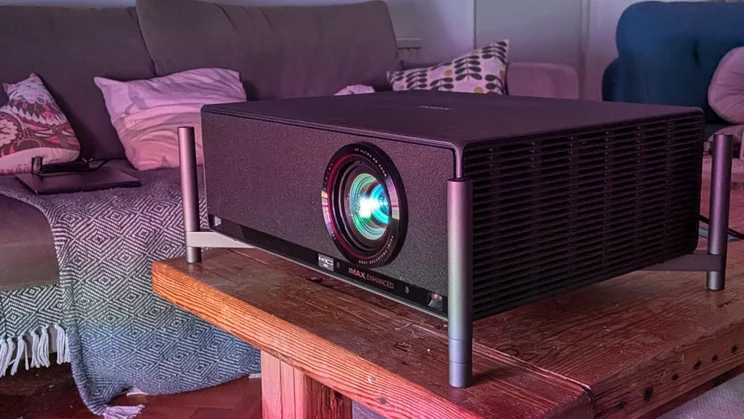
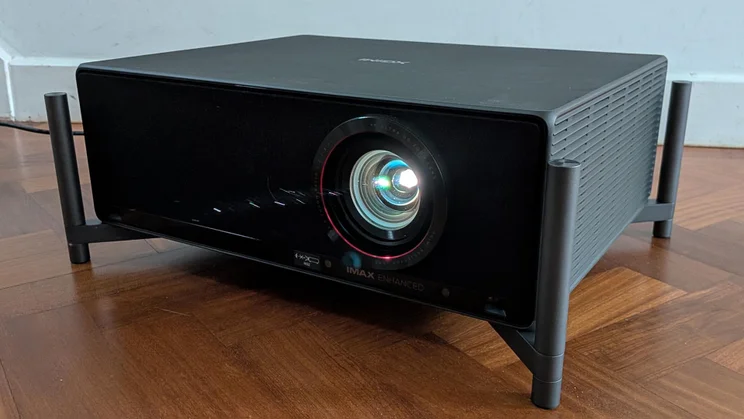
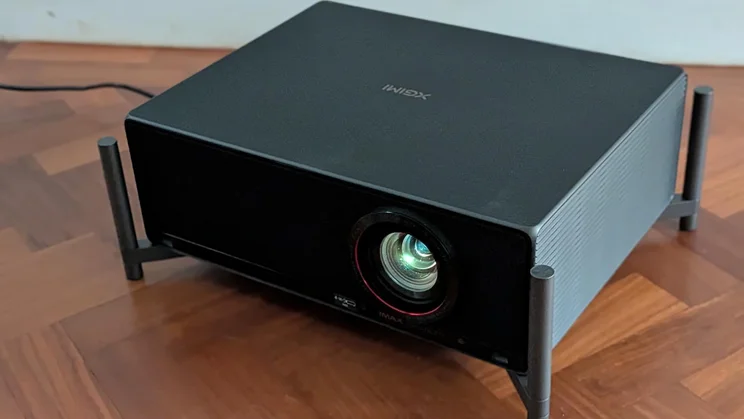
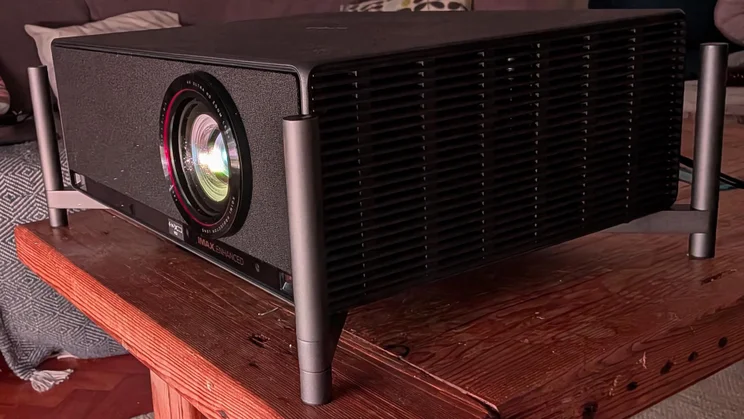
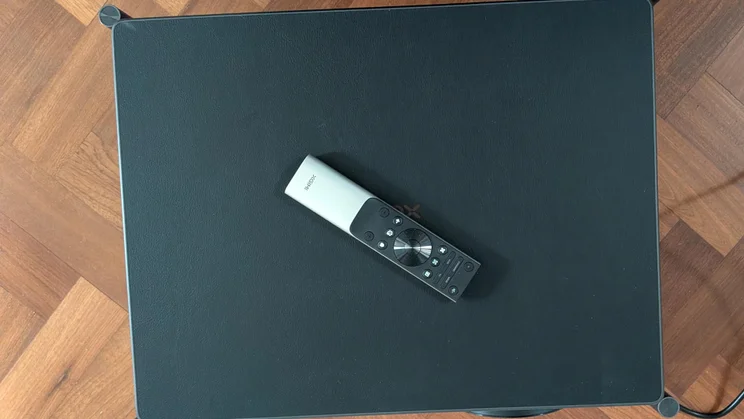
This is a fairly big projector, measuring 442 x 346 x 187mm (WDH). It’s even bigger if you mount it on the four chunky screw-on supports XGIMI provides, at which point it’s roughly the size, if not the height, of a small coffee table. XGIMI also sells it with a ceiling mount or floor stand, but be aware that either bundle will set you back an additional £349.
What does it do well?
This isn’t a plug, point and play projector like we’ve come to expect from XGIMI. It has very effective systems for automatic zoom, picture shift, trapezoid correction, focus and alignment, but you still need to be fairly careful about your positioning, and you don’t really want to move it too much once you have it set up properly.
The upside of this more expert-friendly approach is that you have serious amounts of control. You can switch between different picture profiles, with Standard, Film, Sports, Performance and Game modes all available. You also have a range of different dynamic and AI enhancements, which you may want to leave on or off according to your tastes; I found some made motion look artificial or had the unwanted side-effect of emphasising grain. You also have really detailed controls for switching colour space and compensating for any colour shifts, making it easier to tune for specific sources or types of content. In short, it’s ideal for tweakers, though not too much hard work if you just want to get the best picture you can.
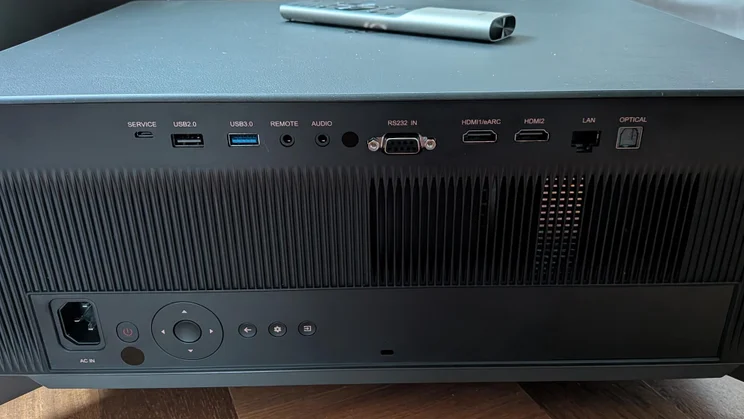
You have enough connectivity to work with, with two HDMI 2.0 ports, one supporting eARC, a USB 3.0 port and a USB 2.0 port, plus an optical audio output and a 3.5mm line-out. A third HDMI and HDMI 2.1 ports would have been nice, but the projector can’t support 4K/120Hz in any case.
I suspected that the sound system would be a half-baked effort, added in case you needed to use it in a pinch, with the understanding that you’re going to have your own AV amp or soundbar. Surprisingly, though, it’s perfectly decent, delivering nicely rounded audio at sensible volume levels, with a bit of punch, some bass, clear dialogue and even a recognisable soundstage. I found it perfectly listenable when using the projector with the sound turned down fairly low late at night, and it managed a screening of Mamma Mia: Here We Go Again without drawing any complaints from the Abba-loving audience.
All the same, this one lives or dies on its picture quality, and here there’s plenty to shout about. For a start, the Titan really does go very bright; brighter than any other projector I’ve tested in years. This means that there’s no fall off on brightness, colour or contrast as you move up to a bigger screen – and my own 100in screen certainly didn’t pose any problems. It also means that HDR performance is spectacularly good by projector standards. Watching John Wick 3: Parabellum, Ballerina or Furiosa, I was regularly struck by how intense the highlights looked, and how effectively the projector resolved shadow detail.
The picture is sharp as well, with consistently impressive clarity and detail. Watching 4K streams or – even better – 4K Blu-rays, I was occasionally awestruck by how clear and rich the presentation is. Colours can be incredibly vivid without looking artificial. And if you want a more traditional cinematic look, a quick switch of picture mode to Movie or Filmmaker Mode can give you that as well.
At first, I worried that this brightness came at a cost: a high black level, impacting contrast and resulting in some muddy, grey-ish blacks. However, some judicious fiddling with the dynamic contrast settings and a black level calibration in the menus did a great job of sorting this out. No, you’re not going to get the deep blacks you’ll get from an OLED TV, especially if you use a screen with any light gain, but it’s as close as I’ve seen a projector get.
If you need further evidence that this is a fantastic projector, I found it covered 96.9% of the sRGB colour spectrum with a 166.4% sRGB gamut volume and 90.1% of DCI-P3 with a 117.8% gamut volume. I suspect I could boost the coverage figures with a better screen and even more tweaking, but the gamut volumes are far above what I’ve seen with comparable projectors. These are seriously great results.
The Titan also has dedicated game settings and supports ALLM for instant switching to a reduced latency mode, with options to tweak this further. The high levels of brightness, rich colours and impressive HDR effects make for a great gaming experience, particularly if you’re more interested in blockbuster action-adventure games than twitchy eSports shooters. I had a great time playing Monster Hunter: Wilds and Silent Hill f.
What could it do better?
It’s not so much a case of what the Titan could do better, as the sort of scenarios it’s suitable for. For such a big projector, it’s surprisingly quiet – the fan noise is just under 32dB – but it isn’t designed to be a lifestyle-friendly, living room projector, and it’s best suited to a permanent position on a stand or mounted to the ceiling rather than a temporary spot on the coffee table or the floor. While the lens shift gives you some flexibility, it works best when it’s closer to the height of the screen.
You also need a certain amount of space to get a good-sized picture, and it really needs a bigger screen to make that superb brightness, clarity and colour shine. For fun, I tried it with a 50in tabletop screen, but you really need 100in or more to give the Titan the canvas it deserves, and 150in to 200in is arguably the sweet spot.
In short, if you’re looking for a more casual living-room projector to serve a 60in to 100in screen, save yourself some money and look at something more compact like the Hisense C2 Pro, the BenQ W2720i or XGIMI’s own Horizon series. You’ll get something that works better in that space, and has everything you need – including streaming – built in.
Should you buy the XGIMI Titan?
If you’re buying for a permanent living room setup or a dedicated home cinema or entertainment space, then it’s a different story. This is a hugely impressive projector, capable of filling fairly massive screens.
Picture quality is superlative in terms of colour, definition and tone, and you can tune it to get the presentation that you’re looking for, whether that’s a brighter, high-contrast style for TV and presentations, or a more cinematic look. It can do subtle and nuanced just as well as punchy. It’s a little too big and too expensive for many scenarios, but if you have the room and the budget, it’s a brilliant buy.


