To help us provide you with free impartial advice, we may earn a commission if you buy through links on our site. Learn more
Ever since I started covering TVs for Expert Reviews, the industry’s leading manufacturers have been locked in a brightness battle, chasing ever-higher peak luminance regardless of the chosen panel technology.
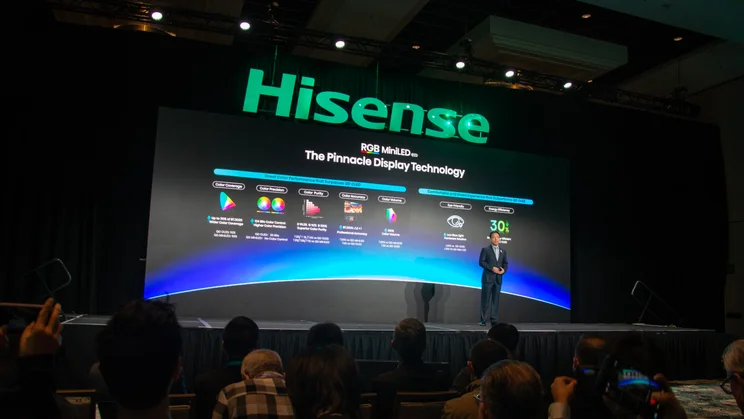
Based on what was said – and what was revealed – at Hisense’s CES press conference in Las Vegas on Monday morning, the Chinese brand is changing tack. While its new range of 4K televisions will undoubtedly have the capability to put out big numbers in the nits department, its focus this year is on colour.
“Stay true to what’s real”, “unlock the wonder of colour”, and harness “the emotional power of colour” were just some of the choice phrases enthusiastically delivered to a packed crowd, of which I was part, in the South Seas Ballroom at the Mandalay Bay hotel.
Senior representatives from the brand, which is the official partner of this year’s FIFA World Cup, took to the stage to detail exactly how it plans to improve consumers’ lives through its various home entertainment lines. And I certainly liked what I heard.
The RGB Mini LED Evo range
Let’s start with the brand’s new RBG Mini LED Evo range, which includes the flagship UX, plus the UR9, UR8 and UR7.
The top-of-the-range UXS adds a fourth colour to the “chromatic precision” Mini LED backlight found on last year’s equivalents. Hisense was the first company to bring an RGB Mini LED to market in 2025 and continues to lead the way by introducing this four-primary approach.
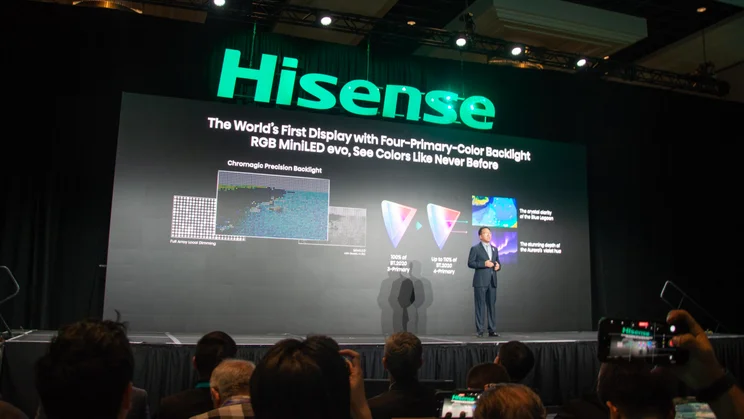
Whereas traditional LED TVs shine white or blue light through colour filters, RGB Mini LED TVs use red, green and blue LEDs to produce colour for each pixel, and this year, sky blue is being added to the mix on the flagship model.
So what are the benefits of this approach? For starters, coverage of the BT.2020 colour gamut used in HDR mastering is up from 100% to 110%. President of Hisense Visual Technology, Dennys Li, added that colour bleeding will be all but eliminated, and tint shift apparent on lesser displays will be reduced significantly.
Compared to Quantum Dot OLED technology, Li says that RGB Mini LED Evo will produce 60% less blue light – or 75% less than traditional Mini LED displays. The tech is also 30% more energy efficient than QD-OLED, it was claimed. All of this will result in what Li described as the new “pinnacle of display technology” and the equivalent of professional reference monitor levels of performance and accuracy in people’s homes. Lofty claims, indeed.
Not only does Hisense want to move the needle forward in terms of colours, but it plans to do so at prices that make the new tech available to a wider range of consumers. The new models will be available in a wider range of sizes and at various price points, building on Hisense’s growing momentum over recent years.
Hisense MXS: The first four-primary colour Micro LED TV
Hisense also dropped a groundbreaking new four-primary colour Micro LED TV, the Hisense MXS. Here, red, green and blue sub-pixels are accompanied by yellow sub-pixels.
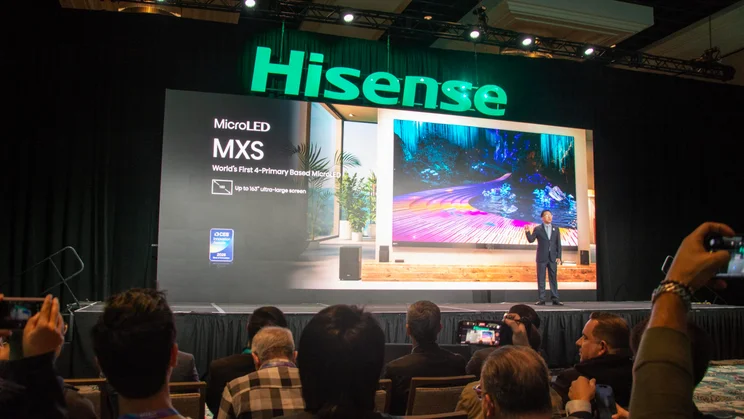
The MXS is set to be available in enormous 163in and 136in screen sizes, though nothing has been confirmed at this stage. Somehow, the brand has still managed to keep the panel relatively thin and wall-mountable. I got a glimpse at it on display on the CES show floor, and it’s truly a sight to behold.
VIDAA OS makes way for Home OS
Alongside the hardware announcements, Guy Edri, CEO of VIDAA – the company behind the operating system used on a lot of Hisense televisions (in Europe and the UK at least, in the US most use Google TV instead) – revealed a new brand identity in the form of “V”. The VIDAA name won’t be disappearing entirely, but VIDAA OS will be replaced by a new operating system: Home OS.
This places Hisense TVs at the centre of people’s smart home ecosystems. We’ve seen Samsung doing this with SmartThings for a while now, and Home OS will seek to curate a “personalised, AI-driven, content-centred” experience for its users.
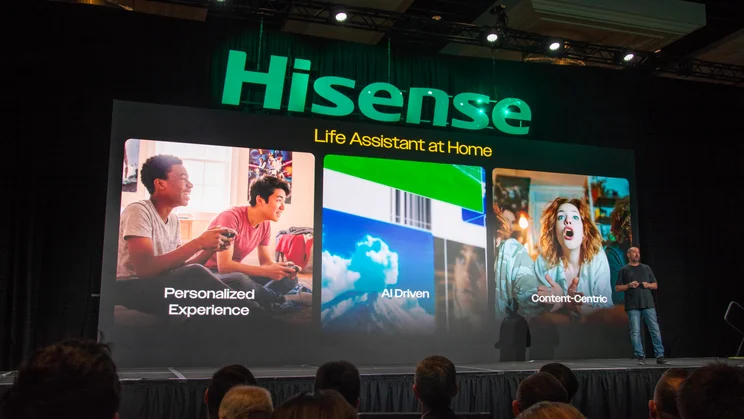
Features mentioned include the ability for the TV to wake you up with a personalised dashboard, and dual-screen alerts powered by AI, showing goals in football matches involving your team while you’re watching other content. The platform also heralds a collaboration with Microsoft to integrate Copilot for productivity and Xbox for game streaming.
I’ll be getting a closer look at what Hisense has in store for 2026 over the coming days, so keep an eye out for more details about its new lineup and the technological advancements being introduced. I’ll also be reporting back from CES on the biggest reveals from the tech world’s biggest players, which you definitely won’t want to miss.