
To help us provide you with free impartial advice, we may earn a commission if you buy through links on our site. Learn more
- Epic brightness and super-sharp pictures
- Easy and flexible to set up and use
- Strong features for gaming and streaming
- Can be prone to RGB flashing and rainbow effect
- Settings could be better organised
More than any other series of projectors, XGIMI’s Horizon series has set the benchmark for the new style of compact, living-room beamer. The 2021 originals pretty much defined the form factor, while 2023’s Horizon Ultra combined laser and LED tech with pixel shifting to deliver stunning clarity and detail. Last year’s Horizon S Pro and Horizon S Max boosted the brightness and colour performance even further, while also coming in at a more accessible price.
Now the XGIMI Horizon 20 aims to push image quality even further, with greater brightness and contrast, more flexible optics, Google TV and IMAX Enhanced certification. You could see it as an upgrade from the Horizon S Max with a flavour of the mighty XGIMI Titan semi-pro projector.
The specs are impressive, but they come with a matching price tag. At £2,599, the Horizon 20 Max is £900 more expensive than the Horizon S Max and twice the price of the Horizon S Pro. It’s also going up against stiff competition from the brilliant BenQ W2720i and the Anker Nebula X1, both of which can be had for a few hundred pounds less. Can the Horizon 20 Max’s image quality justify the cost?
What do you get for the money?
A 4K triple-laser powered projector capable of delivering 5,700 ISO lumens at peak brightness. That’s significantly more than the Horizon S Max (3,100 ISO lumens) or the Nebula X1 (3,500 ANSI Lumens). More surprisingly, it’s slightly higher than XGIMI’s aptly-named Titan, which stops at 5,000 ISO Lumens.
Of course, the Horizon 20 Max doesn’t have the Titan’s whopping 0.78in DMD HEP chip to produce its 4K pictures. Instead, it uses a more conventional 0.47in DMD chip, just like most 4K projectors of this type. As with them, it uses pixel-shifting techniques to simulate a 4K picture from a native 1080p resolution, but at 240 frames per second, it’s nigh impossible to see the difference. XGIMI states that the Horizon 20 Max can cover 110% of the BT.2020 colour gamut, there’s support for HDR10+ and Dolby Vision, IMAX Enhanced certification and a dedicated mode to make the most of IMAX Enhanced content.
Like the previous Horizon models, the 20 Max works as a one-box entertainment system. It has Google TV software onboard for streaming plus a 2x12W Harman/Kardon audio system with Dolby Audio and DTS Virtual:X. XGIMI even specifies the processor and RAM configuration – a MediaTek 9679 chip with 4GB of RAM – along with Wi-Fi 6 and Bluetooth 5.2. There’s a distinct feeling that the brand hasn’t skimped on anything; that every component has been picked to meet a demanding high-performance criteria.
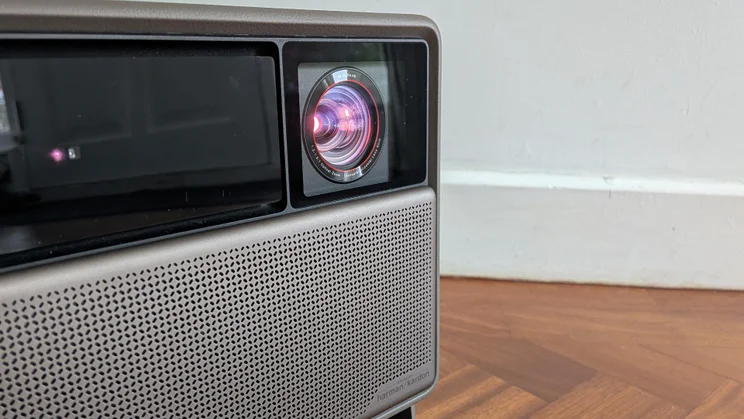
XGIMI’s usual auto-keystone correction and auto-focus systems are in place, ensuring you can get a straight, sharp, properly aligned picture from most sensible angles. Meanwhile, a new optical zoom and dynamic lens-shift system give you even more flexibility around positioning. You can move the projected image up and down by 120% or horizontally left or right by 45%.
Meanwhile, the optical zoom gives you a throw ratio of 1.2 to 1.5:1, meaning you can project a 100in image from 2.66 to 3.33m away, or a 75in image from 2m away. What’s more, the high brightness level means you can realistically project an image of up to 300in, though that entails having 9m or so of space to play with, and I’d expect some fall-off in colour and contrast at that mark.
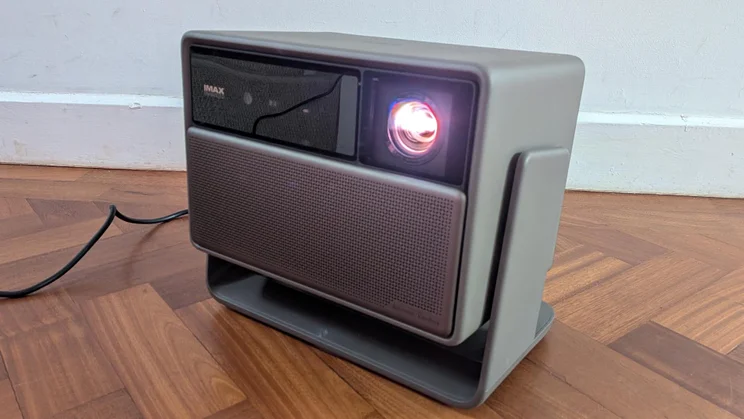
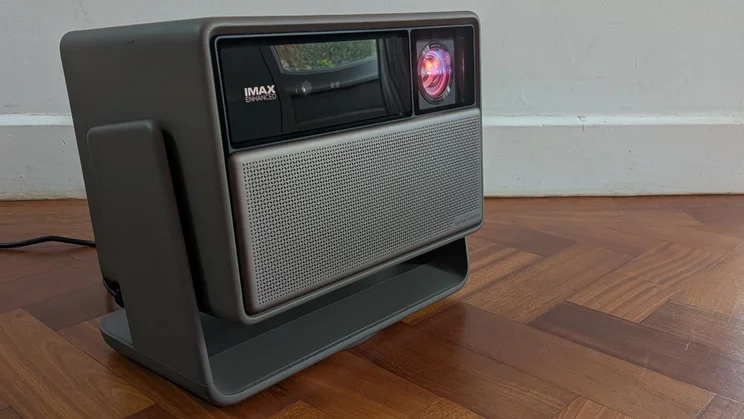
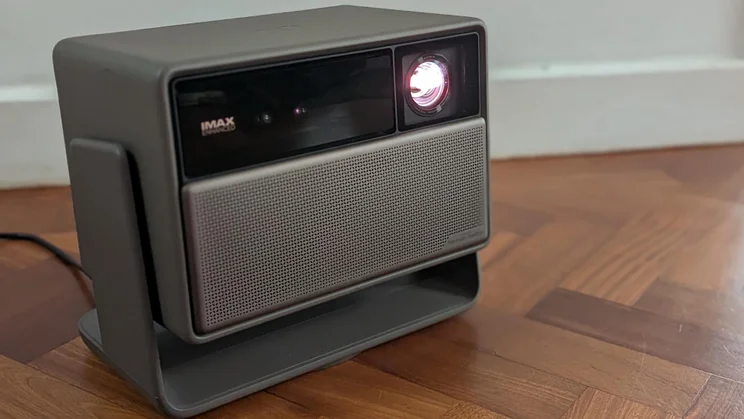
All of this comes in a unit that’s not really any bigger than previous Horizons, with the same integral gimbal stand as the Horizon S Pro, though you miss out on the old lens cover, which used to slide down when the projector was ready for action.
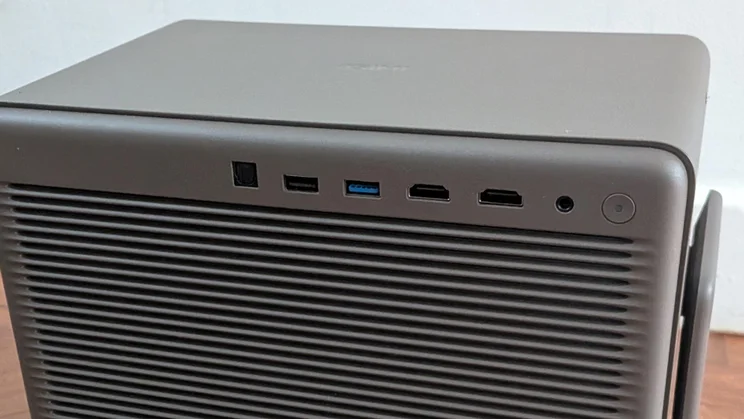
Instead, you have a more straightforward design at the front with a panel containing sensors next to the lens and a speaker grill below, while all the connectivity is packed into a row at the rear. Here you’ll find two HDMI ports, a USB 3.0 port and a USB 2.0 port, plus an SP/DIF optical output and a 3.5mm line out. One of the HDMI ports supports eARC.
What does it do well?
It probably doesn’t need saying that the Horizon 20 Max can produce an extremely bright image, but it is worth drilling down into what that means. The picture is incredibly sharp and detailed, with vivid, highly saturated colour and heaps of contrast. Yet there’s control as well. It can handle subtle tones and hue shifts, and if you switch to the Cinema picture mode or engage Filmmaker Mode, you can have a slightly darker but still very rich presentation that’s perfect for movies and TV dramas.
Over my time with it, I watched excerpts of John Wick 3: Parabellum, Spider-Man: Across the Spider-Verse, The Northman, Nosferatu, Master and Commander: Far Side of the World, Kill Bill Volume 1 and Dune. I also watched episodes of Star Wars: Andor, Star Trek: Brave New Worlds and a whole bunch of game trailers and music videos on YouTube. There was nothing that didn’t look fantastic, even if I had to switch picture modes occasionally or reduce motion smoothing to get the kind of image I prefer.
It also means there’s scope for convincing HDR; Dolby Vision and IMAX Enhanced content looks incredible. I’m not sure I’ve seen another projector that makes games look this good. I had it hooked up to a gaming laptop running Doom: The Dark Ages, Cyberpunk 2077 and Sonic Racing: Crossworlds, and between the variable refresh rate, ALLM support and low-latency game modes, the results were stunning, particularly with the option to run at 1080p at 120Hz or 240Hz. Displays don’t get much bigger than this, and the clarity and colour made me yearn to turn the settings up to max, even if I had to ramp them down again to hit a stable frame rate. There’s also a Black Equaliser setting to help bring out shadow detail in darker scenes.
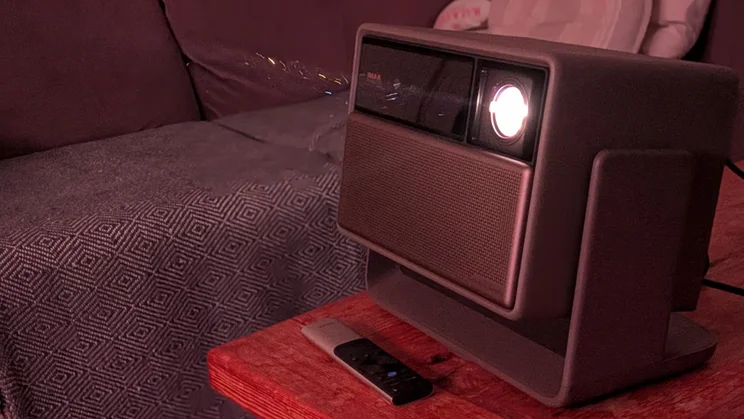
Finally, brightness also impacts your viewing experience with the lights on. In fact, this is one of the few projectors I’ve looked at that holds up in a room with moderate or muted lighting or even in daylight if the sun isn’t streaming in.
I was convinced early on that colour performance was exemplary, and the results in my colorimeter testing confirmed my thoughts. In Standard mode, it covered 97.7% of the sRGB gamut with a 149% gamut volume, and 93.4% of DCI-P3 with a 106% gamut volume. In Vivid mode, this rose to 98.3% and 243.2% for sRGB and 94.3% and 172.3% for DCI-P3. As always, your mileage will vary with your screen and settings, and I wouldn’t be surprised if there was room for improvement with some further tweaks.
The audio isn’t quite so exemplary, but it’s more than good enough for casual viewing. The dual 12W speakers can go surprisingly loud, and while you don’t get much in the way of an immersive surround soundscape, it still doesn’t seem as if the sound is all coming from a single spot. Watching Master and Commander with the volume at roughly 55%, I was struck by how well the Horizon 20 Max conveyed the background noise of life on the HMS Surprise in the opening sequence, even if the pounding guns and shattering timbers of the ensuing battle sound slightly congested without the directional detail you’d get with a soundbar.
Setup is as easy as ever with Google TV, and XGIMI’s auto-configuration tech works brilliantly to deliver a great picture in most situations. There were times when I found it went conservative on screen size, giving me a really crisp, straight image, but not quite using the full width of the screen, but I could usually sort this out with a little repositioning and tuning.
Meanwhile, Google TV gives you a pretty comprehensive lineup of apps and streaming services tied together in a logical interface that feels intuitive for a streaming-first device. Most of the major UK services are actually onboard, except BBC iPlayer, which is mysteriously absent. You can always stream it from your smartphone using Chromecast, but it really ought to come pre-installed.
What could it do better?
With a very bright image comes one obvious downside: blacks that aren’t perfectly black. However, the Horizon 20 Max does a good job of image optimisation. Blacks still look black rather than grey, and dark or low-contrast scenes don’t collapse into a muddy-looking morass. Using the Black Level Enhancement setting helps, though this doesn’t work in Dolby Vision mode and comes with a slight shift in colour balance with no specific adjustment to iron this out. You’re never going to get the deep blacks and perfect contrast of an OLED screen, but who cares when – subjectively – image quality is so good?
On the subject of, erm, subjectivity, it’s also worth noting that the high brightness levels and contrast also make the Horizon 20 Max a little more prone to RGB flashes and the dreaded rainbow effect. I’m not particularly sensitive to either and barely noticed any issues, but others in the room were sometimes bothered. If you sit more rainbow-sensitive, you might want to look elsewhere.
Otherwise, my only complaint regards the settings. Basic settings are available at the press of a button on the remote, with more advanced settings one selection and a further press away. You’ve got a solid array of picture modes to switch between, and some in-depth options for tweaking and optimising. However, not all the settings are arranged logically, especially when you reach for the more advanced picture settings, and it’s not immediately clear what some of them do. Hats off to XGIMI for giving you more control than on the first Horizon projectors, but a bit more work would make it easier to get the best from the impressive hardware.
Should you buy the XGIMI Horizon 20 Max?
Yes, with a handful of caveats. The Horizon 20 Max can dish out superb moving images, and the high brightness levels and fantastic optical system give you scope to go for a really crisp and vivid picture or dial it back for a more conventionally cinematic look. There aren’t many projectors I’ve tested that are this good for gaming, casual entertainment and serious home cinema use.
True, it is a relatively expensive projector, and if you don’t need this much brightness, you might be just as happy with the already brilliant Horizon S Max, the cheaper Horizon 20 or even the stripped-back Horizon S Pro. Yet the Horizon 20 Max is as good as it gets without the size and sheer expense of the Titan or another specialised home cinema projector. It looks like XGIMI has done it again, redefining what you can expect from a compact model.


