To help us provide you with free impartial advice, we may earn a commission if you buy through links on our site. Learn more
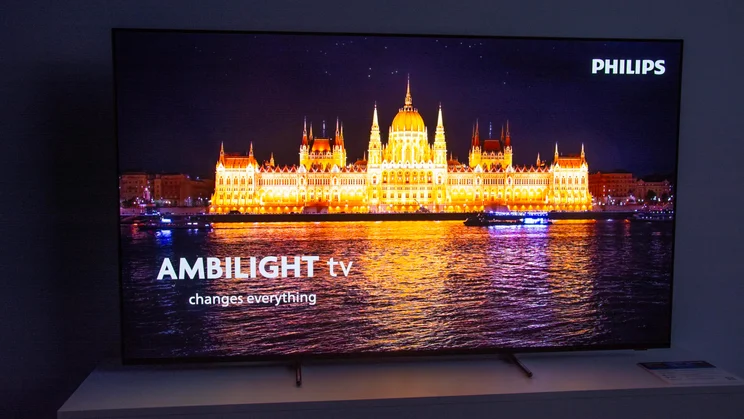
Despite my trip being curtailed by a strike at Berlin airport, I managed to get some ears-on, eyes-on and hands-on time with new Philips TV and audio products this week.
I’ll cover the various audio announcements in a separate article, but here, I’m going to break down all of the new television models coming in 2026. There are a lot of them, and plenty to talk about regarding changes and upgrades, but before I get stuck in, I want to highlight some of the improvements applicable to several models.
First, and perhaps most significantly, Philips is one of the early supporters of the new Dolby Vision 2 HDR format. All of the TVs listed below will support it, but to different degrees. The more premium models support the Max version, while the cheaper options make do with a less advanced version that omits a few picture-tweaking technologies.
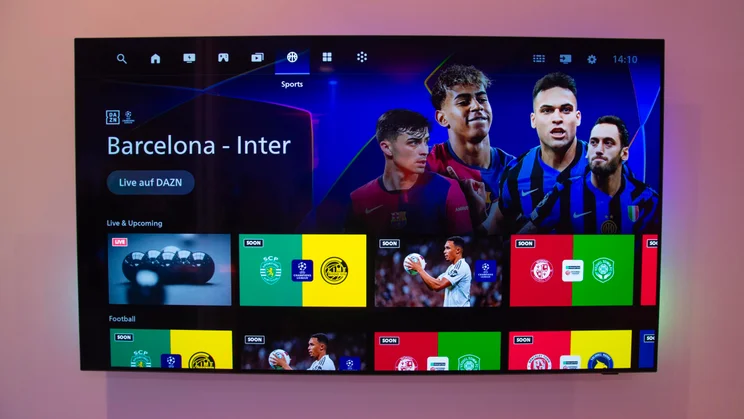
Second, Philips has ditched Google TV and gone all-in on Titan OS. This debuted in 2024 and was previously featured on some of the televisions further down the brand’s lineup, but is now the smart platform of choice for the entire range.
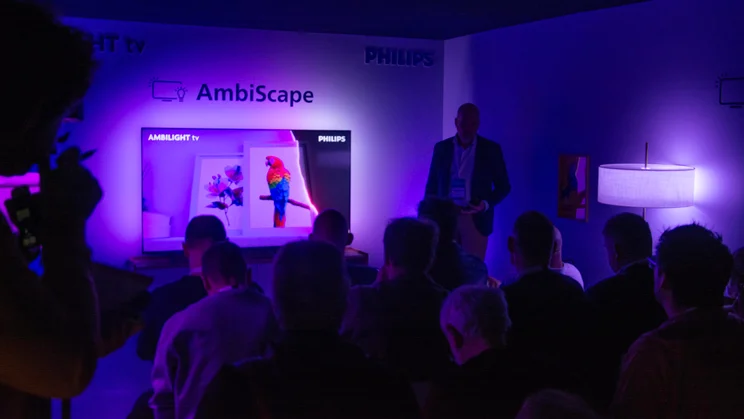
Thirdly, AmbiScape technology, which expands the reach of Ambilight to smart bulbs around your living room and was trialled on select models last year, is now supported across the lineup. You can read more about AmbiScape here.
And finally, several of the more premium models in Philips’ 2026 range have had their gaming credentials boosted, with support for 2.1 features across all four of their HDMI ports and increased refresh rates of up to 165Hz.
As my time in Berlin was cut short by staff striking for higher wages (I stand with you, brothers and sisters), I didn’t get a chance to watch or listen to them all, but I’ve added my impressions about the models I did get up close and personal with. Now that bit of housekeeping is out of the way, let’s get stuck into the models.
Philips OLED+951: The picture quality pinnacle
At the top of the range is the OLED+951, Philips’ all-singing, all-dancing OLED flagship that represents the best picture quality the brand can muster.
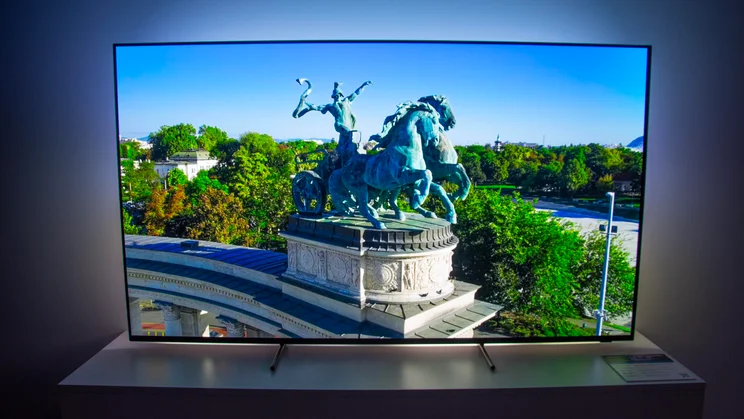
It’s a TV capable of hitting peak brightness of 4,500 nits and producing 400 nits of brightness on a full-field pattern, while also covering 99.5% of the DCI-P3 colour gamut and 83% of the BT.2020 gamut used by HDR content. Its Dual Engine chip unlocks several processing features to enhance picture quality, including Specular Highlight Enhancement, AI Machine Learning Sharpness V3 and AI Perfect Reality V4. Additionally, the OLED+951 benefits from META 4.0 anti-reflection tech. A four-sided Ambilight and Dolby Vision 2 Max features like Authentic Motion, which delivers motion control specified by the creator of what you’re watching, round out what will undoubtedly be a pricey package.
- Panel type: META 4.0 Primary RGB Tandem WOLED
- Processor: 10th Gen P5 AI Dual Engine
- Screen sizes: 65in and 77in
- Refresh rate: Up to 165Hz
- Ambilight: Four-sided
- HDMI: 4 x 2.1
- Sound: 70W 2.2-channel in-built sound system
- Operating system: Titan OS
- Release date: October 2026
Initial impressions: I got to witness demo content on the OLED+951 that showed off its updated anti-reflection tech and Ambient HDR Optimisation feature. The former was a noticeable improvement on the OLED+950 and reduced reflections successfully without decimating the black level in bright conditions.
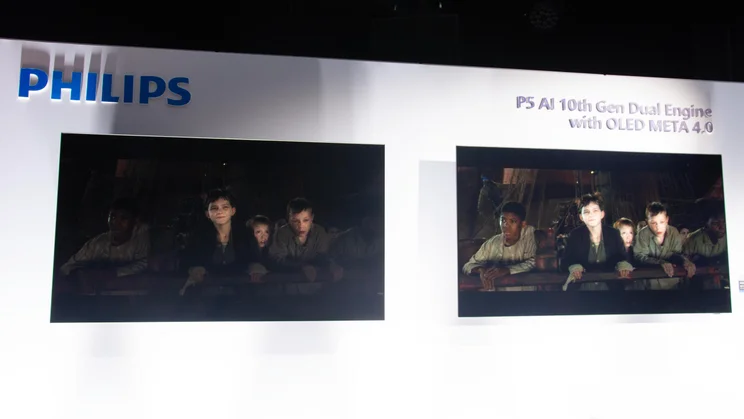
The latter, meanwhile, automatically tweaks HDR images based on the level of ambient light, and did a decent job responding to changes in ambient conditions to highlight important parts of the picture during a scene in the family adventure film Pan. It did stray into the unnatural at times when rendering bright highlights, however, as you can see in the image above. With the two panels side-by-side, the difference in brightness was readily apparent, which is good news for those with bright viewing spaces.
Philips OLED+911: The audio maestro
When Samsung bought Sound United, the parent company of Bowers & Wilkins, last September, I wondered whether that sounded the death knell for Philips’ partnership with the esteemed British audio manufacturer. It may still do so, but we’re getting at least one more premium Philips OLED with on-board B&W sound.
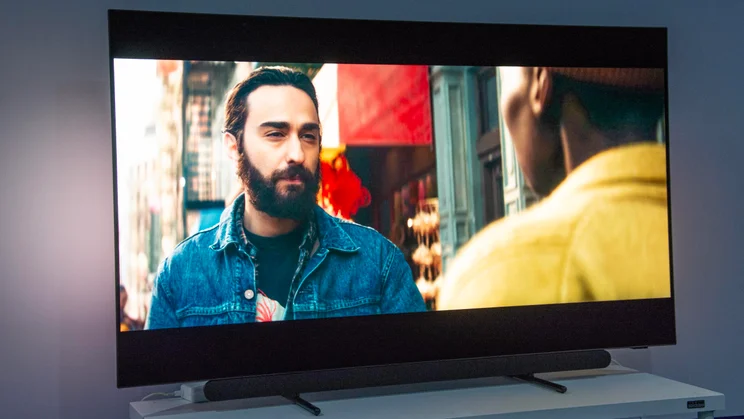
That sound comes in the form of a left, right, centre channel audio solution under the panel and a subwoofer built into the rear. Each front-firing channel uses a pair of 45mm mid-range glass-fibre drivers and a 19mm dome tweeter. Changes to the sub, which is housed in a decoupled bass enclosure and slimmer than that found on the OLED950, mean the TV is a lot more slender, enhancing its aesthetic appeal.
- Panel type: META 4.0 Primary RGB Tandem WOLED
- Processor: 10th Gen P5 AI
- Screen sizes: 48in, 55in, 65in and 77in
- Refresh rate: Up to 165Hz
- Ambilight: Four-sided
- HDMI: 4 x 2.1
- Sound: 81W integrated 3.1-channel Bowers & Wilkins sound system
- Operating system: Titan OS
- Release date: October 2026
Initial impressions: I saw and heard the OLED+911 in action, and enjoyed every second of the demos. The colour palette was well-balanced during scenes from A Quiet Place: Day One; there was ample brightness to draw out detail in both bright and dark areas of the picture, and I found it hard to find fault in the overall presentation.
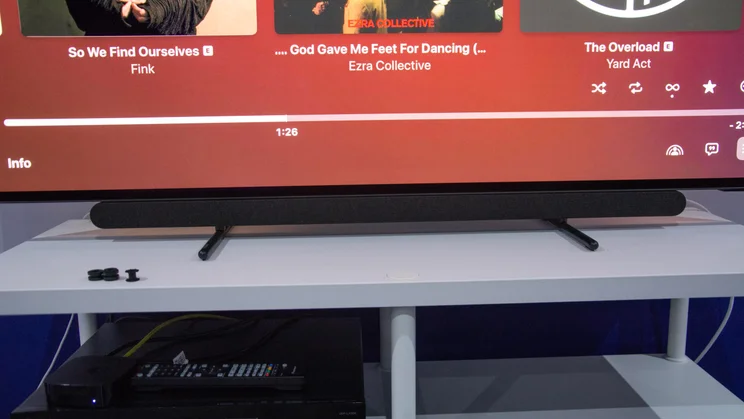
On the audio front, the improved 3.1-channel audio system from Bowers & Wilkins delivered the Atmos soundtrack with superb scale and precision. Dialogue was clear, and explosive effects had plenty of impact, though there was a separate subwoofer wired in, so the jury remains out on just how well the TV itself handles low-end frequencies.
Philips OLED811: The mid-range banger
Philips only released the 77in version of the OLED810 in the UK last year. For such a fantastic television to be limited to such a large screen size and a small audience was a real shame, but it’s back in a range of sizes this year. And I’m pleased to report that the swivel stand that was found on the OLED809 is still present on the smaller versions; the largest screen size uses metal feet instead.
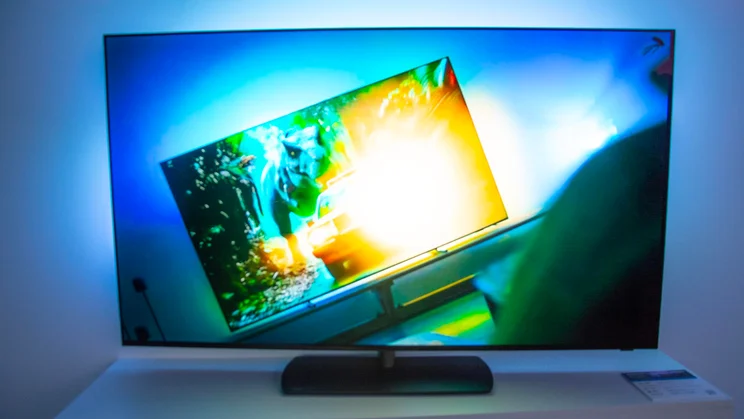
Its OLED EX panel now has a higher output – the three larger models can hit up to 2,500 nits, apparently – faster refresh rate, and all four of its HDMI ports support 2.1 gaming features. The other big new addition is support for Dolby Vision 2 Max – the advanced version of the new HDR format coming later in the year.
- Panel type: OLED EX
- Processor: 10th Gen P5 AI
- Screen sizes: 42in, 48in, 55in, 65in and 77in
- Refresh rate: Up to 165Hz
- Ambilight: Three-sided
- HDMI: 4 x 2.1
- Sound: 70W 2.2-channel in-built sound system (48in and above), 50W (42in)
- Operating system: Titan OS
- Release date: June 2026 (55in), August (42in, 48in and 65in), September (77in)
Philips OLED761: The entry-level OLED
Last year’s OLED760 received a Best Buy award from me, with one of my few criticisms relating to its entry-level brightness. Well, this year’s model is said to be able to break the 1,000 nits mark, which is a significant jump from the 718cd/m2 I measured on a 10% window on the OLED760.
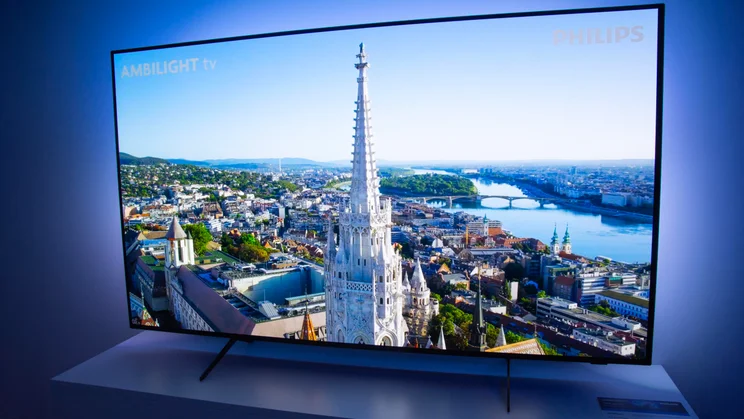
The processor remains unchanged from last year – the OLED761 is still using the seventh-generation P5 AI chip – but there has been a change to the speaker drivers that results in a slimmer profile for the TV, and the feet the TV stand on are slimmer, too.
- Panel type: OLED EX
- Processor: 7th Gen P5 AI
- Screen sizes: 55in, 65in and 77in
- Refresh rate: Up to 120Hz
- Ambilight: Three-sided
- HDMI: 4 x HDMI 2.1
- Sound: 2.1-channel in-built sound system (2.2-channel on the 77in)
- Operating system: Titan OS
- Release date: June 2026 (55in), August (65in), October (77in)
Philips MLED981: Philips first RGB Mini LED
Several other TV brands have decided to double down on Mini LED technology, but Philips is taking a more cautious approach. The brand’s Head of Marketing for Europe, Anette van Dijk, told attendees at the Unboxed press conference that there’s room for both OLED and Mini LED, but we’re only seeing one of the latter coming to market for Philips in 2026. It’s only going to be available in one screen size (85in), and will be positioned below the brand’s 800 and 900 series OLEDs.
It’s powered by the same chip as the OLED+911 and OLED811, and supports the same blazing-fast 165Hz refresh rates, along with Dolby Vision 2 Max. But whereas each pixel on the panel of the OLED models can be controlled independently, the MLED981, or “The Xtra” as Philips refers to it, has over 11,000 dimming zones (3,840 x 3). It’s said to reach brightness peaks of 2,500 nits, and it has a sound system that features two down-firing, two side-firing drivers, and a rear-mounted subwoofer.
- Panel type: RGB Mini LED
- Processor: 10th Gen P5 AI
- Screen sizes: 85in
- Refresh rate: Up to 165Hz (330Hz with DLG)
- Ambilight: Three-sided
- Sound: 70W 4.1-channel in-built sound system
- Operating system: Titan OS
- Release date: October 2026
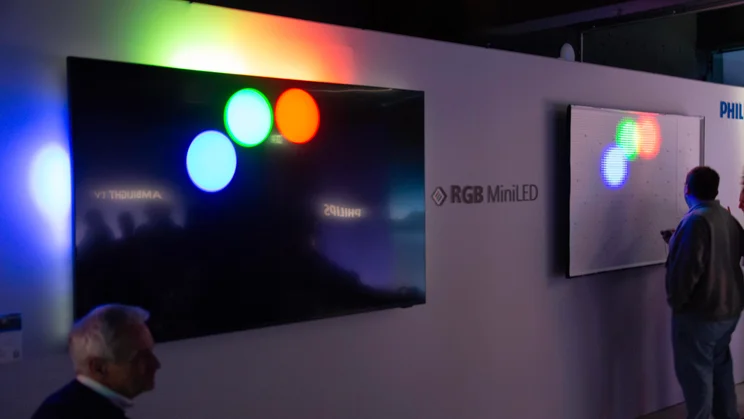
Initial impressions: I didn’t get to see enough of the MLED981 doing its thing to get a strong sense of how it will perform, but I did get to see it naked. By which I mean I saw it with the front of the panel removed, leaving the entirety of its backlight exposed.
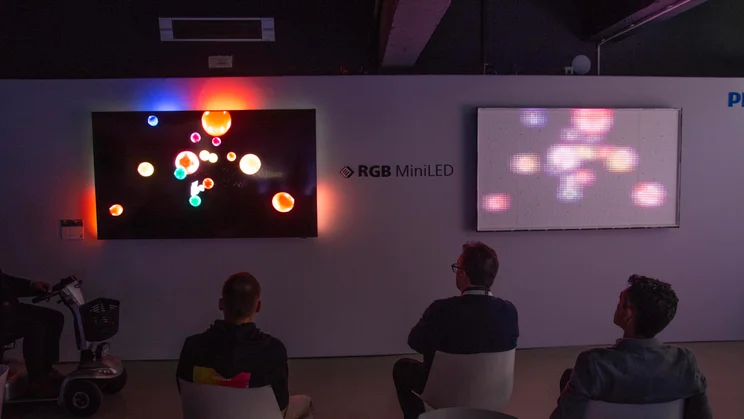
The same content was being played across two 85in MLED981s, and the way the zones of LEDs precisely illuminated the shifting swathes of colours was fascinating to watch. Overall, the picture looked solid on the TV that hadn’t been stripped of its dignity, without blowing me away like some of the RGB Mini LED models I saw at CES in January.
Philips PQS9001: “The One” QLED
Philips calls its flagship quantum dot QLED TV “The One” as it feels it’s the best-suited to the widest range of people, but it might need to rename it “The One Hundred” after revealing a new 100in model for 2026.
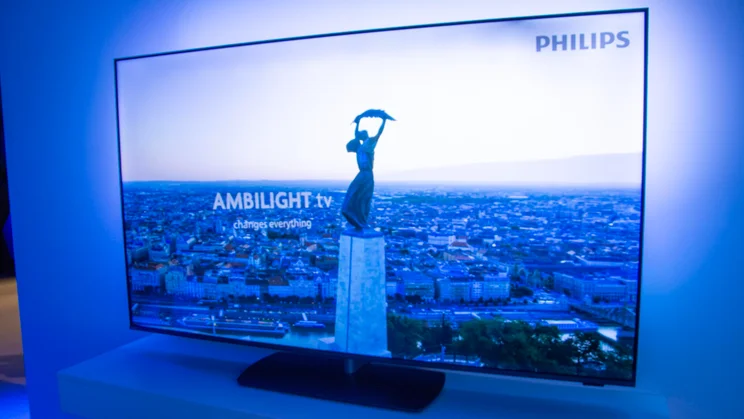
It’s a step down in terms of picture performance from the models mentioned above, but it makes use of a lot of the same features and technology. Ambilight, AmbiScape, Dolby Vision 2 and Titan OS are all present and correct, and at a much lower price point than you’ll find on the OLED and RGB Mini LED options.
- Panel type: Quantum dot LED
- Processor: 7th Gen P5 AI
- Screen sizes: 43in, 50in, 55in, 65in, 77in, 85in and 100in
- Refresh rate: Up to 144Hz
- Ambilight: Three-sided
- Sound: 40W 4.0-channel in-built sound system (50in, 55in and 65in), 50W 2.1-channel (75in, 85in and 100in)
- Operating system: Titan OS
- Release date: June 2026 (43in, 50in, 55in, 65in and 75in), October 2026 (85in and 100in)
Philips QLED 8000 Series TVs
Philips had a few other cheaper QLED models on show, but didn’t make much of a song and dance about them.
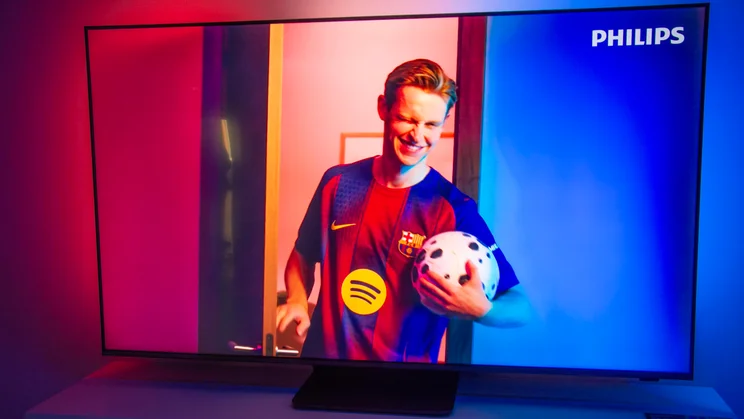
I spotted the Philips 8701 (pictured above), which will be available in 43in, 50in, 55in and 65in screen sizes, the Philips 8601 (below), which adds a 75in model to that list, and the Philips 8501, which replaces the 75in model with an 85in one.
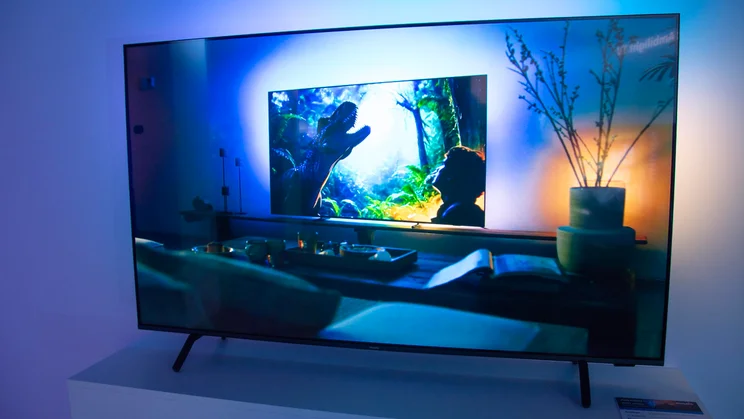
All three are 4K QLED options with Ambilights, AmbiScape and Dolby Atmos support. The 8701 and 8601 are both powered by Philips’ P5 picture engine (the generation of the chip was unclear), while the 8501 uses the manufacturer’s less advanced PixelPrecise Ultra HD chip. The models are also differentiated by their stands; the 8701 sits on a central plinth, while the other two use left and right feet.