To help us provide you with free impartial advice, we may earn a commission if you buy through links on our site. Learn more
- Quiet, efficient and thorough
- Faultless navigation
- Excellent app
- E25 offers similar core performance
- Bagged dust collection
- No spares in the box
The Eufy Omni 25 was a popular robot vacuum here at Expert Reviews. A smart piece of design, it looked at home in just about any domestic environment, cleaned proficiently, and came with a feature-laden but not overcomplicated management app.
At the launch price of £849, it was perhaps a little pricey, but it soon became available at much less, making it an easier choice in what is rapidly becoming a very competitive market.
While the Eufy Omni E35 could easily be regarded as an upgrade on the E25, at launch it’s more expensive with a base RRP of £999. As with the E25 I would expect that price to drop over the coming months, and indeed a voucher offer has appeared on Eufy’s UK web store as I write this review reducing the price to £849.
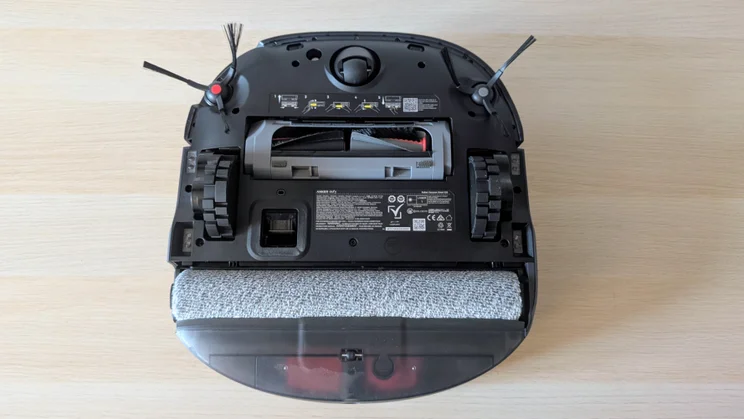
Thorough aesthetic do-over to one side, the key improvements over the E25 are better suction, now rated at 35kPA rather than 20kPa, a longer mopping roller that can now extend to one side by up to 32mm, improved AI-enhanced navigation and higher-temperature (60°C) mop washing.
Before we get to the nitty-gritty it’s worth mentioning that Eufy’s parent Anker is currently rebranding all of its sub-brands. Soon anything carrying the Eufy, Soundcore or Solix name will become Anker, so don’t be surprised if the Eufy Omni E35 overnight starts appearing as the Anker Omni E35.

What do you get for the money?
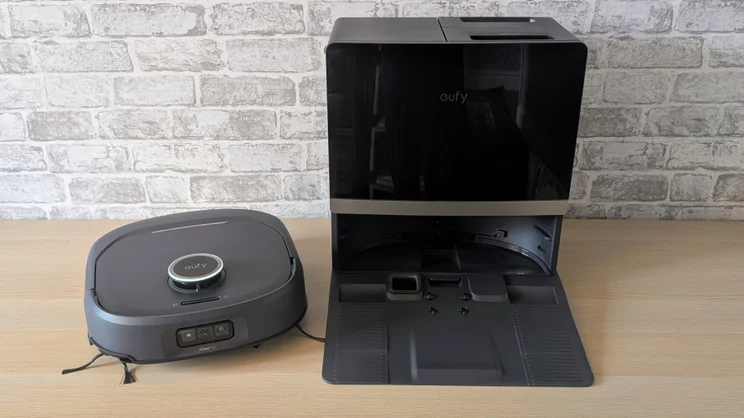
While there’s clearly a family resemblance between the E35 and the E25, Eufy has made some significant cosmetic changes to both the dock and the robot.
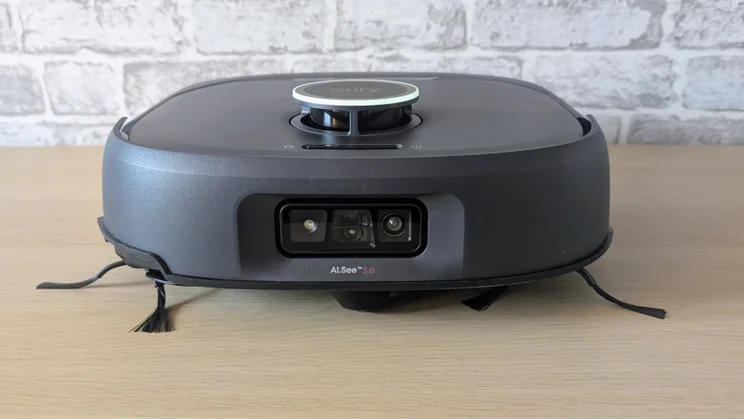
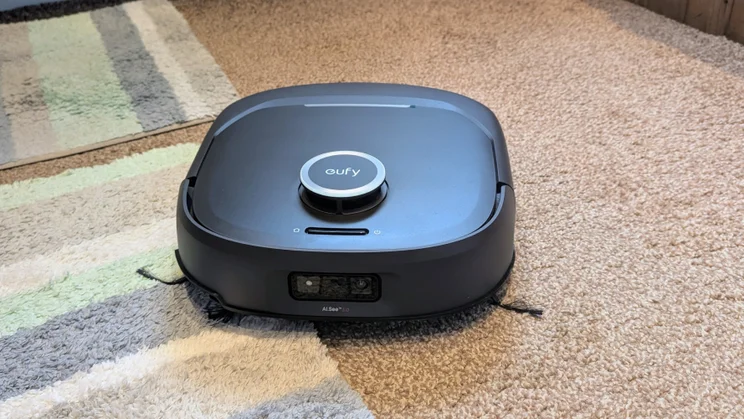
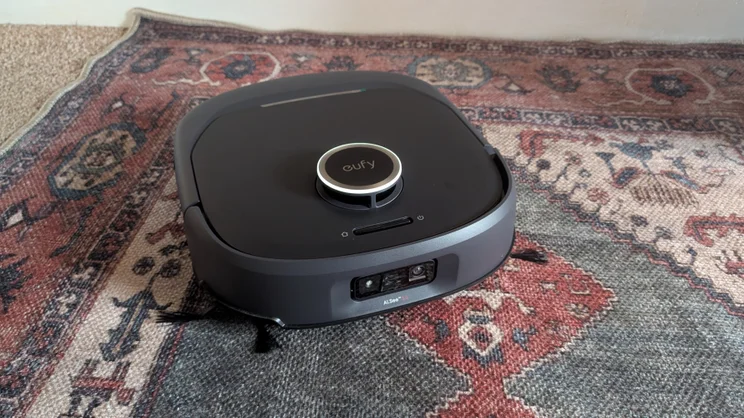
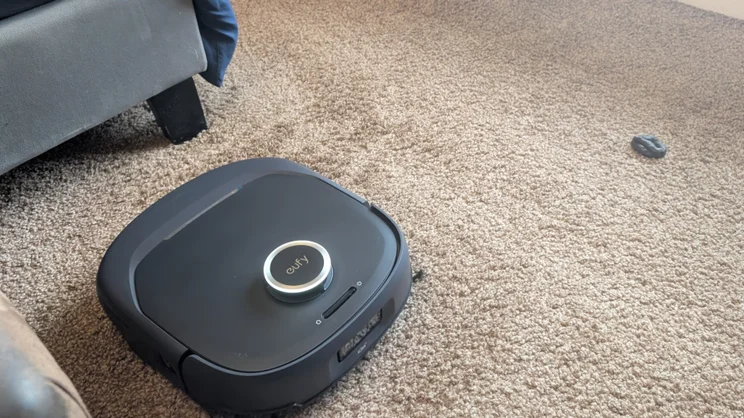
Starting with the robot, the upper surface and front panel now have a matte rather than gloss finish, which does a much better job of hiding any dust that may settle on it.
The tower that houses the LiDAR detector is still there, and it’s still fixed rather than retractable as on the new Roborock Saros 20 Neo, but it’s a few millimeters lower than on the E25 and now has a white LED around the circumference, which makes it easier to spot the robot if it’s running in a dark room.
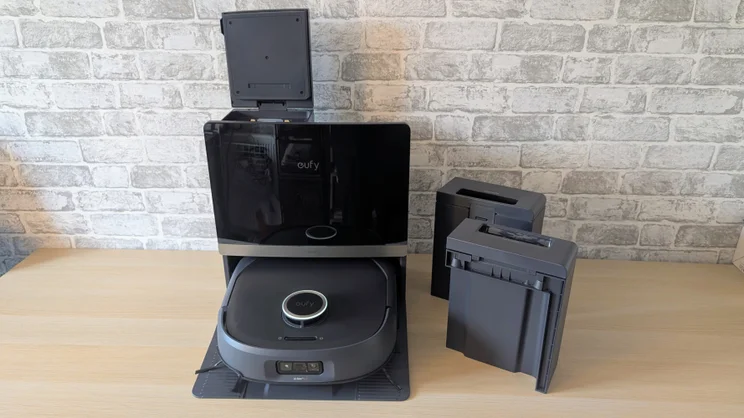
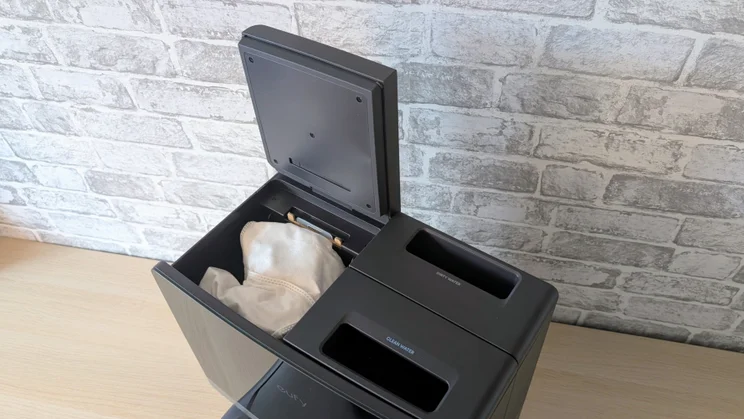
The charging dock that houses the water tanks and dust collection bag has been given a more comprehensive redesign. As well as being a little smaller, the rounded multi-part upper section has been replaced by a unified flat surface. The new look is less fussy and, to my eyes, smarter.
Eufy still favours bagged dust collection, which obviously has a cost impact on operation. How long a bag will last will depend on how often you use your E35, and how messy your home is.
Each bag has a volume of three litres, which I reckon should be good for a couple of months, but my house is quite small, and my dog is a short-haired Greyhound, so your mileage may vary. A three-pack of bags costs £16 from Eufy, which doesn’t seem exorbitant.
The only other accessory that Eufy currently offers for the E35 is a bottle of floor cleaning fluid, one of which comes in the box. A replacement 473ml bottle costs £20, but since you add this manually to the clean water container, any generic robot-friendly cleaner should work just as well.
There are no other spares in the box, but presumably Eufy will soon offer a mixed box of such accessories for the E35 as it currently does for the E25. This includes sweeping brushes, mop and hair rollers, bags, filters and other bits and bobs, and costs £60.
What’s it like to use?
Initial setup
Once you’ve unboxed the E35, removed the transit bumpers from the robot, assembled the dock and plugged it in, setup is a piece of cake. It’s been a long, long time since I’ve had any major issues setting up a robot vacuum, but I’d still say Eufy’s setup is one of the fastest and most reliable, and it’s generally idiot-proof.
Given I had already had the Eufy combo camera/vacuum app on my phone, linking the E35 was the work of seconds. Just tap the + icon, find your vacuum on the list and click Connect. The app asked if I wanted to use the same saved 2.4GHz network as my other Eufy gadgets used, and once confirmed it was good to go.
The initial navigation run then started with the E35 nosing its way around and rendering what it found in real-time in the app. Initially, the system regarded my bed as a separate room, but manually merging that with my actual bedroom was the work of seconds.
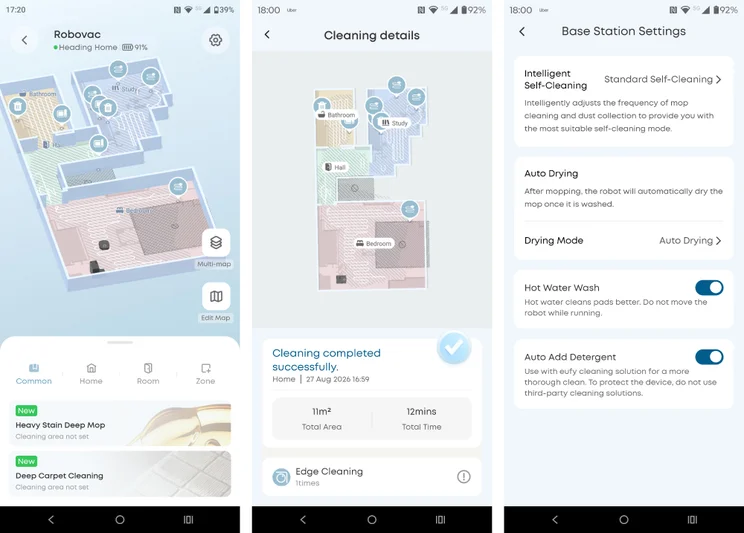
Unlike the Shark vacuum app, the Eufy app can store multiple maps, so you can move the robot (or dock) between floors without having to remap each new environment.
Companion app
When it comes to striking the right balance between easily accessing all the system features, ease of use, and appealing design, Eufy’s smart home app, which also supports Eufy’s security cameras and smart lights, is one of the best.
I particularly like the way the maps are represented. You can choose between 2D and 3D views, and both are simple, clear and easy to understand and exactly mirror the actual floor layout. It’s also easy to add small no-go zones if you want to mark specific points as out of bounds and merge or separate rooms to reflect your preferred cleaning layout.
The app lets you do all the things you’d expect of a modern robot vacuum, including setting up and storing as many as five separate floor maps, adjusting the intensity of the clean (or leaving it up to the system’s AI judgment), setting cleaning schedules and changing the order in which it cleans rooms.
Eufy lets you integrate the E35 with both Google Home and Alexa and it supports voice control via those services rather than directly. I found that the E35 responded reliably to basic voice commands like “vacuum the office” once I’d connected it to my Google account.
There’s also support for Matter 1.4 which means the E35 should play nicely with Apple’s HomeKit platform.
Is it good at finding its way around?
I’d have been surprised to discover that the E35 wasn’t every bit as good at finding its way around as the excellent Eufy Omni S2, and I wasn’t. The E35’s navigational capabilities really are excellent.
All the usual problem areas in my house – a bed that’s almost the same height as the average robot vacuum, a gap between a bedside cabinet and wall that’s almost the same width as the average robot vacuum – were all either avoided or navigated without issue.
All the usual detritus I scatter to trip robot vacuums up: a sock, a faux rubber dog poo, a coiled Ethernet cable, were dodged with aplomb. And when faced with the top of a staircase, the E35 wisely backed away without doing a three-point turn and risking falling into the void. Eufy boasts its new “AI See 3.0” laser-detection system works equally well in darkness as in good light and I’d wholeheartedly agree.
The dog poo dodge prevented a horrifying real-world catastrophe in my own home when my greyhound decided to leave me a present on the lounge carpet just before the E35 was scheduled to make a run. Had the E35 not spotted the mess and avoided it, I dread to think about the consequences.
Rugs and uneven room thresholds posed no issues, either. The E35 can officially surmount obstacles up to 30mm, 10mm higher than the E25. The E35 managed to vacuum my bathroom mats without rucking them up and also coped with a new washable rug that, post-washing, now refuses to lie flat.
The E35 gets good marks for speed and efficiency too. Obviously, both are directly related to how intense a clean you ask the robot to perform, but a light vacuum of my upstairs only took 12 minutes and used up 20% battery capacity. And it it runs out of battery the robot will return to the dock for a top up and resume cleaning.
One trick the E35 can’t do, but likes of the Saros 20 Neo and Dreame Aqua10 Ultra can is give you a live view through its forward facing camera. This is not a vital feature but it can be a handy one if you want a see what the robot is doing without going to look for it.
How well does it clean?
We can argue until the cows come home about which mop system is better: An agitating pad as used by the likes of Shark, spinning mops as favoured by Roborock Saros or rollers as used on the Eufy E35.
Each has advantages, but one thing roller mops can do that the other two can’t is physically scrape gunk off the mop during the mopping process. To this end, the E35 has two plastic scrapers that push against the mop roller when it’s cleaning.
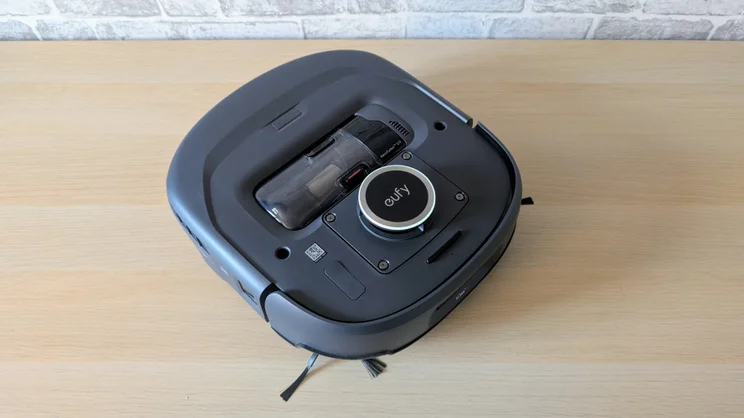
Obviously, this means it has a distinct edge when faced with major spillage. To try this I dumped a big splurge of ketchup on the floor. The E35 did a good job of cleaning it up, and when I flipped the robot over the roller was entirely sauce-free.
Apparently, independent testing has found that the E35 can clean 99.99% of the bacteria and other muck that the roller picks up in operation, too. And mop roller pressure is rated at 1.6kg rather than the 1.5kg of the E25 and S2.
One trick the roller mops can’t pull off is to drop the mop assembly into the dock when not needed. The alternative is to raise the roller into the body of the robot, which is what happens here, lifting it by 11mm to clear carpet when required. This proved more than adequate for all the rugs and carpets I have, but you may want to consider a robot with detachable mops if you have very deep carpets.
The off-side sweeper brush can extend by up to 40mm, while the mop roller moves out by up to 32mm, so both carpets and hard floors are consistently cleaned right up to the skirting board.
Two new features, presumably exclusive to the E35 for the time being, as they don’t show up as options in the app for the Omni S2, let you select areas on a map for extra-thorough scrubbing or vacuuming.
In the case of the former, the E35 will deliberately over-soak an area and mop it it twice, while the latter will vacuum an area twice at a temporarily higher level of suction. This has obvious value if you regularly need to deep clean an area used for food prep or where pets eat.
I’m in two minds as to whether this system of predetermining areas that require a deeper clean is better or worse than an intelligent system that can spot stains and clean until they are gone, as per the Dyson Spot+Scrub. Obviously this system requires no action by the user, but it is dependent on the robot’s smarts and may not be 100% reliable.
My lab test results for the E35 were broadly similar to those I got from the cheaper and less powerful E25 and the more expensive, more powerful S2. For instance, all three machines did a perfect job picking up rice from a carpet, while the E35 sucked up 45 out of 50g of flour from a carpet compared to the E25’s 32g and the Eufy Omni S2’s 48g.
A feature of the E35 it shares with the E25, Omni S2 and budget C28 is that it’s impressively quiet while running. I’m not for a moment suggesting that the E35 can vacuum a room you are sitting in without you noticing, but if you are in an adjacent room or on another floor, it is genuinely hard to hear.
On a couple of occasions, when I left the E35 to clean the upstairs while I was listening to music in the study, I had to go to the foot of the stairs to make sure it was still running when the music stopped.
Eufy Omni E35: Should you buy one?
The E35 is a highly accomplished package. Operationally, it’s impossible to fault, and its cleaning performance and navigational abilities are both as good as one could wish for. It’s also rather handsome and impressively quiet.
Of course, I could say much the same for the Eufy E25, and that costs rather less. At the time of writing, Eufy was selling the E25 for £609, based on an £849 RRP, and the E35 was £849, this time based on an RRP of £999 with an “introductory offer” voucher applied.
If the extra £240 is neither here nor there to you, the E35 can be easily recommended as the best of the two, not least thanks to the extending roller, but the E25 is much the better value.