To help us provide you with free impartial advice, we may earn a commission if you buy through links on our site. Learn more
- Long run time
- Cleaner than traditional mopping
- Effective cleaning and floors that dry quickly
- No vacuuming function
I have to say that, when I first opened up the Philips OneUp 5000 Series Electric Mop, my expectations were not particularly high. I’ve always been quite happy with my trusty mop and bucket combination, so I did think that the Philips electric mop might be more of an indulgence than a convenient and practical product. I’m happy to admit I was wrong on that front and it turns out that the Philips mop has become a fantastic addition to my cleaning arsenal.
I think it’s one of the best hard floor cleaners I’ve tested, its slight limitation being that it’s just a mop – it can’t vacuum at all. However, at this price, I think that’s a fair sacrifice.
Philips OneUp 5000 Series Electric Mop: What do you get for the money?
There’s no getting past the fact that £150 is a fair chunk of change to pay for a mop, especially in comparison to the aforementioned humble mop and bucket. However, it’s a steal compared to the more expensive vacuum mops, with options such as the Dyson WashG1 coming in at £300. There’s also a cheaper Philips mop – the OneUp 3000 – at £100, although this has shorter battery life and fewer settings.
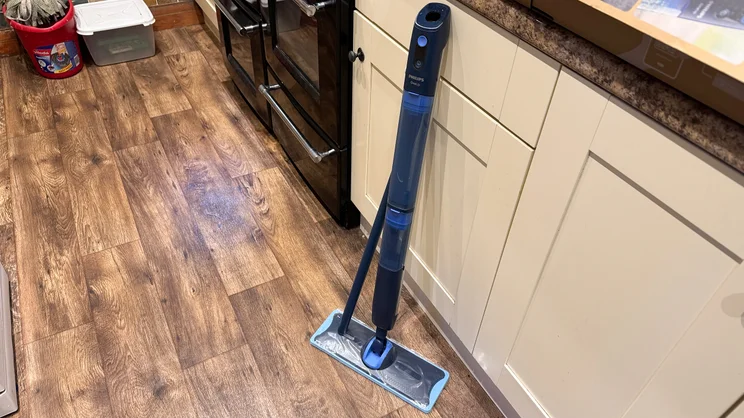
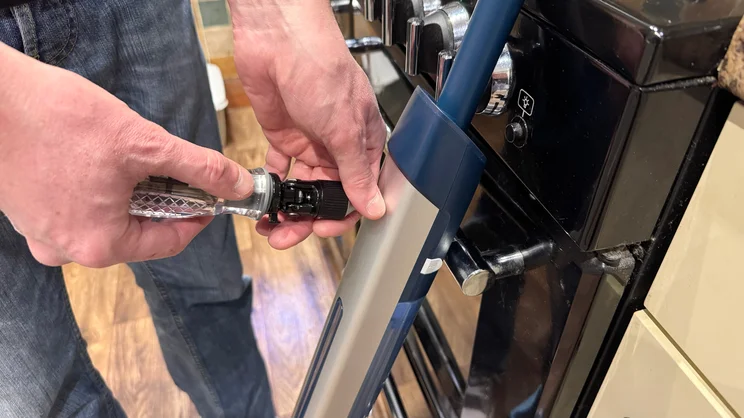
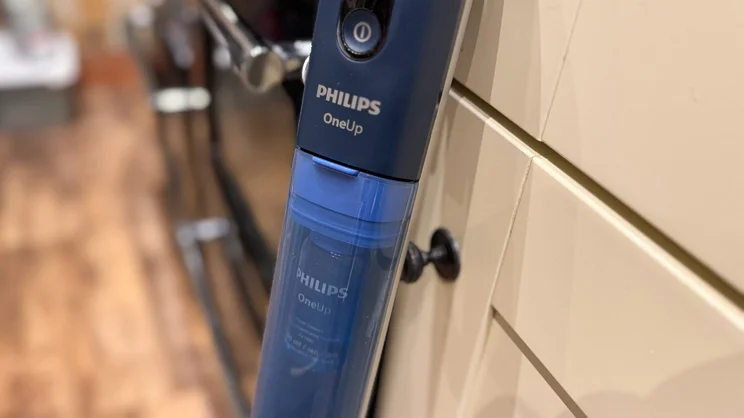
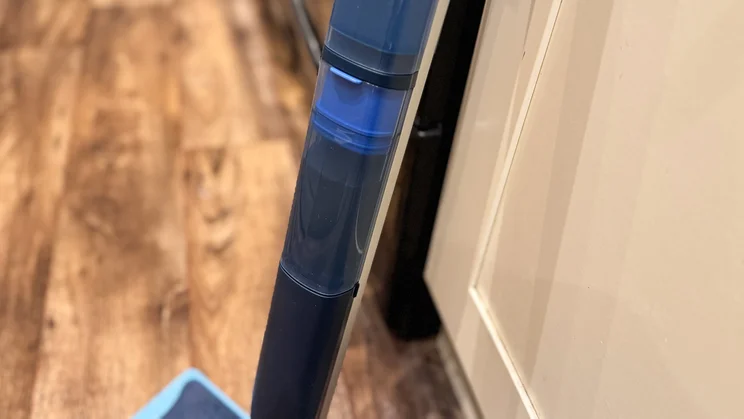
Upon unboxing the Philips OneUp mop, my first impression was that it’s a very neat product. Designed in a pretty shade of blue, the mop is sleek and elegant, without a lot of fiddly components to deal with. It has two water tanks, built into the main body of the mop (one for clean water, one for dirty), and an extension handle needs to be attached using a screwdriver. A large pad clips onto the bottom of the mop, with the multi-angle head flipping up for storage.
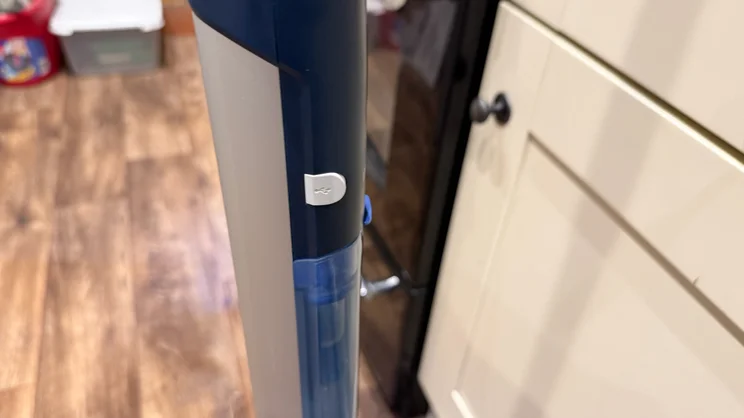
Unusually, the OneUp Mop charges via USB and cable is included in the box, but you’ll have to provide your own mains adapter plug. Philips also supplies a small cartridge of cleaning solution. Each cartridge of cleaning solution has 40 doses and two 40ml replacements cost £17.
That’s not the only consumable you’ll need to worry about, either. According to Philips, the mop pad will last for six months and is machine washable. Replacement pads cost £20 for one and £35 for two from Philips.
I like that the pads are reusable, unlike the Shark VacMop’s rather wasteful single-use pads. However, for £150, it would be nice if Philips provided two pads with the mop rather than one – allowing you to have one on the mop while the other is in the wash.
What’s it like to use?
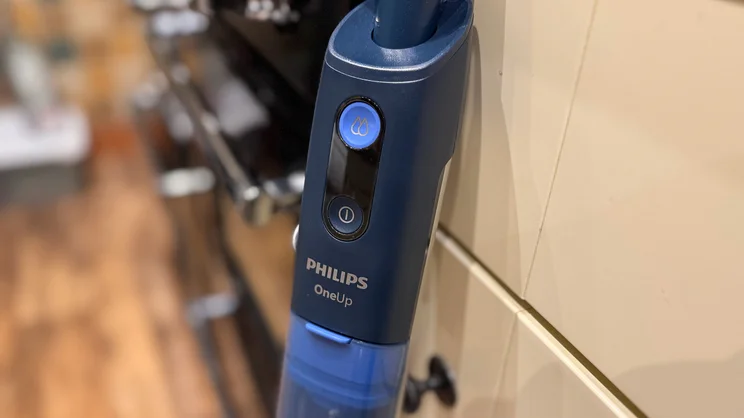
Operating the Philips electric mop couldn’t be simpler. There’s one button to turn the mop on and off, another button to control the “wetness” settings (two levels of cleaning power: the lower setting is more than powerful enough for everyday cleaning, while the higher is better for removing more stubborn stains), plus an LED that shows you how much charge you have.
Another excellent design feature of the Philips mop is the 360-degree angled head, which means that it’s easy to get under tables, chairs and even sofas without having to move furniture about.
The mop feels very well-made and it’s nicely balanced in the hand, requiring surprisingly little effort to push it over floors and gliding smoothly from corner to corner. What really surprised me was how quiet the mop is: the whirring noise it makes during operation is so subtle that I had to check it was switched on properly.
Before you start, you’ll need to take out the clean water tank to add the cleaning solution cartridge. A slight bugbear here: I found that both the clean and dirty water tanks are a little fiddly to get in and out and my husband, with his lack of sharp nails, found this quite awkward when he tried. They feel quite stiff, but they have loosened up during the time I’ve been testing the mop. The clean water tank has a capacity of 281ml and the dirty tank 178ml. The OneUp dispenses a small amount of clean water, mixed with cleaning solution, while dirty water is sucked up into the appropriate tank.
With that done, though, the cleaning solution cartridge is easily secured to the top of the tank with a simple twist and click. You then fill the clean water tank with water before dispensing a dose of the solution. You need to be a bit careful here as the instructions aren’t massively clear; it’s easy to get carried away and press the button on the top of the tank/solution bottle multiple times – this will be throwing good money after bad, though, as you only need to do it once.
In addition, Philips advises dampening the mop pad under the tap before use. I’d urge caution here, too: don’t get the mop pad too wet; you just need to show it to the tap briefly. And you need to do this before clipping the pad onto the mop, otherwise you risk water leaking out of the tank as you’re manoeuvring the whole thing under the tap, as my husband found out the hard way.
Finally, it’s worth noting that you’ll need to vacuum your floor first. As I generally do this before mopping anyway, I didn’t find this requirement a particularly bothersome chore. But if you’re after a more convenient cleaning solution with fewer steps involved, you might want to look for a combined vacuum mop.
How well does it clean?
I started my testing with the lower wetness setting and found that this was more than adequate for everyday cleaning. The higher wetness setting is great if you have any ground-in or stubborn set stains.
The clever design of the Philips mop means that while it’s dispensing clean water and cleaning solution onto the floor via the mop pad, the electric mechanism is sucking dirty water up into a separate container – meaning the two never mix and only clean water touches your floor. This is much more effective than a traditional mop, where you have no choice but to put the dirty mop head back into the clean water bucket.
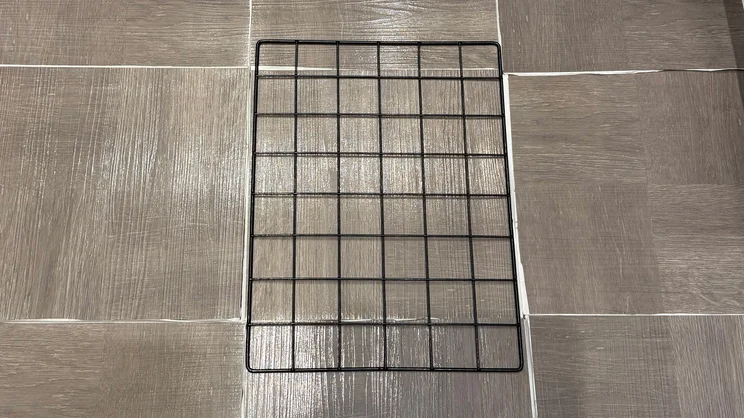
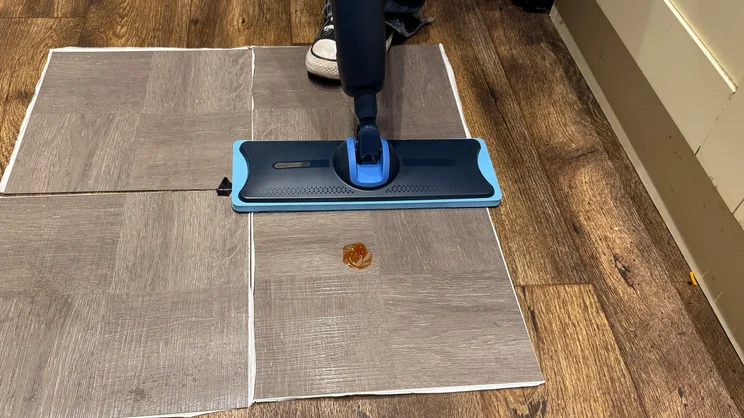
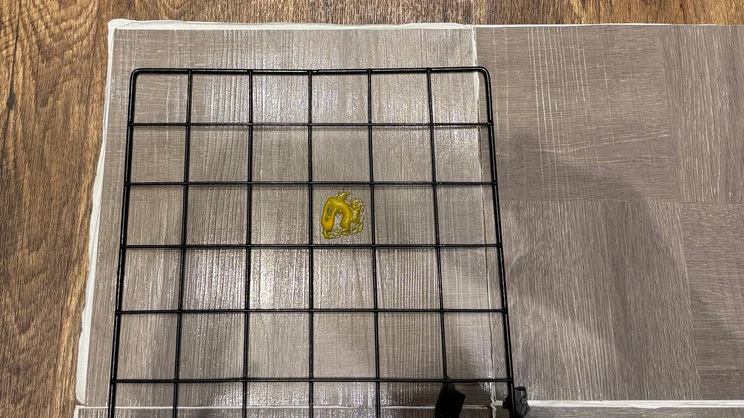
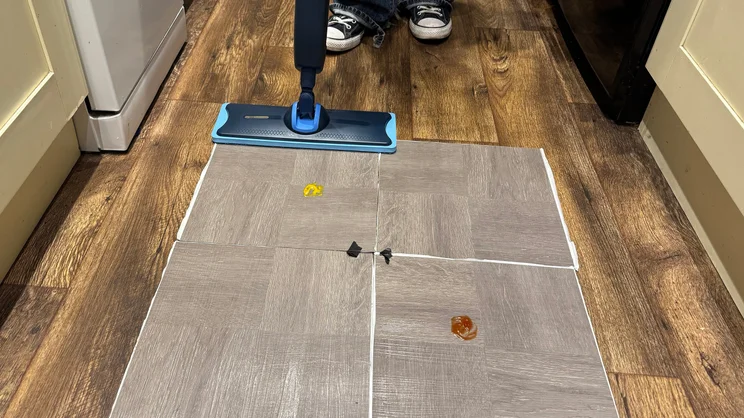
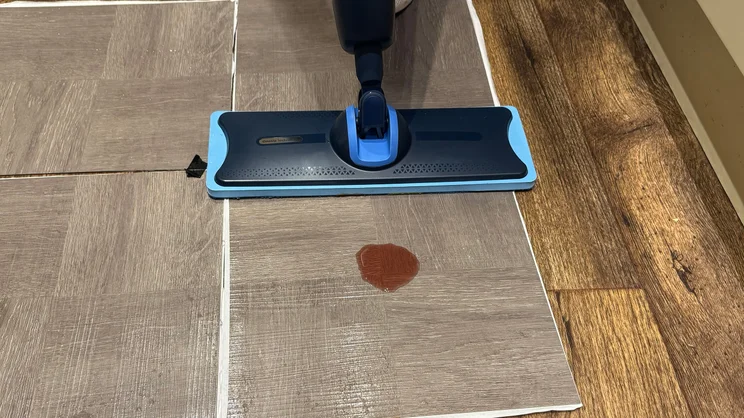
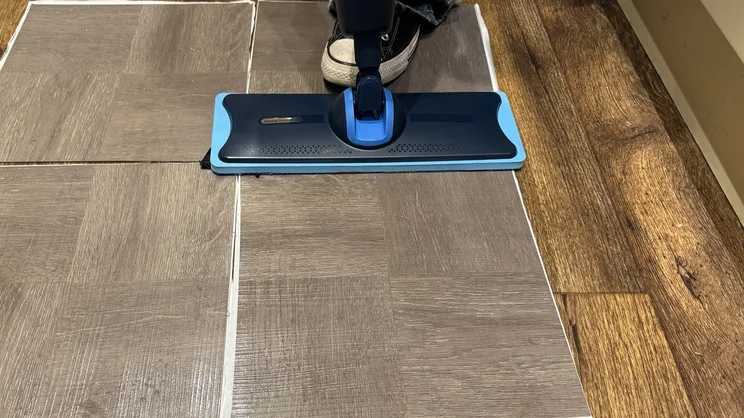
When I first started using the Philips, I didn’t feel that it had much cleaning power. But the results very quickly proved me wrong. I tested the mop with a variety of dried-on stains – mustard, ketchup and a sticky blackcurrant squash solution – on a sample of vinyl flooring. The mop removed every trace of all the stains with one pass forwards and backwards.
In real world cleaning, I could plainly see how much cleaner my floors looked. I had thought my floors were already fairly clean, so it was a little distressing to see the colour of the dirty water tank when I emptied it out.
Mopping was also far quicker compared to traditional mopping and, best of all, the floors were fully dry in less than ten minutes after mopping. I was also impressed by the area that the mop could cover on such a small amount of water – meaning that 281ml tank goes a long way. Philips says that one container of water will cover up to 50m2 of floor and, based on my testing, I’d find this entirely accurate. The same goes for the battery, which delivers a confirmed 70 minutes per charge – enough time to clean even the largest of kitchen floors.
Should you buy the Philips OneUp 5000 Electric Mop?
Yes, the Philips will cost you more than a traditional mop and bucket, but I think it’s worth every penny. It’s incredibly easy to use, cleans quickly and you don’t need to wait long for dry floors. It gives fantastic results using very little water.
Of course, you do have to vacuum beforehand, and you’re tied in to Philip’s own replacement pads and cleaning solution, but you’ll save a bunch of time and end up with far cleaner floors. With great battery life and USB charging to add to its list of strengths it’s an easy product to recommend.