To help us provide you with free impartial advice, we may earn a commission if you buy through links on our site. Learn more
- Excellent AI avoidance
- Fast room mapping
- Good mopping performance
- Steep RRP means you’ll need to seek out deals
- Not the best for cleaning corners
- No mopping-only option
Robotic vacuums exist to make your life easier. But truth be told, that’s sometimes overshadowed by the need to frequently empty the dust collector or base unit, and refill or empty fresh or waste water.
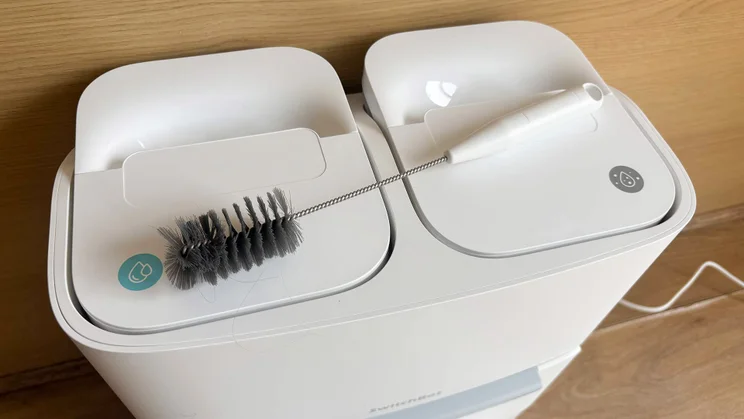
There are no such dramas with the SwitchBot S20: it has a dust bag which its makers say only need to be emptied once every three months, and the fresh and waste water tanks hold 2.5l apiece.
What might not make your life quite so easy is the price: the official RRP is a hefty £799, but SwitchBot frequently runs enticing deals. Indeed at the time of writing, it is offered at half price. And that price, as we shall see, overcomes some of its slight deficiencies.
But is that enough to ensure the SwitchBot S20’s place on your list of the best robot vacuum cleaners? Read on to find out.
SwitchBot S20 robot vacuum: What do you get for the money?
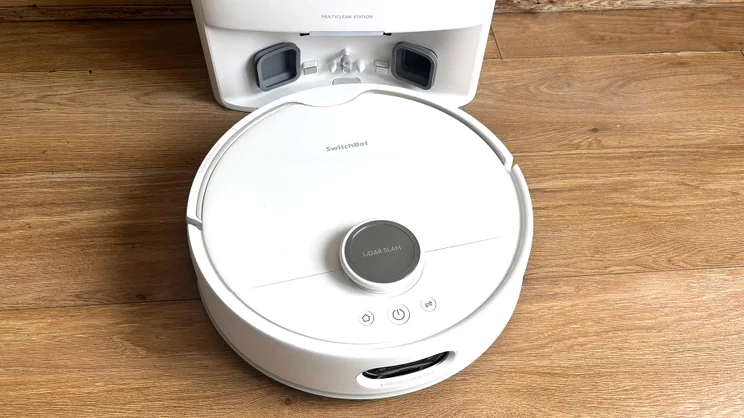
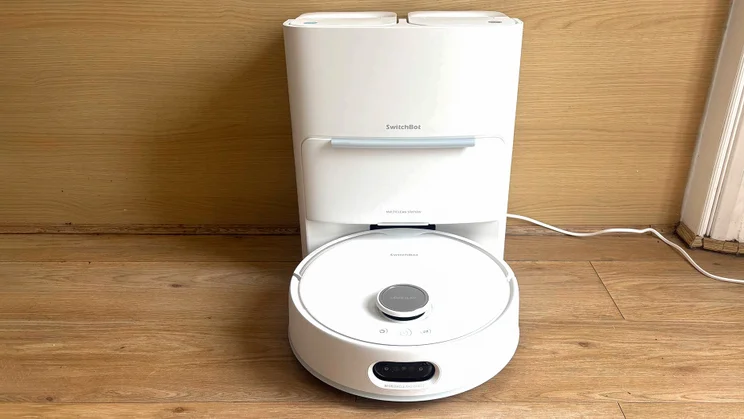
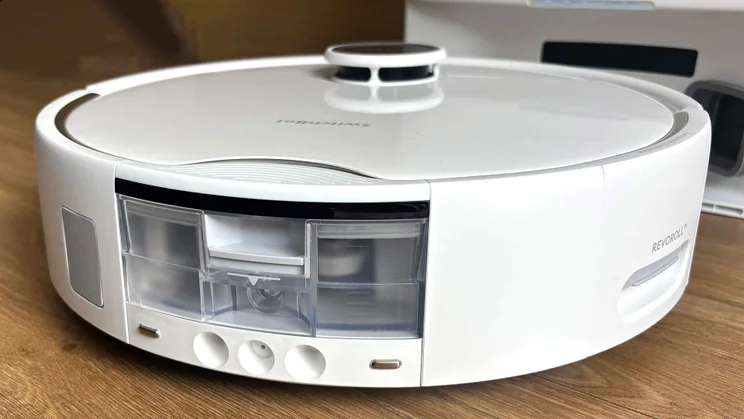
Firstly, the SwitchBot S20 isn’t a robovac that’ll hide in plain sight. The vacuum measures 365mm in diameter, and the base unit is 38cm wide and 46cm tall. Both are finished in shiny white plastic, so would feel more at home in a utility room than a lounge. This design choice is perhaps unsurprising, because the S20 is also available with a feature that connects the fresh water and waste feed directly to your home’s plumbing. That particular option isn’t available yet, but could boost its usability further.
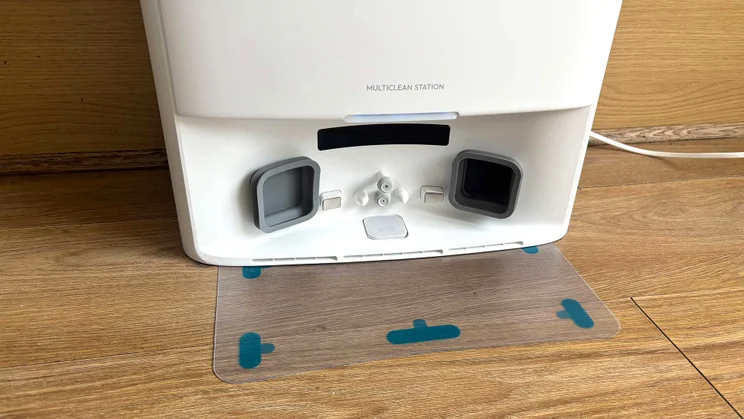
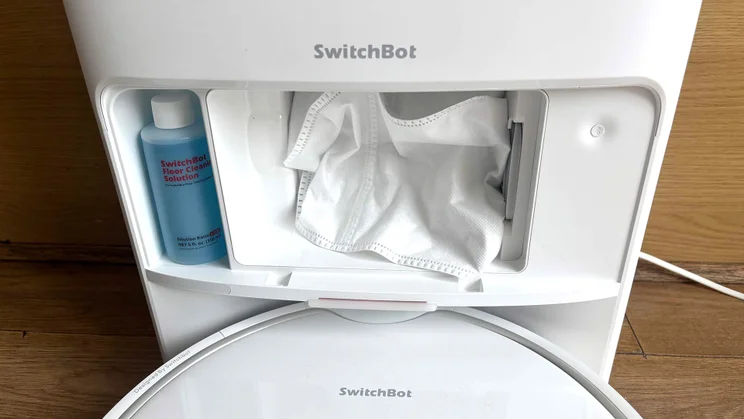
The fresh and waste water containers hold 2.5l each, and there’s space beside the dust bag to hold the small bottle of supplied detergent. There’s also a plastic mat that sticks to the floor using double-sided tape for the damp roller to rest on (to avoid marking carpets), and a mysterious square of chalk-like material which is there to absorb any drips from the vac’s empty and refill nozzles.
It has a four-stage mopping process: wetting the mop, scrub and rinse, followed by a squeeze and drain. That’s far more advanced than the rotating pads of the Ezviz RS2, for example. During mopping, the roller rotates at 300rpm and applies 1kg of downward pressure, and after mopping, the unit automatically warms the roller to 50°C to dry it for anywhere from one to eight hours. I like that you’re able to dampen the mop before starting a task and can specify how often the mop will self-clean: both of these functions are controlled via the app.
In use, the S20 can distinguish between carpet and hard floor, and zones can be selected via the app. It will lift the mopping roller to avoid touching the carpet.
Its vacuum performance is rated at 10,000Pa, and the roller uses patented rubber brushes that are designed to prevent tangling. As with other SwitchBot robovacs, there’s a single side brush with two arms, which does a good job of sweeping hair to the side rather than becoming tangled with it.
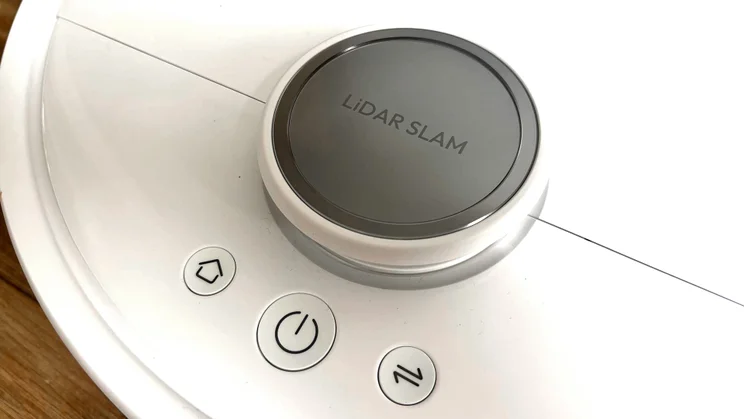
It uses LiDAR to map the rooms to be cleaned, and its AI cameras are used to identify and avoid obstacles. I particularly like the pair of bright LEDs that assist the cameras in low light conditions, making the S20 reminiscent of a character from Batteries Not Included. There’s also a cliff sensor to avoid any unfortunate tumbles down the stairs.
It’ll display images of identified objects in the smartphone app, which is where you can also track its movements and select more advanced features. These include the establishment of no-go zones, forcing the dust collector to be emptied into the base unit and selecting from four levels of suction power. You can also set whether you want it to vac and mop, vac then mop or just vac. Oddly, there’s no option to simply mop.
What’s it like to use?
It’s extremely easy to use, and the quick start guide is very clear, although there’s a more in-depth instruction manual, too. The side brush clicks into place, and you position the base unit where you want it, plug it in, dock the vac and connect to it via the SwitchBot app. The dust bag, which has a clever self-sealing opening, slides into a slot in the base unit, and you fill the fresh water tank, adding a small amount of the supplied detergent. The whole process from unboxing to the first vac took me less than 15 minutes.
The S20’s first task is to map your room or rooms. It’ll determine the positions of your furniture (although it’s a shame it was too tall to clean under my sofa) and you can view your rooms and maps via the smartphone app.
Once it’s determined the lie of the land, it’s time to start cleaning. You can select from four levels of suction – quiet, standard, strong and max – and the number of times it will complete a clean (I tend to leave it in max and have it cover each room twice). It’s here you can select whether you want to vac, mop or both; I found it most effective to vac then mop.
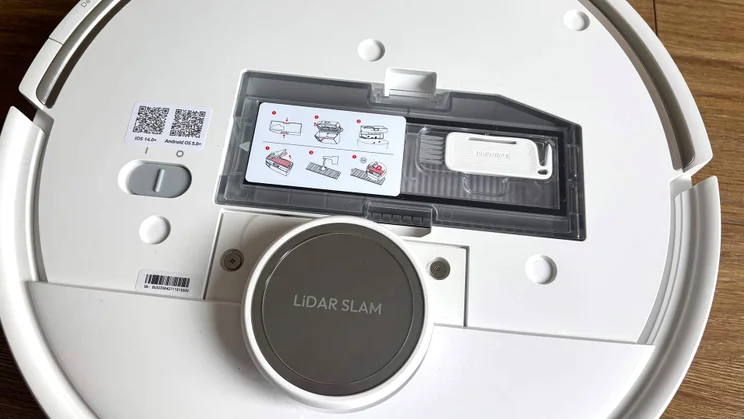
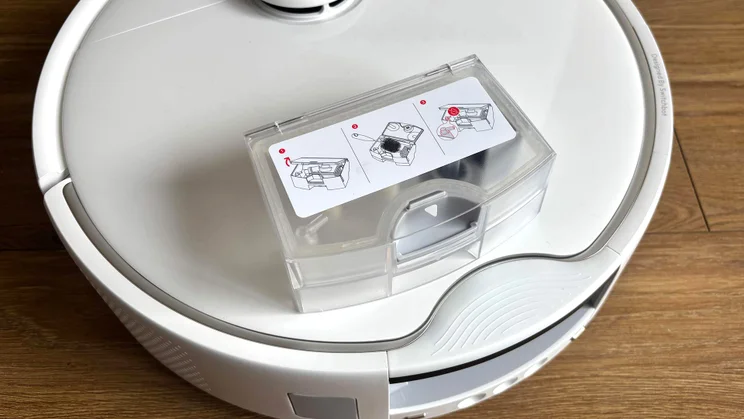
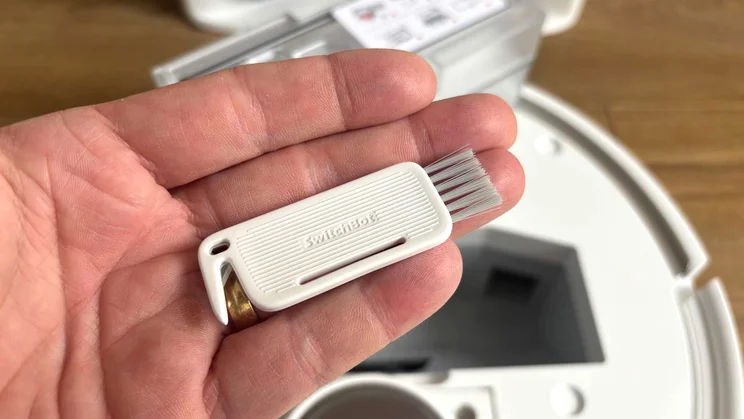
I like that it can distinguish between carpet and hard floors with no intervention, so it doesn’t trail a wet mop over your shag. The main roller is worthy of note, too, because it resists tangling well. And even when it does collect a bunch of strands, the ends pull off, allowing you to slide the hair away, which renders the supplied detangling tool (which is stored in the dust box lid) redundant.
In use, I tended to command it either using the app or by pressing the largest of three buttons on top of the vac with my toe. The latter starts and stops the selected operation, but I found that it’s prone to the odd false start with ‘mapping failed’ or ‘cleaning paused’ messages sounding. The other buttons will send the S20 back to its base unit or switch between cleaning modes.
At 65dBa at a distance of one metre, it’s quite noisy, though, and the (effective) mopping method it employs makes more of a din than other robot mops.
Is it good at finding its way around?
In my experience, some robotic vacuums can confuse themselves, rotating back and forth like John Travolta searching for Uma Thurman’s intercom in Pulp Fiction, before they pick up the scent and begin vacuuming. Not so the SwitchBot S20: it’ll take a quick glance around, find the edge of a room and begin scouting the perimeter in a clockwise direction.
Once the outermost edges have been established, it will criss-cross the room once or twice, depending on what you’ve selected in the app.
The LiDAR and AI cameras are key to its ability to accurately cover ground. I like that it’s able to identify a number of different objects, which are displayed in the app, and I particularly like its ability to display an image to precisely determine what the object is. What’s particularly impressive is that it can determine the kind of object detected – cables, fabrics, faeces, toys and even bathroom scales – and display how accurate it thinks its decision is and the action that it will take as a result. You can instruct the S20 to ignore these, too, which is handy if you’re away from home at the time.
The bottom line here was that it faultlessly negotiated its way around the sock, cable and fake dog poo traps I left for it. And after several months’ real-world usage, I can count on the fingers of one hand the number of foreign objects that have jammed the roller. These have been mostly tiny Lego bricks.
Like most of its contemporaries, you can instruct it to avoid particular areas via the app, and it has a cliff-edge sensor to prevent it tumbling down stairs.
The unit is wide, so it won’t find its way into slender gaps, but it does mean that the rubber roller is larger than it is in the tiny SwitchBot K11+, so it’s quicker to achieve the same coverage.
How well does it clean?
The S20 cleans well, but there are a couple of caveats to address first. While it performs well in most conditions, it struggles a bit around corners. Also, I found that the SwitchBot S20 frequently made hard work of some of those mysterious bits of fabric (sock fluff, maybe) which have a knack of tangling themselves into a carpet’s weave. It may be better, then, as an accompaniment to an upright vacuum than as your only sucker-upperer.
But when it came to our empirical testing, the S20 shifted through the gears very well. I scattered 50g of flour followed by the same amount of rice on a carpet: it sucked up 29.4g of the former – slightly better than the class average – and a near-perfect 49.8g of the latter. It was a step behind when it comes to pet hair, where it gathered 3.8g of the 5g we dropped; a typical figure for robovacs.
It’s better on hard floors, though. While 39g of our 50g of flour is a little behind the class average, it collected all 50g of our rice and, remarkably, all 5g of our pet hair. Key to the success, in my view, is that the asymmetric two-armed design of the single side brush means that rice isn’t scattered, and it doesn’t tangle with hair.
One observation, though, is that the S20 seems to dwell a little too much around the edges – spending a little more time in the middle of the room, where the majority of debris is spilled, might yield even better results. That’s particularly true in smaller rooms, where it took a while for the S20 to get into its groove.
It performs better when it comes to mopping – with the caveat that the roller doesn’t give quite the width coverage as rivals with twin spinning mops. While the setup means it’s able to better clean the mop as it moves around, it also means that it can’t get quite as close to room edges.
Still, where it does clean, it does so very well. There’s an option on the app to wet the mop before starting, but even in regular use the S20 only has to travel about 30cm before the mop moisture can be seen.
The S20 breezed through our dried mud and orange squash tests, and all traces of both were obliterated in two passes. It found our dried-on ketchup a little harder, though. Most of it was shifted in the first pass, but required two more passes to remove the most stubborn traces.
A new feature is in beta which allows the S20 to start mopping away from the dock – but it does mean you’ll need to dock it, let it fill its water tank before carrying it to the area you want to clean. You’ll also have to do this each time, which is tiresome. But as it’s still in beta, it’s hard to criticise.
Should you buy the SwitchBot S20 robot vacuum?
The SwitchBot S20 is a hard robotic vacuum to ignore, particularly if you hunt down one of its maker’s deals. At that price, the vacuuming is good and the mopping even better, although it’s far more at home on hard floors than it is on carpet.
Despite the complexity and number of features, it’s very easy to use. I found its avoidance technology first-rate and it should continue to get even better as time goes on, such is the nature of AI.
In fact, the only real things that count against it are so-so cleaning in corners, and that it’s rather noisy, especially when mopping. That’s perhaps not an issue if you’re clearing downstairs while you’re asleep upstairs, but is worth pondering if you’re in a smaller flat,