To help us provide you with free impartial advice, we may earn a commission if you buy through links on our site. Learn more
- Ingenious detachable dual mops
- Stellar navigation
- Good battery life
- Can only use Tapo’s own detergent
The problem of what to do with the floor mop assembly when vacuuming deep carpet has vexed robot vacuum mop combo device makers for many a year. Some, like the Dreame Aqua10 Ultra, use a rotating shield that covers the retractable mop roller when not in use. Others, like the Eufy Omni E25, rely on simply retracting the mop roller into the vacuum’s body.
The simplest option, used on lower-priced machines like the Ultenic T20 Pro, is to simply have a detachable mop pad that can be manually removed. If you can’t be bothered to do that, it merely drags the dry mopping pad over the carpeted surfaces.
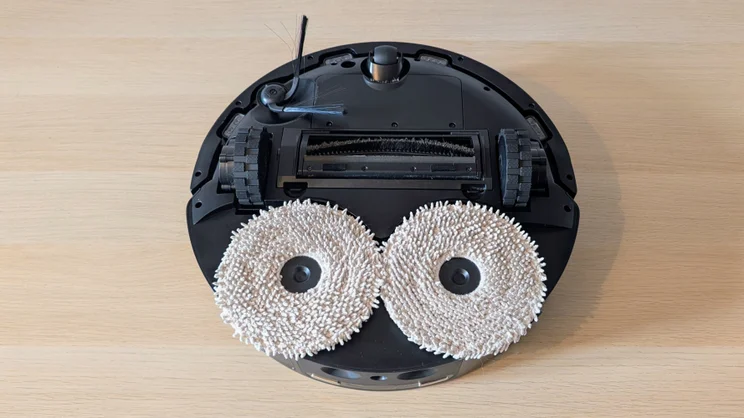
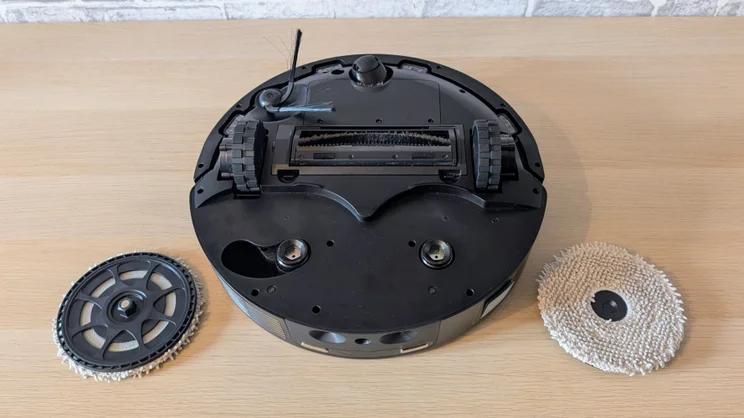
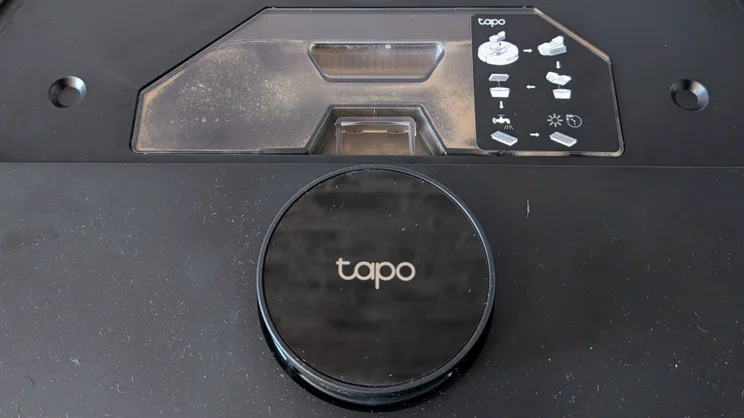
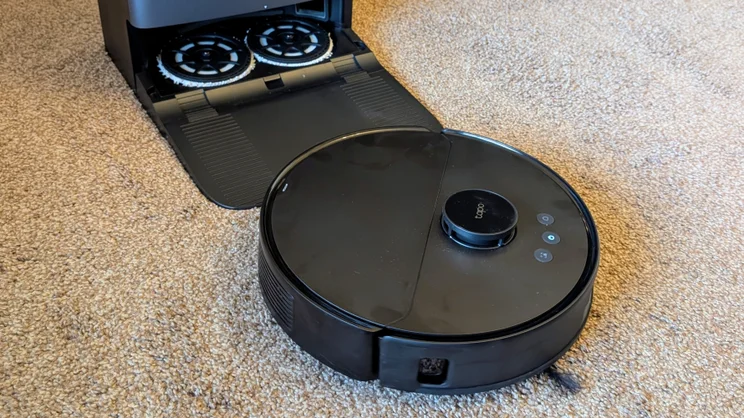
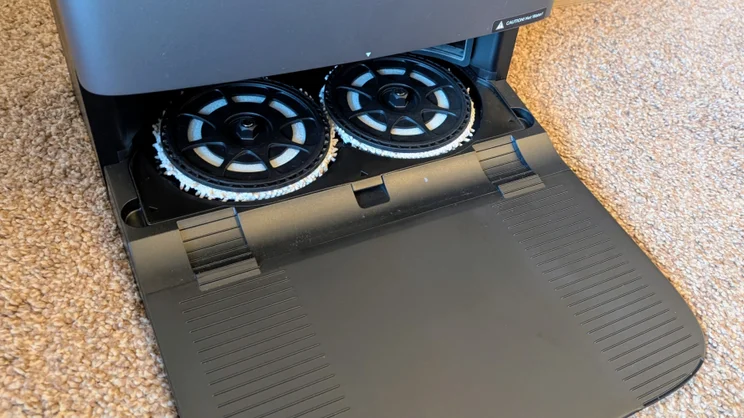
Tapo has come up with a different but ingenious system for the RV50 Pro Omni robot vacuum. The two spinning mop pads are attached via magnets, so when deep, soft carpet is encountered, they are simply dropped into the docking station.
What do you get for the money?
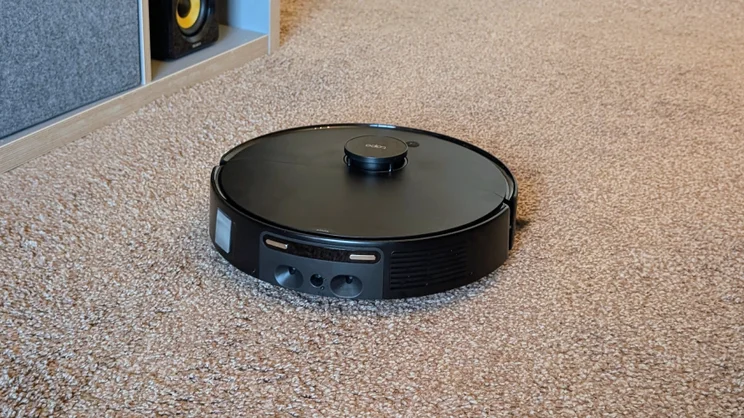
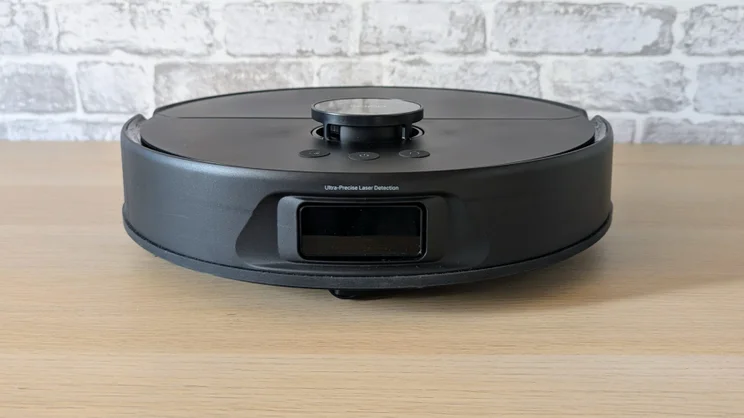
Like most mid-to-high-end robot vacuums with a mopping function, the RV50 consists of two parts. The robot is a stereotypical round affair with a 350mm diameter and it stands a little over 100mm tall, with a camera array at the front and a LiDAR detector in a fixed tower amidships.
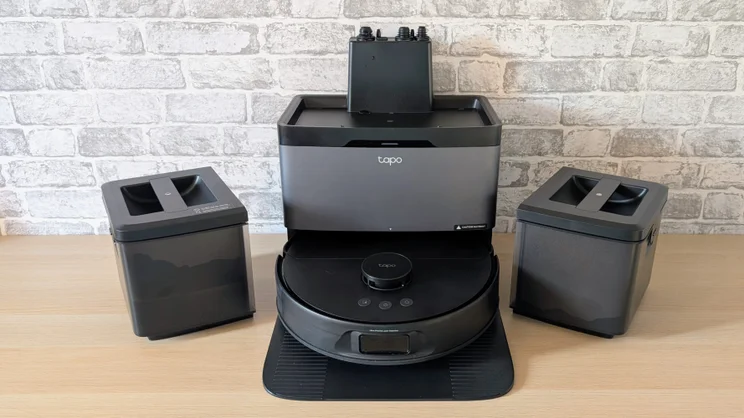
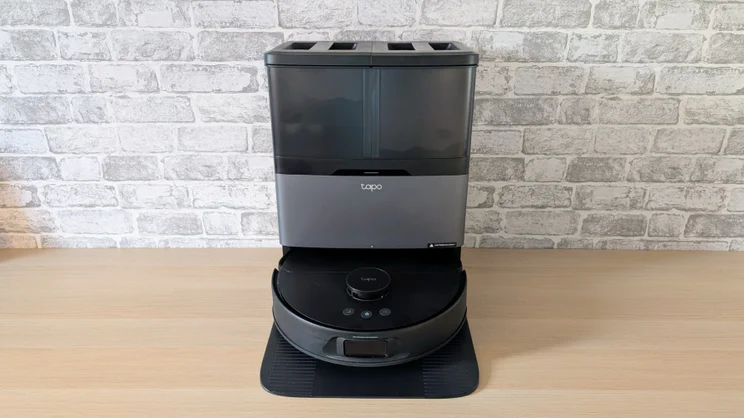
The dock not only handles charging and holds the mop pads when not in use, but also houses two large containers which hold the fresh and waste water for the mopping system, a large 3L dust bag that the robot can empty into and a slot for the cartridge of supplied cleaning detergent.
Naturally, all that takes up quite a bit of space, although at 480mm tall by 350mm wide and 475mm deep – including the detachable docking ramp – the RV50’s dock is much the same size and weight as those that ship with the Eufy E25 or Dreame Aqua10.
Of the three, I’d say the Tapo is the most stylish: a smart mix of matte black and silver plastics with semi-translucent water reservoirs that don’t show up dirt or dust. Gauging the contents of the water tanks is not quite the one-glance job it is with the Eufy E25, however, with its red and blue underwater LED indicators.
Another downside here is that the detergent bottle is specifically designed to slot into the dock and can’t be refilled, so you are stuck with using Tapo’s own. At the time of writing, the detergent is not available as a stand-alone item to order from Tapo’s UK website, but I’m told it will be on sale in the first quarter of 2026 for £30 per 500ml bottle.
Given the amount of detergent used to clean my small kitchen floor, each bottle should be good for several months, assuming you don’t live in a mansion and only set the robot to mop the floor once a week.
What’s it like to use?
Initial setup
As is usual with such devices, setup simply involves downloading the Tapo app, setting up an account and then linking the RV50 to that account.
As I already had the Tapo app installed on my phone, thanks to the Tapo C120 camera that I use to keep an eye on my frontage, I was up and running in a matter of moments. Again, typically for domestic robot vacuums, the RV50 only supports 2.4GHz Wi-Fi.
Initialisation was among the easiest of any robot vacuum I’ve tested of late. To begin with, it made the first sighting rounds of both floors of my house very quickly and only got hung up once, at the top of the stairs.
Like every other system I’ve tested it got too close to the edge of the stairs and got itself marooned. Manually repositioning the robot and then setting a no-go zone at the top of the stairs was a simple fix.
The machines from Dreame, Eufy and Ultentic all had problems with at least one part of my house, usually the narrow gap between a bedside table and wall, into which they would fit but couldn’t get out of. The Tapo simply reversed out of the gap when it encountered problems turning around.
Tapo boasts that the RV50 uses a dToF (Direct Time of Flight) system for greater accuracy in its long-range LiDAR measurements. Whatever the genuine technical enhancements of the system, the RV50 certainly created virtual rooms in the app more quickly and more accurately than any robot vacuum I’ve used.
Companion app
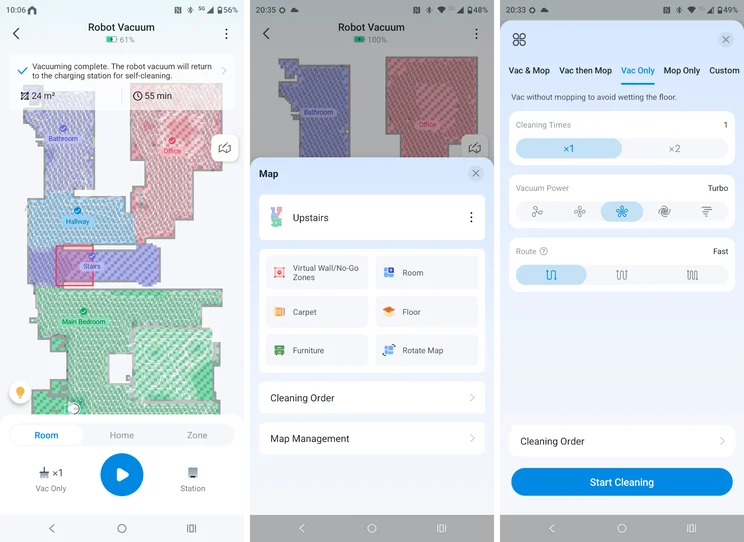
Tapo’s app lacks the vast, but sometimes bewildering, range of features that Dreame’s equivalent offers, but being simpler, it’s easier to master. Tapo has also shorn the app of unnecessary frills. For instance, there’s no option to view maps in 3D, a feature I’ve never once used in all vacuum apps where it is offered.
Moreover, all the basic features are covered, such as the ability to just clean certain rooms or zones, adjust the cleaning intensity, choose between vacuum, mop or both, set schedules and create no-go zones and indicate floor-covering types.
There’s also a handy “Point and Go” feature that lets you press-and-hold on a map to send the robot directly to that point and clean, plus a facility to manually remote control the robot.
Tapo doesn’t directly support voice control of the RV50, but you can link it to your Google Home or Alexa account. Once I’d linked my Tapo account to my Google account, simple commands like “vacuum the bedroom”, “mop the kitchen”, and “cancel clean and return to dock” were understood and acted on.
Tapo also supports the Matter universal, IP-based connectivity standard for smart home (IoT) devices, which makes it ideal for deep integration into a smart home setup.
Is it good at finding its way around?
Navigationally, the RV50 is impossible to fault. The routes it took always made sense, and it never seemed to waste time and battery power covering ground unnecessarily.
The obvious benefit of this comes in battery life. An intense vacuum of the 24m2 upper floor of my house took 55 minutes, which was slower than the Eufy E25, but this only reduced the 2,500mAh battery by 39%, making it one of the more efficient robot vacuums we’ve seen.
Just like the robot vacuums I’ve recently tested from Dreame, Eufy and Ultenic, the RV50 is just (and I mean just), short enough to fit under my bed. The Dreame didn’t have a problem thanks to its retractable LiDAR tower, but the Eufy machine looked at the bed frame and decided that discretion was the better part of housekeeping.
The Ultenic, meanwhile, repeatedly charged underneath like a robo-vac Light Brigade and, just as repeatedly, got stuck. So when I noticed the RV50 was under the bed, I anticipated having to once again remove the mattresses and the slats to rescue it, but no need. On repeated runs, the RV50 vacuumed the area under the bed and made it back to daylight with no issues.
The only conclusion I can draw is that the RV50 then has a better-than-usual sense of its own dimensions and how they relate to the world around it.
Watching and listening, a robot vacuum dither and faff as it tries to get back to its charging dock when low on power can be quite annoying, but the new Tapo returned home like an arrow from a bow when the battery level hit 15%.
Object avoidance
The RV50 failed to dodge the small faux pet turd I use for testing, but that’s a failing it shares with every other robot vacuum I’ve had on trial recently, so I can’t beat it up too badly on that score.
In all other ways, it did a good job, deftly dodging random shoes and trailing curtains. It also managed to circumvent the feet of the gaming chair and rats’ nest of cables on the floor in my office.
Steps, rugs and thresholds
Without the Dreame Aqua10’s trick articulated legs, the RV50 can’t surmount steps greater than 20mm, but that’s more than adequate to cross even the most ill-fitted edging strips between carpeted and non-carpeted rooms and climb onto fluffy rugs.
The RV50 did get into a wrestling match with the toilet pedestal mat and lost, but as with the stairs, the fix was just to designate this as a no-go zone.
How well does it clean?
How well your robo can suck depends on how much it costs. The expensive Dreame Aqua10 hits 30,000Pa (the number of Pascals of pressure the system can generate) while the budget Ultenic T10 makes do with 8,000Pa. The Tapo can inhale to the tune of 15,000Pa.
That’s less than the similarly priced Eufy E25’s 20,000Pa, but to be honest, the difference between the two is impossible to notice in real-world use.
In our standard tests, which involve sucking various substances off various surfaces, the Tapo performed well, matching the Eufy on every count and not giving much away to the far more powerful but also far more expensive Dreame.
At first glance, the Tapo seems deficient in the side brush stakes, having a single spinner with two brushes rather than two spinners with three as per the Eufy. But these only help to sweep in dust and dirt from the edges of your carpets and floors – it’s the roller brush beneath the robot that does all the hard work – but the reduced number of brushes didn’t seem to have a deleterious effect on the amount of rubbish the RV50 could sweep up while vacuuming along skirting boards.
Mopping performance was excellent, too. The argument between rollers versus spinners will probably never be fully resolved, but I’ve always tended to the opinion that a fast-spinning circular mop head has a greater frictional effect and is thus better at removing dried-on gunk.
The RV50’s mopping performance was every bit as good as the Dreame Aqua10 and Eufy E25. In fact, I found it removed troublesome stains – like dried ketchup and coffee granules – rather faster.
Another trick up the RV50’s sleeve is that one of the mop pads can extend beyond the edge of the robot’s body by 50mm, which means it can get right up against the base of kitchen cabinets, even if they are overhung and the gap is too low for the whole of the RV50 to slide under.
The Dreame Aqua10 has an extendable roller to achieve much the same results, but the Tapo’s pads aren’t as tall, so they will theoretically fit in smaller gaps.
Should you buy the Tapo RV50 Pro Omni?
At the time of writing, the RV50 is on offer direct from Tapo for £500, down from the usual RRP of £749, and that offer is scheduled to run until January 14th. Eufy’s broadly similar E25, meanwhile, is currently available with £250 off the regular price of £849 or £599.
Both machines do a fine cleaning and vacuuming job, but while the Tapo is slower, it does have the more consistent navigation, and I have to admit I’m thoroughly sold on the removable mop system. It’s the first feature on a robot vac/mop combo that I’ve looked at and thought “now that’s clever”.
The Eufy still deserves its Best Buy award and just about edges it for the win due to its faster cleaning speed and the fact that you’re not forced into buying proprietary cleaning fluid bottles. But I can’t in all conscience deny the new Tapo RV50 the same Best Buy accolade.