
To help us provide you with free impartial advice, we may earn a commission if you buy through links on our site. Learn more
QD-OLED monitors have many benefits, from vivid colours and incredible contrast to supremely fast response times, but one area where they have fallen short is text sharpness. Thanks to the way the panels’ sub-pixels (the R, G and B pixels) have typically been arranged – sometimes in triangles or diamonds, or with one sub-pixel larger than others – text can end up looking fuzzy or fringed with one or more colours.
In 2026, Philips and AOC are launching several “fifth-generation” QD-OLED monitors, which they say address those issues. These new panels use what the companies are calling a V-RGB pixel substructure, which is essentially red, green and blue subpixels arranged in vertical stripes of gradually diminishing size; red being the tallest, then green, then blue.
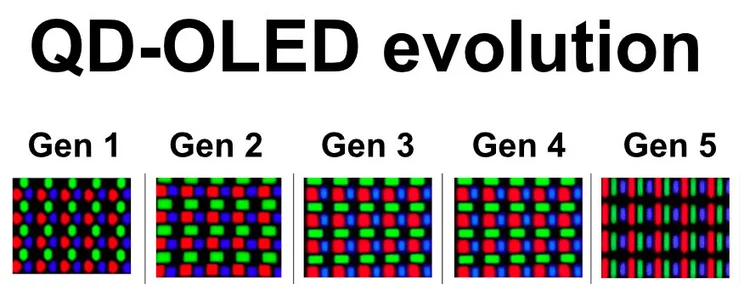
The result is that, as with IPS monitors, text looks clean and is free from fringing, while the monitors retain all the advantages of OLED: vivid, saturated colour, excellent HDR performance, superb contrast and incredibly fast response times. I had the chance to sit down with one of the new monitors over the weekend, when Philips and AOC launched a whole range of new models, and can confirm that text is indeed much sharper and cleaner to look at.
Alas, the new technology is not going to be cheap. Philips and AOC have confirmed two models are coming in 2026, and the prices are well north of £500: the (snappily named) Philips Evnia 34M2C8600P and AOC Agon Pro 346UCSD.
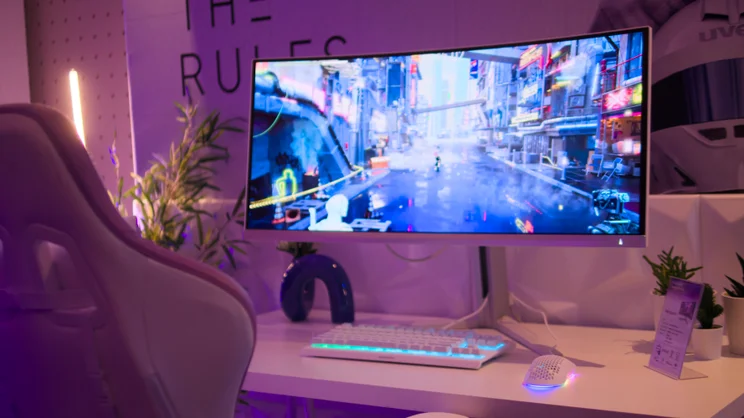
The Philips Evnia 34M2C8600P is a 34in screen and employs a curved fifth-generation QD-OLED panel with a WQHD resolution of 2,560 x 1,440, a refresh rate of 280Hz, response time of 0.03ms grey-to-grey and 99.3% coverage of the P3 colour gamut. Peak brightness reaches 1,300 nits during HDR playback, and the monitor comes with HDR500 TrueBlack certification.
As for connectivity, you’re getting two HDMI 2.1 and one DisplayPort 2.1 input, plus two USB Gen1 3.2 ports, KVM support and 90W of power delivery. The stand gives you height, swivel and tilt adjustment, plus there’s an array of Ambiglow LEDs on the rear to really put you in the heart of the action. The Evnia 34M2C8900P is set to launch in Q3 2026 at €899.
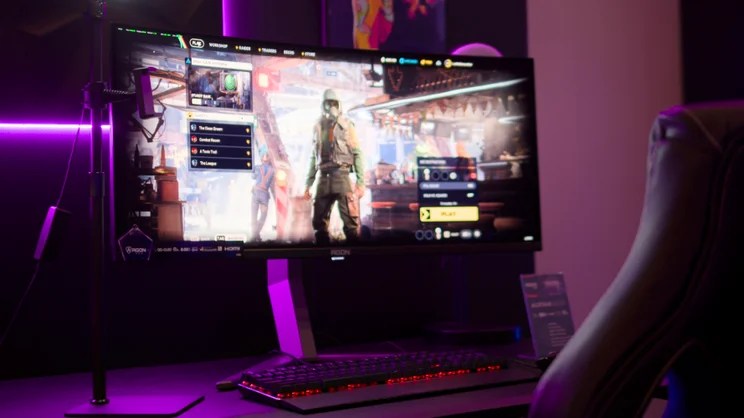
The AOC Agon Pro 346UCSD will appear in shops at the same time but will sit slightly above the Evnia in the pecking order. AOC says the Pro range is aimed at more serious gamers, whereas it sees Evnia monitors playing more of a hybrid role. As such, the price is higher at €999, and the specifications are, too.
Like the Evnia, the 346UCSD is a 34in monitor with a WQHD resolution (2,560 x 1,440), but it has a higher refresh rate of 360Hz. The response time of 0.03ms is the same, and connectivity is similar, with a pair of HDMI 2.1 inputs and one DisplayPort 2.1, plus three USB Gen1 3.2 ports and support for KVM and USB-C power delivery, albeit at a fairly low 15W. The stand has height, swivel and tilt adjustment.
But that’s not all. AOC also has a new cable clip mounted to the bottom-right corner, a redesigned OSD with customisable buttons and a pop-out headset hanger on the upper-left corner.
Early verdict
Of course, AOC and Philips aren’t the only companies to have announced fifth-gen OLED monitors. The MSI MPG 341CQR QD-OLED X36 is already available to pre-order for £998 for those who can’t wait to get their hands on the new technology.
It has similar specifications to the AOC, but it can’t match the Evnia’s Ambiglow tech, nor its accompanying Ambiscape tech, which extends colour synchronisation to the lamps in your room as well as the LEDs on the rear of the monitor. The Evnia is cheaper, too.
Either way, we’ll hopefully be getting our hands on both these new monitors just as soon as they drop later in the year. Watch this space.


