To help us provide you with free impartial advice, we may earn a commission if you buy through links on our site. Learn more

I got a behind-closed-doors look at what Samsung is cooking up in the home entertainment department at CES this week, including demos of its latest flagship QD-OLED TV, the Samsung S95H, and its new Micro RGB offering: the Samsung R95H.
The S95H is the follow-up to one of our favourite televisions of last year, the Samsung S95F. The first thing to note about it is that it’s significantly brighter than its predecessor. Where the S95F was able to hit peaks of 2,000 nits, Samsung claims that the S95H reaches 2,700 nits in Movie mode, thanks mainly to improvements made to the colour filter and light-emitting layer.
Samsung S95H: Wall-friendly design and improved picture quality
The difference was evident when viewing content on the newer TV next to the older model, although it wasn’t as obvious as I’d expected. The additional luminance was clearest during scenes with a lot of highlights: natural, snowy environments were freer of clipping at their peaks, with the brightest sections of a mountain range and the fur on a snow-dwelling animal popping that little bit more than on last year’s model.
This is not entirely due to hardware enhancements, however: HDR tone mapping has been upgraded to deliver improved gradation for high-brightness content mastered at up to 4,000 nits. There’s not a huge amount of mainstream content mastered at this level, but the delineation of clouds moving over a setting sun was far clearer on the S95H than the S95F in the demo I was shown. These brighter peaks were accompanied by more granular detail in the darker areas of the picture.
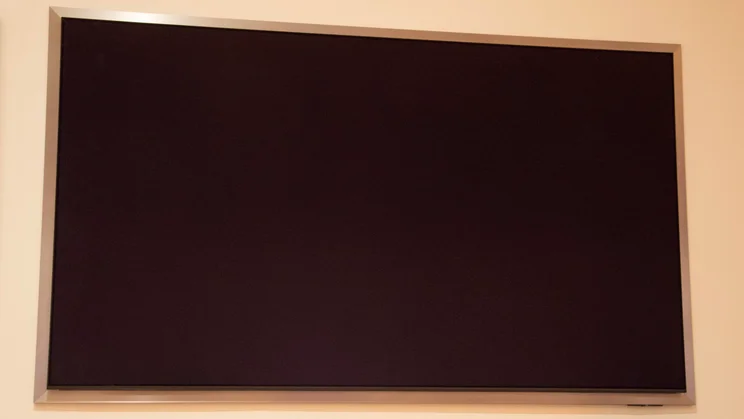
The other picture-quality step-up was visible when the S95H was handling low-bitrate 4K content. Where the S95F was prone to displaying patches of visual noise in such situations, the S95H’s image is a lot smoother. In a scene with a woman swimming underwater, the deep blue sea around her looked consistent across the S95H’s panel, in contrast to the slightly patchier image on the S95F.
As well as picture quality upgrades, the S95H has received a design overhaul. Samsung’s premium TVs have been stellar performers in recent years, and while we’ve enjoyed their design, some have felt that more focus should be given to eye-catching aesthetics. To this end, the S95H comes with an “Art Frame” design, which is new to the OLED range and marks the TV out as one intended to be wall-mounted.
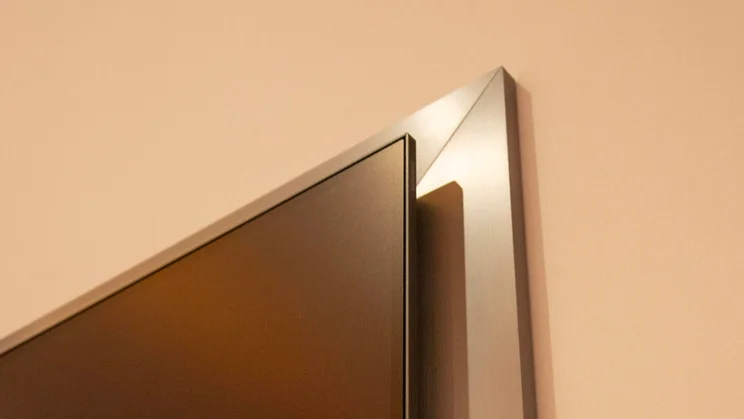
Its “Dual Plate” design sees the main panel sitting on a rear plate that has a detachable magnetic bezel, giving the TV the appearance of floating in front of the wall it’s installed on. I rather like it, and I imagine it’ll be a hit with those searching for a television that seamlessly blends into their decor. Unlike in previous years, Samsung’s One Connect box is optional, not part of the package, although if you do buy this, you can broadcast wirelessly using a transmitter that attaches to the TV, and enjoy support for up to eight HDMI 2.1 connections.
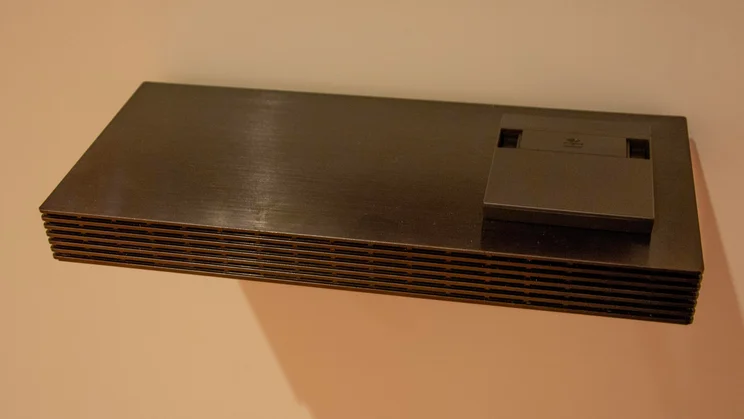
The S95H is set for release later this year and will be available in screen sizes ranging from 48in to 83in. At the time of writing, pricing had yet to be confirmed; it will be interesting to see whether the new design results in a price increase – let’s hope that’s not the case.
Samsung R95H: The flagship Micro RGB TV
The other TV highlight from Samsung’s Innovation Room demo was the Samsung R95H. The R series uses a panel with tiny Micro LEDs and was only available in an enormous 115in screen size last year. This year, however, Samsung has expanded the range to include 55in, 65in, 75in, 85in and 100in models.
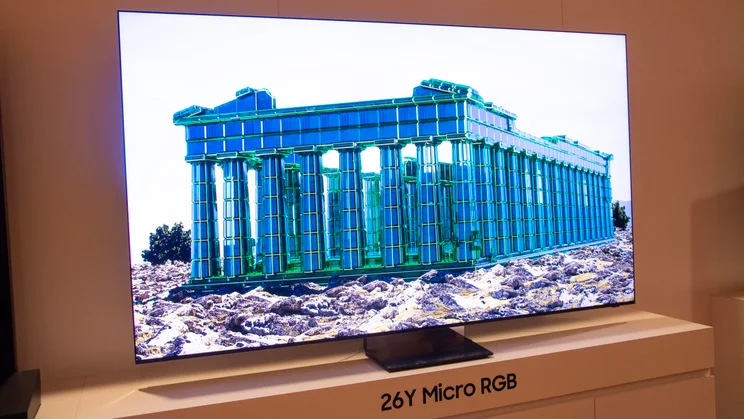
The R95H uses tiny, individual, self-emissive red, green and blue LEDs (hence the RGB), and these enable 100% BT.2020 colour gamut coverage. As with OLED panels, each pixel can be controlled independently to prevent colour mixing, ensuring ultra-precise light control and enhancing the clarity of colours, particularly mid-shades (as opposed to pure, fully saturated hues).
To showcase this elevated colour performance, Samsung had the R95H set up alongside an SQD (Super Quantum Dot) Mini LED option from a rival Chinese brand. Though not explicitly stated, it’s safe to assume this was the TCL X11L, which was launched in China in late 2025 and was confirmed to be coming to the UK later this year during CES.
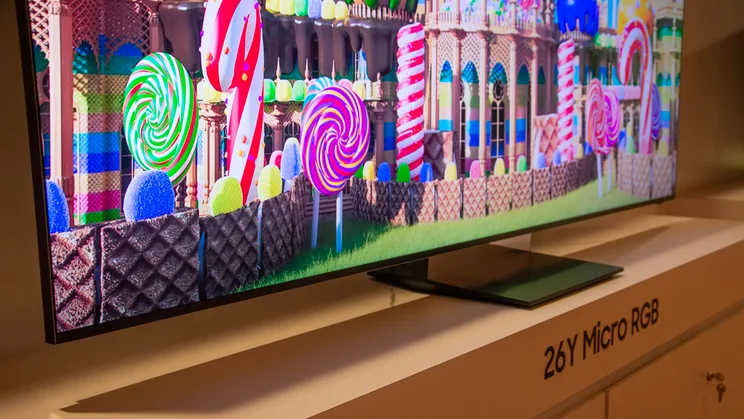
Both TVs were in Standard mode with their ambient light sensors off, and under these conditions, the Samsung communicated less saturated colours with greater vividness. Red tree frogs and the different shades of green foliage looked natural yet wonderfully expressive, and there was less blooming around objects during the peak highlights present in a scene showing a satellite rotating in space. According to Samsung, this is due to the increased AI processing power of the neural processing unit in the TV being able to better control the 7,000 dimming zones it has at its disposal.
Samsung also said that the R95H has an advantage over the SQD competition when it comes to energy efficiency, though this isn’t a claim I’m able to verify.
Samsung’s Freestyle projector gets an upgrade
In addition to sneak peeks at the two televisions detailed above, I was given a demonstration of the capabilities of the new Samsung Freestyle+ projector.
This promises vast improvements over the second-generation Samsung Freestyle we reviewed back in 2023. The headline improvement concerns brightness. Samsung says the Plus model can put out up to 430 ISO lumens, almost twice that of the original version. This has big implications for its practicality and should let owners enjoy a clearer picture in environments with more ambient light.
Brightness isn’t the only way in which the Freestyle+ moves Samsung’s portable beamer range forward. The team from Korea talked me through several features that harness AI to deliver a superior viewing experience.
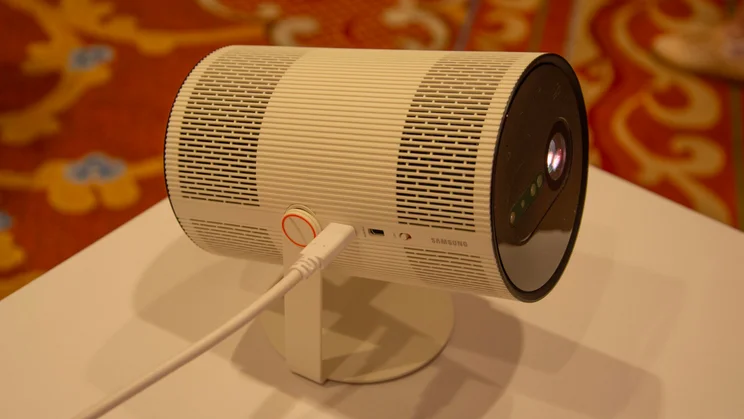
The first was Wall Calibration, which now works on patterned walls as well as coloured walls. It was effective, but not flawless. I found myself less distracted by the shapes on the wallpaper in the Wynn hotel’s Musigny Room, but could still make out some of the markings.
I was more impressed by the Obstacle Avoidance, 3D Auto Keystone and Real-Time Focus features. The former shifted the image automatically to ensure it wasn’t obstructed by a picture frame on the wall, while the latter pair responded quickly to manual adjustments, optimising the picture to fit into the conjoining space between two walls with minimal blurriness.
The unit remains extremely portable; Samsung hasn’t changed much in terms of design, so assuming the price is right, the Freestyle+ looks set to be a great choice for those after a projector that balances flexibility and picture quality. I wasn’t given a price or release date for the Freestyle+; it seems unlikely to arrive during Q1, but I wouldn’t be surprised to see it on shelves in the spring.