
To help us provide you with free impartial advice, we may earn a commission if you buy through links on our site. Learn more
- Compact and attractive
- Dolby Atmos and DTS:X
- Decent connectivity and customisation
- No physical remote
- Only one HDMI port
- Heston 200 required for true low-end impact
Marshall has been producing audio gear for over 60 years, but it wasn’t until last summer that the UK manufacturer made a move into soundbars.
The brand’s goal is to create a home audio ecosystem to take on the likes of Sonos, and the Heston 60 I’m reviewing here is its latest step towards that. It’s a smaller, cheaper alternative to the Heston 120, which we described as a “real contender”, praising its standard of build and finish, bold, spacious sound, and support for both Dolby Atmos and DTS:X.
Given that the Heston 60 shares several key similarities with its bigger brother, my hopes were high ahead of testing it alongside the Heston 200 subwoofer. In many respects, it lives up to its billing – and it fits into Marshall’s instantly recognisable product range perfectly – but can it dethrone the Sonos Beam 2 as the best soundbar for most people?
What do you get for the money?
The Heston 60 costs £500, slightly more than our favourite soundbar overall, the aforementioned second-generation Sonos Beam 2 (£449). That soundbar has been around for a while now, and the Heston 60 has some clear advantages over its rival on paper.
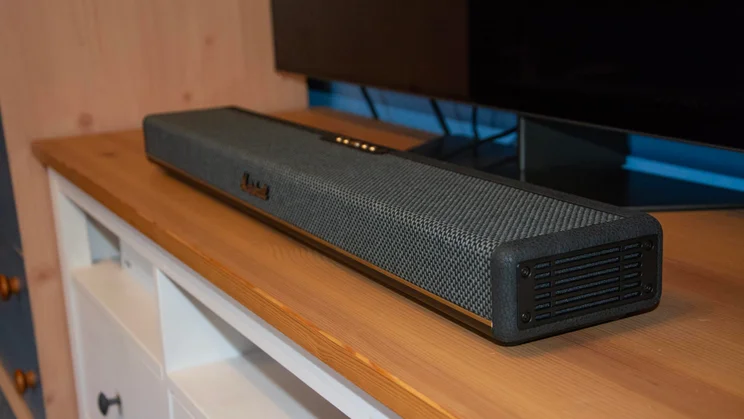
Most significant of these is support for DTS:X. While the Beam 2 supports the more prominent object-based audio format, Dolby Atmos, the Heston 60’s 5.1-channel arrangement can deliver both. That arrangement comprises seven speaker drivers, each powered by its own Class D amplifier. The five 1.25in full-range drivers that handle mid-range and treble reproduction receive 5W of amplification apiece, with the pair of 3in woofers that look after the lower end of the frequency spectrum, driven by 25W amps.
Peak power output is stated at 56W. Sonos doesn’t reveal output figures for its products, so I can’t make a direct comparison, but given the Beam’s 5.1-channel setup is powered by five amps, Marshall could well have the slight edge here.
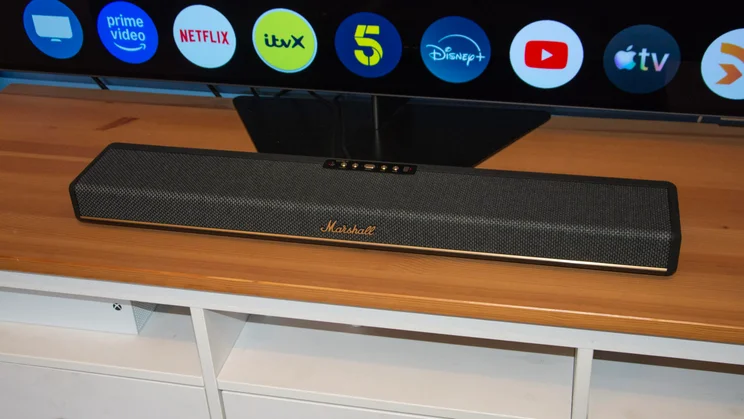
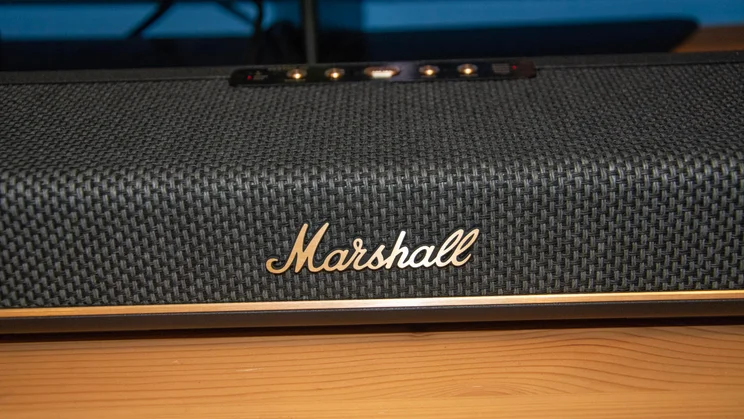
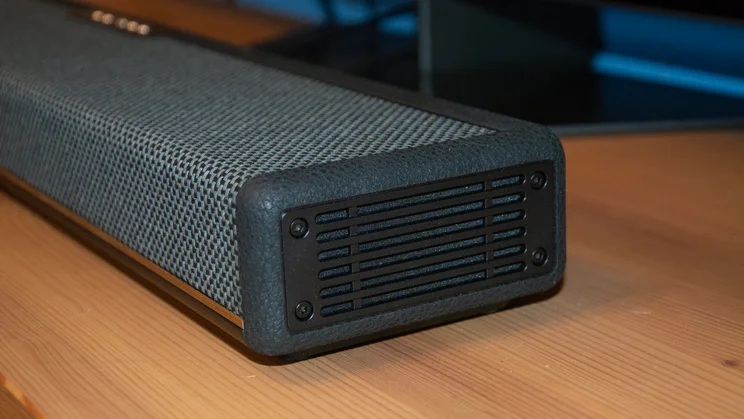
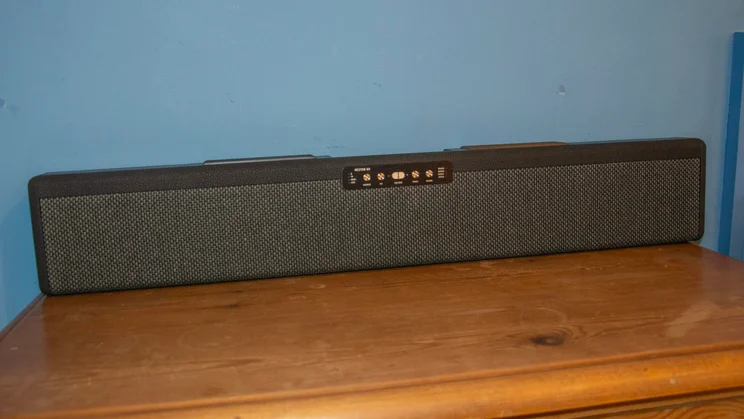
At 730 x 124 x 68mm (WDH), it’s not quite as petite as the Beam but still pretty compact by soundbar standards, and it’s designed in such a way that it looks equally good, if not even better, when mounted to your wall rather than positioned on a TV stand. The aesthetic is archetypal Marshall. It has an environmentally friendly bent, too, with around 75% of the plastic used made from recycled materials, and no PVC in sight. I imagine most people will gravitate towards the black version I tested, but for the spicier among you, Marshall also produces a cream colourway.
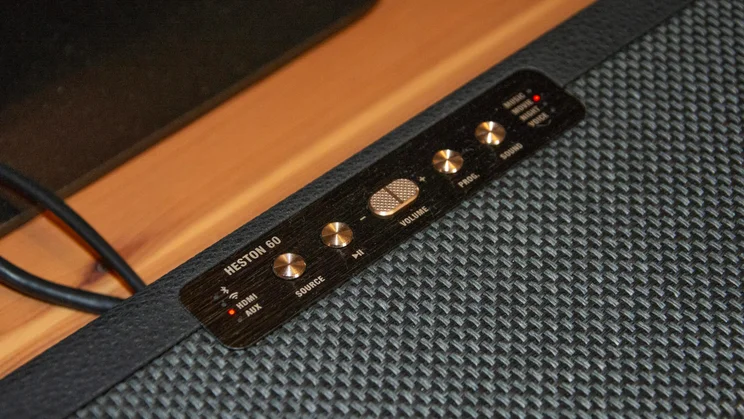
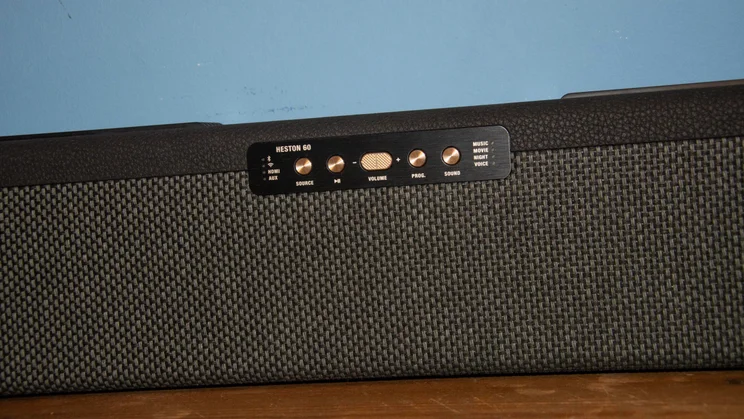
Buttons on top of the bar (or the front, if you choose to wall mount) are required for setup via the Marshall app and handle source switching, play/pause, volume, etc. However, there’s no remote control included, so the app will be your go-to for controlling the Heston 60 from your sofa if you’re not relying on your TV remote to change volume.
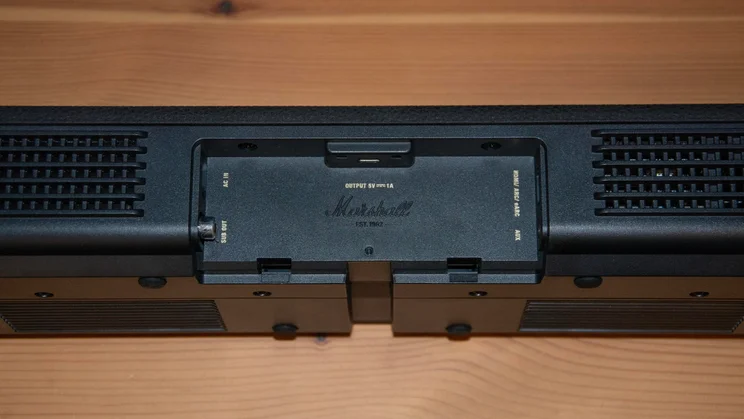
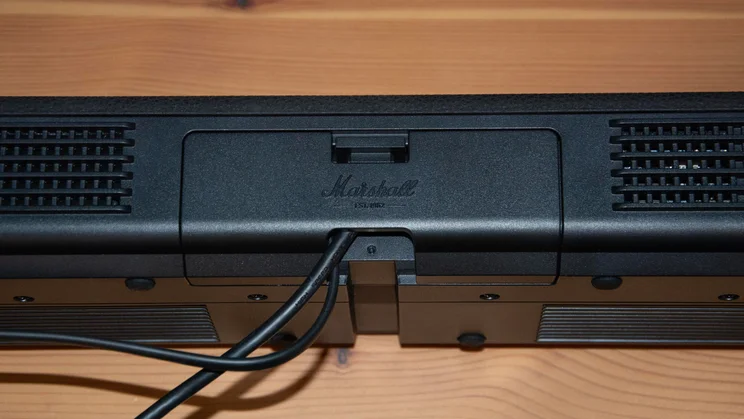
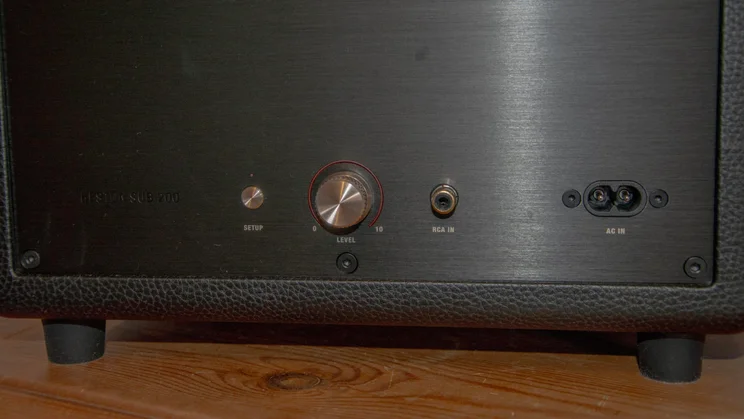
Connection-wise, you’ve got the obligatory HDMI (eARC) port, a legacy AUX-in, a USB-C port, Wi-Fi and Bluetooth 5.3, and a mono RCA socket you’ll need if you plan to pair the Heston 60 with Marshall’s Heston 200 subwoofer.
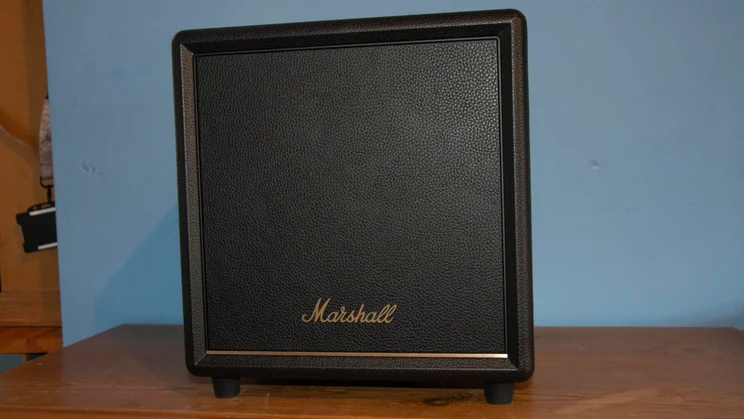
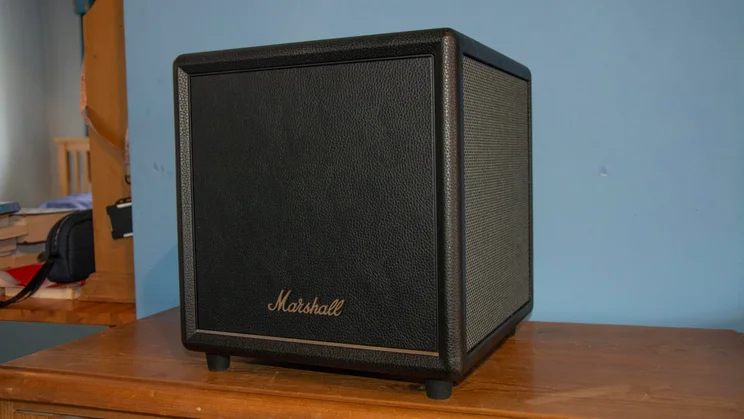
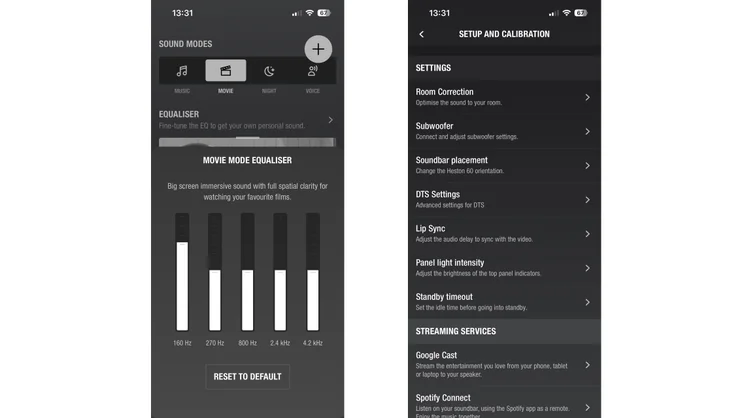
That subwoofer costs almost as much as the soundbar itself (£430), and is a chunky 282 x 282 x 303mm (WDH) affair weighing 7.6kg. Housed within the ported cabinet are a pair of 5.25in woofers, each powered by 120W amps and capable of reaching down as deep as 30Hz. Marshall has included an in-app option to adjust the crossover point between the soundbar and sub, which is a nice touch. I won’t be writing a standalone review of the Heston 200, but I’ll discuss the relative merits of buying it with the Heston 60 below.
What did we like about it?
The Heston 60 put in a very solid, but not spectacular, performance across a varied range of test material. To kick things off, I watched Tron: Ares on Disney+, a film that has Dolby Atmos and DTS:X soundtrack options. I went for the latter and left the Heston 60 in Movie mode with the customisable EQ untouched.
My initial impressions were positive: the bar created a decent sense of space and effectively covered a decent proportion of my viewing area. I watched the first couple of scenes of the film and then ran Marshall’s room calibration, which marginally improved the Heston 60’s room-filling capabilities. The transformation wasn’t miraculous, but I found the soundstage more immediate and compelling post-calibration.
Tron: Ares is a film that has plenty going on across the entire frequency spectrum, and it revealed the Heston 60’s strengths and weaknesses. Dialogue was intelligible in all but one scene, in which Jeff Bridges’ gravelly mutterings were slightly swallowed up by background noise within “The Grid”.
Otherwise, I had no problem picking up voices, even when they were coming from beneath helmets. Switching to Voice mode resolved the issues I had, though doing so interfered with the overall balance, so I recommend you avoid it unless you’re really struggling.
Mid-range and treble frequencies were impressive in general; the Heston 60’s ability to highlight smaller details like the whirring of computers and the splashes of puddles kept me alert to easily missed aspects of chaotic scenes, enhancing my engagement with what is, otherwise, a somewhat disappointing movie.
The bar also displayed pleasing dynamic range, smoothly and naturally transitioning from quiet, restrained dialogue to action sequences backed by in-your-face electro music. Suspenseful moments swiftly exploded into life in a non-jarring fashion, and the Heston 60 built to the movie’s many crescendos capably.
Without up-firing drivers or rear speakers, the Heston 60 has to rely on virtual channels to maximise the impact of DTS:X and Dolby Atmos soundtracks. The fight scene between Ares and Athena towards the end of Tron: Ares showcased smart spatial positioning. Sounds tracked flailing limbs and flashy cybernetic weaponry accurately, matching the on-screen fluidity.
The soundstage didn’t feel overly narrow, and light cycles zipping and whooshing through the city during a frantic chase scene were communicated with a convincing sense of direction and positioning. However, as we’ll discover below, the Heston 60 isn’t the most immersive of DTS:X/Dolby Atmos soundbars.
All of the above was further reinforced when watching the new Frankenstein on Netflix with Dolby Atmos. The nuances of speech in what is a dialogue-heavy tale were clearly articulated, and I felt the soundtrack was reproduced particularly well. The film uses classical instruments to reflect shifts in tone and mood, and the Heston 60 captured these variations elegantly.
I was struck by how realistically the bar created a sense of space in contrasting environments. The acoustics in internal spaces felt very natural; echoes were evident in a large, grand dining hall, while in the intimate setting of a ship’s cabin, sound felt more immediate and oppressive. Sound was cleverly moved around the soundstage, most obviously when a carriage approached Victor’s estate from off-screen (left) and moved right across the landscape. There was a palpable sense of left-to-right motion, and I felt similarly when fire tore through Victor’s residence in his attempt to destroy his creation.
Given that Marshall has a prodigious musical pedigree, you’d expect the Heston 60 to deliver the goods on the music front. It certainly demonstrated keen rhythmic expression during my listening tests in Music mode, and overall, I found it pretty well-balanced.
Treating myself to a blast from the past with the Arctic Monkeys’ Whatever People Say I Am, That’s What I’m Not, I found the aggressive guitars and teenage-angst-ridden vocals confidently and clearly conveyed, with plenty of energy.
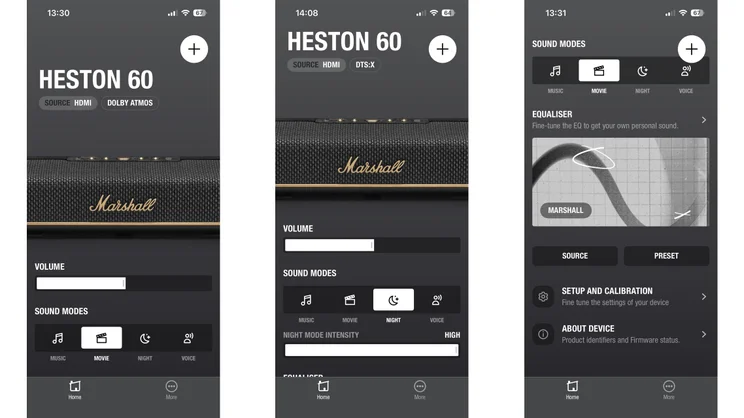
As the Heston 60 doesn’t come with a physical remote or support voice controls, the Marshall app has to do the heavy lifting when communicating with the bar. So, it’s just as well it’s laid out sensibly and offers plenty of scope for making adjustments.
There’s a Night mode in addition to the three modes already mentioned, and you can adjust the sonic characteristics of each EQ using a five-band equaliser. You can also tweak the audio/video delay, which I had to do at the start of Tron: Ares, and access internet radio stations and integrated streaming services, including Spotify Connect, Tidal Connect and Google Cast.
What could be improved?
The Heston 60 has two main weaknesses. The first is its inability to create truly immersive surround sound. The sideways-firing drivers are good at conveying a sense of breadth, but I never felt enveloped by what was being produced. This is a limitation of many all-in-one 5.1-channel soundbars, and one of the trade-offs you make by not buying a package with up-firing drivers and/or rear speakers.
When Victor addresses a hearing in Edinburgh early on in Frankenstein, I was strongly aware that things were happening in front of me rather than around me. Although often rousing, the Heston 60’s Atmos and DTS:X presentation fell short of ultra-immersive.
I also felt the Heston 60’s in-built subwoofer could be a little more impactful. At between 50% and 70% volume, it provided just enough low-end force to carry most movie moments cleanly. However, when a scene was crying out for forceful, deep bass or I pushed volume over 80%, it couldn’t quite hit the spot.
During the intro sequence of Tron: Ares, the kicking basslines were rich and well-rounded, but not supremely deep. And the dance track Ascendance by Enyka highlighted that, while the Heston 60 has a solid high- and mid-bass response, you’ll need the separate Heston 200 subwoofer to hit the kind of lows that bring movie blockbusters to life.
Having spent some time using the Heston 60 and Heston 200 together, I can say with confidence that the sub will have most living rooms rocking. With the sub connected and crossover point set to 120Hz, the cinematic feel of the experience increased significantly.
Two sections in Tron: Ares stood out here: Ares fighting off guards at Dillinjer HQ, and Ares and Eve Kim’s escape from the grid. In the former, I felt the guttural thud as Ares’ fists slammed into villains’ bodies deep in my chest, while the exploding facility in the latter shook the floor of my room with worrying violence.
The trouble is, adding the Heston 200 almost doubles the price of the overall package. It’s nice to have the option to do this further down the line, but I think Marshall has a battle on its hands to convince consumers to buy both at the same time. As much as I felt the benefit of the sub when connected, I wouldn’t be looking to pay an extra £430 for the privilege.
My final criticisms of the Heston 60 are less detrimental to the overall audio experience. There’s no HDMI passthrough, which is a shame, and personally, I’d have liked a remote control included. Perhaps I’m in the minority here, but I want to distance myself from my phone when zoning out in front of the TV, not feel like I’m glued to it as I am for most of the rest of the day.
Finally, although the app offers a welcome selection of options and functions, it proved pretty buggy at times. It was occasionally slow to load and find my connected devices, and the room calibration process froze on me twice before I was able to complete it fully.
Should you buy the Marshall Heston 60?
This is a tricky one. I certainly don’t recommend splashing out over £900 on it with the Heston 200, but as a standalone unit, the Heston 60 is tempting. It deals with the sonic fundamentals gamely, with mids, trebles and dialogue reproduced to a standard well above that of most mid-range and even several premium TVs. I personally could have done with a bit more weight in the lower frequency regions, but you might find making a few tweaks to the EQs sufficient to meet your needs.
In addition, the Heston 60 is one of the best constructed compact soundbars on the market, and one of the best looking. And it’s got that dual support for both Dolby Atmos and DTS:X going for it, even though its spatial sound delivery can’t defy the limitations of an all-in-one 5.1-channel arrangement.
Personally, I’d lean towards the Sony Bravia Theatre System 6, which has the same number of channels but uses rear speakers for a more pronounced surround sound effect. If, however, you’re willing to forgo that for a striking single bar that requires relatively little space under your telly, the Heston 60 deserves consideration.


