
To help us provide you with free impartial advice, we may earn a commission if you buy through links on our site. Learn more



- Exceptionally powerful, impactful sound
- Outstandingly seamless surround sound staging
- Impressive connectivity
- Comprises four separate components
- Subwoofer needs tweaking with music
- Previous generation still available much cheaper
The high channel counts, immense power and exceptional soundstage-building talents of Samsung’s flagship soundbars have seen the brand dominate the immersive surround-sound soundbar sector over the past few years. Especially since it found a way to make its top-tier home-cinema powerhouses adapt well to music.
Even a sudden move to a radical new design for the subwoofer of last year’s Samsung HW-Q990F failed to cause so much as a stumble in Samsung’s unbroken stride of flagship soundbar hits. So, with 2026’s HW-Q990H model keeping changes to a minimum, it’s unlikely to throw a spanner in one of Samsung’s most successful works.
What you need to know
The HW-Q990H is Samsung’s most premium soundbar for 2026. A position it earns by delivering a whopping 16 real (rather than virtual) channels of sound from a soundbar, a pair of wireless rear speakers that carry three channels each, and a cute but potent dual-driver subwoofer.
It’s a potentially great solution for anyone looking to combine a big TV with a compact surround sound experience that puts you right at the heart of a good movie or TV sound mix.
Price and competition
The £1,599 Samsung charges for the HW-Q990H puts it in relatively expensive territory for a soundbar. It does give you more components, more channels, more power and better connectivity than the vast majority of soundbars, though – and if it lives up to its predecessors, it will convert those raw materials into an exceptionally immersive and cinematic soundstage.
The closest rival to the Q990H is the JBL Bar 1300 Mk2, which also offers an 11.1.4-channel count and, as a 2025 model, is currently selling for under £1,200 – significantly less than the Q990H.
LG’s US95TR is another four-component home audio solution with a 9.1.5-channel arrangement, while the Sonos Arc Ultra is a standout one-bar solution, though it lacks rear channel sound and isn’t as well-connected as the Q990H. The Arc Ultra typically costs £999, but could be picked up for £799 at the time of writing.
Design and features
A carbon copy of the HW-Q990F
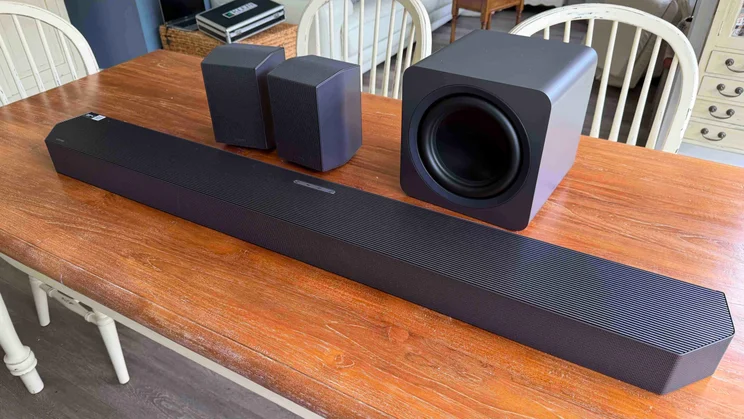
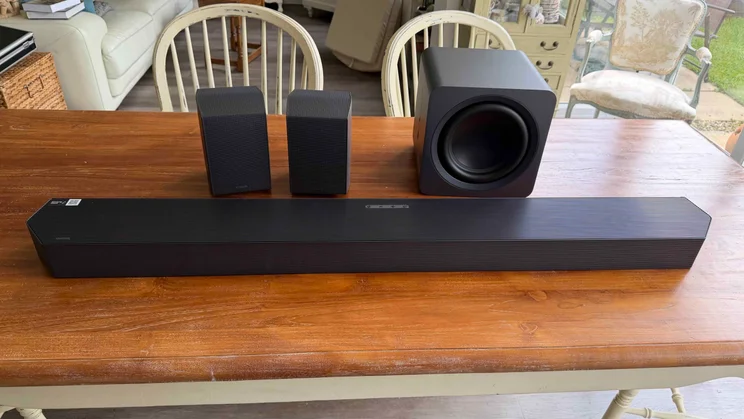
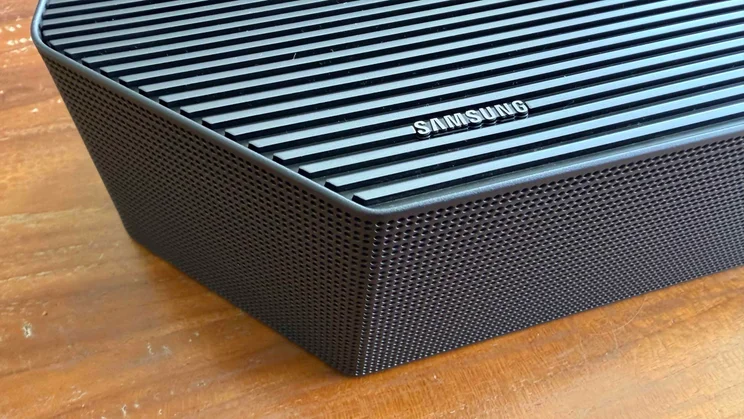
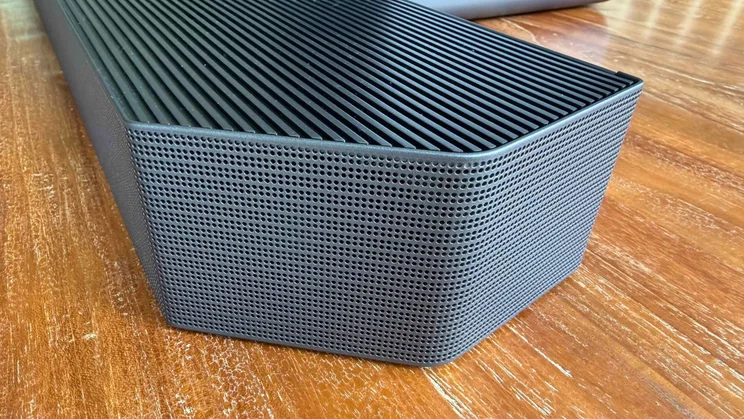
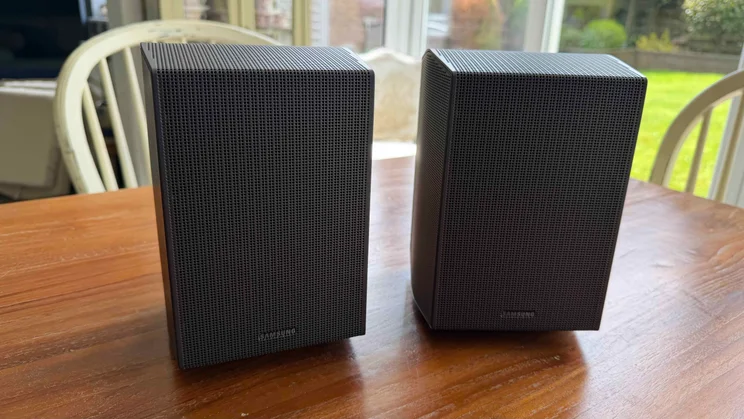
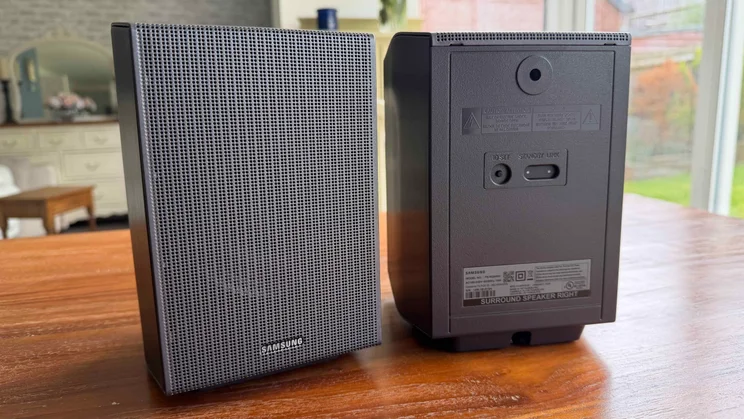
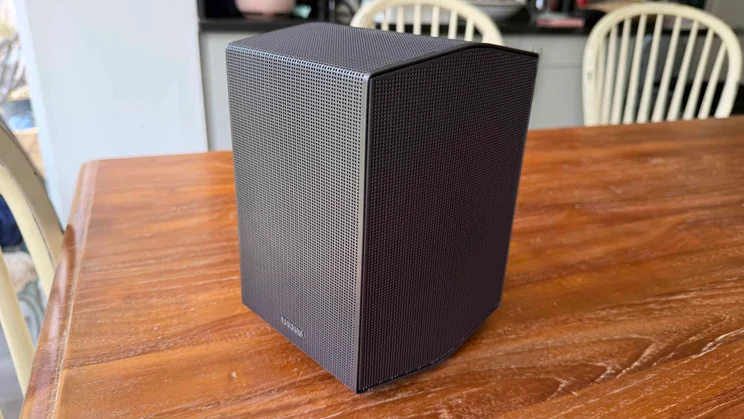
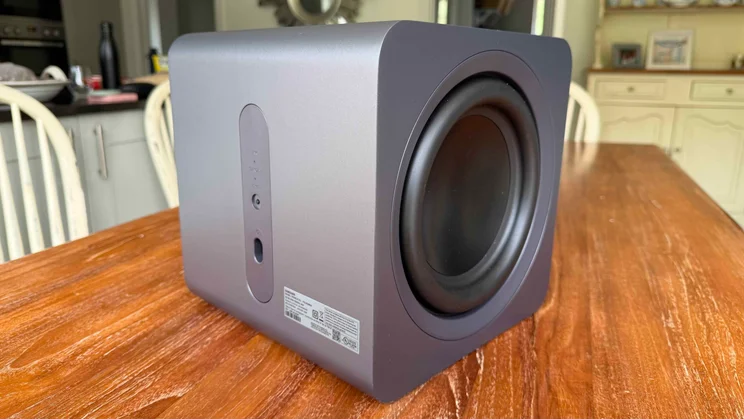
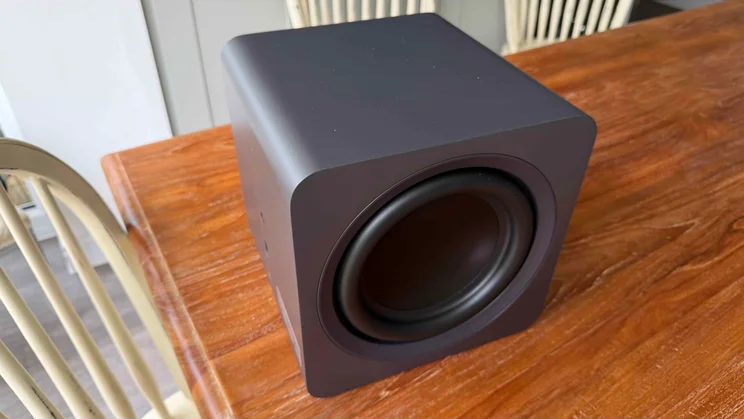
If the HW-Q990H looks familiar, that’s because it is. It’s basically a carbon copy of its Q990F predecessor, boasting the same sculpting, dimensions and hard-plastic grille finish for the main soundbar and two rear speakers, and the same smooth finish, dimensions, rounded-off edges and dual-driver design for the roughly cubic subwoofer.
Together, these four components make the package look like a quite substantial imposition on your living room. Once they’ve been spread around the room, though, including potentially placing the subwoofer under a sideboard or down the side of a sofa, the system feels pretty compact. Especially given its room-filling capabilities.
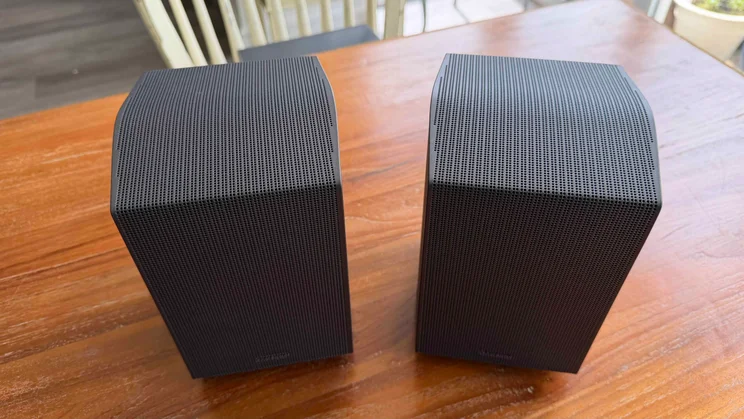
The black plastic finish for the bar and rears is crisp and industrial in all the right ways. The double-angled ends of the main bar and the slightly arched top edge of the rears combine stylish form with function, as the different angles enable better steering of the system’s side, front, and up-firing channels.
Joining the side and front-side channels on the main bar are front-left, right and centre channels, plus two up-firing speakers in the top edge. Despite being smaller than typical bookshelf music speakers, the Q990H’s rear speakers contain three separate drivers and channels: the usual forward-firing drivers, secondary drivers on their outer sides to deliver rear side channel sound, and the previously mentioned up-firing drivers for providing Dolby Atmos’s overhead effects. Add the bass channel provided by the striking-looking subwoofer, and you arrive at the massive 11.1.4 channel count.
The dual-driver design of the subwoofer, which Samsung first introduced in 2025, helps bass roll out more smoothly and evenly, with less potential for distortion and less distracting directionality.
Multi-channel audio format support
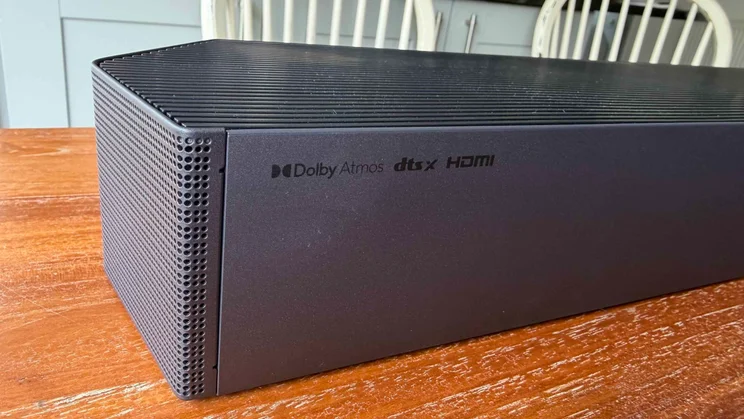
The HW-Q990H can play DTS:X and Eclipsa Audio soundtracks as well as Dolby Atmos, and can remix lower-channel sources, including stereo audio, to take advantage of its full speaker count if you choose its Surround Sound preset. Purists can rest easy that you can still play stereo music in its native two-channel form via the Standard preset.
The presets also include a Game Pro mode designed to emphasise the directionality of sound, so that you can tell where you’re being attacked from, and an Adaptive AI mode that tries to optimise the sound profile based on analysis of the content you’re watching.
You can, of course, manually adjust the relative volume of each channel in the system, but there’s also a Space Fit automatic room correction feature, which, once activated, continually assesses the sound and can correct it if anything in your room layout changes. This works alongside an Active Bass Control system that monitors how low frequencies are managed and adjusts the sound profile to avoid distortion.
The HW-Q990H can also be set to monitor ambient noise levels and adjust the relative weight of vocals in the mix. Additionally, you can have its speakers join forces with (rather than replacing) those in Samsung TVs courtesy of Samsung’s Q Symphony feature. It’s also possible to have the rear speakers work in a simple stereo configuration when streaming two-channel music.
Three upgrades on the previous generation
There appear to be only three new things the Q990H adds to the specification of the Q990F. First, a Sound Elevate feature makes dialogue sound as if it’s coming from a higher position in the mix. This better matches sound to the onscreen action of either massive TVs or those mounted relatively high on a wall.
Second, the Q990H can work with the Roon music player and library management software (alongside previously established support for Spotify, Chromecast, AirPlay and Tidal Connect), and third, an auto-volume feature has been added to level out the sometimes massive volume disparities between different sources. The design, hardware specifications and speaker configurations between the Q990H and Q990F have all apparently remained the same.
Connections and control
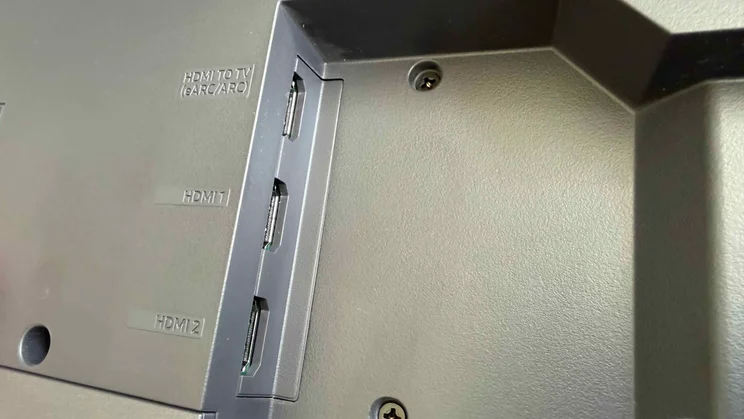
The Q990H is one of a limited number of soundbars to support full HDMI 2.1 passthrough. Meaning that its two-in, one-out HDMI system can pass along 4K/120Hz gaming signals with HDR intact, and support variable refresh rates up to 120Hz and auto low latency mode switching. The HDMI passthrough also supports the HDR10+ and Dolby Vision formats, even though Samsung’s TVs remain a Dolby Vision-free zone.
There’s an optical digital audio input, as well as the Wi-Fi and Bluetooth cable-free content sharing options we’ve come to expect from pretty much any soundbar. The Wi-Fi support includes receiving Dolby Atmos soundtracks sent wirelessly from compatible Samsung TV models. However, since this wireless Atmos transmission isn’t lossless, you may prefer to stick with ARC capability for Atmos. Or loop external sources through the soundbar.
The Q990H ships with a slender, stripped-back remote control with a cool, smooth finish that’s comfortable to use for basic day-to-day adjustments. This can also be used to control Samsung TVs; for anything beyond simple input switching, volume adjustments and sound preset selection on the soundbar, I’d recommend using the Samsung SmartThings app or Samsung Sound app.
In addition to providing access to features such as the Space Fit Pro auto-calibration system and automated bass profile controls, it offers a helpful visual interface that’s more engaging than the (admittedly welcome) LED carried on the soundbar’s front edge. The HW-Q990H also supports voice control via built-in Alexa or ‘works with’ Google Assistant support.
Sound quality
Given that there are only a few relatively small feature changes distinguishing the Q990H from its predecessor, it’s not exactly shocking to find the two sound very similar. Which, as anyone who has read my review of the Q990F will know, is a very good thing.
The two well-established ‘killer apps’ of Samsung’s flagship soundbars are apparent: massive power and volume combine with the most fully formed and immersive surround-sound effect the soundbar-system world has to offer.
The power enables the Q990H to run at volumes far beyond anything your average living room/human hearing can comfortably tolerate without so much as a hint of distortion, speaker breakdown or cabinet rattles. Or, more usefully, it means the Q990H can run at sensible but still properly cinematic volume levels without ever sounding remotely strained, muddy or incoherent.
Beyond massive volume, this power is felt in the extreme clarity and detail the soundbar presents even at high volumes. It’s also apparent in the way sounds are channelled out of the various components in all the directions necessary to create a complete hemisphere of sound around your seating position. Such a hemisphere is exactly what you need to get the maximum enjoyment from Dolby Atmos and DTS:X soundtracks.
The Q990H can adapt the scale of its sound hemisphere to accurately represent both the biggest and the smallest spaces movie soundtracks might seek to portray. It doesn’t leave any gaps in the surround sound effect, either, with transitions down the side of the room, across the room or overhead, all progressing perfectly smoothly.
Cinematic impact
The Q990H’s power and force also contribute to outstanding impact for explosions, punches, gunfire and other movie staples, completely avoiding the swallowed, muted, restrained feel that such sounds can have on more polite and underpowered soundbars. That’s not to say that impact sounds come on too strong; on the contrary, another Q990H strength is the way it delivers every sound element, no matter how subtle. It always managed to articulate the correct level of weight, helping it recreate a film’s sonic world just as its audio engineers intended. In fact, even though Samsung isn’t claiming any major changes to the Q990H’s audio, it felt to me like it’s a little better in this respect than its predecessor.
It’s worth stressing how well the rear speakers blend sonically with the main soundbar: the way they match tones and steer various sound channels is magnificent.
Crystal clear dialogue
Dialogue continues the Q990H’s outstanding work, sounding clear at all times without losing context, and also, crucially, enjoying a gentle vertical lift that puts it on a physical level with the images on the screen. This is even without using the new Sound Elevate feature, which will likely only come into its own with screens of 85in or more.
All this and I haven’t yet mentioned that distinctive opposing-driver subwoofer. As with the Q990F, this interjects some of the deepest bass the soundbar world has ever produced – at volume levels commensurate with (but not dominant over) the rest of the soundbar’s elements. Its design really does help it roll low-frequency sounds throughout large rooms with extra smoothness and non-directionality, too. Yet, there’s nothing monotonous or cumbersome about the subwoofer’s contributions. It’s able to vary both the weight and frequency of its sound unusually nimbly to ensure that it’s always doing the job a movie mix wants it to do and nothing more.
Excellent musicality as well as magical movie moments
The Q990H’s efforts with music are top-notch, too. It still manages to sound exceptionally powerful, filling a room at high volumes without sounding shouty or forced. But in its Standard (native stereo) setting, it reins in its most aggressive attributes to create a more musical tone. Also, while it creates an excellent sense of stereo separation, it doesn’t push things too far or become clinical. And best of all, it locks vocals at the heart of everything (assuming that’s where the mix intended them to be) without them becoming either too bright or muddled in with the rest of the mix. This combination of power, sensitivity and musicality is a rare find in the soundbar world, especially with a soundbar that excels as much as this one with film soundtracks.
Like everything in the AV world, not even the Q990H is perfect. I found I needed to rein in the subwoofer a touch with some types of music, for instance. Movie dialogue sometimes sounds slightly hard-edged, too, and treble effects in music, especially snare drums, can become distractingly exaggerated if you use the Surround Sound preset option to remix stereo tracks to the soundbar’s full channel count. But with the Q990H’s simple stereo presentation sounding so good, there’s not much need to remix stereo tracks for surround sound anyway.
These niggles are all pretty small, anyway, compared to everything the Q990H does right, ensuring that it continues Samsung’s reign at the top of the single-package surround sound soundbar world.
Samsung HW-Q990H review: Verdict
In a perfect world, the Samsung Q990H would have delivered a wider range of improvements over its predecessor. However, this is one of those rare occasions in the home entertainment market where the adage of ‘if it ain’t broke, don’t fix it’ really does apply.
The Q990F was the best soundbar in its full-surround class last year, so it’s pretty hard to complain about the Q990H maintaining that status while also delivering a few extra features. That said, it would be remiss of me not to mention that you can get the HW-Q990F for just £710, less than half the price of this year’s model. That’s outstanding value, and the smarter option if you don’t require Samsung’s latest and greatest.


