
To help us provide you with free impartial advice, we may earn a commission if you buy through links on our site. Learn more




- Big, spacious and unified Dolby Atmos sound
- Great standard of build and finish
- Multiroom and multichannel possibilities
- Not as successful with music as with movies
- Glass top-plate is a brave move
- No HDMI passthrough
The world is far from short of fairly expensive spatial audio soundbars that can form part of a larger multichannel and/or multiroom system, as and when you decide you want them to. Indeed, Bose is a big part of why this market exists in the first place.
But the market it helped create has grown arms and legs in the last few years, and the new Bose Lifestyle Ultra Soundbar is the brand’s latest attempt to reassert itself in a product category it helped bring to prominence.
How much does it cost?
The Bose Lifestyle Ultra Soundbar is a premium all-in-one soundbar solution that costs £999. We’ve tested several capable rivals, the two most impressive of which are the Sonos Arc Ultra (£799) and our favourite all-in-one bar, the Sony Bravia Theatre Bar 9, though that model costs a fair bit more at £1,399.
Is it designed well?
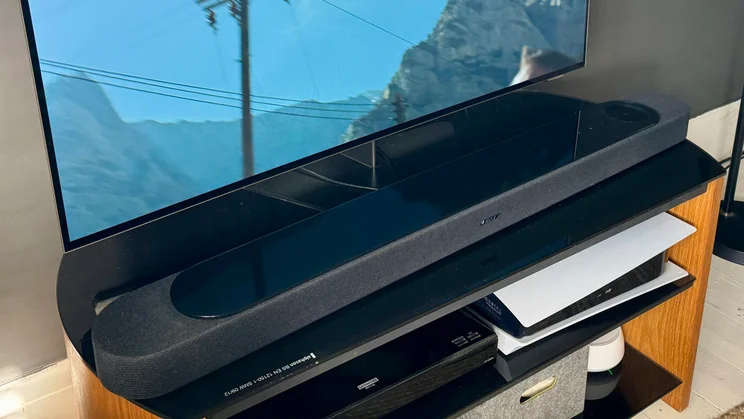
Dimensions of 1,100 x 125 x 67mm (WDH) mean that the Lifestyle Ultra Soundbar can fit in all the drivers it needs to deliver convincing spatial sound, but the knock-on effect is that it takes up a significant amount of space on your TV cabinet. You will want to pair the Lifestyle Ultra with a TV of at least 55in to prevent it from looking ridiculous, and ensure there’s enough clearance underneath the screen to avoid the bar from obstructing the picture.
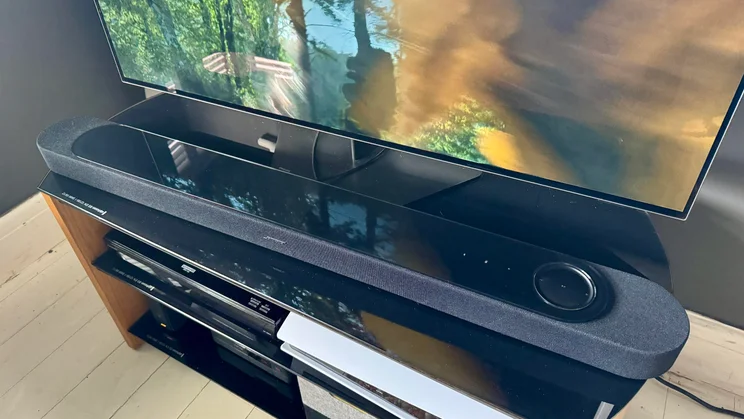
It’s large, but the Lifestyle Ultra Sound is elegant and discreetly designed. The standard of build and finish is exemplary, and the industrial design is a cut above the norm, too. Regardless of whether you choose the Black or White Smoke options, you’ll be the owner of a soundbar that looks and feels every penny of the money you paid for it.
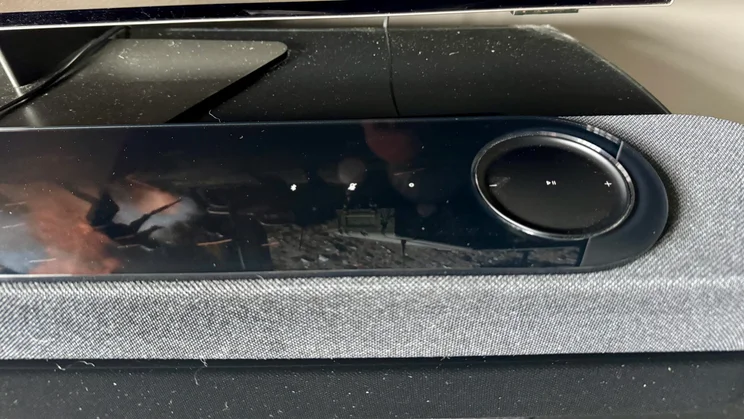
There is one element of its design that causes a problem, however. A good-looking slice of glass covers most of the soundbar’s top surface, and this reflects light and colour. If you’re watching 21:9 content with black bars above and below the picture, it’s not an issue. But if you’re watching stuff that fills the entire screen, these reflections are rather distracting. It’s a really weird design choice that seems like less and less of a good idea the more I use it. The soundbar looks great all by itself, but is problematic if it’s sitting beneath a TV, which is where it’s likely to spend most of its time.
What connection options does it have?
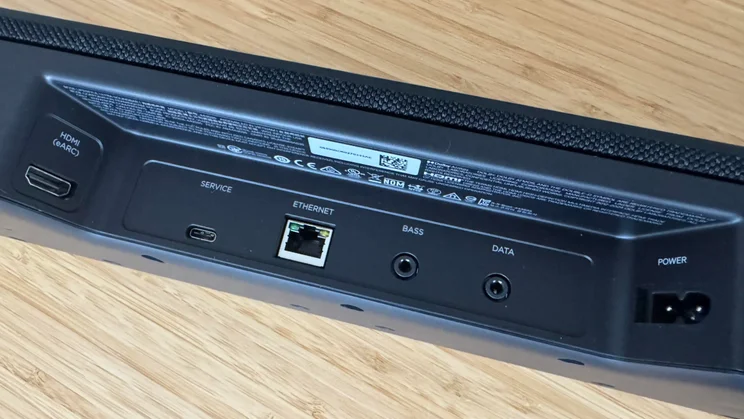
The Lifestyle Ultra Soundbar only has one HDMI eARC socket and an Ethernet port. Bose isn’t the only brand fitting its premium spatial audio soundbar with a single HDMI eARC socket, but this doesn’t mean it shouldn’t think long and hard about providing an HDMI passthrough next time. Some of us have larger systems that require greater flexibility where connectivity is concerned.
The soundbar has a better selection of wireless connection options, though. It supports Bluetooth 5.3 (Bose doesn’t state the Bluetooth codec compatibility of the device) and dual-band Wi-Fi, which means AirPlay, Google Cast and Spotify Connect are available. TIDAL Connect is on its way and needs to arrive soon, as it’s one of the best sources of Dolby Atmos music.
How do you control it?
Bose doesn’t include a remote with the Lifestyle Ultra Soundbar. If you want one, you will have to spend £50 for the Bose Universal Remote. I’d still describe the control options available here as thorough, though.
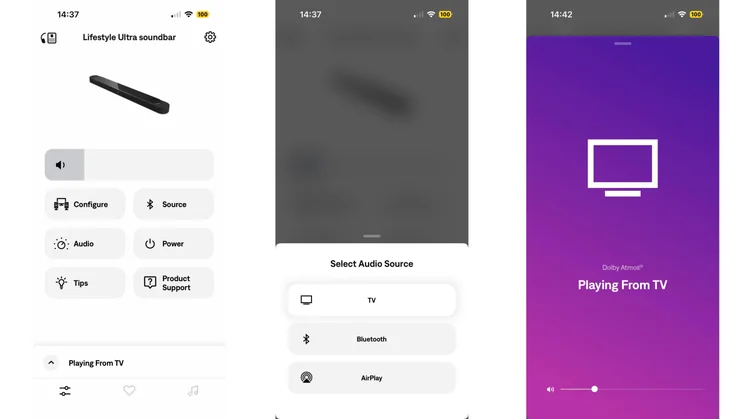
Between built-in Amazon Alexa, physical controls on the soundbar, the ability to use your TV’s remote control (provided it’s appropriately specified) and the dull-looking, great-to-use Bose control app, it seems unlikely you’ll feel the need to fork out.
The circular control dial on the top of the soundbar operates a little like the wheel on an iPod from back in the day. A circular finger-sweep adjusts volume, while various presses in various positions deal with play/pause and skip forwards/backwards. To its left are three touch controls that handle Bluetooth pairing, muting the mics and operating the shortcut you’ve nominated in the control app.
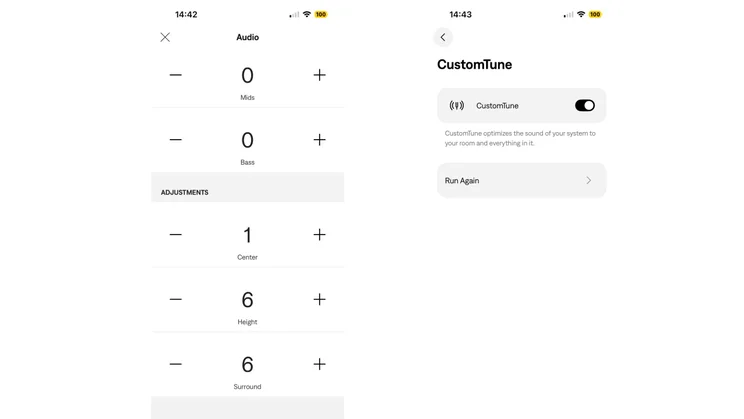
The app itself is, in the established Bose manner, visually tedious and operationally excellent. Here’s where you can access everything from room-correction routines to some granular EQ adjustment (which includes height, surround and centre channel adjustment, as well as bass, treble, and mids sliders). Everything you’ll find there is useful and logically presented, and the app runs very stably.
What driver arrangement and audio technologies does it use?
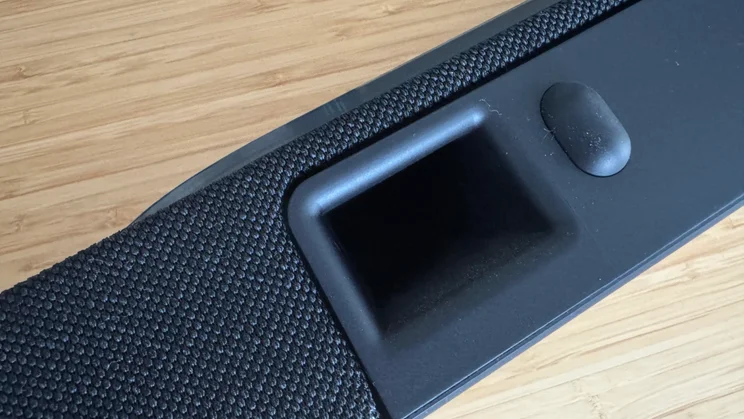
The Lifestyle Ultra Soundbar supports Dolby Atmos (but not DTS:X) and delivers an impression of 5.0.2- channel sound by using a nine-strong array of drivers bolstered by a pair of QuietPort bass reflex enclosures on the rear of the cabinet.
The nine drive units comprise four full-range racetrack drivers across the front of the cabinet, with a tweeter in the middle to take special care of centre-channel information. There are also two PhaseGuide drivers, one towards each end of the front of the soundbar. This Bose technology spreads sound horizontally as wide as possible to fool your ears into thinking there are driver units when there aren’t.
Finally, you have two more full-range drivers positioned towards the outer edges of the top of the soundbar. These are angled outwards at 90 degrees to deliver the sonic height needed by spatial audio soundtracks.
Bose is being secretive about certain specs
There’s plenty of information Bose is keeping close to its chest, however. It hasn’t revealed the size of the drivers, the material from which they’re made, or the frequency response they deliver. We also don’t know how much amplification is on board to power them, or for sure whether Bose is using Class D amplification – that’s just my educated guess.
Bose is happy to discuss the various technologies it uses to optimise the performance of the Lifestyle Ultra Soundbar, though. Take CustomTune, for instance. In a Sonos-tastic manner, it works with the mic in your iOS or Android device to help adjust the soundbar’s output to suit your space and your seated position(s) within it. Then there’s TrueSpatial, which attempts to make non-Atmos content sound as immersive as possible. CleanBass works with DSP and with the QuietPort openings to try to reduce low-frequency distortion to negligible levels. And the AI-powered Speech Clarity algorithm is designed to make dialogue as distinct and direct as possible without ramping up volume levels across the frequency range.
As a sidenote, the Bose Lifestyle Ultra Soundbar can be augmented with a couple of Lifestyle Ultra Speakers as rear channels and/or a Lifestyle Ultra Subwoofer. Such multichannel and multiroom possibilities are very welcome, but they’re not compulsory and do add to the overall cost considerably.
What is the sound quality like?
The Lifestyle Ultra Soundbar’s audio performance makes it a real contender. At the bottom of the frequency range, it’s deep and assertive, but not without subtlety; its bass response is detailed and textured, and controlled to the extent that rhythms sound realistic while the low end keeps well out of the way of the midrange. The midrange itself projects well, keeping dialogue centred and distinct, and it’s just as observant of even the finer details as it is further down the frequency range. At the top end, the Bose has plenty of bite and shine, but its treble response is more than substantial enough to ensure it steers well clear of hardness or glassiness.
Tonality is quite carefully neutral, and while there’s a little nudge forwards from the bottom of the midrange on down (presumably in the name of excitement) the frequency response is pretty smooth and even too.
It’s the impression of spatial audio it creates, though, that really takes the Lifestyle Ultra Soundbar to the next level. The combination of physical drivers at helpful angles and some state-of-the-art DSP lets the Bose sound quite a lot larger than it actually is, and in every direction; its sound is wide, fairly deep and undeniably tall.
Supreme spatial sound for movies, but not music
Give it a cooperative Dolby Atmos soundtrack like Bumblebee to deal with, and it can deliver scale, a proper sense of space and a very unified soundstage where less capable soundbars can get a big vague around the edges. There’s a singularity, as well as a very agreeable directness, about the way the Lifestyle Ultra Soundbar goes about serving up the spatial audio. It’s articulate and distinct, as well as having the dynamic headroom to let the differences between a big explosion and a quiet moment of reflection all too apparent.
The Lifestyle Ultra’s insistence on attempting to force an impression of spatial audio out of everything isn’t always the most helpful, however. Its TrueSpatial feature is always on, and while that’s not automatically a bad thing, it’s most definitely not always a good thing. Not every two-channel recording suits being served up by nine drivers at a variety of angles, and sometimes the direct and articulate nature of the soundbar’s delivery can go astray.
The Lifestyle Ultra Soundbar is a rather more qualified success playing music than it is when handling movie soundtracks. Atmos-mixed songs sound good, but until Tidal Connect is present and correct, the number of these available to enjoy is more limited than it should be.
Should you buy the Bose Lifestyle Ultra Soundbar?
If you’re after a simple, convenient and actually quite good-looking upgrade to quite convincing one-box spatial audio for your movies, the Bose Lifestyle Ultra Soundbar deserves your close attention.
Its performance with Dolby Atmos soundtracks is straightforwardly impressive in pretty much every respect, it’s easy to set up and control, and despite the fact that it’s quite large, it contrives to be quite discreet in situ. When you factor in the ability to add wireless rear speakers or a wireless subwoofer from the same Bose range, it starts to look (and sound) like a really strong contender.
It’s slightly less positive and confident when it comes to music, though, which will be an important consideration for some users, and the glass top panel is, as you can see from the pictures, a bit of an issue when it comes to reflectivity. Taken as a whole, though, this soundbar sits right near the top of the tree with the likes of Sonos and Sony.


