To help us provide you with free impartial advice, we may earn a commission if you buy through links on our site. Learn more
- Best air purifiers: At a glance
- The best air purifiers you can buy in 2026
- 1. Dyson Big+Quiet Formaldehyde: The best air purifier money can buy
- 2. Hoover H-Purifier 500: Best air purifier for large rooms
- 3. Blueair Blue Signature: Best air purifier for living rooms
- 4. Philips PureProtect Mini 900 Series (AC0290/10): Best for ease of use
- 5. Blueair Blue Pure 511: Best for bedrooms
- 6. Blueair Blue Max 3250i: Best for a range of features
- 7. Shark NeverChange 5: Best air purifier for filter longevity
- 8. Best for babies: Levoit Sprout
- How to choose the best air purifier for you
- How do air purifiers work?
- What is the clean air delivery rate?
- What are the most important features of an air purifier?
- Can air purifiers help protect against viruses?
- How noisy are air purifiers?
- How much do I need to spend?
- Our favourite air purifier is the Dyson Big+Quiet Formaldehyde. It’s a beast that really packs a punch when it comes to scrubbing the air of hidden nasties, with a powerful fan that will be a welcome addition to your home come summer.
- That said, its price tag is a beast too. The good news is that our roundup below features air purifiers for a wide range of homes and budgets, from compact air purifiers under £100 to heftier investments to tackle larger spaces.
- You should trust us, because we’ve tested over 25 air purifiers here at Expert Reviews, putting them all through rigorous tests to measure how long each takes to clean the air, and also how much noise each one makes.
- Read on for our top picks of the best air purifiers for your home, as well as our buying guide addressing some questions you might have when shopping for one.
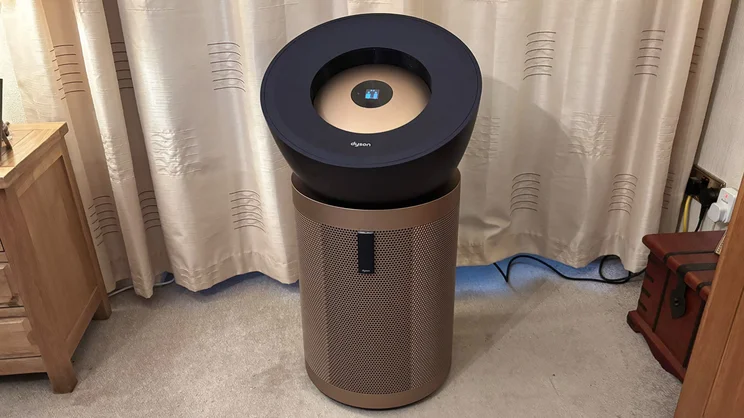
Of the 25 plus air purifiers that we’ve tested and reviewed, our favourite is the Dyson Big+Quiet Formaldehyde: a monster that really lives up to its name. It’s not cheap, though, which is why we’ve featured eight of the best air purifiers in our roundup below – for a range of budget and homes.
But do you need an air purifier? Well, there’s a good chance that you can benefit from one. They can ease the symptoms of asthma, hay fever and allergies by filtering the air you breathe and removing common irritants like pet dander, pollen, dust and smoke.
Quality options are available for less than £100, but with purifiers ranging from ultra-effective to downright useless, it’s essential to do your homework before buying. That’s where this guide comes in. Below our roundup of mini reviews, our buying guide will answer some common questions and explain the key features to look out for.
Alternatively, if you’re just itching to see our top recommendations, you can jump straight to our at a glance list below.
Best air purifiers: At a glance
| Best money can buy | Dyson Big+Quiet Formaldehyde (~£900) | |
| Best for ease of use | Philips PureProtect Mini 900 Series (AC0290/10) (~£130) | |
| Best air purifier for large rooms | Hoover H-Purifier 500 (~£457) | |
| Best for bedrooms | Blueair Blue Pure 511 (~£99) |
How we test air purifiers
We first test air purifiers in normal household circumstances to assess their features, noise levels and performance with everyday particulates and irritants, including wood smoke, pollen and pet dander. We then run standardised tests, spraying a test aerosol inside a small room for five seconds and using an air quality meter to record particulate levels. We time the period it takes to return the room to a normal level (25 micrograms per square metre) to get a base rate of purification.

During testing we also measure noise levels at low, medium and maximum power settings, plus sleep settings where available, and measure power consumption.
The best air purifiers you can buy in 2026
1. Dyson Big+Quiet Formaldehyde: The best air purifier money can buy
Price when reviewed: £900 | Check price at Dyson
Reviewed in December 2025 by Stuart Milne
- Easy to use
- Quiet in operation
- Fan comes in useful for summer cooling too
- Very big…
- …and very, very expensive
The Dyson Big+Quiet Formaldehyde air purifier is a monster that really lives up to its name. It measures 43.4 x 41.5 x 83cm (LWH) and weighs just under 12kg – earning its “Big” title. And in our tests, it reached a maximum noise output of 53dBA (and a minimum of 32dBA at its lowest setting), delivering on its “quiet” promise too: those are some of the lowest volumes we’ve recorded from an air purifier, especially one this powerful.
That’s quite impressive when you consider how powerful the Big+Quiet Formaldehyde is. It brought PM2.5 levels down from 140.7µg/m³ to 25µg/m³ in just under 140 seconds, which is fast performance. Its combination of HEPA and carbon filters – both of which can be replaced – removes a range of pollutants from the air: PM2.5, PM10, volatile organic compounds, nitrogen dioxide (NO2) and formaldehyde. It also monitors CO2 levels, temperature and humidity. The fan is also a boon when summer rolls around, blowing out a maximum airspeed of 2.6m/s in our anemometer tests.
It’s not a cheap option. In fact, at £900, it’s the most expensive air purifier we’ve reviewed. But if you can afford Dyson’s lofty price tags, it’s the best you can buy: a machine we were proud to award air purifier of the year in our 2026 Product of the Year Awards.
Read our full Dyson Big+Quiet Formaldehyde air purifier review
Key specs – CADR: Not quoted by Dyson; Max room size: 100m²; Power settings: 10 fan speeds, plus Automatic and Night modes; Dimensions (LWH): 43.4 x 41.5 x 83cm; Weight: 11.9kg; Filter replacement indicator: Yes
2. Hoover H-Purifier 500: Best air purifier for large rooms
Price when reviewed: £70 | Check price at Amazon

- Powerful purification
- Good automatic mode
- Comprehensive app
- Not much
Reviewed by Stuart Andrews
The Hoover H-Purifier 500 was much more expensive when we first featured it on our roundup – as the best air purifier for larger spaces. Since then, it has dropped to a sub-£100 price tag, making it a great budget option.
It comes packed with features and thoughtful design touches, including a retracting power cord, digital display and an LED ring that changes colour for an at-a-glance update on your air quality. Its three-filter purification system has also been approved by the charity, Allergy UK.
It’s easy to use, with an automatic mode that will adjust its fan speed in accordance with air quality. It’s effective – bringing PM2.5 levels down in two minutes and eight seconds – and quiet too: we measured 31dBA in its sleep mode, barely audible above ambient noise levels.
Key specs – CADR: 330m³/h; Max room size: 110m²; Power settings: 3; Dimensions (WDH): 28 x 32 x 57.5cm; Weight: 6.9kg; Filter replacement indicator: Yes
3. Blueair Blue Signature: Best air purifier for living rooms
Price when reviewed: £369 | Check price at Blueair
Reviewed in October 2025 by Stuart Milne
- Good-looking
- Easy to use
- Rapid cleaning
- Expensive
- Loud in its highest setting
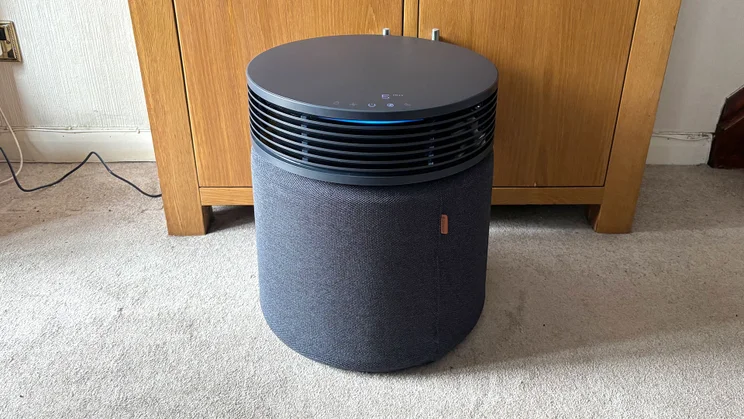
The Blueair Blue Signature stands out as a rather attractive option among a sea of white, clinical-looking air purifiers. And for this reason, it earned a Highly Commended award in Expert Reviews’ Product of the Year Awards 2026.
You get a sensible choice of colours for the purifier’s fabric pre-filter, as well as optional cosmetic additions such as a wood leg base or chrome ring base (an extra £54 or £74 respectively). It’s not just a pretty face, though. The Blue Signature filtered the air quickly in our tests, bringing PM2.5 levels down from 309µg/m³ to 25µg/m³ in one minute and 33 seconds. It makes a bit of a racket at full tilt (63dBA), but is much quieter at its low and night settings (33dBA).
It’s a bit more expensive than some of the competition – though still less than half the price of the Dyson Big+Quiet. Our only other qualm: that lovely fabric pre-filter proved particularly attractive as a scratching post for our reviewer’s cat. Replacements cost £25, making it a potentially expensive endeavour for pet owners. But that’s the price you pay if you have a cat. This is a good-looking and particularly chic air purifier.
Read our full Blueair Blue Signature review
Key specs – CADR: 295m³/h; Max room size: 314m²; Power settings: Four speeds, plus auto and night mode; Dimensions (WDH): 40 x 40 x 44cm; Weim ght: 6kg; Filter replacement indicator: Yes
4. Philips PureProtect Mini 900 Series (AC0290/10): Best for ease of use
Price when reviewed: £130 | Check price at Philips
Reviewed in January 2026 by Stuart Milne
- Incredible easy to set up and use
- Compact and competitively priced
- Lacks more advanced features
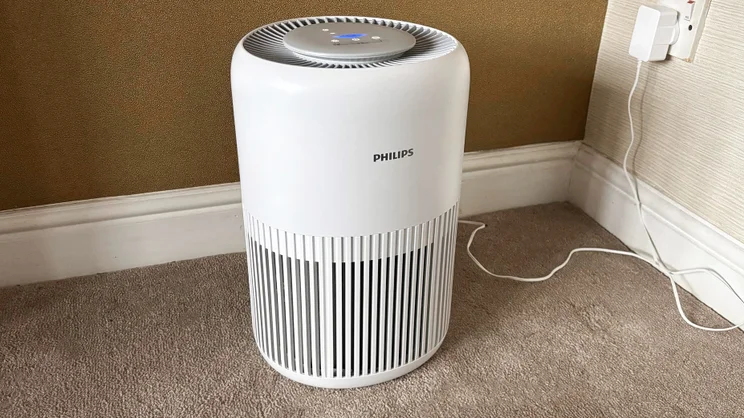
If you’re after an easy-to-use air purifier that’s ready to go straight out of the box, the Philips PureProtect Mini 900 is a great choice. The model names can get confusing, so take it from us when we say that the AC0290/10 is the entry-level air purifier in the brand’s PureProtect range of air purifiers.
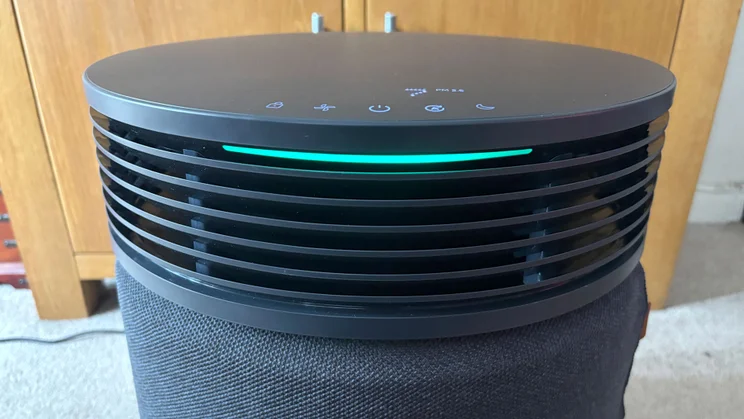
It’s a pretty barebones purifier: you’ve got no WiFi connectivity, Bluetooth or app – just a control panel on the top of the purifier and a simple display to tell you the current PM2.5 level, as well as a coloured band that serves as a useful at-a-glance visual indicator of air quality. What you lose in advanced features you gain in ease of use and its reasonable price tag of £130. And while it’s not the quickest at cleaning the air, performance is impressive: in our tests, it reduced PM2.5 levels to 25µg/m³ in 195 seconds.
Read our full Philips PureProtect Mini 900 review
Key specs – CADR: 250m³/h; Max room size: 65m²; Power settings: Four; Dimensions (WDH): 24 x 23.8 x 36.4cm; Weight: 3.6kg; Filter replacement indicator: Yes

Also consider: Levoit Core 300S (£150)
If you're after an easy-to-use air purifier that is Wi-Fi and app enabled, consider the Levoit Core 300S – it offers smart features such as scheduling and voice control through Google Assistant or Alexa. Max room size is 80m2 and it has three power settings. It brought PM2.5 down from 398µg/m³ to a safer 25µg/m³ in just under four and a half minutes.
5. Blueair Blue Pure 511: Best for bedrooms
Price when reviewed: £99 | Check price at Blueair

Reviewed in April 2024 by Stuart Andrews
- Quiet
- Compact
- Cost effective
- Not as fast as some rivals
Small in stature and volume, the Blue Pure 511 is a great bedroom air purifier. It’s a compact appliance indeed, measuring just 34cm in height and 20cm in diameter, and controls are equally minimal: a touch of the on/off button controls the power, while the central fan button merely toggles between the three speeds.
Performance isn’t outstanding compared to rival air purifiers – it took just over three and a half minutes to clear our test room of PM2.5 spray – but it will cope easily with smaller rooms. And when it comes to noise output, it maxed out at 47dBA at full speed, while its lower settings were almost silent – perfect for sleeping through.
Read our full Blueair Blue Pure 511 review
Key specs – CADR: 191m³/h; Max room size: 38m²; Power settings: 3; Dimensions (WDH): 20 x 20 x 34cm; Weight: 1.9kg; Filter replacement indicator: Yes

6. Blueair Blue Max 3250i: Best for a range of features
Price when reviewed: £169 | Check price at Blueair

Reviewed in April 2024 by Stuart Andrews
- Powerful filtering
- Quiet
- Useful features
- Filter can be a chore to replace
- Voice commands are awkward
The best air purifier in our 2025 Product of the Year Awards, the Blue Max 3250i offers plenty in the way of features and performance. You get five power settings, including a night mode that runs at the lowest fan speed with the lights turned out, and an automatic setting that continuously adjusts the fan speed to match the current PM2.5 levels. In tests, I found it reacted within two or three seconds to any significant change. It also has Wi-Fi and smart features, so you can use the Blueair app to schedule operations and track your air quality over time.
The app also allows you to change the brightness of the handy LED indicator on the front, which glows blue to red to convey the current air quality and will also throw up an alert when the filter needs switching. It’s pretty quiet (between 27.6dB and 49dB depending on setting) but performance is powerful: it took my test room down from a peak of 395µg/m³ to 25µg/m³ within two minutes and 23 seconds with the fan maxed out. It’s efficient, too: I measured power consumption at 3W to 19W depending on the fan speed and it has the same fabric pre-filter around the main drum to keep the HEPA filter up and running longer.
I have some minor grumbles about the 3250i, in that its Alexa voice commands could be more intuitive, and the filter being a hassle to change. But if you’re after a compact purifier with some extra power and useful features, I would say this is the one to buy.
Read our full Blue Max 3250i review
Key specs – CADR: 239m³/h; Max room size: 48m²; Power settings: 5; Dimensions (WDH): 27 x 27 x 48cm; Weight: 3.39kg; Filter replacement indicator: Yes

7. Shark NeverChange 5: Best air purifier for filter longevity
Price when reviewed: £250 | Check price at John Lewis

Reviewed in May 2025 by Stuart Andrews
- Strong performance
- Great filter value
- Noisier than other purifiers
We’ve not tested the NeverChange 5 for long enough to verify its USP; it would take us up to five years to confirm whether its HEPA filter lasts as long as Shark says it does.
This air purifier is powerful and effective, with a clear and intuitive display and control panel. And while we’ve not tested the NeverCharge 5 for long enough to verify its USP (it would take us up to five years to confirm this), you’re looking at fantastic filter value if you’re willing to take Shark at its word.
After using a spray in a small test room, the NeverChange 5 brought the air down to a safe PM2.5 level in 2mins 34secs running at full power, taking a bit longer in its auto mode (3mins 27secs).
While it’s not so hefty that it’s cumbersome, a handle would go a long way in terms of portability. It’s not the quietest air purifier either (the Acerpure Cool is a better option in that regard), but it’s far from the loudest around. Ultimately, the Shark NeverChange 5 is an excellent air purifier with a promising USP that should save you some money in the long run.
Read our full Shark NeverChange5 review
Key specs – CADR: 147.8m³/h; Max room size: 60m²; Power settings: 4; Dimensions (WDH): 23.7 x 26.6 x 38.5cm; Weight: 3.32kg; Filter replacement indicator: Yes
8. Best for babies: Levoit Sprout
Price when reviewed: £280 | Check price at Levoit
- Quiet and compact
- Soothing sounds and a night light
- Tricky to read display
- Air quality monitor can be sluggish
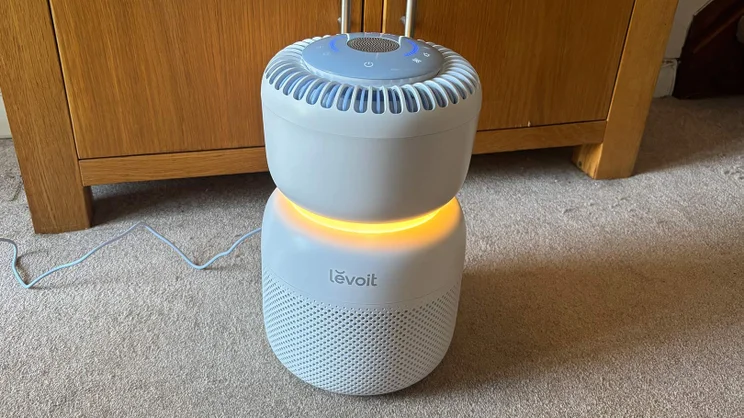
The Levoit Sprout has a compact, cute design, which – when paired with features such as a night light and soothing sounds – makes it a great choice for your baby’s nursery. Its maximum room size is minimal at 30m2, but performance is impressive for its size: it brought PM2.5 levels down from 135µg/m³ to 25µg/m³ in 95 seconds. Noise output is pretty quiet too, reaching 38dBA at its middle settings.
It filters an impressive range of particle sizes – including PM1.0, PM2.5, PM10 and VOCs – and it’ll also monitor CO2 levels, temperature and relative humidity.
Read our full Levoit Sprout review
Key specs – CADR: 144.5m³/h (smoke), 152.9m³/h (dust), 185.2m³/h (pollen); Max room size: 30m²; Power settings: Four fan speeds, plus Auto mode; Dimensions (WDH): 22 x 22 x 35.5cm; Weight: 2.9kg; Filter replacement indicator: Yes
How to choose the best air purifier for you
How do air purifiers work?
Air purifiers use different kinds of filters to do their job – usually, a large, washable, reusable pre-filter to collect bigger particles, plus a finer filter, which is usually a disposable high-efficiency particulate air (HEPA) filter. The length of time this lasts varies from manufacturer to manufacturer, but on average you should expect to replace it every six months (or fewer if you use the machine less).
If you’re concerned about how often you might need to change your filter, look out for something like the Shark NeverChange5, with its cleanable HEPA filters that last up to five years.
It’s the HEPA filter that catches all the tiny airborne nasties, and these are capable of catching particles as small as 0.3 microns, which is more than three times smaller than a cigarette smoke particle.
What is the clean air delivery rate?
The CADR aims to provide an objective measure of the effectiveness of a portable air purifier at dealing with different types of allergens. A purifier with a score of 250 for dust particles is as effective as adding 250 cubic feet of clean air per minute. Buyers should focus on the results of the specific pollutant they’re aiming to eradicate, whether that’s pollen, smoke or dust, and many manufacturers will supply CADR figures for the most common.
Generally speaking, the higher the CADR, the larger the room it can purify effectively. It’s also worth comparing manufacturer figures for the maximum size of room as these can vary enormously, sometimes when the CADR doesn’t.
What are the most important features of an air purifier?
Air purifiers come in a range of shapes and sizes: from basic compact models without bells and whistles, to fully kitted-out purifiers complete with app and smart home connectivity. Here’s a rundown of some common features of many – but not all – air purifiers:
- Speed settings – Most air purifiers have a choice of speeds so you can keep it lower for sleeping and turn it up when the pollen count is high. A night mode can also help if you want a quiet setting and dimmer lights while you sleep, though we found this doesn’t always work as well as you’d hope.
- An air-quality sensor, which enables the machine to switch itself on when the air quality becomes poorer, can be useful. After all, you can’t see when the air quality dips, for example, as the result of a high pollen count.
- A few high-end units double as humidifiers, managing the moisture in the air to prevent dry air causing irritation to the nose, throat, lips and skin.
- Carry handles can be handy if you need to move it from room to room. Wheels, a compact design and a low weight don’t go amiss here, either.
- Controls – easy-to-use controls are always a plus, with a good remote control a must-have when you’re using a purifier in a larger room. Some purifiers even have Wi-Fi connectivity and apps, so you can set the purifier going before you get home from the office or control it from your phone.
- Filter replacement indicators aren’t crucial and not all air purifiers have them, but this is a helpful feature as a clogged air cleaner won’t work properly.
- Some purifiers have a built-in timer. This can be really useful if you want your machine to come on a few hours before you get home, or if you want to turn it off automatically at night.
- Smart features allow you to operate your purifier remotely or switch it on and off according to a schedule. You may also get useful data on air quality, temperature, humidity and more.
Can air purifiers help protect against viruses?
Understandably, there has been a lot of talk over recent years about whether HEPA air purifiers offer any protection against viruses, including Covid-19. The answer is pretty complex. Most viruses – and the droplets of mucus and saliva that might contain them – are perfectly capable of filtering particles in the 20- to 500-nanometre range in which you’d find most viruses. What’s more, the US Centre for Disease Control has advised that used properly, air purifiers can help reduce airborne contaminants, including viruses, in a home or confined space.
However, there’s no way to ensure that a HEPA air purifier would catch the virus prior to you inhaling it, and there are a lot of variables in play, including the type of filter used, the size of the room and the airflow in it. There’s also still a lot of discussion about the extent to which many viruses are spread through the air or transmitted through contact with respiratory droplets. In short, an air purifier might help, but there’s not enough evidence to make the case compelling.
READ NEXT: What are the benefits of air purifiers?
How noisy are air purifiers?
Of course, you don’t want to replace one irritation (allergies) with another (the sound of a jet plane in your room). For many, the hum of an air purifier won’t be much of a bother, but some can get very noisy. It’s also worth remembering that, while some machines are quiet on their lowest setting, they might be loud on their fastest – where they’re working at their best.
We test the noise output of every air purifier we review, measuring this in A-weighted decibels (dBA) from one metre away. In the chart below, you can see the data for air purifiers featured in our roundup.
How much do I need to spend?
Air purifiers can cost below £100 or close to £1,000, but it’s not simply a case of the more you spend, the better the machine. We’ve found low-cost machines with features that are usually only found in much more expensive models. For instance, see the Hoover H-Purifier 500 we featured above: sub-£100 model that offers enough power to tackle large spaces.
That’s not to say that a pricey air purifier is inevitably overpriced: more expensive models – such as the Dyson Big+Quiet Formaldehyde – have additional modes and features that cheaper products lack. And remember, it’s not just the initial financial outlay you need to think about, with operating costs ranging from a few pounds a year up to over £70 per annum, especially if you need to replace filters once or twice a year.