
To help us provide you with free impartial advice, we may earn a commission if you buy through links on our site. Learn more


- Clean, balanced and revealing sound
- Exemplary control app
- Understatedly good-looking and usefully compact
- Can sound fractionally dispassionate at times
- Doesn’t feel anything special
Bluesound was quick out of the blocks with hi-res audio streaming, and, if the Pulse Flex 2025 is anything to go by, the company still has exactly what it takes to stay in the leading pack. This wireless speaker is a genuinely hi-res device that can handle 24-bit/192kHz PCM and DSD256 digital audio files, and it’s easily integrated into a full-on home cinema or multiroom set-up.
The BluOS ecosystem is a big part of what makes the Pulse Flex 2025 so successful. Used as a standalone mono speaker, the control app makes getting exactly what you want as simple as can be. As part of a larger setup, the fact that plenty of other brands carry BluOS means you have a wide range of partnering equipment to choose from.
And, no matter what you’re listening to, the Pulse Flex 2025 sounds remarkably open considering the physical constraints of its cabinet and drivers. It’s a clean, uncoloured listen, capable of successfully revealing and contextualising details, and punching hard when it has to. Its balanced, slightly hands-off sonic approach could be interpreted as a minor lack of engagement at times, but generally, the Pulse Flex 2025 sounds grown-up and accomplished.
What do you get for the money?
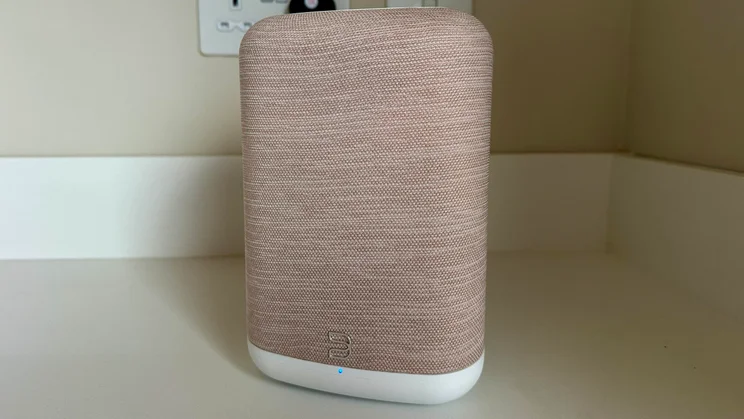
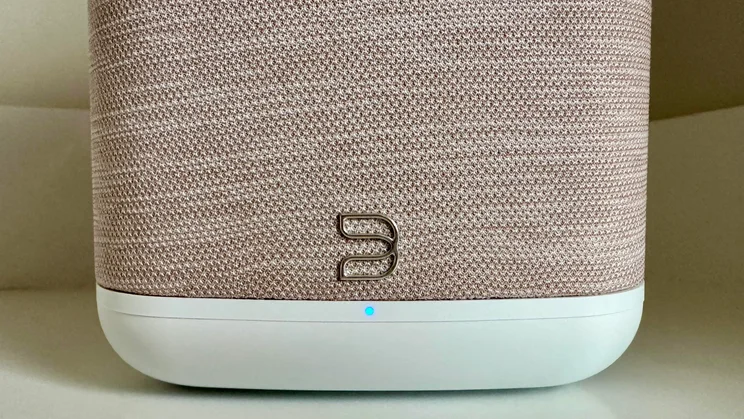
Bluesound seems strongly of the opinion that less is more, at least in visual and physical terms. The Pulse Flex 2025 will set you back £279 and is a compact mains-powered wireless speaker measuring 131 x 111 x 196mm (WDH), available in three finishes: Black (which equates to black plastic at the top and bottom, with a quantity of charcoal fabric in between), Pebble Grey (white plastic with grey fabric) or Tan (white with a sort of pinky-brown fabric). Each looks clean, and the standard of finish is basically flawless.
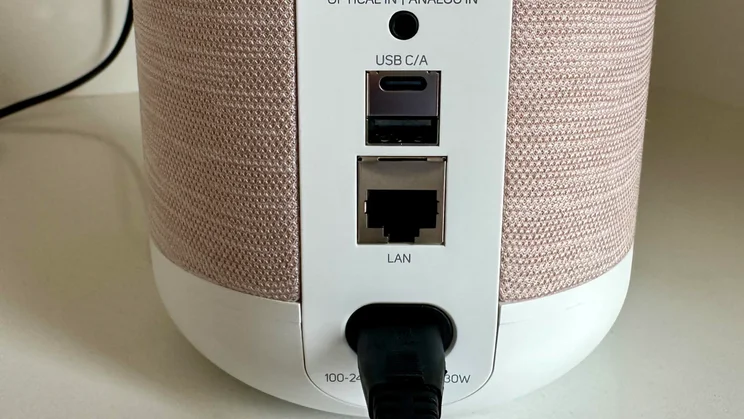
The Pulse Flex 2025 features dual-band Wi-Fi and Bluetooth 5.3 (with aptX HD codec compatibility) for wireless connection. Physical connectivity extends to an Ethernet socket, a hybrid 3.5mm analogue/optical input (Bluesound supplies a Toslink/3.5mm adapter), and USB-A and USB-C slots. All incoming digital information is handled by a DAC chipset with DSD256 and 24-bit/192kHz PCM capabilities, and there’s compatibility with every worthwhile file type as well as quite a few less worthwhile alternatives.
Amplification is Class D, with some of Bluesound’s secret sauce (or, more accurately, ‘Smart DSP’) augmentation. There’s 50W of it, of which 10W drives a 21mm tweeter; the other 40W is for a 102mm mid/bass driver. Bluesound isn’t quoting a frequency response. In fact, it’s not even prepared to divulge the composition of the drivers. It will concede that they both face forward, though.
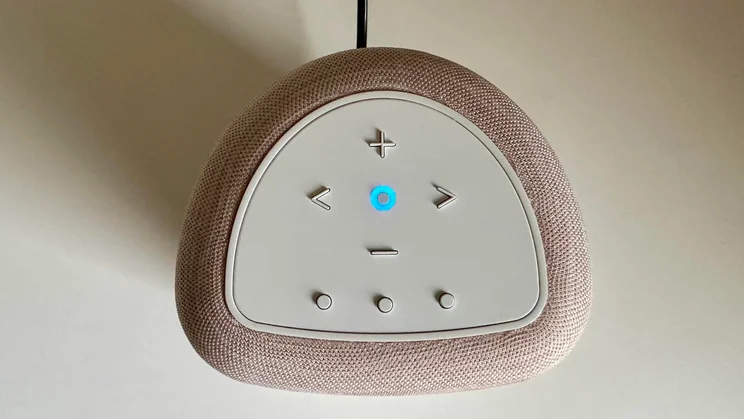
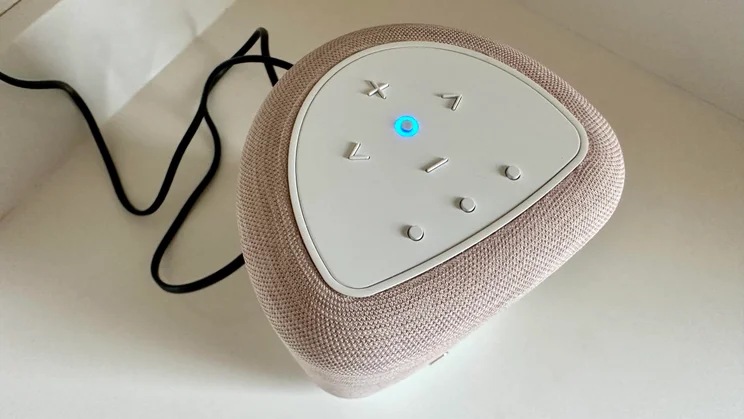
Control of the Pulse Flex 2025 can be achieved in a few different ways. If you have to have voice assistance, the speaker can be integrated into Amazon Alexa Skills, and there are a few physical controls (play/pause, skip forwards/backwards, volume up/down) nicely integrated into the plastic top plate. There are also three buttons, each one a shortcut to the podcast, playlist or radio station the user specifies.
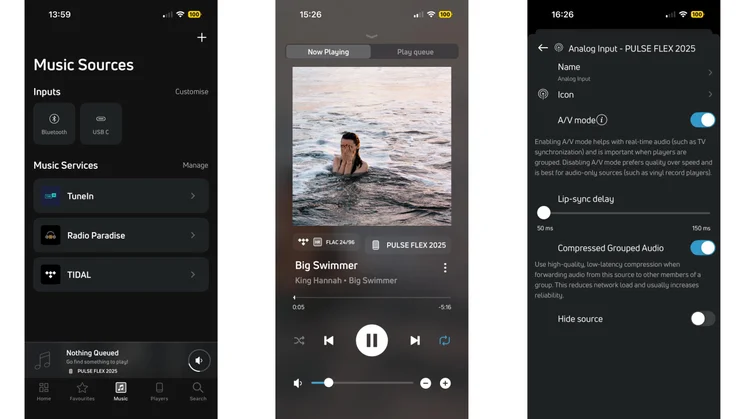
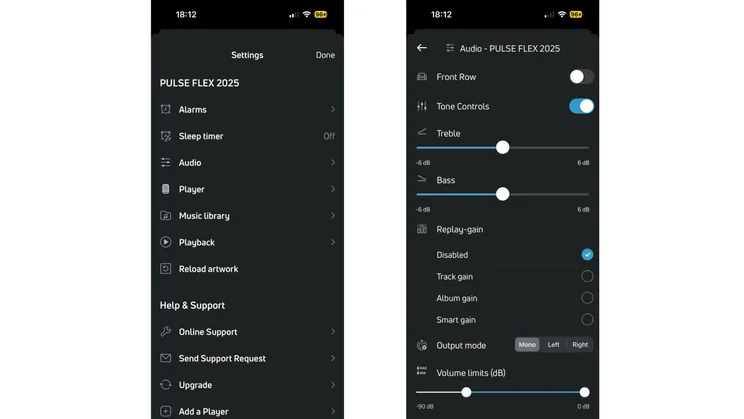
Choosing the function of the shortcut buttons can be done in the BluOS app, and here’s where you can take full and exhaustive control of what your speaker is up to. Want to check for updates? Adjust the EQ settings? Specify two Pulse Flex 2025 as a stereo pair, or as part of a wider multiroom system? Want to access your favourite music streaming service(s) in all their hi-res glory? The app will let you do it, quickly and with great stability – and there are plenty more granular control options here too.
What did we like about it?
You’ll make your own mind up where design is concerned, but to my eyes, the Pulse Flex 2025 is a very successful speaker in terms of the way it looks, and there’s certainly no arguing with the way it’s built and finished.
There’s plenty to enjoy about its flexibility and functionality, too. Being able to serve as part of a stereo pair, or as part of a home cinema surround-sound system, or as part of a full-on multiroom setup, is very welcome, especially as setting up the system of your choosing is made so simple by the BluOS app.
The success of the BluOS app is a big contributor to what makes Bluesound, in general, and the Pulse Flex 2025 in particular, so compelling. It’s been around for over a decade now, and if there’s a more stable, more logical or more extensive control app out there, I’ve yet to see it. A huge choice of music streaming services is available, and compatibility with the Connect versions of Qobuz, Spotify and TIDAL makes for a top-tier experience sonically as well as ergonomically. The fact that numerous third-party manufacturers have opted in to the BluOS experience (which means your choice of partnering equipment is not restricted to Bluesound products) only adds to the appeal.
And though what was once a Bluesound USP – the ability to stream genuinely hi-res audio content wirelessly – is now routinely available from any number of rival brands, the sound of the Pulse Flex 2025 sees the company remain one of the true front-runners. With some chunky FLAC files incoming via TIDAL Connect or via the USB-C socket connected to a FiiO M15S digital audio player, this speaker sounds the money’s-worth in virtually every respect.
No matter if it’s a Bluetooth-streamed 16-bit/44.1 kHz file of the hushed voice-and-piano of Patty Waters’ I Can’t Forget You, a 24-bit/48kHz file of James Holden’s rampaging Common Land via TIDAL Connect, or a DSD64 copy of Michael Jackson’s Don’t Stop ‘Til You Get Enough via the USB-C input, the Pulse Flex 2025 is unflappable. In every circumstance, it’s a clean and detailed listen, remarkably open when you consider the size of its cabinet and of the drivers inside it, and more than willing to get out of the way of a recording rather than impose itself on it.
Despite the relative spaciousness of its presentation, it’s quite direct and unequivocal. If there’s a particular character or flavour in a recording, it has a very commendable stab at revealing it. It manages to be reasonably dynamic when there are big shifts in volume or intensity to be dealt with, and it maintains a very even tonal balance from the top of the frequency range down to the bottom. There’s a fair amount of weight to the lowest frequencies here, but what’s more notable is the control the speaker exerts over them. The attack of bass sounds is gripped firmly, and the Bluesound manages to express rhythms with a fair amount of confidence as a result.
More than anything, though, it’s the balance the Pulse Flex strikes – its even-handed frequency response, its tonal consistency, its combination of unity and spaciousness – that’s most impressive. This is a device that sounds bigger than it looks, and a fair bit more sonically talented than its size or its price might have led you to anticipate.
What could be improved?
I’m not a big fan of the Tan finish my review sample showed up in; it’s not quite brown, it’s not quite pink, and it doesn’t quite blend in with any of the design choices I’ve made in my home. Mind you, that’s hardly a reason to be too down on the Pulse Flex 2025. Other finishes are available, after all, and no one’s all that interested in my opinions on interior decor anyway.
You’ll probably be able to tell from that previous paragraph, though, that I’m reaching a bit when it comes to suggesting ways in which Bluesound could improve this product. It’s fair to say that while the standard of finish is very good, the plastics and the fabric used in its construction are not the last word in tactility. And while it has a whole lot going for it in sonic terms, it’s not beyond sounding a little bit remote or restrained, especially when playing recordings that prioritise attitude and attack. There’s a slightly self-consciously grown-up character to the Pulse Flex 2025 that doesn’t automatically suit every single thing you might choose to listen to.
Should you buy the Bluesound Pulse Flex 2025?
If you’re after a smart speaker, using voice control via Amazon Alexa Skills is an inelegant faff. If you’re expecting a display on your speaker, some album artwork or even just a clock, the Pulse Flex 2025 is not for you.
If, however, you’re after one of the best-sounding wireless speakers this sort of money can buy, and you want great sound from a small and unassuming cabinet that won’t physically dominate a space, you’re getting much warmer. If you want your great-sounding wireless speaker to be part of a class-leading ecosystem, and to be ready to form part of a wider system using partnering electronics from a wide range of brands, you’re warmer still.
The Bluesound Pulse Flex 2025 is far from your only choice if you have getting on for £300 to spend on a wireless speaker. But its particular skill set is so focused and so impressively realised that it really deserves a place on your shortlist, even if that list is very short indeed.


