To help us provide you with free impartial advice, we may earn a commission if you buy through links on our site. Learn more
We’ve tested and reviewed several pairs of Cambridge Audio headphones in recent years. Still, it’s been a while since we’ve run the rule over its higher-ticket, audiophile-focused streaming products.
That’s not because they don’t sound great – I’ve heard many of them in action, and they’re fantastic – but because, for our mainstream audience, such premium purchases are a pipedream.
With the announcement of the new Cambridge Audio L/R active speaker series at CES in Las Vegas, however, the dream of having Cambridge sound in your home just got a lot closer to reality for those without bulging wallets.
Granted, the flagship L/R X and mid-range L/R M will still be out of reach for many, but the smallest entry in the lineup – the L/R S – is priced to entice more casual consumers into the alluring world of Hi-Fi audio.
I’m genuinely excited to see how the L/R S perform, but I’ll have to wait until I get my hands on a sample later this year, as Cambridge’s CES showcase focused solely on the large, loud and luxurious L/R X, which will cost £1,799.
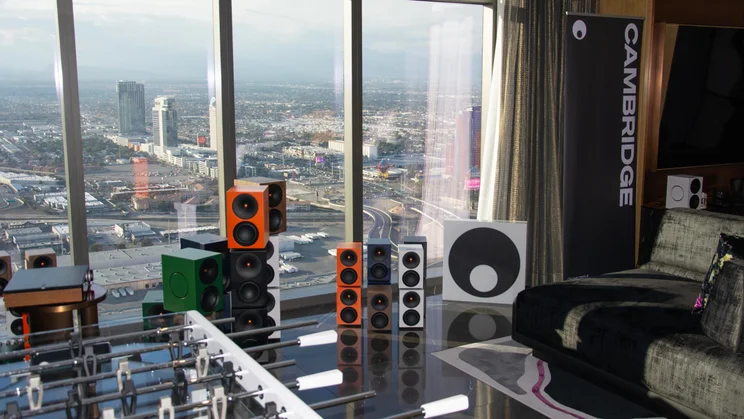
Still, I wasn’t about to turn down the chance to listen to a pair of premium speakers in a 61st-floor suite of The Cosmopolitan, so here are my thoughts, along with some key info about how the three models in the range differ.
Cambridge Audio L/R X: Rock the Cosmo
Boy, am I glad I didn’t turn down the invite to join Cambridge high above the Las Vegas strip: the L/R X proved to be the most refined yet impactful active speakers I’ve had the pleasure of listening to in a long time.
Each of the stylish Wi-Fi speakers needs to be powered separately but is capable of outputting a fearsome 400W. It houses Cambridge’s new 28mm Torus tweeter, dual 5in woofers, and two 6in force-cancelling passive radiators.
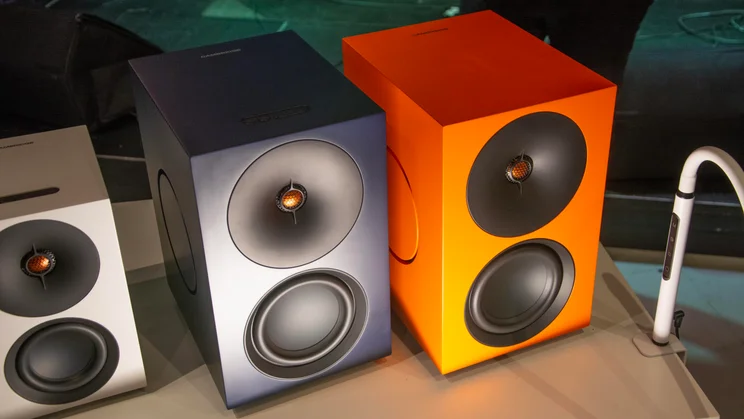
In addition to impressive music-making chops, the L/R X offer a variety of connection options. There’s wireless and Bluetooth connectivity, an HDMI (eARC) port for connecting the speakers to your TV, USB-C inputs, a USB-A port, an optical in, and left and right AUX and phono inputs. You also get LED underlighting on the bottom of each speaker, though disco fans will be disappointed to learn that while you can adjust the warmth and brightness, you can’t change the colour from white.
I only heard the L/R X doing their thing over Wi-Fi, but I loved what I heard. Amistat’s Ready was presented with fantastic scale, and the vocals on the track were communicated with great detail and delicacy.
At the other end of the frequency spectrum, it quickly became clear that Cambridge isn’t holding back. Development Manager, Ollie Marshall, told me that a comparatively low crossover point between the tweeter and woofers has enabled the latter to be better optimised, and it really showed as we raved it up to one of my favourite DnB tunes of all time, M.I.S.T’s Outerspace.
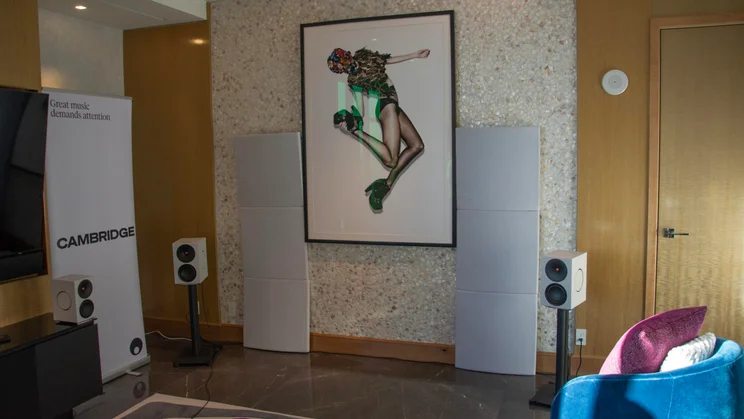
After spitting a few bars to the assembled congregation (Cambridge’s Head of Global PR Simon Osborne Walker and the brand’s Director of Fun, Hannah Rudolph), I sat back down to enjoy some Earth, Wind and Fire and found the elaborate musical arrangements handled with skill, at rather less raucous volume.
Cambridge has incorporated its DynamEQ into the L/R X with the intention of ensuring that music sounds equally good at any volume, and that certainly proved the case during my brief time with the speakers. Though let’s be real, the highlight of the demo was seeing the passive radiators throb as they pumped out Godfather by MC Det & Martial Taktics.
The L/R X are due to be released in June in six attractive finishes: blue, green, orange, black, white and walnut, though the last option will cost more as it uses a real walnut veneer.
Cambridge Audio L/R S: Good things come in small packages
We won’t have to wait nearly as long for the L/R X’s smallest sibling. Nor will we have to shell out a small fortune to have the range’s most compact option in our living room or office.
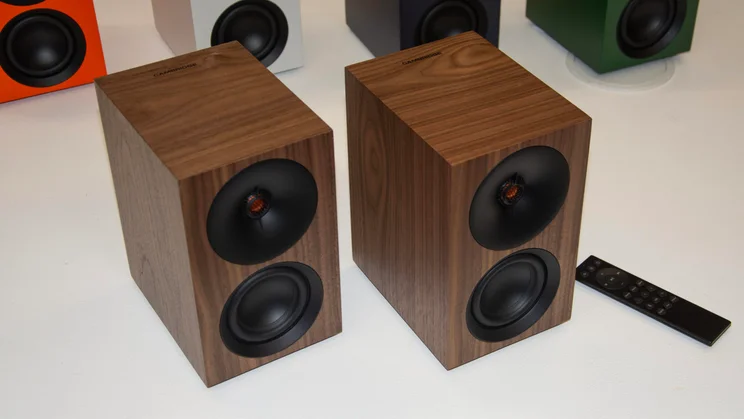
The L/R S share a very similar aesthetic to the X, but are more petite and less technologically advanced. They operate over Bluetooth aptX HD and contain 21mm hard-dome tweeters and 3in woofers capable of a maximum output of 100W. That’s still plenty to keep the vibes flowing from your desk or bookshelf, and the L/R S will definitely look the part wherever you decide to position them.
Due for release in the UK in March, the Cambridge Audio L/R S will cost £399, putting them in close competition with the Ruark MR1 MK3, which Steve May gave our Best Buy award to last year. I’m hoping to receive a sample of the L/R S before release, so keep your eyes peeled for a review.
Cambridge Audio L/R M: The middle ground
Nestled between the X and S is the L/R M. Here, one speaker draws power from the mains and passes over audio via a connecting USB-C cable. The Torus tweeter found in the X is present and correct, but the other components are necessarily smaller to fit into the more compact MDF cabinets.
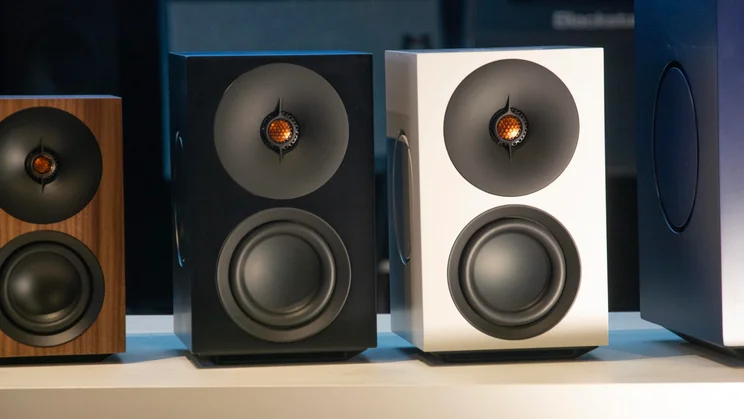
The woofers lose an inch, while the passive radiators are three-quarters of the size found on the flagship option, at 4.75in. The system can still output a hefty 300W, though, and still has HDMI and phono stage inputs and an LED underlight.
The L/R M will be the last of the trio to hit shelves, with an estimated street date of July. It’ll start at £1,199, with the walnut veneer model costing slightly more.